Paranormal

Drought in China Reveals Puzzling ‘Alien’ Patterns in Dry Lake Bed
A debilitating drought drastically depleted the water of a massive lake in China and, in turn, revealed a sizeable series of puzzling patterns that some have likened to crop circles. The curious shapes (seen in the video above) were reportedly spotted in the exposed bed of Dongting Lake, which is located in the province of Hunan. Videos of the curious formations soon spread like wildfire on Chinese social media with many people offering some rather fantastic explanations for the odd patterns. As one might imagine, due to their resemblance to crop circles, many suggested that aliens may have been behind the strange shapes, while one particularly imaginative individual simply declared “don’t touch it. It’s the door to a secret underground chamber.”
In response to the speculation, an official from the group that manages the lake suggested that the patterns are probably the remnants of a type of fishing trap, known as an ‘ai wei,’ wherein small walls are used to capture the creatures as water levels rise and then fall due to a river that connects to the lake. However, not everyone is convinced of that explanation as one local resident expressed some skepticism due to the sheer size of the shapes, noting that “each block is as big as standard football fields.” Whether the patterns were made by humans or aliens, that they could be seen at all is cause for concern among many since the site is the country’s second largest freshwater lake and the drought has caused it to lose a staggering 70 percent of its water.
Security Guard Filmed Talking to Ghost?
Video below.
An intriguing video from Argentina shows the moment when a hospital security guard claims to have greeted a visitor that he later learned was seemingly the ghost of a patient who had died earlier that night. The remarkable incident reportedly occurred last Saturday at the Finochietto Sanatorium in the city of Buenos Aires. At around three in the morning, the guard says that he was at the hospital’s front desk when an elderly woman entered through the automatic doors and explained that she had left something behind in her room. He subsequently took down her information and directed her into the building to retrieve the forgotten item. When the woman did not return a few hours later, he called the floor where she was headed and received an stunning response.
The security guard was informed that no such woman had visited the floor that night, which understandably piqued his curiosity. Going back to his paperwork from when she entered the building, he told them the name of the woman and that she had stayed in room 915. In what was likely an Earth-shattering experience for the man, the staff on the floor told him that person was a patient who had died three hours before he had encountered her in the front lobby. While this would normally be a fantastic tale worthy of an evening around the campfire, what makes the guard’s account particularly compelling is that his exchange with the woman was actually filmed by the hospital’s security camera.
In the bewildering video, seen above, the security guard stands up from the desk as the doors to the building open and, although no one can be seen entering, he grabs his clipboard and walks forward as if to speak to someone. For several seconds, the man appears to carry on a conversation which culminates with him ushering the invisible individual into the building and offering them a wheelchair, which they apparently declined. Since appearing online over the weekend, the confounding footage has gone viral on social media in Argentina with many wondering if the security guard’s eerie account is genuine.
In response to the furor surrounding the video, a skeptical official at the hospital indicated that they are investigating the matter and offered one particularly curious note about that night. He explained that a check of the security footage showed multiple instances wherein the possibly faulty automatic doors were seemingly triggered by nothing in particular. It was only in the one instance wherein the guard claims to have spoken to the woman that he responded as if someone had entered the building. That said, it has also been suggested that the video and accompanying tale might be an elaborate hoax orchestrated by the guard.



Route 66’s glowing mystery orb

A floating orange ball over the famed US route has puzzled travellers for more than 100 years. And while most agree that the Hornet Spook Light exists, few agree on what causes it.
On a four-mile rural road eerily nicknamed the Devil’s Promenade, just off the old Route 66 in the north-east corner of Oklahoma, a paranormal mystery has puzzled spirit seekers for more than 100 years. The Hornet Spook Light – a mysterious, basketball-sized glowing orb named for the former town of Hornet – has been appearing in the night sky here since 1881. No-one knows what this peculiar, smouldering ball of light signifies, where it comes from or what it’s composed of. Even the Army Corps of Engineers have concluded that it’s a “mysterious light of unknown origin”.
It moves, spinning and bobbing up and down, like a lantern held by a dancing ghost, and is usually spotted from inside the Oklahoma border looking to the west.
As Route 66 historian Cheryl Eichar Jett, author of Route 66 in Kansas and founder of the annual Miles of Possibility Route 66 Conference, explained, “The Mother Road’s historical path through Joplin, Galena, Baxter Springs and then south to Quapaw, overlaps the Hornet Spook Light’s fame in the corners of Missouri, Kansas and Oklahoma, where those three states’ borders meet. And so, the legends and lore of the eerie light have become inextricably tied to the equally legendary highway.”
Drawn by the mystery like so many other Route 66 aficionados, I parked my car along the empty road in the still of a moonless night. I waited for over an hour in the darkness, and though the Spook Light never bounced in the distance, the lore I’d read magnified my expectation so much that a pair of passing headlights spooked me, if only for a second.
Local resident Vance Randolph documented his encounter with the phenomenon in his 1947 tome Ozark Magic and Folklore. “I have seen this light myself, on three occasions,” he wrote. “It first appeared about the size of an egg but varied until sometimes it looked as big as a washtub. I saw only a single glow, but other witnesses have seen it split into two, three or four smaller lights. The thing looked yellowish to me, but some observers describe it as red, green, blue, or even purple in colour. One man swore that it passed so close to him that he could plainly feel the heat, and a woman saw it burst like a bubble, scattering sparks in all directions.”
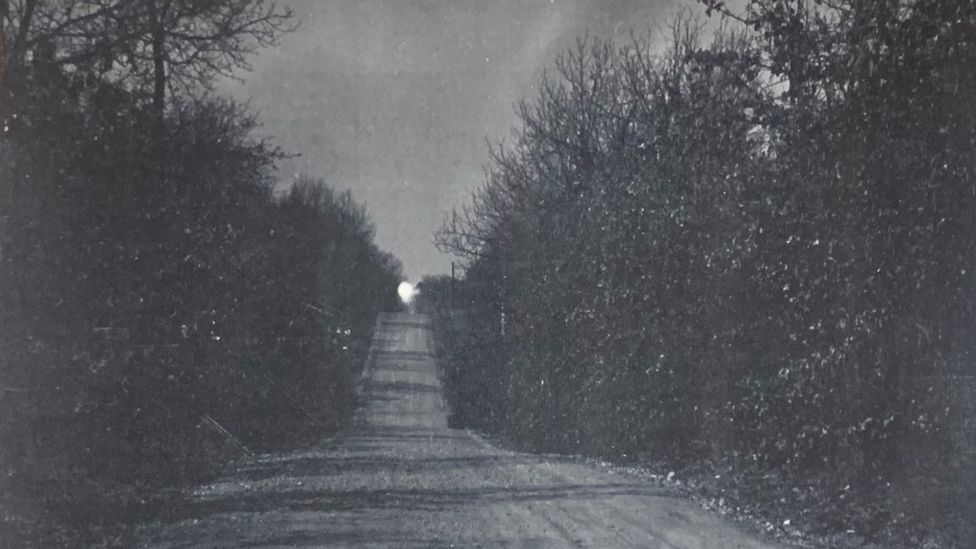
The Hornet Spook Light, photographed in 1970 by area photographer Ed Craig, remains a mystery (Credit: Ed Craig Collection at Dobson Museum and Home Archive)
Dean “Crazylegs” Walker hails from Baxter Springs, Kansas, and was the inspiration behind the character of Tow-Mater in the Route 66-themed Cars film franchise. He volunteers at the Kansas Route 66 Visitors’ Center and recalls seeing the Spook Light at Devil’s Promenade on several occasions, starting with a first sighting at age eight. “My dad, mom and my uncle often took my cousins and me out to try to find the Hornet Spook Light,” he said. “Once, it even floated right through the front windshield of our car! My cousins and I crouched in the backseat, hiding from the light, until – poof! – it disappeared. We were all so spooked that no-one said a word ’til we got back to our home.”
Grace Goodeagle, an elder member of the Quapaw Nation, which is based in Quapaw, has a similar story: “One night, when I was about 10, my uncle drove my siblings and me to the Devil’s Promenade. Moments later, a glowing light appeared in the distance, deep in the woods. We weren’t afraid of it, though.”
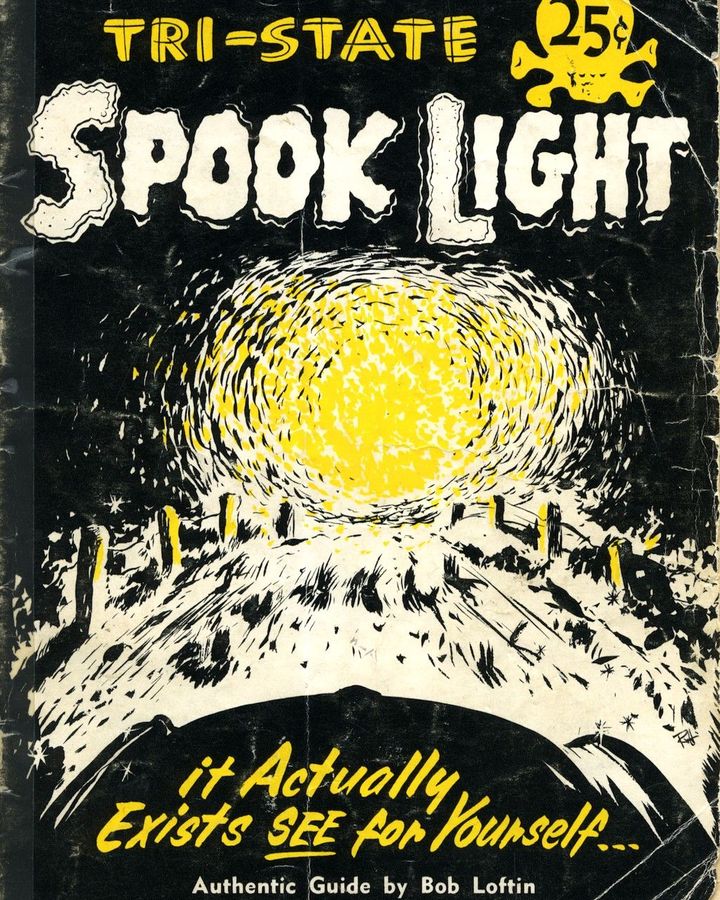
Spook Light chasers and fans have published booklets about the phenomenon, including this 1955 guide (Credit: Courtesy Joplin Historical & Mineral Museum)
While locals agree that the Hornet Spook Light indeed exists, few agree on what causes it.
In Vance’s book, he offered some theories of his era: some believed it to be the ghost of a murdered Osage chief; others said it was “the spirit of a Quapaw maiden who drowned herself in the river when her warrior was killed in battle”.
Goodeagle disputes those tall tales. “We must remember that our peoples are not native to this area,” she said. “The Quapaw peoples were forcibly removed from our ancestral home in the Mississippi valley beginning in 1830, after the enactment of the Indian Removal Act. The legends pointing towards ‘Indian spirits’ haunting this area are just that, legends. Our Nation believes in spirits, good and bad, but our family felt that the lights were simply due to nature, and not good or bad spirits, playing around with us.”
The first documented investigation into the Hornet Spook Light was undertaken by AB MacDonald, a reporter for the Kansas City Star, in January 1936. MacDonald judged that the mysterious lights were the headlights of cars driving east on Route 66.
Writer Robert Gannon concluded the same in a 1965 article in Popular Mechanics after conducting a test: he flashed his headlights on the adjacent highway at a specific time. His assistant, stationed on Devil’s Promenade, reported that the Hornet Spook Light appeared simultaneously.
“I doubt it was car headlights,” countered Goodeagle. “I won’t ever forget the experience. The light I saw bounced around and slowly approached my uncle’s truck. It simply did not appear to be automobile headlights from a distance in any way.”
“Some locals think the lights are caused by swamp gas,” she added. But Andrew George, associate professor of biology at Pittsburg State University in Kansas, disagrees. “The landscape around the Hornet Spook Light is unlikely to produce luminescent gasses, which are thought to cause similar phenomena elsewhere,” he explained.
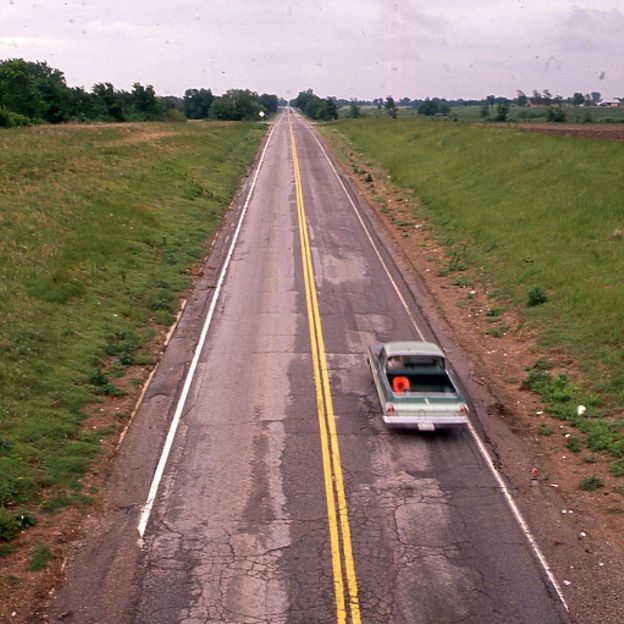
“The legends of the eerie light have become inextricably tied to the equally legendary highway,” said historian Cheryl Eichar Jett (Credit: Oklahoma Historical Society)
Though he has not tested it himself, George backs the headlights idea. “The Hornet Spook Light is almost certainly caused by vehicle headlights on the larger roads a few miles to the west,” he said. “The unusual appearance and movement of the light probably result from changes in air densities above the Spring River and the surrounding forests and fields. The light is refracted as it passes through the warmer and cooler air.”
Walker, like many locals, is not buying it. “No, it’s not car headlights,” he said. “It’s just too far from the turnpike. There is just no way.”
The Royal Succession
Coarse language: viewer indiscretion is advised.
Bigfoot Sightings by State

States with the most bigfoot sightings overall
| State | Sightings | State Population | Sightings per 100k |
|---|---|---|---|
| Washington | 676 | 7,614,893 | 8.9 |
| California | 445 | 39,512,223 | 1.1 |
| Florida | 328 | 21,477,737 | 1.5 |
| Ohio | 302 | 11,689,100 | 2.6 |
| Illinois | 296 | 12,671,821 | 2.3 |
| Oregon | 254 | 4,217,737 | 6 |
| Texas | 246 | 28,995,881 | 0.8 |
| Michigan | 220 | 9,986,857 | 2.2 |
| Missouri | 154 | 6,137,428 | 2.5 |
Approximately 5,000 reported sightings in the United States. Some people interested in the subject argue that there are many more sightings: the unreported ones. They put forward the idea that only a small percentage of people that think they saw a Bigfoot make a report. Most people that see something like that want to avoid being ridiculed, so they keep it to themselves. Some estimates put the actual reported sightings at between 10-40 percent of all sightings. Lets go to middle and say 25 percent are reported. Then you can times the 5,000 by 4. This is all conjecture, but then you have 20,000 sightings!
With today’s technology, cameras, drones etc., there should be more good sightings. But this technology is a two edged sword. The technology also creates better fakes, hoaxes and CGI images. There are very intereting videos and photos out there. But are they real or elaborate hoaxes.
Video below is very intriguing. The end of this video shows the actual footage.
The true origin of Sasquatch
By Lisa Kadane 21st July 2022

Stories of a hairy, forest-dwelling, bi-pedal primate have persisted for centuries in British Columbia. But perhaps more important than whether it exists, is what it symbolizes.
From a lookout above the Harrison River Valley in south-western British Columbia, dense forest stretches all the way to the snow-capped Coast Mountains on the Pacific shore. Thick with towering western red cedars, hemlock and Sitka spruce trees, the wilderness continues almost uninterrupted all the way north to Alaska.
Beyond the roads and hiking trails, the terrain soon becomes impassable, punctuated by steep mountains that plunge into glacier-carved lakes. This remote valley 130km east of Vancouver conjures an ancient land filled with mystery and possibility, and some believe it’s home to the world’s most famous cryptid – Sasquatch, Canada’s Bigfoot.
I’d arrived at the viewpoint in an all-terrain vehicle with Bhima Gauthier, who leads tours to spots in the region where sightings have been reported.
“I can’t say for sure that they are real,” he said. “I have a feeling that there has to be some truth behind it. And there’s a lot of stories, especially here we have a very rich mythology.”
There have been 37 notable Sasquatch sightings near the town of Harrison Hot Springs since 1900. Called Bigfoot in the United States, and yeti or metoh kangmi (“wild man of the snows”) in the Himalaya, Sasquatch is a tall, hairy, bi-pedal, primate-like creature of disputed existence. Regular sightings have kept the popular legend alive, but now it’s being told from an Indigenous perspective. The change is driven by public interest in the idea of a Sasquatch rooted in spirituality and symbolism, rather than sensationalism. The creature is considered sacred to West Coast First Nations, particularly the Sts’ailes (sta-hay-lis), who have lived in the Harrison River Valley for at least 10,000 years.
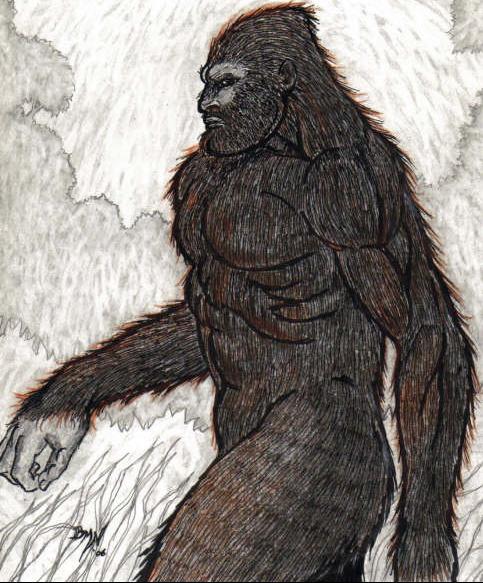
To sate a growing curiosity, Harrison Hot Springs opened a Sasquatch Museum inside its visitor centre in 2017, and worked with Sts’ailes member Boyd Peters, who provided input on the original Sts’ailes acquisitions, including a drum and replica wood mask of Sasquatch. Other displays explain the Sts’ailes belief in Sasquatch as a caretaker of the land and totem for their nation (a stylized image of Sasquatch is on the Sts’ailes flag). These exhibits are juxtaposed with casts of Sasquatch footprints, news clippings about sightings that date to 1884 and a logbook of reported local encounters. Since the museum opened, tourist numbers to the visitor centre have doubled to 20,000 annually, and the resort community received a CAD $1 million government grant to build an expanded museum-and-visitor-centre facility that will aim to balance the telling of Western sighting accounts with Sts’ailes stories and mythology. It’s slated to open in 2023.
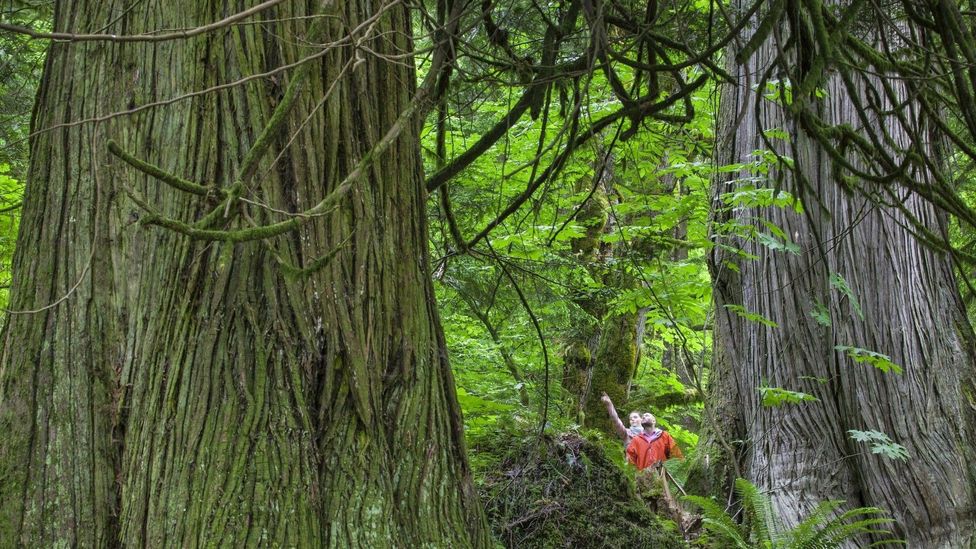
Under the dim green glow of the coastal rainforest, it’s easy to see how someone could mistake a mossy stump for a humanoid life form (Credit: Tourism Harrison/Graham Osborne)
Long before TV shows such as Animal Planet’s Finding Bigfoot sensationalised the pursuit of the creature, the Sts’ailes passed down songs and stories about sasq’ets, a supernatural slollicum, or shapeshifter, that protects the land and people. In fact, Sasquatch is the anglicised version of sasq’ets (sas-kets), which means “hairy man” in Halq’emeylem, the Sts’ailes upriver dialect.
“The word comes from a mountain that’s called Sasq’ets Tel, the place where the Sasquatch gather,” said Kelsey Charlie, a Sts’ailes band councillor (an elected governance position). “Everybody paid reverence and honour to the emblem of our nation, which is the Sasquatch.”
Long before TV shows sensationalised the pursuit of the creature, the Sts’ailes passed down songs and stories about sasq’ets
This intersection of Sasquatch as symbolic totem, and Sasquatch as living primate, has taken the story beyond mere speculation in Harrison Hot Springs. The town has become a magnet for those seeking answers, like the 26 percent of Canadians that believe cryptids such as Sasquatch are “definitely” or “probably” real, according to an Angus Reid Institute public opinion poll from 2016.
“People literally come here on a pilgrimage, and more than you might think,” said Robert Reyerse, executive director of Tourism Harrison.
In addition to visiting the Sasquatch Museum, visitors can take a Sasquatch tour with Gauthier’s company, Harrison Lake Nature Adventures, or walk the Sasquatch Trail and take selfies next to Sasquatch statues. Every June, visitors can attend Sasquatch Days, which have been held since 1938. At the event, West Coast First Nations gather for canoe races, salmon barbeque and Sts’ailes Sasquatch dances.
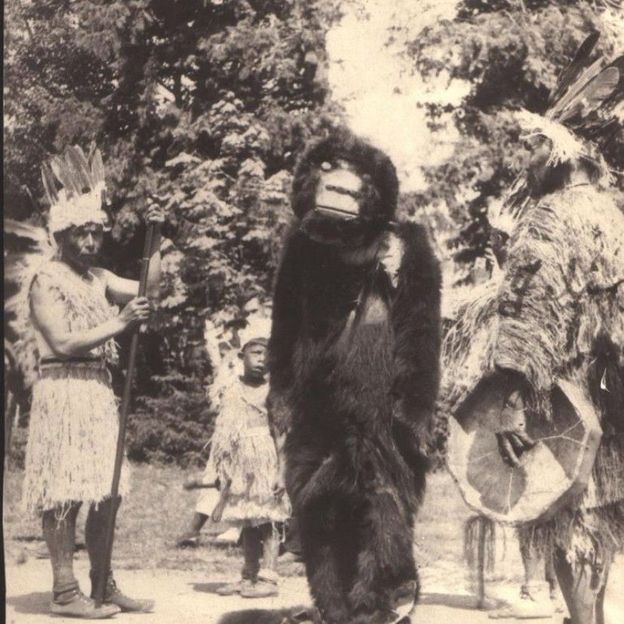
A historical photo shows Sts’ailes community members dressed in sasq’ets costumes for the original 1938 Sasquatch Days festival (Credit: courtesy Kelsey Charlie)
“Your first thought is, these [visitors] are going to be crazy, but they’re not,” said Reyerse. “They’re like ordinary people and some of their stories are pretty compelling.”
The town also draws researchers such as Thomas Steenburg, who has written four books on the subject, including In Search of Giants: Bigfoot Sasquatch Encounters, and has appeared as a guest speaker on the subject at events such as Alberta Culture Days. He insists he remains a healthy sceptic.
“I accept the possibility that the Sasquatch may turn out to be nothing more than mythology and folklore, and that alone makes it worth looking into,” said Steenburg, who lives in the nearby city of Mission.
If Sasquatch is real, Steenburg believes it’s an unclassified primate, possibly gigantopithecus blacki, an extinct ape from southern China that could have crossed the Bering Land Bridge and remained concealed in North America’s vast boreal forest. But the fact that no one has produced credible documentation of Sasquatch bothers him. Ultimately, the burden of proof lies in DNA, he said.
“Science needs what science has always demanded: a body or piece of body,” said Steenburg, standing next to a display case of Sasquatch footprint casts inside the Sasquatch Museum.
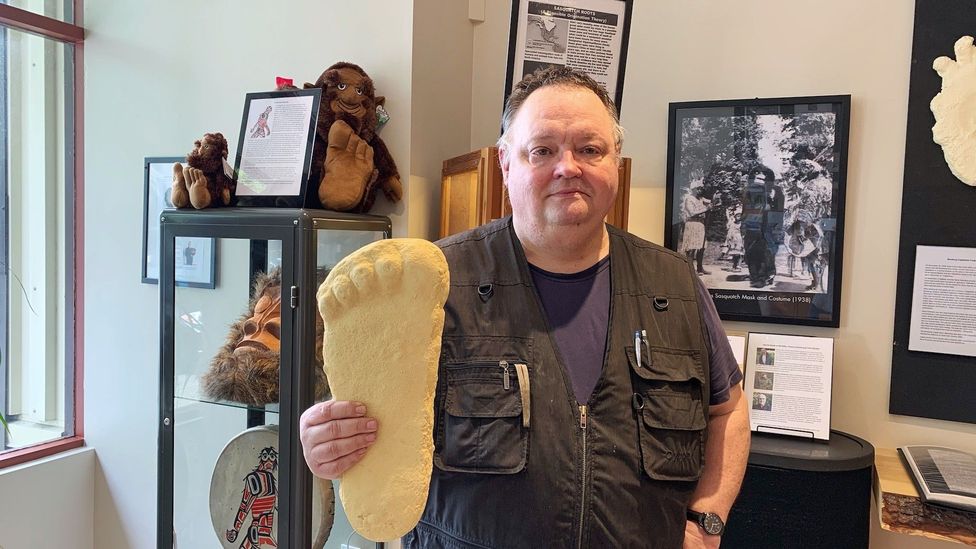
If Sasquatch is real, researcher Thomas Steenburg believes it’s an unclassified primate, possibly gigantopithecus blacki (Credit: Lisa Kadane)
My curiosity piqued, I went hiking in nearby Sasquatch Provincial Park. Under the dim green glow of the coastal rainforest, it’s easy to see how someone could mistake a mossy stump for a humanoid life form. It’s a psychological effect called pareidolia – seeing an object where there is none, such as Jesus on a piece of toast. This phenomenon could explain the sightings, like the dark figure spotted close to a campground outhouse in 2010, or a purported Sasquatch that caused a group to flee another campground in 1994.
It’s comforting to pass these off as someone’s overactive imagination, but these woods give Bonnie Kent pause. A former volunteer with BC Search and Rescue, she helped extract lost hikers from the bush for 15 years.
Kent, now manager of the Sasquatch Museum, initially rolled her eyes about the creature. But after listening to stories from travellers who have come from as far away as New Zealand, she became open-minded about the possibility. “My first response was that people around here used to smoke too much weed and see big hairy guys!” she said with a laugh, before turning serious. “Out in the bush there are a number of times when your hair stands up; there are areas that you just feel you’re not supposed to be there.”
As Charlie explained, Sts’ailes tradition holds that the creature can change from its physical form to a rock, tree or even another animal. “My grandpa used to say, ‘The slollicum is a shapeshifter and can walk in the two realms, the spiritual and the physical. That’s why you’ll never catch him,'” he said.
But he’s not surprised people are still trying. “I think [Sasquatch] resonates because all cultures in the world had some thing, like a supernatural being, and through time and evolution and humanness, we’ve lost a lot of these things,” said Charlie. Perhaps science has made us all sceptics.
Charlie told me about how he saw two Sasquatch drinking water from Harrison Lake in 2002, a dusk sighting that made his hair stand up on end. At the time, he was bashful to tell anyone what he’d seen, fearing derision.

“The word comes from a mountain that’s called Sasq’ets Tel, the place where the Sasquatch gather,” said Kelsey Charlie, a Sts’ailes band councillor (Credit: Lisa Kadane)
“You don’t want to have people looking at you in a certain way,” Charlie explained. “Then again, I thought, ‘Xwem xwem sq’welewel,’ which in our language means, ‘you’re proud of who you are, where you come from and what you belong to.” So, he shared his story.
Ultimately, seeing Sasquatch is considered a blessing and a sign of good luck, Charlie’s grandfather used to say. “If you’re able to see him, hear him or see his footprints, there’s some type of good fortune that’s going to come your way because he’s making sure that you know that he’s there and that you still have to live by the rules,” said Charlie, referring to the agreement between humans and sasq’ets to live in harmony with nature. “They live off the land, they live on the land, they are the land.”
It’s a sentiment shared by Steenburg, and perhaps a place where Sts’ailes mythology and Western fascination come together. “Sasquatch, if it exists, is a symbol that there’s still wilderness out there,” he said. “We haven’t tamed everything.”

Ghost Drives Burning Bus Across Road?
A bizarre video from New Zealand shows the moment when a burning bus inexplicably drives across a road on its own and some suspect that the mystifying maneuver may have been the work of a ghost. The very strange incident reportedly took place last month in the community of Raumati Beach as witness Craig Meek was in the area visiting his family. Troubled by the smell of gasoline, the man ventured outside and was stunned to see that a bus parked along the side of the road had burst into flames. While watching the fiery scene, Meek spoke to the owner of the burning vehicle, who expressed concern that it could explode and cause untold damage to the neighborhood, which is when something truly weird unfolded before their eyes.
Seemingly in response to the owner’s fears, the light of the bus suddenly went out and then it started on its own. With its horn blaring, the burning vehicle then proceeded to drive drove across the road to a less precarious spot where the fire was unlikely to threaten any residences. According to Meek, the odd turn of events occurred at the “perfect time” as the flames from the vehicle had begun to burn a nearby hedge. Had the fiery bus not moved to the other side of the street, he believes, the resulting inferno would have “definitely taken out the house” next to where the blaze had begun and, quite possible, spread to even more homes.
Musing that the situation was “surreal” and “paranormal,” Meek revealed a rather odd insight which suggests that there may have actually been a supernatural explanation for the eerie event.During their conversation, the owner of the bus wistfully recalled how he and his late wife had many adventures in the vehicle over the years. Chillingly, he also indicated that the woman had actually passed away in the bus itself. This spooky detail was seemingly acknowledged by the owner when the peculiar trip across the road occurred as he wondered aloud “if it’s my wife taking it away,” since she wanted to spare their neighbor’s home from the flames.
Meek subsequently shared his video of the peculiar event on social media and some viewers offered a prosaic explanation for what could have happened. They theorize that the fire caused a short circuit in the vehicle’s starter, which led to it ‘coming to life’ and lurching across the street. However, Meek is not entirely convinced of that scenario, noting that “it’s the timing that’s bizarre,” since the bus moved just moments before the blaze would have erupted and taken out the neighboring home.
 The MarkoZen Blog