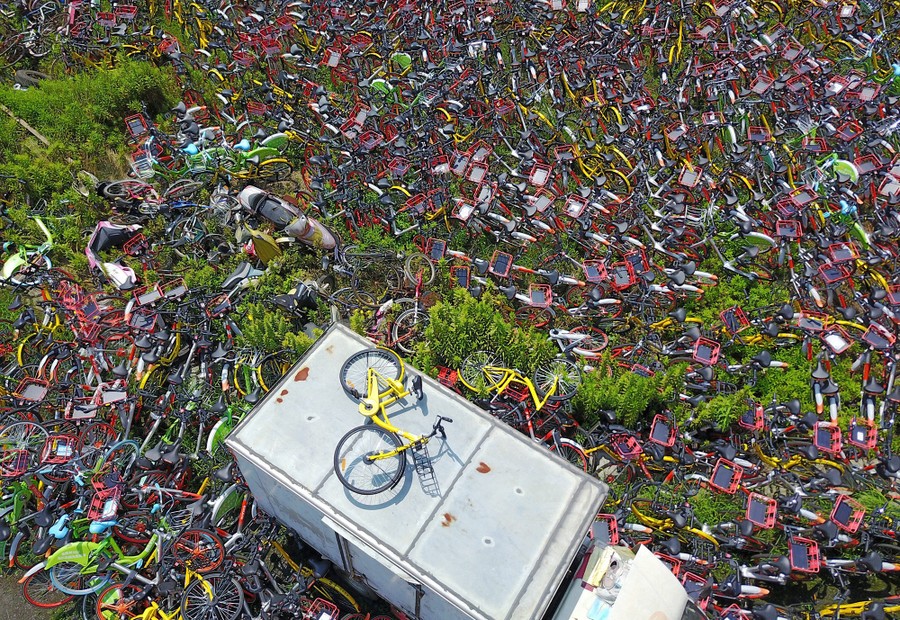
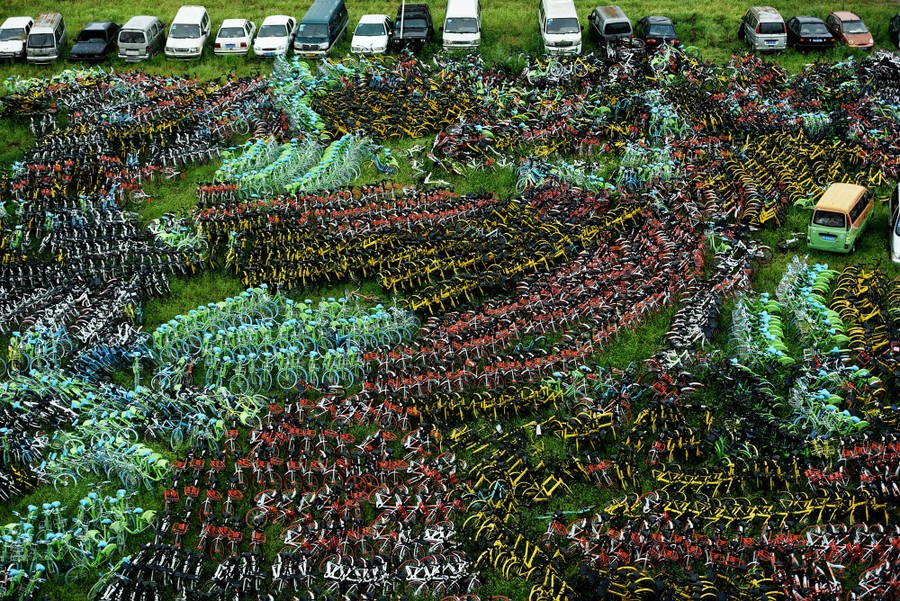
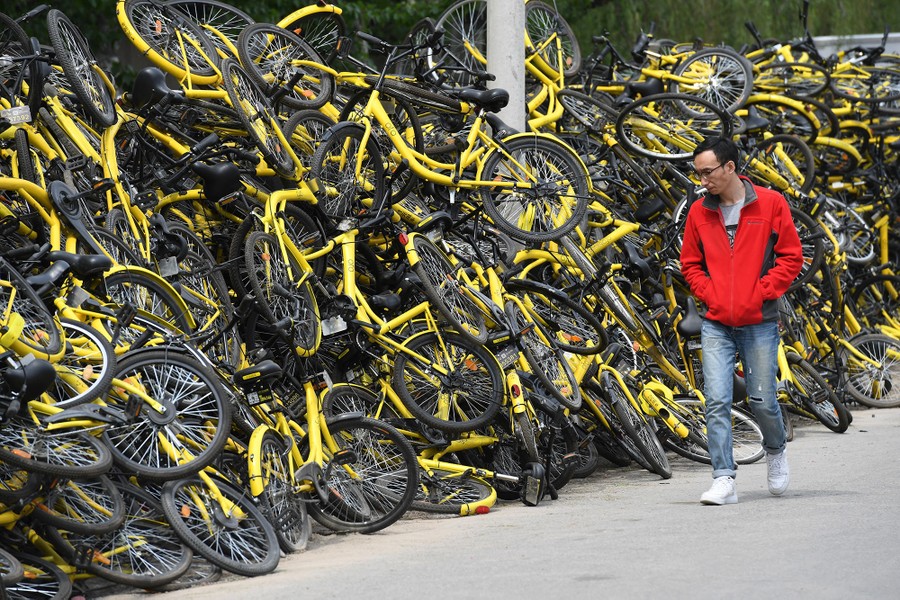
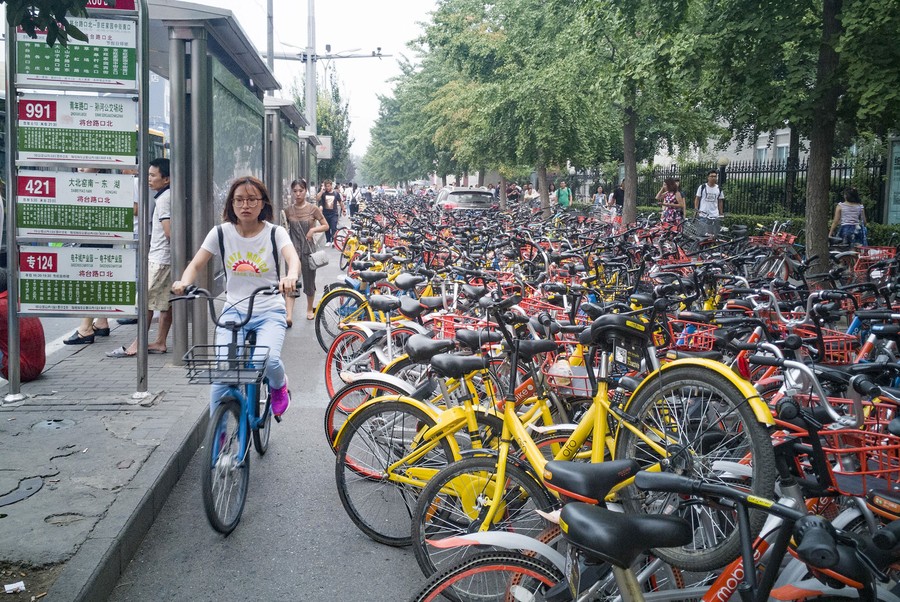
In 2017, bike sharing took off in China, with dozens of bike-share companies quickly flooding city streets with millions of brightly colored rental bicycles. However, the rapid growth vastly outpaced immediate demand and overwhelmed Chinese cities, where infrastructure and regulations were not prepared to handle a sudden flood of millions of shared bicycles. Riders would park bikes anywhere, or just abandon them, resulting in bicycles piling up and blocking already-crowded streets and pathways. As cities impounded derelict bikes by the thousands, they moved quickly to cap growth and regulate the industry. Vast piles of impounded, abandoned, and broken bicycles have become a familiar sight in many big cities. As some of the companies who jumped in too big and too early have begun to fold, their huge surplus of bicycles can be found collecting dust in vast vacant lots. Bike sharing remains very popular in China, and will likely continue to grow, just probably at a more sustainable rate. Meanwhile, we are left with these images of speculation gone wild—the piles of debris left behind after the bubble bursts.
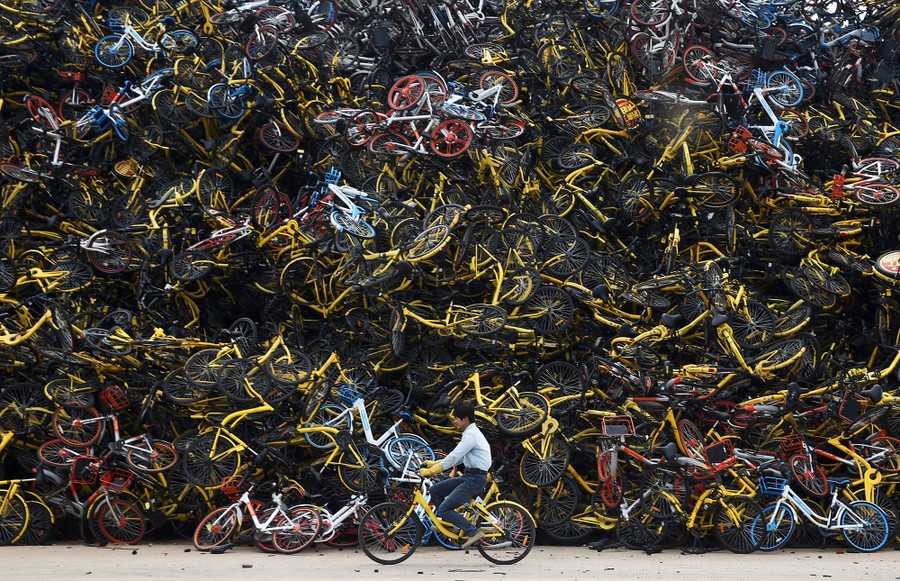
A worker rides a shared bicycle past a huge pile of unused shared bikes in a vacant lot in Xiamen, Fujian province, China, on December 13, 2017.
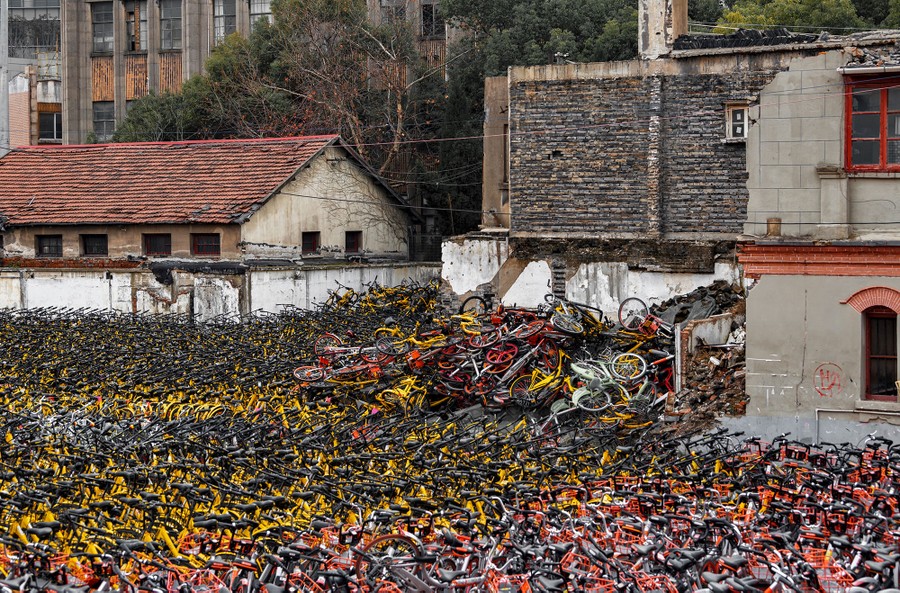
Shared bikes stored and piled in Shanghai on February 1, 2018.
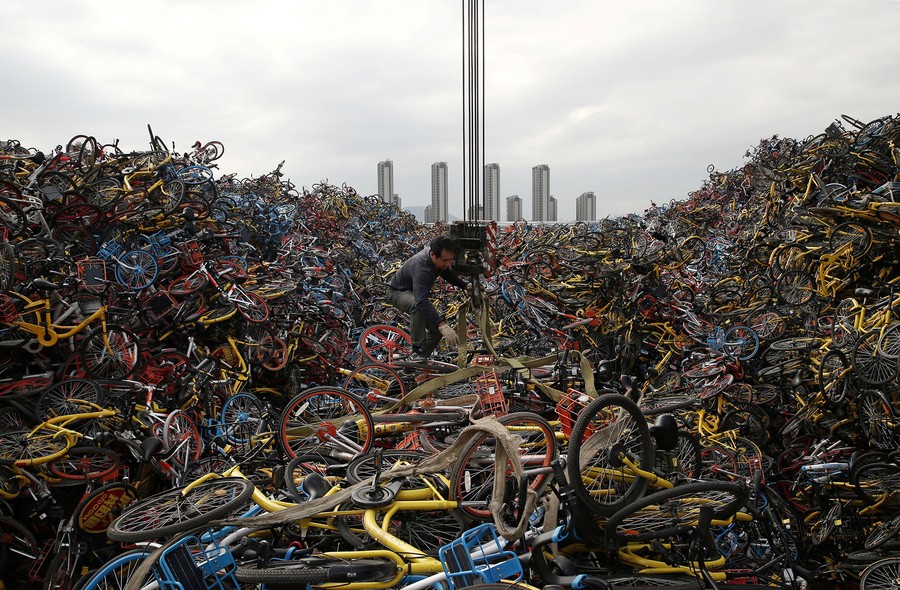
A worker untangles a rope amid piled-up bicycles in a lot in Xiamen, Fujian province, China, on December 13, 2017.
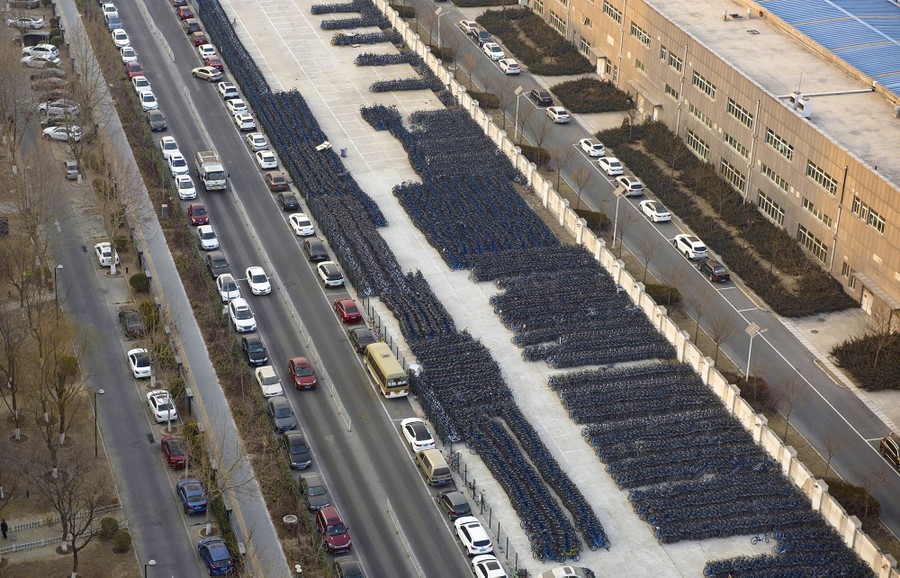
A parking lot is seen packed with tens of thousands of shared bikes belonging to the Chinese bike-sharing firm Bluegogo in Beijing’s Chaoyang District on March 5, 2018. Bluegogo, once China’s third-largest bike-rental service, ceased operations last November having run out of money, leaving tens of thousands of its bicycles in limbo. Bluegogo was recently acquired by Didi, another bike-share company, which says it plans to replace some of the older Bluegogo bikes with its own.
Thousands of illegally parked share bikes are temporary detained in a sports field in Hefei, Anhui, China, on August 17, 2017.
Bicycles from various bike-sharing services sit in a lot in an urban village in Hangzhou, Zhejiang province, China, on September 7, 2017.
A man walks past piles of share bikes outside a repair shop in Beijing on April 13, 2017.
Shared bicycles block a pathway in Jiuxianqiao, Chaoyang district, Beijing, on July 14, 2017.
Bicycles of various bike-sharing services completely fill a large lot in Shanghai, China, on November 23, 2017.
A community in England is on edge following sightings of a proverbial ‘clown gang’ that has been roaming the streets in a van blasting eerie music from a loudspeaker atop the vehicle. According to a local media report, the haunting harlequins were first spotted last Friday evening when an unnamed resident of Laindon was walking home at around two in the morning. What should have been a peaceful late night stroll turned rather terrifying when he realized that he was being trailed by a van full of clowns. Making the experience all the more unnerving for the unfortunate walker, he said, was that “they also had a massive speaker on top of the van which was playing creepy music.”
As one might imagine, the man was deeply disturbed by being in the crosshairs of the clowns and he fled the scene in fright. Later sharing the story on social media, he warned his fellow residents about the harlequins in their midst and mused that “it worries me that this is happening in my area, as it is scary, creepy and weird.” Chillingly, his account of the creepy music emanating from the van was echoed by another individual who reported that she had also heard the clowns’ creepy chords late at night and that her kids were terrified by the troubling tunes. “My children now want to move as they are scared,” she lamented, “I just don’t know what to do.”
It would seem those concerns are shared by other residents as several other people chimed in on social media to say that they had also encountered the clowns or heard their haunting music. For now, the strange sightings seem confined to the online rumor mill as one local authority asked about the situation indicated that “I hadn’t been contacted personally by residents about this yet, but it does sound really concerning.” Noting that “playing really loud, scary music” would be something for the police to investigate, he promised to investigate the situation and get to the bottom of the clown mystery unfolding in the community.
QAnon is a movement started on social media made up of conspiracy theorists who believe the wildest things. They are hardcore supporters of Donald Trump. And Trump said he doesn’t know much about them, “but they like me”. For Trump no matter how looney any group is, if they like him, he likes them.
Back to the convention:
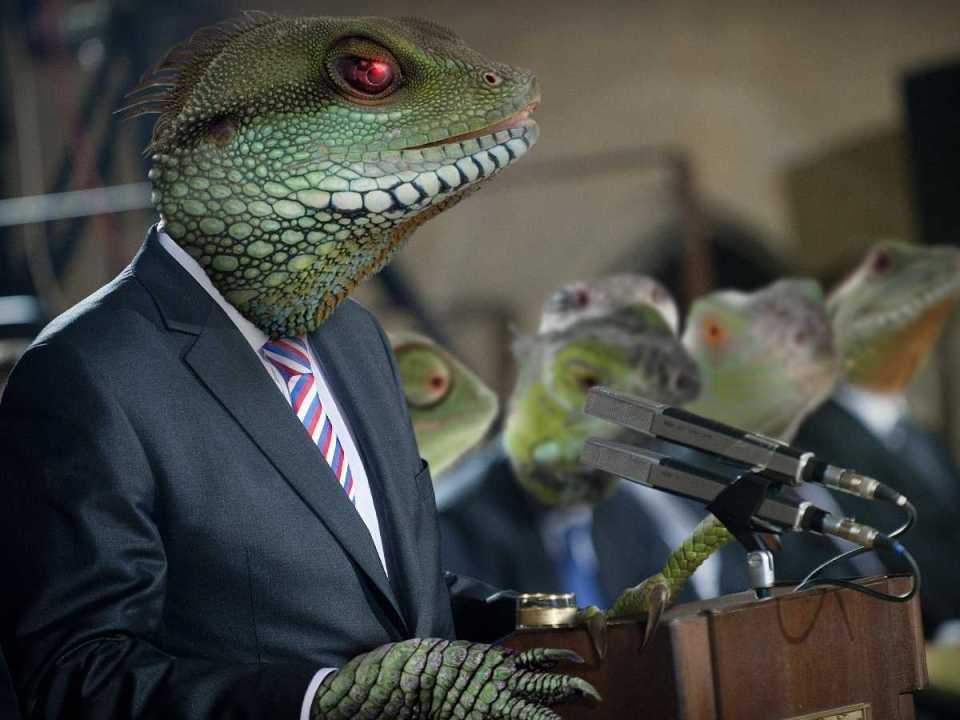
The deadly Capitol siege was fueled by far-out conspiracy theorists, including Ashli Babbitt, a QAnon supporter fatally shot by police as she tried to breach a barricaded doorway. Meanwhile, federal investigators are still looking into the belief system of Anthony Quinn Warner, who made statements about a conspiracy of lizard people taking over the planet before the explosion that damaged 41 buildings and injured three people in Nashville, Tennessee, on Christmas Day.
Many are scratching their heads. Why are people embracing such bizarre ideas?
The notion of shape-shifting, blood-sucking reptilian humanoids invading Earth to
control the human race sounds like a cheesy sci-fi plot. But it’s actually a very old trope with disturbing links to anti-immigrant and anti-Semitic hostilities dating to the 19th century.
Bonkers? Sure. Harmless? Definitely not.
Law enforcement sources say Warner’s writings indicate his interest in a number of conspiracy theories — including the lizard people takeover. He may even have had a pastime of hunting such aliens in the park. Before the blast, Warner sent packages to friends filled with material expounding on his bizarre worldview. They included a letter that began “Hey Dude, You will never believe what I found in the park.”
The world-ruled-by-lizard-people fantasy shot to prominence in recent years in part through the ramblings of David Icke, a popular British sports reporter-turned-conspiracy theorist known for his eccentric ideas.
Icke would have you believe that a race of reptilian beings not only invaded Earth, but that it also created a genetically modified lizard-human hybrid race called the “Babylonian Brotherhood,” which, he maintains, is busy plotting a worldwide fascist state. This sinister cabal of global reptilian elites boasts a membership list including former President Barack Obama, Queen Elizabeth II of Great Britain, former Federal Reserve Chairman Alan Greenspan and Mick Jagger.
Mick getting medical attention in the Nevada desert after a very long jog.
This nonsense is espoused by a variety of internet conspiracy-mongers, including far-right, Trump-loving QAnon adherents, one of whom was accused in 2019 of murdering his own brother because he thought he was a lizard. As many as 12 million Americans believed in this lizard people conspiracy in a 2013 Public Policy Polling survey. It’s safe to assume the number is higher today.
A QAnon lizard person at the Treasure Island casino.
A spooky-looking red pillar of light appeared in the night sky over Houston earlier this week and caused a brief sensation before the source of the strange glow was seemingly identified. The odd incident reportedly unfolded on Wednesday at around 8:30 in the evening when several people living in the eastern part of the city noticed something rather out of the ordinary on the horizon. Local TV stations were soon flooded with calls about the puzzling scene with one outlet indicating that they were “inundated with videos and photos” of the peculiar red pillar of light. As one can expect in this day and age, social media was rife with all manner of theories for what might be behind the weirdness, though thankfully it didn’t take too long for the mystery to be solved.
Often the proverbial first line of defense when it comes to possible UFO events, local meteorologists appear to have put the pieces of the puzzle together and while the anomaly was not alien in nature, how it came about is fairly fantastic. The source of the illumination was found to likely be flaring that was occurring at a Houston refinery at the same time as the mass sighting. The light appeared in the clouds hovering over a different part of the city because it was being reflected onto tiny ice crystals in the sky which gave it the elongated pillar-like appearance.
Charges for Russian after stunts atop Toronto skyscraper
An “urban explorer” has been charged after he was seen in an online video leaping and doing somersaults atop a downtown Toronto skyscraper.
In a video posted to YouTube, Russian stuntman Oleg Cricket can be seen leaping, sliding and rolling on the ledge of a skyscraper. In another shot, he appears to be jumping between beams, with the CN Tower as his backdrop. In one of the final shots, Cricket is shown doing a handstand on a ledge, high above city streets.
Police arrested Cricket on Nov. 12, 2021. He has been charged with breaking and entering and mischief, Toronto police say.
Cricket is well-known for his vertigo-inducing acrobatic feats atop skyscrapers in various cities. He records his stunts and puts them on YouTube and other social media channels, where his followers number in the hundreds of thousands.
Another man who was allegedly with Cricket is facing the same charges.
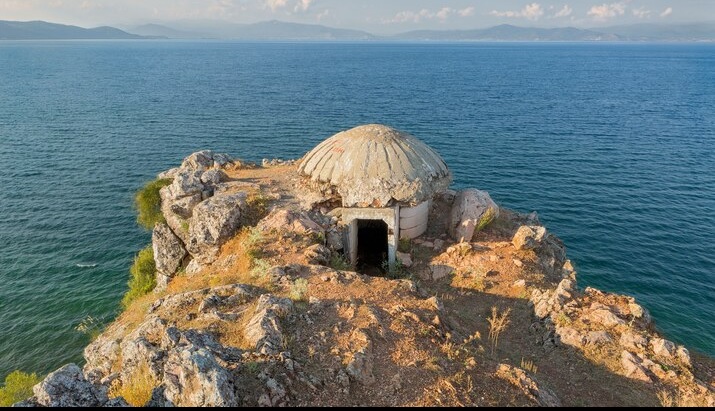
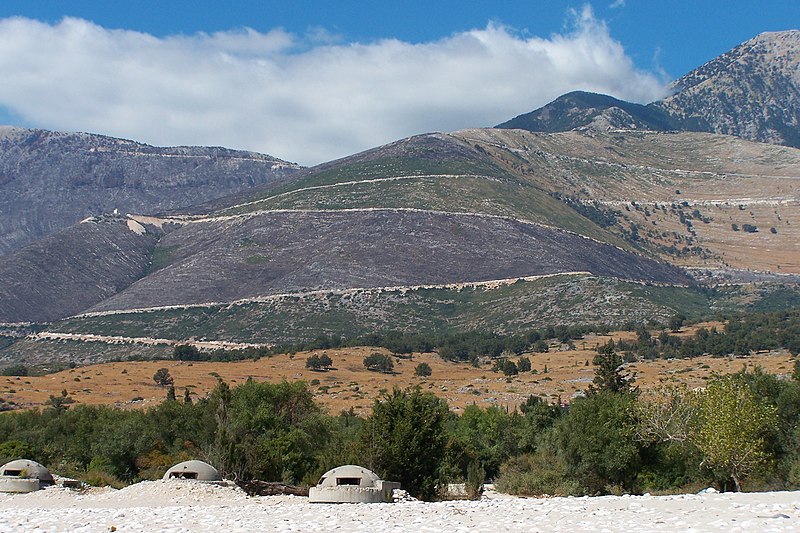
Concrete military bunkers are a ubiquitous sight in Albania, with an average of 5.7 bunkers for every square kilometre (14.7 per square mile). The bunkers (Albanian: bunkerët) were built during the Stalinist and anti-revisionist government of Enver Hoxha from the 1960s to the 1980s; by 1983 a total of 173,371 bunkers had been constructed around the country.
Hoxha’s program of “bunkerization” (bunkerizimi) resulted in the construction of bunkers in every corner of the then People’s Socialist Republic of Albania, ranging from mountain passes to city streets. They were never used for their intended purpose during the years that Hoxha governed. The cost of constructing them was a drain on Albania’s resources, diverting them away from more pressing needs, such as dealing with the country’s housing shortage and poor roads.
The bunkers were abandoned following the dissolution of the communist government in 1992. A few were used in the Albanian insurrection of 1997 and the Kosovo War of 1999. Most are now derelict, though some have been reused for a variety of purposes including residential accommodation, cafés, storehouses, and shelters for animals or the homeless.
From the end of World War II to his death in April 1985, Enver Hoxha pursued a style of politics informed by hardline Stalinism as well as elements of Maoism. He broke with the Soviet Union after Nikita Khrushchev embarked on his reformist Khrushchev Thaw, withdrew Albania from the Warsaw Pact in 1968 in protest of the Warsaw Pact invasion of Czechoslovakia, and broke with China after U.S. President Richard Nixon’s 1972 visit to China.
His regime was also hostile towards the country’s immediate neighbours. Albania did not end its state of war with Greece, left over from the Second World War, until as late as 1987 – two years after Hoxha’s death – due to suspicions about Greek territorial ambitions in southern Albania as well as Greece’s status as a NATO member state.
Hoxha was virulently hostile towards the government of Josip Broz Tito in Yugoslavia, accusing Tito’s government of maintaining “an anti-Marxist and chauvinistic attitude towards our Party, our State, and our people”. He asserted that Tito intended to take over Albania and make it into the seventh republic of Yugoslavia, and castigated the Yugoslav government’s treatment of ethnic Albanians in Kosovo, claiming that “Yugoslav leaders are pursuing a policy of extermination there.”
Albania still maintained some links with the outside world at this time, trading with neutral countries such as Austria and Sweden, and establishing links across the Adriatic Sea with its former invader Italy. However, a modest relaxation of domestic controls was curtailed by Hoxha in 1973 with a renewed wave of repression and purges directed against individuals, the young and the military, whom he feared might threaten his hold on the country. A new constitution was introduced in 1976 that increased the Labor Party’s control of the country, limited private property, and forbade foreign loans. The country sank into a decade of isolation and economic stagnation, virtually cut off from the outside world.
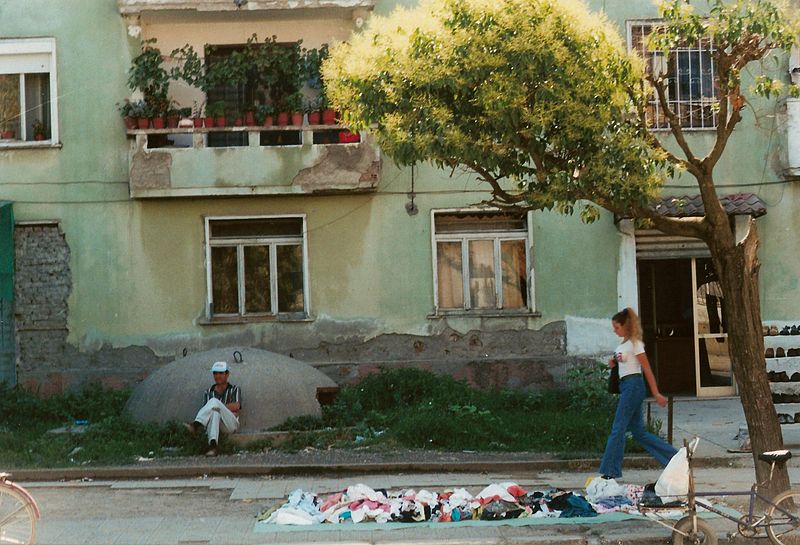
A bunker on a city street in Shkoder. The street’s inhabitants would have been expected to defend it.
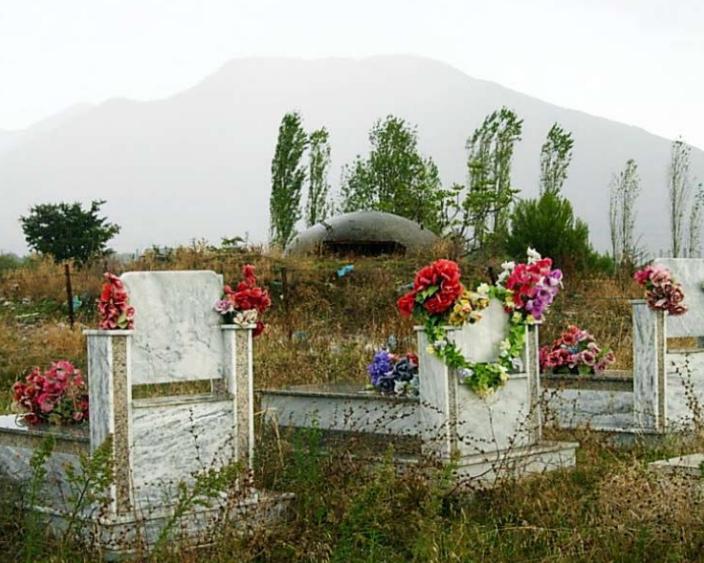
A bunker in a cemetery.
Starting in 1967 and continuing until 1986, the Albanian government carried out a policy of “bunkerisation” that saw the construction of hundreds of thousands of bunkers across the country. They were built in every possible location, ranging from “beaches and mountains, in vineyards and pastures, in villages and towns, even on the manicured lawns of Albania’s best hotel”.[9] Hoxha envisaged Albania fighting a two-front war against an attack mounted by Yugoslavia, NATO or the Warsaw Pact involving a simultaneous incursion by up to eleven enemy airborne divisions. As he put it, “If we slackened our vigilance even for a moment or toned down our struggle against our enemies in the least, they would strike immediately like the snake that bites you and injects its poison before you are aware of it.”
A “triple series” of linked Qender Zjarri bunkers in the coast of Himara, southern Albania
The bunkerisation programme was a massive drain on Albania’s weak economy. The construction of prefabricated bunkers alone cost an estimated two percent of net material product, and in total the bunkers cost more than twice as much as the Maginot Line in France, consuming three times as much concrete. The programme diverted resources away from other forms of development, such as roads and residential buildings. On average, they are said to have each cost the equivalent of a two-room apartment and the resources used to build them could easily have resolved Albania’s chronic shortage of housing. According to Josif Zagali, building twenty smaller bunkers cost as much as constructing a kilometre of road. It also had a human cost; 70–100 people a year died constructing the bunkers. In addition, the bunkers occupied and obstructed a significant area of arable land.
A line of bunkers in Dhërmi, Himara The bunkerisation of the country had effects that went beyond their ubiquitous physical impact on the landscape. The bunkers were presented by the Party as both a symbol and a practical means of preventing Albania’s subjugation by foreign powers, but some viewed them as a concrete expression of Hoxha’s policy of isolationism – keeping the outside world at bay. Some Albanians saw them as an oppressive symbol of intimidation and control.
Albanian author Ismail Kadare used the bunkers in his 1996 novel The Pyramid to symbolise the Hoxha regime’s brutality and control, while Çashku has characterised the bunkers as “a symbol of totalitarianism” because of the “isolation psychology” that they represented. It has been argued that the bunkerisation programme was a form of “patterned large-scale construction” that “has a disciplinary potential as a means of familiarising a population with a given order of rule”. The regime’s xenophobia had the effect of creating a siege mentality and a sense of constant emergency.
There have been various suggestions for what to do with them: ideas have included pizza ovens, solar heaters, beehives, mushroom farms, projection rooms for drive-in cinemas, beach huts, flower planters, youth hostels, and kiosks. Some Albanians have taken to using the bunkers for more romantic purposes. In a country where until recently cars were in short supply, they were popular places for lovers to have sex; as travel writer Tony Wheeler puts it, “Albanian virginity is lost in a Hoxha bunker as often as American virginity was once lost in the back seats of cars.”
In November 2014, a “five star” nuclear shelter built near Tirana for Hoxha was opened as a tourist attraction and art exhibition. The large bunker contains a museum with exhibits from World War II and the Hoxhaist period.
Albania’s bunkers have become a national symbol. Pencil holders and ashtrays in the shape of bunkers have become one of the country’s most popular tourist souvenirs. One such line of bunker souvenirs was promoted with a message to buyers: “Greetings to the land of the bunkers. We assumed that you could not afford to buy a big one.”
Florida Man Asked Cops To Test His Meth Because He Was Worried The Drugs Were Actually Bath Salts
A Florida man dialed 911 to implore police to test the meth he bought as he worried his dealer had sold him bath salts instead. Thomas Colluci, 41, requested a sheriff be sent to his home in Spring Hill, a suburb of Tampa, to look into the purity of the drugs he’d purchased at a local bar. He’d used a bit of the substance but felt from the effects that he may not have a pure product on his hands. He ended up drugless and in cuffs by the end of the night.
1. COLUCCI DESCRIBED HIMSELF TO POLICE AS AN EXPERIENCED DRUG USER.Because of that, he was sure he would “know what it should feel like” when he did meth. When he tried the product he bought from the random man at the bar, however, something felt different and he was obviously concerned for his health.
2. HE HANDED OVER TWO BAGGIES FULL OF A “CRYSTALLINE SUBSTANCE” TO AUTHORITIES.In Colucci’s head, he legitimately believed that police would test the drugs and give them back. That obviously wasn’t how things went down, much to his disbelief.
3. COLUCCI WAS LOOKING OUT FOR OTHER DRUG USERS.He told police that he didn’t want other customers to end up with “fake” meth from the man. Also, despite the fact that he didn’t have any contact info or even a name for the dealer, he said he wanted to “put the person in trouble” for selling narcotics.
4. THE PRODUCT COLUCCI BOUGHT DID INDEED CONTAIN METH.The Hernando County Sheriff’s Office confirmed the presence of methamphetamines in the bags, which was bad news for Colucci after all as he was arrested on a felony drug possession charge as well as two misdemeanor drug paraphernalia charges. He was released from the county jail after posting $7,000 bail.
5. THIS WASN’T COLUCCI’S FIRST BRUSH WITH THE LAW. As per The Smoking Gun, Colucci was convicted in 2019 of slamming his SUV into another vehicle while under the influence of alcohol. As he drove away from the scene without stopping, he hit another vehicle that was getting gas and knocked the driver to the ground while injuring the passenger as well. He pleaded no contest to DUI and leaving the scene of an accident and was given a year of probation as well as an order to attend outpatient substance abuse treatment. Looks like that worked well!
Authorities in Denmark are on the hunt for a loose kangaroo that was spotted by a motorist who filmed the out-of-place creature hopping through a field. Footage of the weird encounter was shared by South Zealand and Lolland-Falster Police in a Facebook post on Monday. Joking that the “morning driver had to rub his sleep out of his eyes” when he saw the mysterious marsupial, they indicated that the strange sighting had occurred earlier that day near the community of Øster Ulslev on the island of Lloland. Perhaps thinking that no one would believe him, the motorist managed to capture a brief video of the kangaroo before it hopped out of view from the vehicle.
As one might imagine, cops are confused as to how a kangaroo wound up roaming the island since no one has reported such a noticeable creature having gone missing. However, as news of Monday’s sighting spread throughout the community, several people came forward with claims that the marsupial has actually been living in the area for quite awhile. “We see it from time to time, four or five times a week it comes bouncing,” resident Morten Friis nonchalantly told a local media outlet, “it has been here for several years, it is nothing new.” He went on to laugh that “it is very funny, many stop and are completely incomprehensible, and think they see visions. Then we say calmly, ‘it’s just the kangaroo you’ve seen.'”
The possibility that such a creature could make its home on the island is not completely out of the question, wildlife expert Anne Sofie Meilvang said, “even though kangaroos are associated with the warm climate in Australia, the Danish weather does not scare them.” She went on to explain that the animal subsists on a diet of “grass, herbs, bark and leaves,” which can be found in abundance in the area. While the kangaroo may have managed to adapt to living on Lloland, one suspects that its time in the wild may sadly soon come to an end now that its presence in the area has come to light and animal welfare workers are on the lookout for the creature.
A wild video out of Egypt shows a horse running along the narrow gap between two trains as one of the locomotives speeds beside it to the astonishment of passengers watching the surreal scene unfold. The hair-raising moment reportedly occurred near the village of Manqbad earlier this month and was captured on video by one of the amazed witnesses. The jaw-dropping footage begins people on the train leaning out their windows and trying to persuade the horse to move away from the tracks as they approach another train that is parked perilously beside them up ahead.
Their urgent cries turn panicked when the daring creature briefly disappears into the darkness between the two locomotives. Moments later, they are amazed to see that the horse is now furiously galloping within the narrow gap between the moving and stationary train. As the death-defying dash lasts for several worrisome seconds in which the slightest misstep could be a disaster for the animal and culminate with wild cheers from the passenger when they finally pass the other locomotive and the horse is free from the predicament seemingly unscathed.







 The MarkoZen Blog