The Ideal toy company produced a line of Evel Knievel themed “gyro powered” motorcycle toys from 1973 until 1977, the year Knievel attempted to beat Shelly Saltman to death with a baseball bat. Needing a quick replacement for their motorcycle toys, Ideal rolled out a line of “Scare Cycles” in 1978. These were the coolest toys ever in 1978. There were three characters in the series of monster-themed bike riders: Frankenstein, Dracula, and the Grim Reaper. Somehow the horror of monsters on cycles was deemed more palatable to children than the real-life horror of a baseball bat-wielding stunt-monster on a bike, IE Evel Knievel.
Dracula rode a “Dracucycle”—a coffin on wheels. Frankenstein’s monster rode a “Frankencycle” with skull handlebars and a tombstone backrest. The Grim Reaper rode “Boneshaker,” a three-wheeled hearse.
In addition to their macabre detailing, the toys glowed in the dark. They also included a haunted house themed wind-up base.
The Scare Cycles were produced up until 1983 when Ideal discontinued them in favor of the “Team America” line of motorcycle toys.
These things pop up on Ebay from time to time, but apparently horror toy geeks have deep pockets. They aren’t cheap.
Still, if you happened to luck across one of these bad boys in a thrift shop or yard sale, how could you resist the pure 1970s plasticky badassness of these little dudes?
Technology moves faster every day. But commercial air travel hasn’t changed as quickly as some industries in recent years. Experts project big changes in the next few decades, though, especially as aviation companies deploy significant innovations in design, material sciences and alternative energy sources. Here we take a look at some of changes on the horizon for commercial, cargo and experimental aircraft.
The N3-X concept aircraft, from Boeing and NASA, is based on a blended wing body (BWB) design intended to improve aerodynamics, fuel efficiency and noise emissions. The ultra-wide fuselage would greatly expand carrying capacity for commercial flights.
Developed by a research team from the Massachusetts Institute of Technology (MIT), the D8 “Double Bubble” aircraft would be used for domestic flights and is designed to fly at Mach 0.74 carrying 180 passengers in a coach cabin roomier than that of a Boeing 737-800. The D8 could enter service as soon as 2030, NASA says.
From Lockheed Martin, this concept design for a future supersonic aircraft is focused on reducing emissions and creating a quieter boom. A quieter craft would allow supersonic flights over land, where they are currently prohibited.
Meanwhile, over on the cargo plane tarmac, the GIGAbay concept envisions a ginormous aircraft powered by four hybrid fuel/electric engines, with supplemental energy provided by hydrogen fuel cells, wind generators and solar panels. The cargo area of the GIGAbay design is so large it could carry other jumbo aircraft, or even mobile field hospitals.
Powered by two superconducting electric motors, the concept plane known as the VoltAir (get it?) is a proposed all-electric airliner out of Europe. The engines would draw from next-generation lithium ion batteries — really big ones — that would be simply swapped out between flights.
Some cutting-edge technologies on the horizon are actually modifications of existing designs that have been around for more than a century. To wit, the illustration above imagines the closed-wing “PrandtlPlane” design applied to commercial passenger aircraft. Closed-wing planes have smaller wingspans than traditional aircraft, relative to fuselage size, allowing larger planes to operate out of smaller airports.
Another sort of hybrid, the E-Thrust design — from Rolls-Royce and several European partners — uses a combination of gas-turbine engines and battery-powered fans. The jet engines would only kick in when needed, similar to gas/electric hybrid cars. The fans would also be used, on descent, as built-in windmills to recharge the onboard batteries.
Finally, from the designer who brought us the GIGAbay cargo plane, the mighty Sky Whale also subscribes to the concept that bigger equals better — and greener. The Sky Whale is a largely theoretical vision for a passenger plane that could seat 755 passengers on three floors, using a combination of alternative power sources. The upshot? More passengers per flight means fewer flights, and fewer emissions.
Duga-3 (NATO reporting name Steel Yard) was a Soviet over-the-horizon (OTH) radar system used as part of the Soviet ABM (anti-ballistic missile) early-warning network. The system operated from July 1976 to December 1989. Two Duga-3 radars were deployed, one near Chernobyl and Chernihiv, the other in eastern Siberia.
The Duga-3 systems were extremely powerful, over 10 MW in some cases, and broadcast in the shortwave radio bands. They appeared without warning, sounding like a sharp, repetitive tapping noise at 10 Hz, which led to it being nicknamed by shortwave listeners the Russian Woodpecker. The random frequency hops disrupted legitimate broadcast, amateur radio, commercial aviation communications, utility transmissions, and resulted in thousands of complaints by many countries worldwide. The signal became such a nuisance that some receivers such as amateur radios and televisions actually began including ‘Woodpecker Blankers’ in their design.
The unclaimed signal was a source for much speculation, giving rise to theories such as Soviet mind control and weather control experiments. However, many experts and amateur radio hobbyists quickly realized it to be an OTH system. NATO military intelligence had already photographed the system and given it the NATO reporting name Steel Yard. This theory was publicly confirmed after the fall of the Soviet Union.
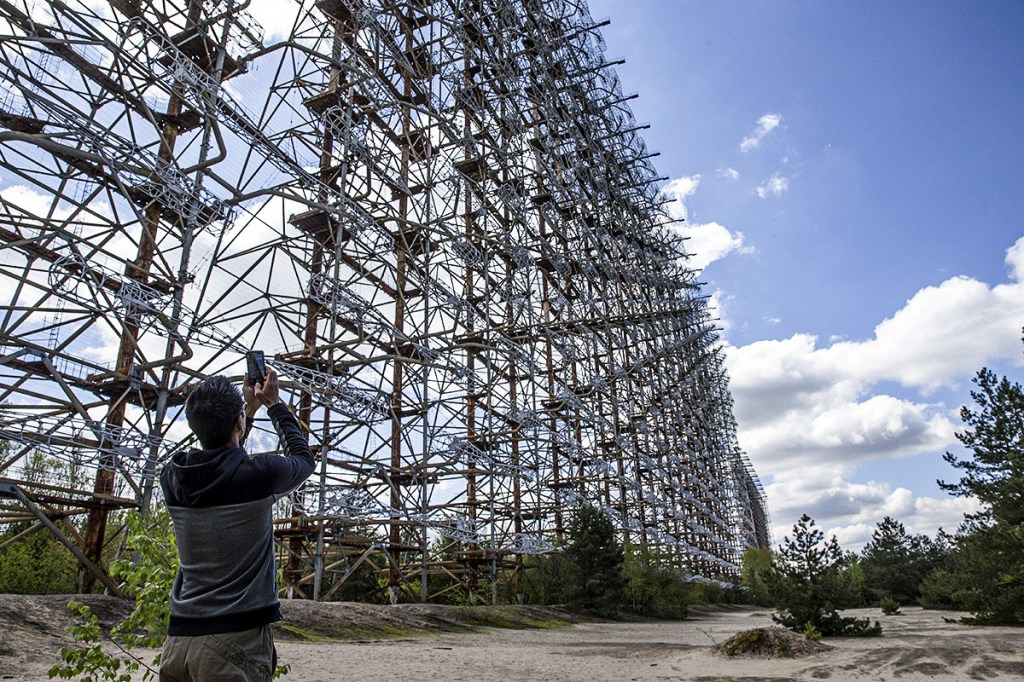
The bigger array is 150 meters tall and 500 meters long. The smaller array is 90 meters tall.
The Soviets had been working on early warning radar for their anti-ballistic missile systems through the 1960s, but most of these had been line-of-sight systems that were useful for raid analysis and interception only. None of these systems had the capability to provide early warning of a launch, within seconds or minutes of a launch, which would give the defences time to study the attack and plan a response. At the time the Soviet early-warning satellite network was not well developed, and there were questions about their ability to operate in a hostile environment including anti-satellite efforts. An over-the-horizon radar sited in the USSR would not have any of these problems, and work on such a system for this associated role started in the late 1960s.
The first experimental system, Duga-1, was built outside Mykolaiv in Ukraine, successfully detecting rocket launches from Baikonur Cosmodrome at 2,500 kilometers. This was followed by the prototype Duga-2, built on the same site, which was able to track launches from the far east and submarines in the Pacific Ocean as the missiles flew towards Novaya Zemlya. Both of these radar systems were aimed east and were fairly low power, but with the concept proven work began on an operational system. The new Duga-3 systems used a transmitter and receiver separated by about 60 km.
Starting in 1976 a new and powerful radio signal was detected worldwide, and quickly dubbed the Woodpecker by amateur radio operators. Transmission power on some woodpecker transmitters was estimated to be as high as 10 MW equivalent isotropically radiated power.
Triangulation quickly revealed the signals came from Ukraine. Confusion due to small differences in the reports being made from various military sources led to the site being alternately located near Kiev, Minsk, Chernobyl, Gomel or Chernihiv. All of these reports were describing the same deployment, with the transmitter only a few kilometers southwest of Chernobyl (south of Minsk, northwest of Kiev) and the receiver about 50 km northeast of Chernobyl (just west of Chernihiv, south of Gomel). Unknown to civilian observers at the time, NATO was aware of the new installation, which they referred to as Steel Yard.
To combat this interference, amateur radio operators attempted to “jam” the signal by transmitting synchronized unmodulated continuous wave signals at the same pulse rate as the offending signal. They formed a club called The Russian Woodpecker Hunting Club.
Starting in the late 1980s, even as the U.S. Federal Communications Commission (FCC) was publishing studies of the signal, the signals became less frequent, and in 1989, they disappeared altogether. Although the reasons for the eventual shutdown of the Duga-3 systems have not been made public, the changing strategic balance with the end of the Cold War in the late 1980s likely had a major part to play. Another factor was the success of the Russian US-KS early-warning satellites, which entered preliminary service in the early 1980s, and by this time had grown into a complete network. The satellite system provides immediate, direct and highly secure warnings, whereas any radar-based system is subject to jamming, and the effectiveness of OTH systems is also subject to atmospheric conditions.
According to some reports, the Komsomolsk-na-Amure installation in the Russian Far East was taken off combat alert duty in November 1989, and some of its equipment was subsequently scrapped. The original Duga-3 site lies within the 30 kilometer Zone of Alienation around the Chernobyl power plant. It appears to have been permanently deactivated, since their continued maintenance did not figure in the negotiations between Russia and Ukraine over the active Dnepr early warning radar systems at Mukachevo and Sevastopol. The antenna still stands, however, and has been used by amateurs as a transmission tower (using their own antennas) and has been extensively photographed.
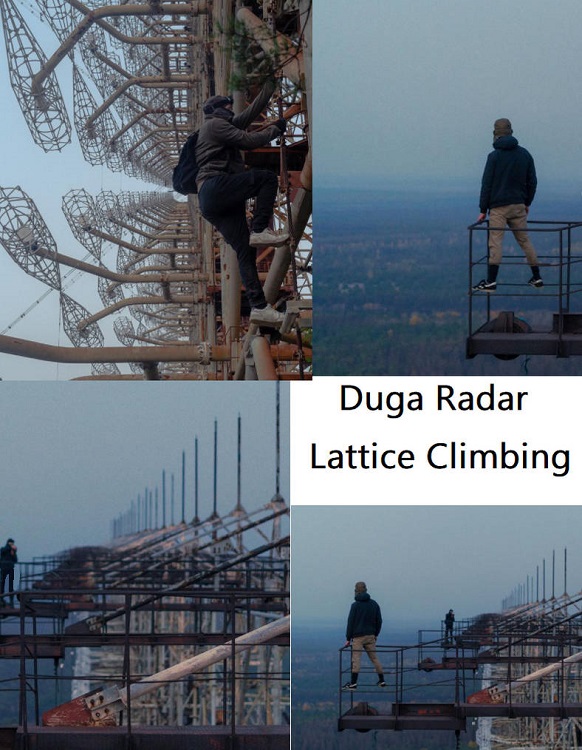
Always a few people that have to climb these things. “Now how do we get down”?
Stephen King was famously inspired by the Stanley Hotel of Estes Park, Colorado, and now, the hotel is looking to add on to their heritage as a horror destination: by adding on a museum dedicated to horror. The hotel was the inspiration for the Outlook Hotel in the novel, “The Shining.”
According to the LA Times, the hotel has issued plans to build a horror museum onto the premise, which would bring in traveling exhibits, and add on an auditorium and sound stage. The founding board for the museum includes some celebrities, such as Elijah Woods (Lord of the Rings) and Simon Pegg (Shaun of the Dead / Star Trek).
Before this happens, the state of Colorado must first grant the hotel $11.5 million from its tourism funds to help with the construction of the facility, which is expected to cost upwards of $24 million. The museum will operate as a nonprofit public-private partnership.
King stayed in room 217 in 1974, which helped to inspire him to write his famous novel The Shining, and serves as inspiration for the Overlook Hotel. The novel and subsequent movie adaptation have helped transform the hotel in to a tourist destination for horror fans. The hotel offers tours and hosts horror writers for workshops.
Ghost hunters trying to scare themselves in the Stanley Hotel.
According to King in later interviews, the Stanley served as his model for the Overlook Hotel, the ominous setting of The Shining, his third major work after Salem’s Lot (1975) and Carrie (1974). The hotel in King’s book is an evil entity haunted by its many victims. The main characters – Jack and Wendy Torrence and their young son Danny – are employed as winter caretakers. As the winter wears on, the hotel begins to exert its influence upon Jack, urging him to murder his family. Danny’s clairvoyant abilities – referred to in the novel as “the shine” – lend the book its title.
In 1980, the novel became the basis for an iconic film adaptation directed by Stanley Kubrick. Kubrick’s vision for the movie differed from King’s significantly in many ways, including the portrayal of the Overlook Hotel. The exteriors of Kubrick’s Overlook were supplied by the Timberline Lodge on the slopes of Mt. Hood in Oregon. Inspiration for the interior sets (erected at Elstree Studios in England) came from the 1927 Ahwahnee Hotel in Yosemite National Park.
Timberline Lodge located at Mt. Hood, Oregon. Exterior shots in the movie “The Shining.”
Wild location for a hotel.
The famous maze in the movie was a studio construct.
There are no mazes at either the Stanley Hotel or Timberline Lodge. The maze was inside a studio in the U.K.
The set design for the interior scenes of the Overlook Hotel was modeled in large parts on the Ahwahnee Hotel in Yosemite, California. Seen here is the Ahwahnee’s Great Lounge, which was recreated on the Elstree Studios set as the Colorado Lounge. Where ‘All work and no play make Jack a Dull Boy.’
The Stanley Hotel that inspired Stephen King to write “The Shining” is said to have many ghosts being labelled a 5 Star haunt.
In the United States, and the western world for the most part, if a person is very intelligent, ambitious, is a workaholic and has a burning desire to make tons of money, opulence can be achieved. A person can make many millions of dollars, or for that matter billions of dollars. What to do with all that wealth. The sky is the limit, i.e. private jets. But back on earth one can build or buy outrageously ostentatious mansions.
The mansion below is listed at 41 million dollars. It is 13,200 square feet and has everything a Saudi prince would desire.
A lap pool that runs around half of the house.
Glass walled garage
This is nuts!
The ramp leading up to a courtyard and the garage.
The CF-18 Hornets Demonstration Team of the Royal Canadian Air Force use different striking liveries year to year as they make stops at various airshows across North America. The paint schemes celebrate different anniversaries and milestones such as the 75th anniversary of the RCAF and the Battle of Britain. The paint jobs are extremely eye-catching.
Here the CF-18 is shadowed by a NATO AWACS and CT-133 Silver Star.
Replica camouflage used by Spitfires during the Battle of Britain



















 The MarkoZen Blog
