Electronic voice phenomenon

Within ghost hunting and parapsychology, electronic voice phenomena (EVP) are sounds found on electronic recordings that are interpreted as spirit voices. Parapsychologist Konstantīns Raudive, who popularized the idea in the 1970s, described EVP as typically brief, usually the length of a word or short phrase.

Enthusiasts consider EVP to be a form of paranormal phenomenon often found in recordings with static or other background noise. Scientists regard EVP as a form of auditory pareidolia (interpreting random sounds as voices in one’s own language) and a pseudoscience promulgated by popular culture. Prosaic explanations for EVP include apophenia (perceiving patterns in random information), equipment artifacts, and hoaxes.

As the Spiritualist religious movement became prominent in the 1840s–1940s with a distinguishing belief that the spirits of the dead can be contacted by mediums, new technologies of the era including photography were employed by spiritualists in an effort to demonstrate contact with a spirit world. So popular were such ideas that Thomas Edison was asked in an interview with Scientific American to comment on the possibility of using his inventions to communicate with spirits. He replied that if the spirits were only capable of subtle influences, a sensitive recording device would provide a better chance of spirit communication than the table tipping and ouija boards mediums employed at the time. However, there is no indication that Edison ever designed or constructed a device for such a purpose. As sound recording became widespread, mediums explored using this technology to demonstrate communication with the dead as well. Spiritualism declined in the latter part of the 20th century, but attempts to use portable recording devices and modern digital technologies to communicate with spirits continued.

cool-gif-girl-mirror-scary-face

In 1980, William O’Neil constructed an electronic audio device called “The Spiricom”. O’Neil claimed the device was built to specifications which he received psychically from George Mueller, a scientist who had died six years previously. At a Washington, DC press conference on April 6, 1982, O’Neil stated that he was able to hold two-way conversations with spirits through the Spiricom device, and provided the design specifications to researchers for free. However, nobody is known to have replicated the results O’Neil claimed using his own Spiricom devices. O’Neil’s partner, retired industrialist George Meek, attributed O’Neil’s success, and the inability of others to replicate it, to O’Neil’s mediumistic abilities forming part of the loop that made the system work. In 2020 Kenny Biddle wrote a comprehensive article explaining the origins of the Spiricom as developed by O’Neil and Meek. He was prompted to do so by the re-emergence of the device on the television series Ghosthunters. He comprehensively debunked the “science” behind the device in both the original development and the Ghosthunters episode.

Another electronic device specifically constructed in an attempt to capture EVP is “Frank’s Box” or the “Ghost Box”, created in 2002 by EVP enthusiast Frank Sumption for supposed real-time communication with the dead. Sumption claims he received his design instructions from the spirit world. The device is described as a combination white noise generator and AM radio receiver modified to sweep back and forth through the AM band selecting split-second snippets of sound. Critics of the device say its effect is subjective and incapable of being replicated, and since it relies on radio noise, any meaningful response a user gets is purely coincidental, or simply the result of pareidolia. Paranormal researcher Ben Radford writes that Frank’s Box is a “modern version of the Ouija board… also known as the ‘broken radio'”.

Explanations and origins
Paranormal claims for the origin of EVP include living humans imprinting thoughts directly on an electronic medium through psychokinesis and communication by discarnate entities such as spirits, nature energies, beings from other dimensions, or extraterrestrials. Paranormal explanations for EVP generally assume production of EVP by a communicating intelligence through means other than the typical functioning of communication technologies. Natural explanations for reported instances of EVP tend to dispute this assumption explicitly and provide explanations which do not require novel mechanisms that are not based on recognized scientific phenomena.

One study, by psychologist Imants Barušs, was unable to replicate suggested paranormal origins for EVP recorded under controlled conditions. Brian Regal in Pseudoscience: A Critical Encyclopedia (2009) has written “A case can be made for the idea that many EVPs are artifacts of the recording process itself with which the operators are unfamiliar. The majority of EVPs have alternative, nonspiritual sources; anomalous ones have no clear proof they are of spiritual origin.”

Natural explanations
There are a number of simple scientific explanations that can account for why some listeners to the static on audio devices may believe they hear voices, including radio interference and the tendency of the human brain to recognize patterns in random stimuli. Some recordings may be hoaxes created by frauds or pranksters.

People want to believe.
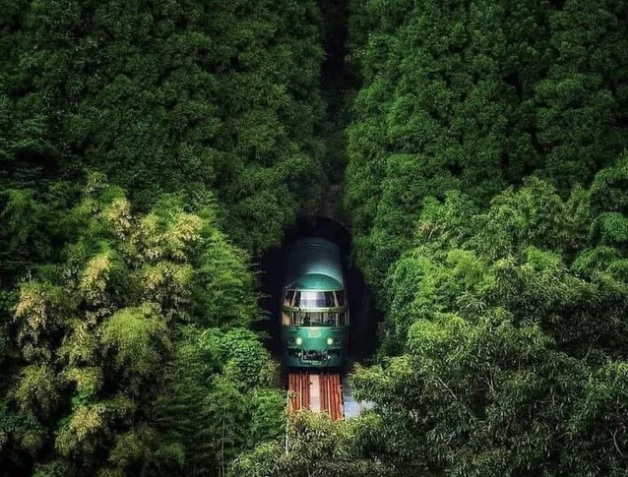
Accidental Cremation of Man Hoping to be Raptured Leads to Lawsuit from Family

An Arkansas funeral home that accidentally cremated the remains of a man who passed away with the hopes of later being raptured has been sued by his family over the grave mistake that, they contend, prevents him from being taken up to heaven when the miraculous moment arrives. According to a local media report, the very strange lawsuit centers around the November 2019 death of a deeply religious individual named Harold Lee. Upon his passing, the man’s family enlisted the Roller-McNutt Funeral Home to handle the arrangements and subsequent burial, which they intended to be at a cemetery alongside his late parents. However, Lee’s final wishes wound up going wildly awry and his family fears that the miscue may result in him being ‘left behind.’
That’s because, their lawsuit states, Lee’s loved ones expressly told the funeral home that he “stickily desired not to be cremated, as he believed his body would be raptured following the second coming.” With that being said, the man’s family were understandably aghast when, a few days later, they were told that his remains had been accidentally cremated. According to the lawsuit, the shocking news left his heartbroken widow “violently shaking” and his family suffered from “extreme mental and emotional distress” due to the error. Believing that Lee cannot be raptured without a body and thus will not join them in the kingdom of heaven, his loved ones are now suing the funeral home for unspecified damages.

Talk about missing the boat!

Eerie Red Pillar of Light in Night Sky Mystifies Houston Residents

A spooky-looking red pillar of light appeared in the night sky over Houston earlier this week and caused a brief sensation before the source of the strange glow was seemingly identified. The odd incident reportedly unfolded on Wednesday at around 8:30 in the evening when several people living in the eastern part of the city noticed something rather out of the ordinary on the horizon. Local TV stations were soon flooded with calls about the puzzling scene with one outlet indicating that they were “inundated with videos and photos” of the peculiar red pillar of light. As one can expect in this day and age, social media was rife with all manner of theories for what might be behind the weirdness, though thankfully it didn’t take too long for the mystery to be solved.

Often the proverbial first line of defense when it comes to possible UFO events, local meteorologists appear to have put the pieces of the puzzle together and while the anomaly was not alien in nature, how it came about is fairly fantastic. The source of the illumination was found to likely be flaring that was occurring at a Houston refinery at the same time as the mass sighting. The light appeared in the clouds hovering over a different part of the city because it was being reflected onto tiny ice crystals in the sky which gave it the elongated pillar-like appearance.

Spy Bases: Secretive HQs of the World’s Intelligence Agencies 

danger

Architecture is a language, one used by institutions to say something about themselves.

The same basic principle is true for the world’s spy agencies. All show their secrecy in their buildings, while some may appear starkly utilitarian, and some may even be frightening and alienating. But they also have their quirks and differences, whether it be an isolated complex hidden by trees, in a location that’s never been officially disclosed, or a prominent complex built by superstar architects and put on prominent display in the middle of a capital city.

United States: Central Intelligence Agency

ciax1

If John Brennan becomes the next CIA director — a likely event — he’ll be working from inside a complex that could blend into a business park anywhere in America. But this park contains the headquarters of America’s foreign intelligence agency.

Protected from prying eyes by a wooded belt in suburban Langley, Virginia, just northwest of Washington, D.C., the complex is actually two sets of buildings connected to a central core, with each set built at different times. The first half of the building and designed by New York architecture firm Harrison and Abramovitz — who had a role in designing the United Nations headquarters — dates back to 1963. It’s a sign of its times, and built from sterile pre-fabricated concrete.  But by the 1980s, the agency was running out of space. Today, the complex is much larger, with an added west wing of two glass office towers, designed by Detroit architects Smith, Hinchman & Grylls in the 1980s.

The CIA also has a penchant for art and assorted knick-knacks. The agency has a chunk of the Berlin Wall on display, and an A-12 Oxcart spy plane. There’s a museum inside the building with all sorts of weird memorabilia inside, from a robotic fish to a Cold War-era mini-submarine. Outside the cafeteria on the grounds of the headquarters’ new wing is the copper sculpture Kryptos, containing 869 encrypted characters on four plates. The final plate, with its 97 characters, is still unbroken. The cafeteria is remarkably pleasant and airy for a government building, actually, with enormous windows and green views. (The food, however, is not quite as pleasing.)

danger1

United States: National Security Agency

There are clear views of the National Security Agency’s headquarters off the Patuxent Freeway, just skirting Fort Meade, Maryland, about 15 miles southwest of Baltimore. But we wouldn’t advise getting any closer, as the NSA is the highly secretive agency responsible for the U.S. government’s codebreaking and collecting communications from around the world. The NSA’s headquarters also fits the part, rising blank and expressionless above a desert of parking lots. Completed in 1986, it resembles a collection of stubby, black, reflective monoliths like from 2001: A Space Odyssey. And according to the Center for Land Use Interpretation, the complex has an estimated 10 acres of underground space.

But like the CIA during the Cold War, the NSA in recent years has outgrown its own building. Fort Meade altogether has grown extremely rapidly as defense agencies relocate there and the NSA boosts its Cyber Command headquarters. Defense and government contractors now have offices surrounding the place, and contract and government jobs have surged, largely due to growth at the base more generally, and partly because of growth at the NSA. The Baltimore Business Journal reported that the base is expected to add an eye-popping 42,500 jobs by the end of the decade. The Defense Department even paved over part of the base’s golf course for the headquarters of the Defense Media Activity organization, the Pentagon’s media wing. Hopefully the Pentagon and the NSA will include a lot more parking.

danger2

United Kingdom: Secret Intelligence Service

There’s perhaps no spy headquarters more recognizable than the SIS Building, headquarters of the British Secret Intelligence Service, or MI6. It’s not only smack-dab in the middle of London, but has been featured in six James Bond movies, and blown up in two of them. Designed by architect Terry Farrell, the structure has been compared to a cross between a Babylonian ziggurat and a power plant. And it’s built like a veritable fortress, capable of withstanding bomb attacks. There are also reportedly extensive underground areas.

It’s also put its defenses to use. In September 2000, militants suspected to be from the Real Irish Republican Army — a splinter faction of the Irish paramilitary group — fired a rocket-propelled grenade round at the building’s eighth floor, causing no injuries. In a demonstration of just how heavily armored the building is, the rocket reportedly bounced off a glass window.

danger3

Russia: Federal Security Service

The Lubyanka building — the yellow, neo-Baroque former headquarters of Russia’s spies — is still the most recognizable symbol of Russian secrecy, even if the bulk of their office space has moved elsewhere. Dating to 1897, the building once housed an insurance company before becoming the headquarters for the feared Soviet spy agency KGB. It was remodeled by Stalin. (The basement contained a KGB prison.) The building was then transferred to the KGB’s successor agency, the Federal Security Service (FSB), after the collapse of the USSR.

According to cybersecurity analyst Jeffrey Carr’s book Inside Cyberware: Mapping the Cyber Underworld, the building today houses the FSB’s Communications Security Center, which oversees and encrypts Russian government computer security systems; and the Center for Licensing, Certification, and Protection of State Secrets, which handles export licenses for cryptographic and surveillance technology. Twin suicide bombing attacks in 2010 also came close to the building — one of the blasts exploded at the nearby Lubyanka metro station.

CDU-Innenexperte Bosbach rechnet mit 1,5 Milliarden fuer BND-Neubau

Germany: Federal Intelligence Service

Germany’s chief spy agency, which in German goes by the name Bundesnachrichtendienst (BND), is proud of its spiffy new headquarters. ABC has reported that it’s “set to be one of the most technologically sophisticated buildings in the world” once it opens in 2014. Located within walking distance of the Reichstag building in Berlin and on the site of a former East German soccer stadium, the BND has even gone online to show off of its facades of “natural stone, render, fair-faced concrete, brick or metal.” It has room for 4,000 employees, and has weird blob art. The agency is also touting its architect, Jan Kleihues, the son of famous architect Josef Paul Kleihaus, who was known for museums in Germany and Chicago.

But the design is also perhaps more open than the Germans would like. In July 2011, Munich news magazine Focus reported that the building’s blueprints were stolen from the construction site. According to Focus, the blueprints contained “the exact function of every single room, the thickness of each wall, the exact position of every toilet and every emergency exit and every security checkpoint.” The theft hasn’t ended Berlin’s plans. However, it was reported to have forced an estimated $1.8 billion interior redesign.

danger7

France: Directorate-General for External Security

This walled compound doesn’t stand out — because it’s not supposed to. It would be an ordinary and undistinguished complex of buildings, that is, if you ignore the high walls topped with spikes and a tall sensor tower. Located on the eastern edge of the Paris city limits is the headquarters for the French Directorate-General for External Security (DGSE), the agency responsible for France’s overseas intelligence works. It’s headquarters also nicknamed “the swimming pool” for its proximity to a facility used by the French Swimming Federation, and Google Maps has even blurred its image in satellite photographs.

danger8

China: Ministry of State Security

The building seen above is not the main headquarters for the Chinese Ministry of State Security (MSS), but a regional office in China’s central Hubei Province. The official headquarters is a little harder to spot. Attempts to track it down have led to frequent — but mistaken — associations with the Ministry of Public Security: the giant Borg-like structure in downtown Beijing which houses China’s national police command. A closer bet for the main MSS offices is a low-key compound in Beijing’s northwest.

The MSS is also different from many Western intelligence agencies because it handles both foreign and domestic intelligence, instead of splitting them up like the CIA and FBI. Hence the reason why it has regional offices inside China, in addition to carrying out Chinese espionage overseas. The Hubei office also sends something of a statement, with its imposing columns, wedding cake facade, sensor dishes and observation perch. Another photo shows what appears to be a police officer on duty, in case anyone gets the wrong idea and wanders a little too closely.

U.S. Intelligence Utah Data Center

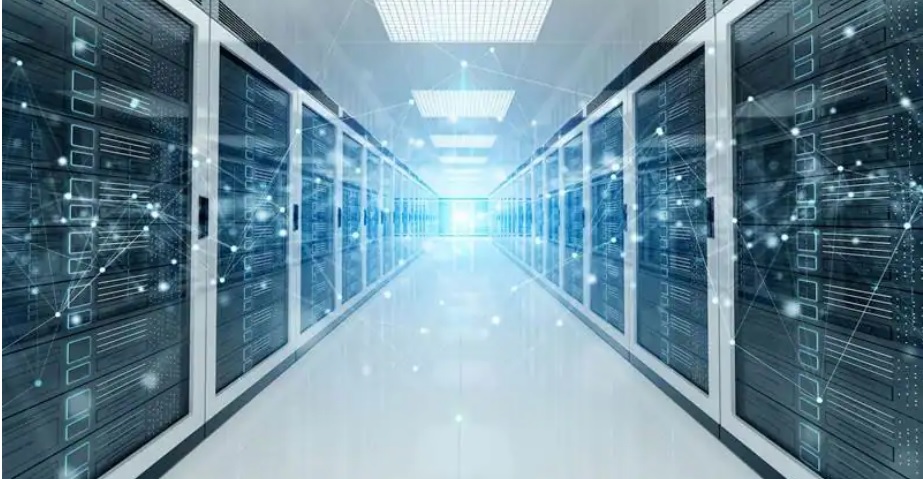
The Utah Data Center (UDC), also known as the Intelligence Community Comprehensive National Cybersecurity Initiative Data Center, is a data storage facility for the United States Intelligence Community that is designed to store data estimated to be on the order of exabytes or larger. Its purpose is to support the Comprehensive National Cybersecurity Initiative (CNCI), though its precise mission is classified. The National Security Agency (NSA) leads operations at the facility as the executive agent for the Director of National Intelligence. It is located at Camp Williams near Bluffdale, Utah, between Utah Lake and Great Salt Lake and was completed in May 2014 at a cost of $1.5 billion.

Critics believe that data center has the capability to process “all forms of communication, including the complete contents of private emails, cell phone calls, and Internet searches, as well as all types of personal data trails—parking receipts, travel itineraries, bookstore purchases, and other digital ‘pocket litter’.” In response to claims that the data center would be used to illegally monitor email of U.S. citizens, in April 2013 an NSA spokesperson said, “Many unfounded allegations have been made about the planned activities of the Utah Data Center, … one of the biggest misconceptions about NSA is that we are unlawfully listening in on, or reading emails of, U.S. citizens. This is simply not the case.”

In April 2009, officials at the United States Department of Justice acknowledged that the NSA had engaged in large-scale overcollection of domestic communications in excess of the United States Foreign Intelligence Surveillance Court’s authority, but claimed that the acts were unintentional and had since been rectified.

In August 2012, The New York Times published short documentaries by independent filmmakers titled The Program, based on interviews with former NSA technical director and whistleblower William Binney. The project had been designed for foreign signals intelligence (SIGINT) collection, but Binney alleged that after the September 11 terrorist attacks, controls that limited unintentional collection of data pertaining to U.S. citizens were removed, prompting concerns by him and others that the actions were illegal and unconstitutional. Binney alleged that the Bluffdale facility was designed to store a broad range of domestic communications for data mining without warrants.

Documents leaked to the media in June 2013 described PRISM, a national security computer and network surveillance program operated by the NSA, as enabling in-depth surveillance on live Internet communications and stored information. Reports linked the data center to the NSA’s controversial expansion of activities, which store extremely large amounts of data. Privacy and civil liberties advocates raised concerns about the unique capabilities that such a facility would give to intelligence agencies. “They park stuff in storage in the hopes that they will eventually have time to get to it,” said James Lewis, a cyberexpert at the Center for Strategic and International Studies, “or that they’ll find something that they need to go back and look for in the masses of data.” But, he added, “most of it sits and is never looked at by anyone.”

The UDC was expected to store Internet data, as well as telephone records from the controversial NSA telephone call database, MAINWAY, when it opened in 2013.

In light of the controversy over the NSA’s involvement in the practice of mass surveillance in the United States, and prompted by the 2013 mass surveillance disclosures by ex-NSA contractor Edward Snowden, the Utah Data Center was hailed by The Wall Street Journal as a “symbol of the spy agency’s surveillance prowess”.

Binney has said that the facility was built to store recordings and other content of communications, not only for metadata.

According to an interview with Snowden, the project was initially known as the Massive Data Repository within NSA, but was renamed to Mission Data Repository due to the former sounding too “creepy”.

An article by Forbes estimates the storage capacity as between 3 and 12 exabytes in the near term, based on analysis of unclassified blueprints, but mentions Moore’s Law, meaning that advances in technology could be expected to increase the capacity by orders of magnitude in the coming years.

Toward the end of the project’s construction it was plagued by electrical problems in the form of “massive power surges” that damaged equipment. This delayed its opening by a year.

The finished structure is characterized as a Tier III Data Center, with over a million square feet, that cost over 1.5 billion dollars to build. Of the million square feet, 100,000 square feet are dedicated to the data center. The other 900,000 square feet are utilized as technical support and administrative space.

Assiniboine River Ice Flow

This post was blogged in 2018. This year there has been substantially more snow in Manitoba. So something more intense could be on the horizon. Updates on the way.

The Assiniboine and Red river watersheds.

Assiniboinerivermap

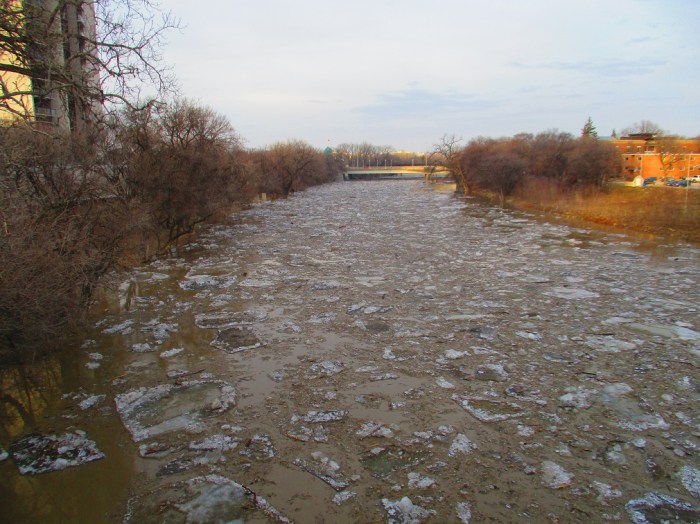
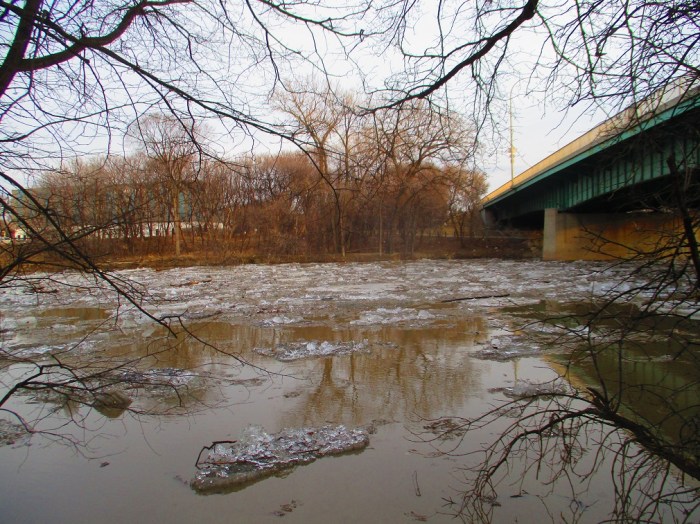
The big melt is underway in Manitoba. The Assiniboine River has substantially risen in the last few days. The current is hauling the broken ice on the Assiniboine into the Red River in downtown Winnipeg.

hice
hice1
hice3
hice4

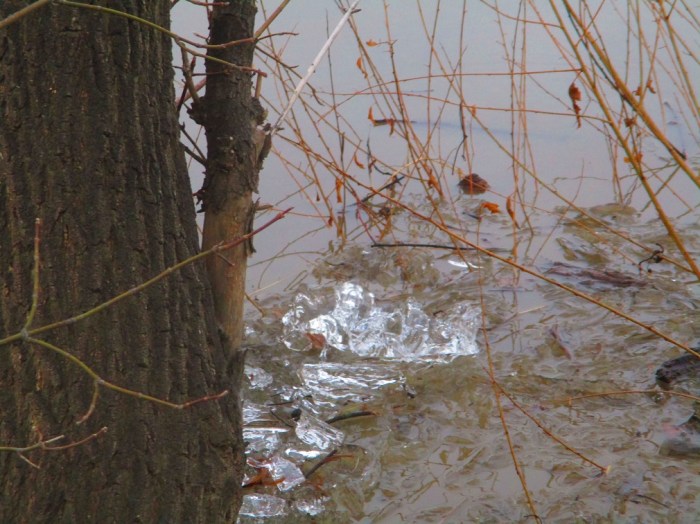
Crystal like ice that looks pretty cool

hice5