Finland’s First 5-Qubit Quantum Computer is Now Operational

PRESS RELEASE — VTT Technical Research Centre of Finland announced today that the country’s first operational 5-qubit quantum computer is up and running. Together with the quantum computing hardware startup IQM, VTT has taken its first steps to enable the building of quantum computers that will be both scalable and easier to manufacture, allowing more companies to begin their quantum computing journey.

The incredible computing performance of quantum computers makes it possible to solve problems that are beyond the capabilities of modern high-performance computers. In the future, quantum computers will be used, for instance, to accurately model viruses and drugs or used to design materials that are challenging to design with today’s technology.

“The development of quantum computing will affect all industries. Our experience in building the quantum computer, and our know-how in developing quantum algorithms will help us develop quantum foresight to, for example, identify future trends and support companies in understanding how and when their business will be affected,” says Pekka Pursula, Research Manager at VTT. “The best way to do this will be for companies to work together with VTT, and actually use our new hardware.”

The now-unveiled 5-qubit quantum computer is located at Micronova, part of OtaNano, the national research infrastructure for micro and nanotechnology, jointly run by VTT and Aalto University.

The big challenge in quantum computing is scalability. Quantum physicists and engineers around the world are trying to figure out how to scale quantum computing hardware to include hundreds and thousands of qubits, scale up the production in an economically efficient way, and scale algorithms and use of quantum computing in real-life applications.

VTT has 30 years of expertise in quantum technology research and excellent facilities to work on hardware scaling. The scaling of the use requires VTT to work hand-in-hand with the companies to develop algorithms for specific applications.

“Today’s announcement marks an important milestone for IQM and for the European quantum initiatives. With the completion of this phase, IQM will become one of the very few quantum companies that can deliver an on-premises quantum computer to a customer. I congratulate our partners, VTT and also the entire IQM team who has managed to deliver this ambitious milestone during the pandemic. This is just the first phase of the delivery and because of our ability to upgrade the systems, we are looking forward to working with VTT on delivering the 20-qubit and the 50-qubit systems,” says Jan Goetz, CEO and Co-founder of IQM.

The 5-qubit quantum computer is part of a larger initiative. VTT and IQM aim to build together a much more powerful 50-qubit quantum computer by 2024 and further develop Finland’s long-lasting technology and expertise in quantum computing.

The country already has an active research community called InstituteQ – of which VTT, Aalto University, and Helsinki University are the founding members – which is focused on developing world-class quantum expertise. BusinessQ network supports companies in incorporating quantum technology into their business, enabling growth for the Finnish society.
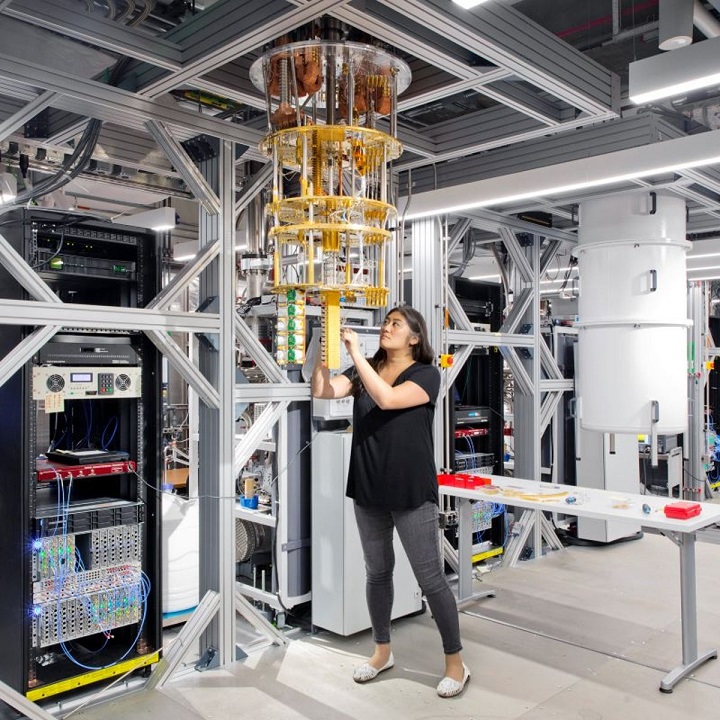
Quantum computing is a type of computation that harnesses the collective properties of quantum states, such as superposition, interference, and entanglement, to perform calculations. The devices that perform quantum computations are known as quantum computers.  Though current quantum computers are too small to outperform usual (classical) computers for practical applications, they are believed to be capable of solving certain computational problems, such as integer factorization (which underlies RSA encryption), substantially faster than classical computers. The study of quantum computing is a subfield of quantum information science.

Creepy robotic head is like Ash from the movie ‘Alien’

Could this be the future of robotics ? Image Credit: YouTube / Engineered Arts

This super-realistic robotic head is capable of exhibiting a wide range of human emotions.The latest creation of British robotics company Engineered Arts, this unnerving facsimile of a human male achieves what is often referred to as ‘uncanny valley’ given that it looks eerily close to being a real human but it is possible to tell that something isn’t quite right about it.

Named Adrian and described as a ‘mesmer robot head’, this fascinating contraption is shown ‘waking up’ in a new video before pulling a range of facial expressions.

Its realism is helped along by incredibly lifelike skin which even features stubble and eyebrows.

According to the video’s caption, the robot has 22 custom servo actuators of which only 5 are in the mouth, hence why this particular test model is not capable of effective lip syncing.

“Each Mesmer robot is designed and built from 3D in-house scans of real people, allowing us to imitate human bone structure, skin texture and expressions convincingly,” the company wrote.

While it’s currently unclear how this technology is likely to be used in the real world, Adrian offers a tantalizing glimpse at a future in which we might live and work alongside highly realistic robots.

Let us hope, however, that such a future doesn’t turn into an episode of Black Mirror.

Without a doubt humans are on the path to cyborgism. Robots and humans will merge. I’m referring to hundreds of years in the future.

Scene from the movie “Alien.”

NASA wind tunnels 1927-1991

tunnel
tunnel1

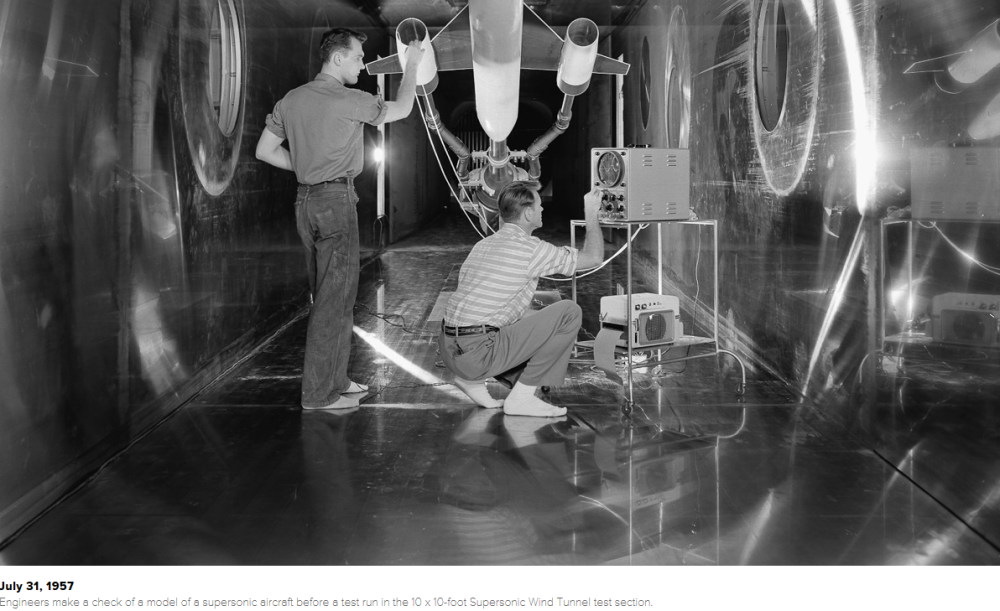
Before any NASA craft is cleared for liftoff, it must undergo exhaustive testing in one of the administration’s 42 major wind tunnels, which range from just a few inches wide to cavernous enough to contain a full-sized airplane.

With an aircraft model held on a stationary post, air is accelerated through the tunnel by fans, allowing engineers to study the effects of different designs on flight characteristics such as lift, drag and stability.

NASA’s earliest wind tunnel predates NASA itself, and was built in 1920 at the Langley Research Center, then under the auspices of the National Advisory Committee for Aeronautics (NACA).

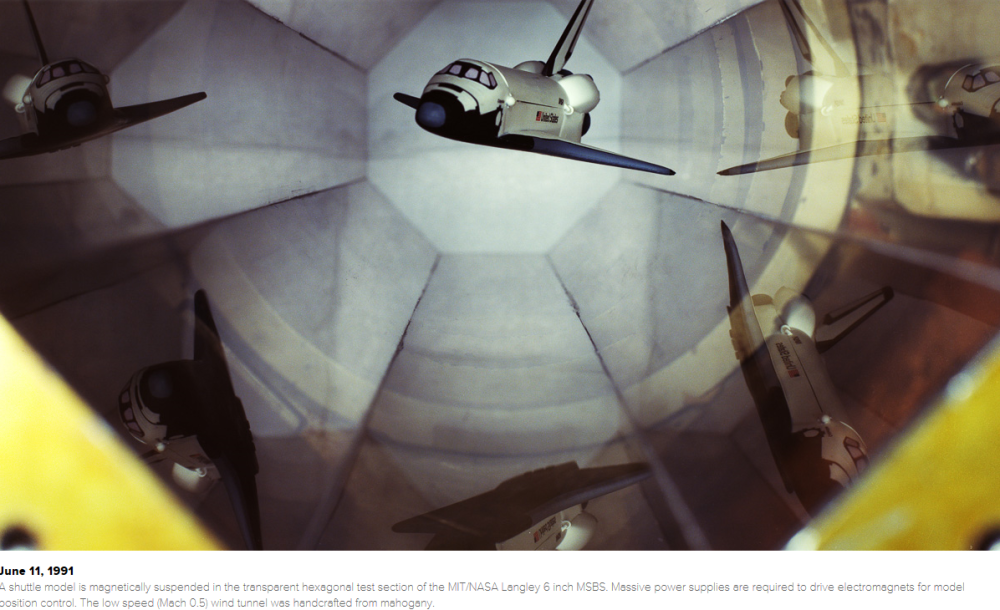
As flight technology became more advanced and complex, so did the testing facilities. Specialized tunnels were developed to simulate subsonic, transsonic, supersonic and even hypersonic speeds — five times the speed of sound. Some tunnels can approximate the fiery heat of atmospheric re-entry, while others can test the effects of ice buildup at high altitudes. Some newer facilities can magnetically suspend aircraft models in midair, eliminating aerodynamic interference from support structures.

Today, NASA-operated wind tunnels are routinely used to test and tweak military and civilian aircraft.

tunnel2
tunnel3
tunnel4
tunnel5
tunnel6
tunnel7

Sept 11, 1959 A Mercury capsule model in the Spin Tunnel.

c. 1960

A 10-story bank of vanes which turn the air around one of the four corners of the 40 x 80-foot Wind Tunnel at Ames Research Center.

c. 1962

Technicians install a model of an Apollo command module in the 9 x 6-foot Thermal Structures Tunnel for tests of possible heat shield materials.

tunnel9

April 14, 1975

A space shuttle model undergoes a wind tunnel test simulating the ionized gasses that surround a shuttle as it reenters the atmosphere.

April 1, 1980

A Marshall Space Flight Center engineer holds a replica of the proposed Liquid Booster Module while observing the testing of a small Space Shuttle orbiter model at Wind Tunnel 14.

Nov. 17, 1986

NASA technician W.L. Jones inspects a transport model Pathfinder I between test runs at Langley’s National Transonic Facility.

April 10, 1990

The Pioneer Aerospace Parafoil undergoes testing in the world’s largest wind tunnel, the 80 x 120-Foot Tunnel at NASA’s Ames Research Center in Mountain View, California.

tunnel10

They want to believe. Man thinks he saw Giant UFO while in airliner over Nevada desert.

Some imaginative fellow was on an airplane flying over Nevada when he was sure he saw a giant UFO below the airplane.  It was massive and giving off extremely bright lights. The guy must have thought Earth was under alien attack.

He took some photos below:

aaaufo
aaaufo1

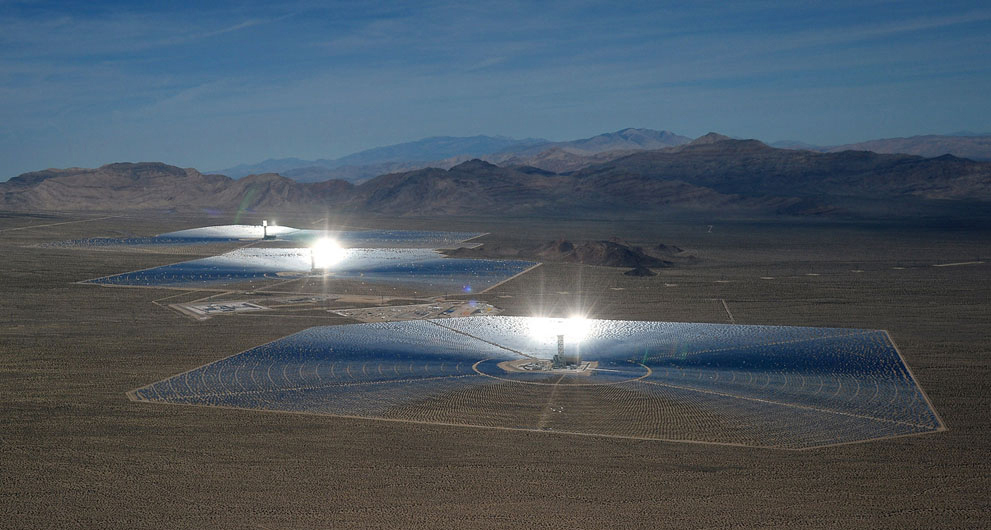
The “I want to believe” UFO community was abuzz when they saw the photos.  Maybe some real evidence that the little green bastards do exist!  But then a skeptic pointed out that the sighting was almost 99.999 percent a solar energy facility in the desert.

The Ivanpah Solar Electric Generating System is a concentrated solar thermal plant in the California Mojave Desert, 64 km (40 miles) southwest of Las Vegas, with a gross capacity of 392 megawatts (MW). It deploys 173,500 heliostats, each with two mirrors, focusing solar energy on boilers located on three centralized solar power towers. Unit 1 of the project was connected to the grid in September 2013 in an initial sync testing. The facility formally opened on February 13, 2014, and it is currently the world’s largest solar thermal power station.

There are ten huge Solar Generating facilities in the Mojave Desert.  The airplane passenger should have done some research before he came to a UFO conclusion.

Ivanpah

ivanpah-glare-photo1
Ivanpah_SEGS_(2)

173,500 of these heliostats (mirror reflectors).

Ivanpah_SEGS_(1)
ivan1
ivan2
ivan3

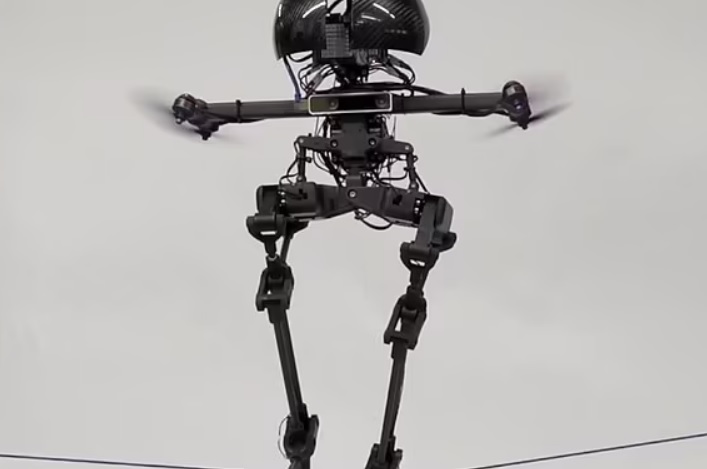
Leo the Walking and Flying Drone Robot


Meet LEO: Tiny 2.5ft-tall drone-robot hybrid can use its two legs to navigate a slackline and skateboard, or switch on its thrusters to fly through the air

  • LEONARDO (Legs Onboard Drone) is a 2.5ft-tall robot that has bipedal legs and thrusters
  • It is able to walk on two legs with enough dexterity to slackline and skateboard, but can also fly through the air
  • The team says the robot could one day be used to perform tasks currently very difficult for drones, robots or humans – including operating in hazardous and hard to reach environments

The idea of a robot that can navigate a slackline, skateboard and fly might sound like a concept of science fiction.

But such a bot is very much real, in the form of LEONARDO, or Legs Onboard Drone – a bipedal robot that has drone like thrusters for stability.

Known as LEO for short, it was built from parts of robots and drones found around the lab by engineers from the California Institute of Technology in Pasadena.

As well as improving stability when walking a tightrope, the propeller-based thrusters also allow the 2.5 foot tall bot to take to the air and fly. 

The team says that LEO could someday apply its conquest of land and air to robotic missions currently difficult for ground- or aerial-based robots and drones.

As well as slacklining and skateboarding, the team says the robot could one day be used to perform tasks currently very difficult for drones, robots or humans – including operating in hazardous and hard to reach environments. 

The team hasn’t said when LEO would be available for commercial use, or how much it would cost, as it is still at the research and development stage, but hope to work with a manufacturing partner in the future.

Drones Rain from the Sky onto Chinese City Following Light Show Fail

A wild video out of China shows the moment when an elaborate light show went awry and dozens of drones began raining down onto stunned spectators watching from below. The eerie scene reportedly unfolded last Friday evening as part of an event celebrating the anniversary of a prominent shopping mall in the city of Zhengzhou. Part of the festivities included a light show wherein around 200 illuminated drones would form the name of the mall, Wanda Plaza, over a crowd of onlookers. However, shortly after the UAVs took flight, the performance took a rather dystopian turn as several of the devices suddenly began to falter and subsequently drop from the sky.

One witness managed to capture the chaos on film and, in the video, dozens of the ‘dead’ drones can be seen falling to the Earth like wayward stars as the people in the crowd shout to each other watch out for the errant UAVs. Some onlookers took cover from the deluge of devices that were crashing onto the pavement, cars, and trees, while other enterprising individuals attempted to snag the downed drones, perhaps thinking that they would be of some value or maybe as merely a memento from the very weird incident. As for what could have caused the mishap, the leading theory is that it was simply a dropped internet connection, though there are also rumblings that it could have been the result of a rival drone company sabotaging the event.

Robotic Police Dogs: Useful Hounds or Dehumanizing Machines?

Hawaii Public Radio

APA robotic dog called Spot trots during a Honolulu Police Department demonstration to reporters Friday, May 14, 2021. (AP Photo/Jennifer Sinco Kelleher)

HONOLULU — If you’re homeless and looking for temporary shelter in Honolulu, expect a visit from a robotic police dog that will scan your eye to make sure you don’t have a fever.

That’s just one of the ways public safety agencies are starting to use Spot, the best-known of a new commercial category of robots that trot around with animal-like agility.

The handful of police officials experimenting with the four-legged machines say they’re just another tool, like existing drones and simple wheeled robots, to keep emergency responders out of harm’s way as they scout for dangers. But privacy watchdogs — the human kind — warn that police are secretly rushing to buy the robots without setting safeguards against aggressive, invasive or dehumanizing uses.

In Honolulu, the police department spent about $150,000 in federal pandemic relief money to buy their Spot from robotics firm Boston Dynamics for use at a government-run tent city near the airport.

“Because these people are houseless it’s considered OK to do that,” said Jongwook Kim, legal director at the American Civil Liberties Union of Hawaiʻi. “At some point it will come out again for some different use after the pandemic is over.”

Acting Lt. Joseph O’Neal of the Honolulu Police Department’s community outreach unit defended the robot’s use in a media demonstration earlier this year. He said it has protected officers, shelter staff and residents by scanning body temperatures between meal times at a shelter where homeless people could quarantine and get tested for COVID-19. The robot is also used to remotely interview individuals who have tested positive.

“We have not had a single person out there that said, ‘That’s scary, that’s worrisome,’” O’Neal said. “We don’t just walk around and arbitrarily scan people.”

Police use of such robots is still rare and largely untested — and hasn’t always gone over well with the public. Honolulu officials faced a backlash when a local news organization, Honolulu Civil Beat, revealed that the Spot purchase was made with federal relief money.

“One of the big challenges is accurately describing the state of the technology to people who have never had personal experience with it,” Michael Perry, vice president of business development at Boston Dynamics, said in an interview. “Most people are applying notions from science fiction to what the robot’s doing.”

For one of its customers, the Dutch national police, explaining the technology includes emphasizing that Spot is a very good robot — well-behaved and not so smart after all.

“It doesn’t think for itself,” Marjolein Smit, director of the special operations unit of the Dutch national police, said of the remote-controlled robot. “If you tell it to go to the left, it will go to the left. If you tell it to stop, it will stop.”

Earlier this year, her police division sent its Spot into the site of a deadly drug lab explosion near the Belgian border to check for dangerous chemicals and other hazards.

Perry said the company’s acceptable use guidelines prohibit Spot’s weaponization or anything that would violate privacy or civil rights laws, which he said puts the Honolulu police in the clear. It’s all part of a year-long effort by Boston Dynamics, which for decades relied on military research grants, to make its robots seem friendlier and thus more palatable to local governments and consumer-oriented businesses.

By contrast, a lesser-known rival, Philadelphia-based Ghost Robotics, has no qualms about weaponization and supplies its dog-like robots to several branches of the U.S. military and its allies.

“It’s just plug and play, anything you want,” said Ghost Robotics CEO Jiren Parikh, who was critical of Boston Dynamics’ stated ethical principles as “selective morality” because of the company’s past involvement with the military.

Parikh added that his company doesn’t market its four-legged robots to police departments, though he said it would make sense for police to use them. “It’s basically a camera on a mobile device,” he said.

There are roughly 500 Spot robots now in the wild. Perry said they’re commonly used by utility companies to inspect high-voltage zones and other hazardous areas. Spot is also used to monitor construction sites, mines and factories, equipped with whatever sensor is needed for the job.

It’s still mostly controlled by humans, though all they have to do is tell it which direction to go and it can intuitively climb stairs or cross over rough terrain. It can also operate autonomously, but only if it’s already memorized an assigned route and there aren’t too many surprise obstacles.

“The first value that most people see in the robot is taking a person out of a hazardous situation,” Perry said.

Kim, of the ACLU in Hawaiʻi, acknowledged that there might be many legitimate uses for such machines, but said opening the door for police robots that interact with people is probably not a good idea. He pointed to how Dallas police in 2016 stuck explosives on a wheeled robot to kill a sniper, fueling an ongoing debate about “killer robots” in policing and warfighting.

“There’s the potential for these robots to increase the militarization of police departments and use it in ways that are unacceptable,” Kim said. “Maybe it’s not something we even want to let law enforcement have.”

.

Super Spyware That Can Take Total Control of Smartphones

NSO Group Technologies (NSO standing for Niv, Shalev and Omri, the names of the company’s founders) is an Israeli technology firm whose spyware called Pegasus enables the remote surveillance of smartphones. It was founded in 2010 by Niv Carmi, Omri Lavie, and Shalev Hulio. It employed almost 500 people as of 2017, and is based in Herzliya, near Tel Aviv, Israel.

Pegasus is spyware developed by the Israeli cyberarms firm NSO Group that can be covertly installed on mobile phones (and other devices) running most versions of iOS and Android. The 2021 Project Pegasus revelations suggest that current Pegasus software is able to exploit all recent iOS versions up to iOS 14.6. According to the Washington Post and other prominent media sources, Pegasus not only enables the keystroke monitoring of all communications from a phone (texts, emails, web searches) but it also enables phone call and location tracking, while also permitting NSO Group to hijack both the mobile phone’s microphone and camera, thus turning it into a constant surveillance device.

Pegasus was discovered in August 2018 after a failed attempt at installing it on an iPhone belonging to a human rights activist led to an investigation revealing details about the spyware, its abilities, and the security vulnerabilities it exploited. As of 2016, Pegasus was capable of reading text messages, tracking calls, collecting passwords, tracking location, accessing the target device’s microphone and camera, and harvesting information from apps. News of the spyware caused significant media coverage. It was called the “most sophisticated” smartphone attack ever, and was the first time that a malicious remote exploit using jailbreak to gain unrestricted access to an iPhone had been detected.

On August 23, 2020, according to intelligence obtained by the Israeli newspaper Haaretz, the NSO Group was reported to have sold Pegasus spyware software for hundreds of millions of US dollars to the United Arab Emirates and the other Gulf States, for surveillance of anti-regime activists, journalists and political leaders from rival nations, with Israeli government encouragement and mediation. Later, in December 2020, Al Jazeera investigation show The Tip of the Iceberg, Spy partners, showed exclusive footage about Pegasus and its penetration into the phones of media professionals and activists, used by Israel to eavesdrop on its opponents and even its allies.

The spyware can be installed on devices running certain versions of iOS, Apple’s mobile operating system, as well as some Android devices. Rather than being a specific exploit, Pegasus is a suite of exploits that uses many vulnerabilities in the system. Infection vectors include clicking links, the Photos app, the Apple Music app, and iMessage. Some of the exploits Pegasus uses are zero-click—that is, they can run without any interaction from the victim. Once installed, Pegasus has been reported to be able to run arbitrary code, extract contacts, call logs, messages, photos, web browsing history, settings, as well as gather information from apps including but not limited to communications apps iMessage, Gmail, Viber, Facebook, WhatsApp, Telegram, and Skype.

Misuse
Although Pegasus is stated as intended to be used against criminals and terrorists, use by authoritarian governments to spy on critics and opponents has often been reported.

Use by India
In late 2019, Facebook initiated a suit against NSO, claiming that Pegasus had been used to intercept the WhatsApp communications of a number of activists, journalists, and bureaucrats in India, leading to accusations that the Indian government was involved.

Phone numbers of Indian ministers, opposition leaders, ex-election commissioners and journalists were allegedly found on a database of NSO hacking targets by Project Pegasus in 2021.

Independent digital forensic analysis conducted on 10 Indian phones whose numbers were present in the data showed signs of either an attempted or successful Pegasus hack. The results of the forensic analysis threw up shows sequential correlations between the time and date a phone number is entered in the list and the beginning of surveillance. The gap usually ranges between a few minutes and a couple of hours.
11 phone numbers associated with a female employee of The Supreme Court of India and her immediate family, who accused the former Chief Justice of India, Ranjan Gogoi, of sexual harrasment, are also allegedly found on a database indicating possibility of their phones being snooped.

Records also indicate that phone numbers of some of the key political players in Karnataka appear to have been selected around the time when an intense power struggle was taking place between the Bharatiya Janata Party and the Janata Dal (Secular)-Congress-led state government in 2019.

It was reported that the Indian government used Pegasus to spy on Pakistan Prime Minister Imran Khan and diplomats from Iran, Afghanistan, China, Nepal and Saudi Arabia.

Use by Mexican drug cartels
Reversing the intended use against criminals, Pegasus has been used to target and intimidate Mexican journalists by drug cartels and cartel-entwined government actors.

Use by Saudi Arabia
Pegasus software, whose sales are licensed by the government of Israel to foreign governments, helped Saudi Arabia spy on Jamal Kashoggi, who was later killed in Turkey.

Pegasus was also used to spy on Jeff Bezos after Mohammed bin Salman, the crown-prince of Saudi Arabia, exchanged messages with him that exploited then-unknown vulnerabilities in WhatsApp.