The Lakes of Afghanistan

Markozen.com's avatarThe MarkoZen Blog

The name Afghanistan invokes images of a dry and arid country with mountainous terrain, endless desert, thorn bushes and mud houses. But at the center of this depressing landscape is a series of spectacular lakes with water so blue that it looks almost like ink.

Band-e Amir is a series of six incredibly deep blue lakes in the heart of the central Afghanistan. The lakes are situated in the foothills of the Hindu Kush, the second highest mountain range in the world, 80 kilometers from the ancient town of Bamiyan, where the Taliban destroyed the world’s tallest Buddha statues in 2001. Surrounded by pink towering limestone cliffs almost in complete lack of vegetation, the stunning lakes seems totally out of place.

The beautiful lakes were created by the carbon dioxide rich water that is drawn from the spring melt-water in the surrounding mountains and came out from faults and cracks…

View original post 221 more words

Atacama Large Millimeter Array

The Atacama Large Millimeter/submillimeter Array (ALMA) is an astronomical interferometer of 66 radio telescopes in the Atacama Desert of northern Chile, which observe electromagnetic radiation at millimeter and submillimeter wavelengths. The array has been constructed on the 5,000 m (16,000 ft) elevation Chajnantor plateau – near the Llano de Chajnantor Observatory and the Atacama Pathfinder Experiment. This location was chosen for its high elevation and low humidity, factors which are crucial to reduce noise and decrease signal attenuation due to Earth’s atmosphere. ALMA is expected to provide insight on star birth during the early Stelliferous era and detailed imaging of local star and planet formation.

ALMA is an international partnership among Europe, the United States, Canada, Japan, South Korea, Taiwan, and Chile. Costing about US$1.4 billion, it is the most expensive ground-based telescope in operation. ALMA began scientific observations in the second half of 2011 and the first images were released to the press on 3 October 2011. The array has been fully operational since March 2013.

alma


alma2


The initial ALMA array is composed of 66 high-precision antennas, and operates at wavelengths of 3.6 to 0.32 millimeters (31 to 1000 GHz). The array has much higher sensitivity and higher resolution than earlier submillimeter telescopes such as the single-dish James Clerk Maxwell Telescope or existing interferometer networks such as the Submillimeter Array or the Institut de Radio Astronomie Millimétrique (IRAM) Plateau de Bure facility.

The antennas can be moved across the desert plateau over distances from 150 m to 16 km, which will give ALMA a powerful variable “zoom”, similar in its concept to that employed at the centimetre-wavelength Very Large Array (VLA) site in New Mexico, United States.

The high sensitivity is mainly achieved through the large numbers of antenna dishes that will make up the array.

The telescopes were provided by the European, North American and East Asian partners of ALMA. The American and European partners each provided twenty-five 12-meter diameter antennas, that compose the main array. The participating East Asian countries are contributing 16 antennas (four 12-meter diameter and twelve 7-meter diameter antennas) in the form of the Atacama Compact Array (ACA), which is part of the enhanced ALMA.


alma3


The complex was built primarily by European, U.S., Japanese, and Canadian companies and universities. Three prototype antennas have undergone evaluation at the Very Large Array since 2002.

General Dynamics C4 Systems and its SATCOM Technologies division was contracted by Associated Universities, Inc. to provide twenty-five of the 12 m antennas, while European manufacturer Thales Alenia Space provided the other twenty-five principal antennas (in the largest-ever European industrial contract in ground-based astronomy). Japan constructed 16 Antennas. The first antenna was delivered in 2008, the last in 2011.
 

alma5


The Atacama Large Millimeter/submillimeter Array (ALMA), an international astronomy facility, is a partnership of Europe, North America and East Asia in cooperation with the Republic of Chile. ALMA is funded in Europe by the European Southern Observatory (ESO), in North America by the U.S. National Science Foundation (NSF) in cooperation with the National Research Council of Canada (NRC) and the National Science Council of Taiwan (NSC) and in East Asia by the National Institutes of Natural Sciences of Japan (NINS) in cooperation with the Academia Sinica (AS) in Taiwan. ALMA construction and operations are led on behalf of Europe by ESO, on behalf of North America by the National Radio Astronomy Observatory (NRAO), which is managed by Associated Universities, Inc (AUI) and on behalf of East Asia by the National Astronomical Observatory of Japan (NAOJ). The Joint ALMA Observatory (JAO) provides the unified leadership and management of the construction, commissioning and operation of ALMA. Its current director since February 2018 is Sean Dougherty.


alma4


What is ALMA?

Half of all light in the universe is in millimeter-wavelength light between the far infrared and radio waves. ALMA can detect this light, which is emitted by cool objects and distant objects. It’s possible thanks to the telescope’s location at 16,400 feet in the driest desert on Earth, and because of the incredible precision of its 66 antennas.

All  telescopes are limited in their angular resolution by the ratio of their aperture to the wavelength they observe, explained Michael Thornburn, head of the ALMA department of engineering. ALMA is an aperture synthesis telescope.

“We cannot make a single aperture 15 kilometers across, so we do it in pieces,” he said. “The signals from individual dishes are combined to build up the image from a single large aperture.”

Radio signals from distant cosmic sources arrive at each dish at ever-so-slightly different times, and these are combined with the signals from every other antenna. This technique, interferometry, allows ALMA to operate like a single huge dish with an adaptable radius.

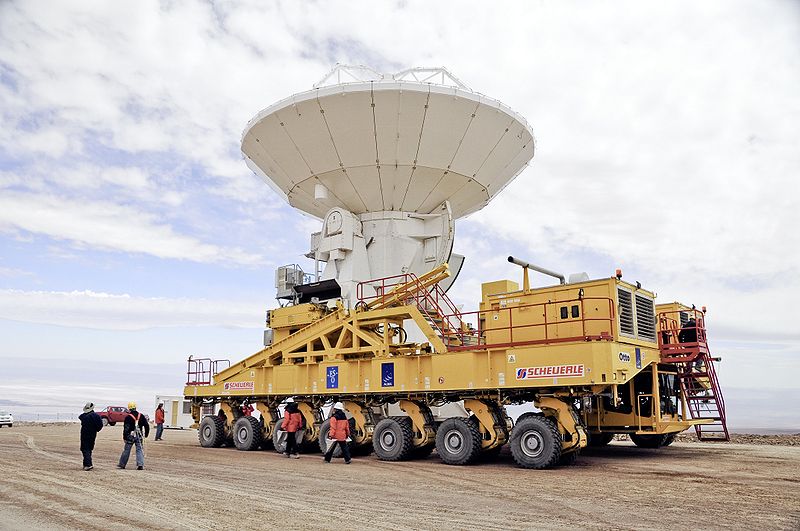
In a carefully choreographed ballet, each dish moves in unison with the others to change the telescope’s observing area. Along with moving in place, giant transporter trucks, specially designed for the dishes, can pick them up and cart them across the Chajnantor Plateau to one of 192 concrete pads. At their greatest distance apart–16 kilometers–ALMA’s angular resolution will be equivalent to the Hubble Space Telescope, Peck said.

ALMA is observing sources that are 10 times weaker than those observed with other arrays, explained Pierre Cox, ALMA’s incoming director. This is key to ALMA’s capability for observing phenomena like star formation, he said.

“Future observations should allow us to detect dark matter substructure and shed light on its nature,” he added.

There’s much more to learn about how ALMA works, and why astronomers are so excited about it–stay tuned for more dispatches from the Atacama.


Happy National Sasquatch Awareness Day

In the pantheon of odd and obscure holidays, October 20th stands out as a date which may be of particular interest to paranormal enthusiasts as it happens to be National Sasquatch Awareness Day. The concept was first proposed back in 2009 by way of a Change.org petition, presumably meant to mark the anniversary of the filming of the iconic Patterson-Gimlin Bigfoot film on October 20th, 1967. Although the idea initially received middling support online, it has since slowly grown over time, not unlike the legend of Bigfoot itself.

This year, the burgeoning holiday caught the attention of Oregon television station KPTV, who dispatched reporter Joe Vithayathil to The North American Bigfoot Center which is located in the ironically named city of Boring and helmed by ‘Finding Bigfoot’ star Cliff Barackman. Reflecting on the impact of the Patterson-Gimlin movie, he mused that the footage was “the best and the first footage obtained of a Sasquatch and its one of the only ones that holds up to that level even now.”

Meanwhile, indicative of how October 20th holds a special place in Sasquatch lore, Nebraska governor Pete Ricketts signed a proclamation recognizing the date as ‘Bigfoot Crossroads of Nebraska Day.’ Honored as part of the decree is Harriett McFeely, who operates a museum devoted to the cryptid in the city of Hastings that made headlines earlier this year when it acquired a flag believed to have been shredded and braided by Bigfoot.

Although National Sasquatch Awareness Day has yet to achieve the level of notoriety afforded to Extraterrestrial Culture Day or World UFO Day, which is inexplicably two separate dates, it’s likely only a matter of time until it becomes as much a part of the paranormal calendar as those aforementioned celebrations once word about it grows. To that end, it would seem that perhaps the only thing holding the holiday back is, ironically, a lack of awareness that it exists.

‘Iron Man’ Balloon Mistaken for Alien Invader by Indian Village

A humanoid-shaped object descending upon a village in India sparked fears of an alien invasion until authorities identified the ‘visitor’ as merely a life-size Iron Man balloon. The bizarre panic reportedly occurred on Saturday in the community of Dankour when residents spotted what appeared to be some kind of entity floating in the sky. Their mystification quickly turned to concern when the flying humanoid slowly began falling from the sky and ultimately landed around some bushes near a canal.

Given its aerial origin and the fact that the strange entity appeared to be moving after it had come down to the ground, many villagers suspected that it was some kind of ET and refused to go near it. Fortunately, a call to the authorities squashed their concerns about an alien invasion as it was soon determined that the ‘space brother’ was, in fact, a helium balloon depicting Iron Man which had falling from the sky because it started to deflate.

As for why it seemed to be moving once it touched down, a police spokesperson explained that “a part of the balloon was touching the flowing water in the canal which had led it to shake.” Authorities blamed the balloon’s humanoid shape and the robotic-looking design for why the villagers had believed it was an alien. After checking to ensure the object was harmless, cops confiscated the balloon and are now trying to figure out who set it loose in the first place.

Chain of Discount Stores in England Under Fire for Selling Ouija Boards

A chain of discount stores in England is under fire for selling incredibly inexpensive Ouija Boards as part of their seasonal Halloween offerings. Poundland is the British equivalent of the popular ‘dollar store’ found here in North America and, as one has likely surmised, sells a variety of goods for merely one pound. While discount-hunting shoppers undoubtedly appreciate the savings, customers were reportedly taken aback when they recently noticed that the chain’s Halloween products for the year included a Ouija Board.

Images of the infamous alleged supernatural communication device quickly popped up on social media with many people expressing concern that the Ouija Boards would be easily accessible for children since they’re priced at, of course, only one pound. “Someone should go in and buy the lot…save them getting near any kids,” wrote one worried customer online. The sentiment was echoed by another irritated individual who declared “most adults don’t even know how to use them correctly, never mind kids.”

Others observed that the tumultuous nature of this year makes the prospect of a Ouija Board falling into the wrong hands particularly problematic. “The last thing we needed in 2020 was Poundland to start selling Ouija Boards,” declared another person on social media. While people online called for the chain to pull the ‘talking boards’ from store shelves, at least one individual argued that the furor was overblown. “I love the way people are thinking little six-year-old Britney is going to cause a zombie apocalypse with their Poundland board with some letters on it,” they laughed, “has everyone gone mental?”

Halloween Decoration Scares Delivery Man in Arizona

While the spooky season has only just begun, a delivery driver in Arizona has likely already had enough Halloween hijinks for the year following a frightening encounter with a spooky prop stationed outside of someone’s home. The amusing moment, which was reportedly captured by a doorbell camera earlier this week, occurred at a residence in the city Glendale when the unnamed man walked up to the porch to drop off a package. As he was stepping forward to leave a large envelope at the front door, the driver pauses for a moment to admire the Halloween decorations and then things took an unsettling turn.

Suddenly, a life-size doll of an old woman sitting in a chair bellows “I told you to stay away,” startling the man and causing him to take a step back. Eyeing the mannequin with apprehension, his concern is well founded as it then springs up out of the chair towards him, causing the terrified driver to unleash a terrified scream as the animatronic prop laughs in a sinister fashion. After getting his bearings, the man simply leaves the package by the door and understandably muses aloud, “I’m getting too old for this.”