



November 22
Horse credited with saving owner’s life takes a helicopter ride after being cut off by rising water.

Winter the horse was saved using an Anderson Sling owned by a Fraser Valley veterinarian. The animal was airlifted by helicopter last Friday out of a flooded area near Spences Bridge in B.C.’s southern Interior. (Kelly Kennedy)
A small menagerie of marooned animals — including a horse and a pregnant cow — were rescued in recent days from flooded farms on the Nicola River west of Kamloops, B.C., using a helicopter, a specialized livestock harness and a whole lot of ingenuity.
Kim Cardinal says it was a desperate situation when her two horses and mule became trapped on a stretch of pavement near the community of Spences Bridge following torrential rains that ultimately swept her home into the raging Nicola River last Monday.
Cardinal says she can still hear the sounds of smashing boulders and glass as her house was destroyed by the power of the waters.
She and her partner Lorne Cardinal were airlifted to safety after a B.C. Hydro crew spotted smoke from a campfire they had lit after their house was destroyed. But their animals remained trapped by flooded roads.

“The horse — Winter — saved my life. I just couldn’t bear the thought of him there, dying after that,” said Cardinal.
She said the horse began acting spooked and almost “dancing” as the waters rose. It alerted her and Lorne to the danger and they got out just in time, she said.
But the rushing water made it impossible to get Winter, along with a mini-horse named Spicey and mule named Moxy, to safety.

Kelly Kennedy says she got a call last Thursday from RCMP livestock officer Cpl. Cory Lepine about the dire situation.
“I was thinking about it and I was like, why can’t we just airlift them out?” said Kennedy, a director with the Horse Council of B.C. who also runs Sageview Rescue Centre in Kamloops.
Over the next three days she orchestrated the rescue.
She hired Summit Helicopters with funds from the B.C. Horse Council and had a special sling shipped from the Fraser Valley to Kamloops.
Aldergrove veterinarian Dr. David Paton owns the device, known as an Anderson Sling, that protects large animals when they are lifted off the ground — which is both difficult and dangerous.
The contraption allows this to be done — usually for urgent transport — with little risk to the animal. Paton recommended using the sling in this rescue, which he called a “perfect” example of its usefulness, given there was no other way to get the animals out of their spot.
Paton said despite the fact that horses do not generally fly, they handle being moved in a sling quite well.
“Horses are amazingly calm and quiet, they may need a mild sedation — kind of a little bit of an exciting ride for sure. Once they are airborne they’re not struggling or thrashing,” he said.
Paton says there is only one Anderson Sling in the province and this type of rescue was a first in B.C.
At the beginning of the operation, Kennedy met the pilot Aaron Toombs near Spences Bridge and they flew over the muddy, angry river to the rescue site. The harness took so long to fasten on Winter that the tranquilizer used to keep the horse calm wore off.

“That horse was wide awake. He stayed quiet through the air but when it came to landing it took the helicopter half an hour before we could drop him and try and get a long line on him to control him,” said Kennedy.
By then, Kennedy said “the whole town” of Spences Bridge had come to watch as the pilot tried to delicately land the big horse without breaking the large animal’s legs.
“It wasn’t pretty but we got it done.” Kennedy said.
Some of the other animals needing rescuing were too small for the sling, so Kennedy devised a backup plan. A massive grain tote made out of netting that can handle loads of up to 680 kilograms of feed was used to cradle the smaller animals in and fly them to safety.
Then they heard the neighbours nearby were also in need — with a pregnant Jersey cow named Tina and three goats, cut off by the floods.
But by Friday night they’d run out of daylight and money for the $3,000-per-hour helicopter so they had to refuse. However, the pilot knew a government official looking at the highways who had a helicopter booked but only half a day of work on Monday, so they used that aircraft for the goats and the pregnant cow.

They laid the cargo net on the ground, “and the cow walked into the middle of it and we just scooped her up,” said Kennedy.
It took three days and used up the animal rescue contingency fund of the Horse Council of B.C., but in the end they rescued two horses, a mule, a pregnant cow, nine puppies, two large dogs, three goats and several cats.
Cardinal says she can’t stop sobbing thinking about the ordeal, and is so thankful that she survived and that her animals got out thanks to fast-thinking volunteers — especially Kennedy.
“She is my hero,” Cardinal said.


Kakutsa, the curious cat, caused quite the stir when he jumped onto a news desk interrupting a political interview in progress, drawing hilarious memes and viral videos.
An anchor and a studio guest were discussing the regional political issues and economic situation.
Out of the blue, a cat jumped on the table and sat right in the middle.
The guest was surprised and burst into laughter.
Georgia’s TV Kavkasia said they don’t know where it came from, and it was not part of the show.
The feline felt comfortable and started to the pet itself.
A Twitter user wrote, “Who knows why the creature jumped onto the desk — maybe to check their mics or make-up?”
However, after the encounter, the cat was taken away by a studio member, and the show went on.

An Australian photographer has captured a rare moment of animal communion with a shot of a fur seal surfing a humpback whale off the New South Wales coast.
Robyn Malcolm had been photographing a pod of whales on a feeding frenzy 500km (310 miles) south of Sydney. But she only realised she had taken the unusual picture when she went through the photos later, she told the Sydney Morning Herald.
Animal experts say that witnessing such a partnership is rare.
New South Wales National Parks and Wildlife whale expert Geoff Ross told the paper the coupling was very rare but he had heard of it happening once before.“The only other time was a seal trying to get away from a killer whale… the seal hopped on the back of the pectoral fins of a humpback whale,” he said.
Ms Malcolm insisted that the photo was not doctored.
“I’m positive, because I don’t know how to use Photoshop. And I do still have it on the camera so I can prove it,” she told the newspaper.

The meeting of seal and whale is the latest in a series of serendipitous animal piggyback rides which have been captured this year.
In March, amateur photographer Martin Le-May shot this picture of a weasel clinging on to the back of a woodpecker at Hornchurch Country Park in east London.

Bosom buddies? Sadly the picture actually shows a baby weasel attacking the woodpecker
In June, a family walking in a forest in central Florida spotted this raccoon hitching a ride on the back of an alligator.
Mr Richard Jones told local television station WFTF that he “snapped a lucky picture right when the gator slipped into the water and before the raccoon jumped off and scurried away”.

Here we have a mother polar bear giving the cub a helping hand/swim.

The Ili pika (Ochotona iliensis) is a species of mammal in the family Ochotonidae, endemic to northwest China. After its discovery in 1983, it was not documented again until 2014. Its population is declining due to largely unknown causes, and it is currently considered to be endangered.
The Ili pika somewhat resembles a short-eared rabbit. It is large for a pika, with a length of 20.3–20.4 cm and a weight of up to 250 g. It has brightly colored hair and displays large rusty-red spots on forehead, crown, and the sides of the neck.
It is endemic to the Tian Shan mountains of northwest Chinese province Xinjiang. A recent census indicated that the Ili pika may have been extirpated from the Jilimalale and Hutubi South Mountains.

Almost nothing is known about the ecology or behavior of the species. The Ili pika has low population densities. It is mostly a diurnal species, but may exhibit nocturnal activity. Only one to two litters are produced each year, but litter size for this species is unknown.


In an incredible video from Ireland, a sleeping tiger at the Dublin Zoo had a ferocious reaction to being woken up by its fellow feline.The footage from a family’s visit to the zoo begins innocently enough, with a young girl mimicking a tiger as it comes prowling towards the glass.But when the tiger rouses its companion from a serene slumber, the scene becomes rather unsettling and the toddler reels back in terror as the two big cats prepare to do battle.Fortunately, it appears the tigers were able to work out their issues without resorting to violence, despite some tense moments when it appeared the conflict could get ugly.While the incident may have been a surprise to the little girl, for anyone who has ever been woken up by an annoying roommate, it probably looked all too familiar.
Following a storm that swept over the region, a city in southern Egypt found itself under siege from a swarm of scorpions that scurried into the community and stung more than 500 people. The unsettling incident reportedly began on Friday evening when torrential rains pounded the area around the city of Aswan, resulting in widespread flooding. As residents struggled to deal with the fallout from the inclement weather, they were soon faced with a more troubling problem as the storm caused the region’s scorpion population to flee their underground burrows and take shelter inside people’s homes.
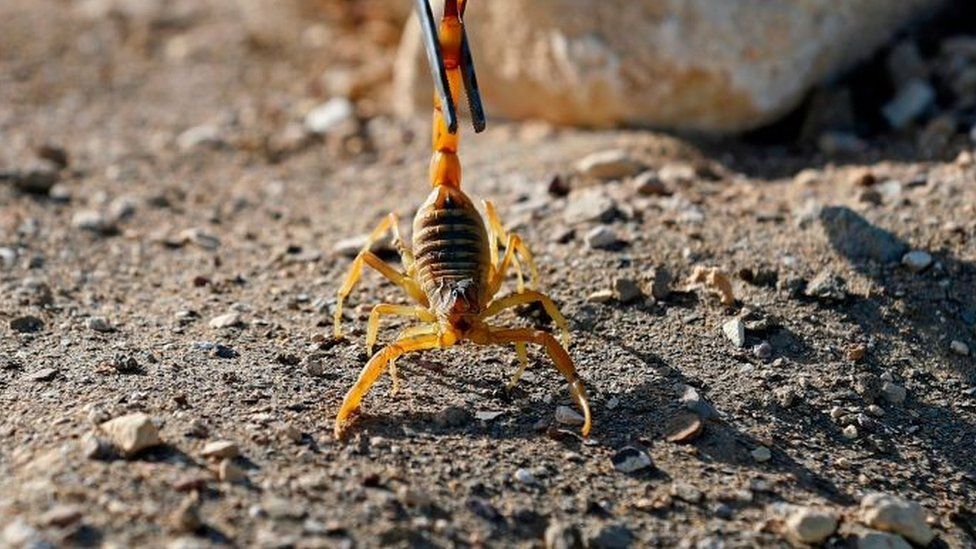 IMAGE SOURCE,AFP VIA GETTY IMAGES Image caption,Scorpions are regularly washed into Egypt’s streets by heavy rain and take refuge in houses (file photo)
On Friday night alone, a staggering 503 individuals were stung by the creepy creatures, causing the country’s Ministry of Health to issue a warning to residents about the situation. Dozens of different scorpion species reside in Egypt, including two particularly troubling types: the fat-tailed scorpion, which boasts venom that can kill a person within an hour, and the nightmarishly named ‘deathstalker,’ which possesses a less-lethal sting, but one that can also kill children and badly sicken adults.
Fortunately, the region is familiar with the dangers that come from the deadly creatures that have called the area home for hundreds of years and, as such, ample supplies of antivenom were rushed to hospitals in order to treat the massive wave of afflicted people. Meanwhile, some enterprising individuals have found a silver, albeit very dangerous, lining to the influx of scorpions as people have now begun wrangling the deadly animals, since their venom is highly valuable to scientists and medical professionals.
NY Times
Super cool pic of a young lion cub with Mom.



 The MarkoZen Blog
