Virgin Mary Visitation Witnessed by Over 100 Parishioners at Nigerian Church?

A priest in Nigeria claims that the Virgin Mary recently appeared at his church and over 100 parishioners were on hand to witness the miraculous event. The peculiar incident reportedly occurred at the St Charles Lwanga Catholic Church in the city of Calabar last month and was revealed to the world shorty thereafter by Fr. Evaristus Bassey, who heads the parish, on his Twitter account. In detailing the wondrous event, he asserted that more than 100 people witnessed the visitation, including “a Protestant pastor who came to visit his cousin, the assistant priest.” After first appearing at the church, Bassey recalled, “she moved up to the Shrine dedicated to her and then was taken up. It was amazing.”

Along with his recounting of the visitation, the priest also including several photos (which can be seen in the video above) of what he contends to be the Virgin Mary, though conceded that “the rays around her were too bright for a clear picture.” According to Bassey, there was no message imparted during the visit, which led him to theorize that “she came to assure” the congregation “of God’s presence with us.” A few days after sharing the amazing account, the priest provided an update to the story by way of insights from interviews that he conducted with some of the witnesses to the event, including the first individual who allegedly saw the Virgin Mary appear in the sky that day.

Saviour Asuquo told Bassey that his attention was initially drawn to a rainbow on the horizon that was so vivid that it “made him wonder what was up.” Before he had much time to ponder that question, he noticed “a beam of light that came from the sky” and fell onto a spot in the church parking lot. When Asuquo looked back at where the rainbow had been, he saw “the figure of the Blessed Virgin Mary emerging” from that area and coming closer towards him. According to Bassey, “he saw very clearly a woman wearing a blinking crown and a rosary with lights blinking as well, and that all around her was light.”

Looking over at a statue of the Virgin Mary, Asuquo marveled that “it did not in any way match the beauty of the woman,” who proceeded to smile at him. The apparition then merged with the beam of light on the ground and illuminated the entire area, which led to the entire congregation coming out of the church to see what had caused the curious event. Another witness that Bassey spoke to was a young woman who insisted that “I saw the apparition very clearly” and, despite being doubted by her friends and family, was adamant that “I know what I saw.” This was echoed by yet another observer, who told the priest “this wasn’t a matter of seeing only the brightness of the sun, I saw her very clearly with my own eyes.”

Alas, despite there being so many witnesses to the event, the handful of pictures from the visitation only show a glowing anomaly in the sky that seems to be in the shape of a figure. Responding to those who wondered why there were no videos from the incident, Bassey amusingly argued that “maybe they think it is like the visit of a celebrity, where you have time to take all the selfies you want.” On the contrary, he said, “a supernatural event such as this fills you with a certain awe that you don’t even think about reaching to your phone.” He concluded the account by noting that some parishioners hope that the Virgin Mary will return with a message, but the priest mused that he is content with “the fact that she came with a smile,” which he believes “is a positive indication.”


Oklahoma Man Blames ‘Bigfoot Summoning’ for Alleged Murder of Fishing Buddy

In a bizarre story out of Oklahoma, a man arrested for allegedly killing his friend during a fishing trip told police that the deadly incident came about in response to his companion summoning Bigfoot to attack him! According to a local media report, the very weird case occurred this past Saturday afternoon near the city of Ada as Larry Sanders and Jimmy Knighten were attempting to catch catfish in the South Canadian River by way of their bare hands using a technique known as ‘noodling.’ However, their day took a dark turn when the two fishing buddies got into a disagreement which ultimately left Knighten dead and Sanders pointing the finger at Sasquatch.

Responding to a report of a homicide that had unfolded at the river, police say that they arrived to find Sanders recounting his role in Knighten’s death to a family member. Upon being questioned by deputies at the scene, the noodler confessed to killing his friend by first striking him and then strangling him. As for why he did it, Sanders shockingly explained that “Knighten had summoned Bigfoot to come and kill him” and, in order to save his own life, the man concluded that he had to silence his companion before the proverbial call to action reached the hirsute ears of Sasquatch. In what might be the least surprising aspect of the case, police also observed that Sanders “appeared to be under the influence of something.”

While the misguided measure of self defense appears to have worked, since he was not killed by Bigfoot, Sanders was subsequently arrested for Knighton’s murder after police recovered the downed noodler’s body from the river the following day. Musing that the man’s forthcoming nature “makes it easier” to prosecute the case, Sheriff John Christian indicated that “you still have to prove all the elements of the crime, and that what the suspect is telling you is actually what happened.” Since it is unlikely that Sanders will be able to find Bigfoot to testify on his behalf, he’s likely facing an uphill legal battle in which, if he is found guilty, could ironically culminate with him facing the death penalty for the Sasquach-inspired slaying.

This Instagram Account Collects Funny And Strange Things Spotted On Public Transport

This page is the best-kept secret of the entire ‘Humans of’ series. Heck, maybe of the entire internet. Humans of Trolleybuses (Humans of Trūlai) offers a glimpse into the funny side of Lithuanian public transport, and it’s really colorful, too. Extravagant clothing, questionable luggage, they feature it all.

The creator of the page, Rokas Stasevičius, said he started it after one memorable encounter. Rokas was taking a trolleybus when one of the passengers, a drunk, was smoking inside of it, singing chanson songs and, after being kicked out of the vehicle, waved Rokas goodbye with a smile on his face. This pretty much sums up what content to expect from Humans of Trolleybuses.

Humans-Of-Trolleybuses

“Time spent with cats is never wasted.”

Humans-Of-Trolleybuses

When the other girl wears the same dress on prom as you

Humans-Of-Trolleybuses

When she used to call me on my cell phone

Humans-Of-Trolleybuses

Is this the driver’s dog?

Humans-Of-Trolleybuses

How much hairspray did it take?

Humans-Of-Trolleybuses

Crap I missed my stop!

Humans-Of-Trolleybuses

Boredpanda.com

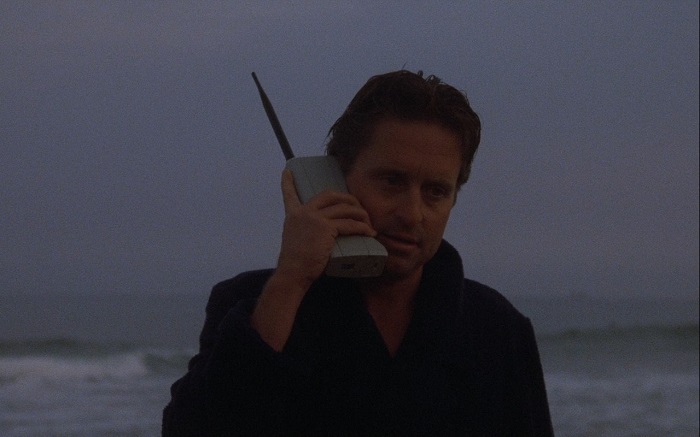
The First Cellular Phone, and It was Big!

DynaTAC is a series of cellular telephones manufactured by Motorola, Inc. from 1983 to 1994. The Motorola DynaTAC 8000X commercial portable cellular phone received approval from the U.S. FCC on September 21, 1983. A full charge took roughly 10 hours, and it offered 30 minutes of talk time. It also offered an LED display for dialing or recall of one of 30 phone numbers. It was priced at $3,995 in 1984, its commercial release year, equivalent to $9,831 in 2019. DynaTAC was an abbreviation of “Dynamic Adaptive Total Area Coverage.”  It weighed 1.75 lb., stood 13 in. high.

Several models followed, starting in 1985 with the 8000s, and continuing with periodic updates of increasing frequency until 1993’s Classic II. The DynaTAC was replaced in most roles by the much smaller Motorola MicroTAC when it was first introduced in 1989, and by the time of the Motorola StarTAC’s release in 1996, it was obsolete.

Martin Cooper of Motorola made the first publicized handheld mobile phone call on a prototype DynaTAC model on April 3, 1973. This is a reenactment in 2007.

The first cellular phone was the culmination of efforts begun at Bell Labs, which first proposed the idea of a cellular system in 1947, and continued to petition the Federal Communications Commission (FCC) for channels through the 1950s and 1960s, and research conducted at Motorola. In 1960, electrical engineer John F. Mitchell became Motorola’s chief engineer for its mobile communication products. Mitchell oversaw the development and marketing of the first pager to use transistors.

Motorola had long produced mobile telephones for cars that were large and heavy and consumed too much power to allow their use without the automobile’s engine running. Mitchell’s team, which included Martin Cooper, developed portable cellular telephony, and Mitchell was among the Motorola employees granted a patent for this work in 1973; the first call on the prototype was completed, reportedly, to a wrong number.

While Motorola was developing the cellular phone itself, during 1968–1983, Bell Labs worked on the system called AMPS, while others designed cell phones for that and other cellular systems. Martin Cooper, a former general manager for the systems division at Motorola, led a team that produced the DynaTAC 8000x, the first commercially available cellular phone small enough to be easily carried, and made the first phone call from it. Martin Cooper was the first person to make an analog cellular mobile phone call on a prototype in 1973.

Jesus and Joel Osteen

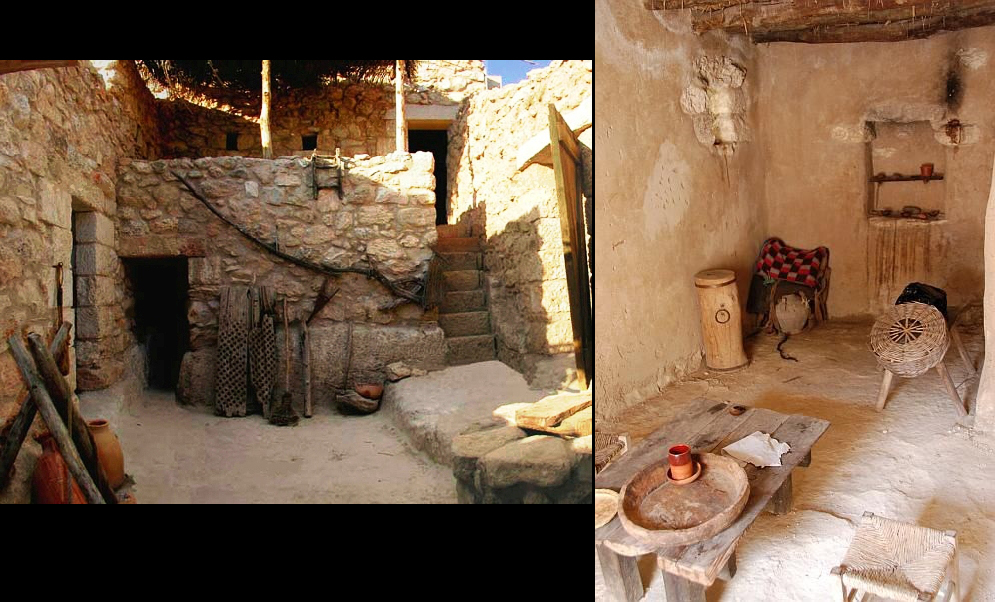
A first century dwelling in Nazareth. It is quite likely Jesus lived in a abode such as this.

Joel Scott Osteen (born March 5, 1963) is an American pastor, televangelist and author based in Houston, Texas. Known for his weekly televised services and several best-selling books, Osteen is one of the more prominent figures associated with prosperity theology.

The current mansion of Osteen and his previous residence below.

Osteen lives with his family in a 17,000 square-foot mansion in River Oaks, with an estimated value of $10.5 million. Osteen says that as senior pastor, he draws no salary from the church, which has an annual budget of $70 million, and that he instead relies on income from book sales.

Prosperity theology (sometimes referred to as the prosperity gospel, the health and wealth gospel, the gospel of success, or seed faith) is a religious belief among some Protestant Christians that financial blessing and physical well-being are always the will of God for them, and that faith, positive speech, and donations to religious causes will increase one’s material wealth. Material and especially financial success is seen as a sign of divine favor.

Prosperity theology has been criticized by leaders from various Christian denominations, including within some Pentecostal and charismatic movements, who maintain that it is irresponsible, promotes idolatry, and is contrary to the Bible. Secular as well as some Christian observers have also criticized prosperity theology as exploitative of the poor. The practices of some preachers have attracted scandal and some have been charged with financial fraud.

Prosperity theology views the Bible as a contract between God and humans: if humans have faith in God, he will deliver security and prosperity. The doctrine emphasizes the importance of personal empowerment, proposing that it is God’s will for his people to be blessed. The atonement (reconciliation with God) is interpreted to include the alleviation of sickness and poverty, which are viewed as curses to be broken by faith. This is believed to be achieved through donations of money, visualization, and positive confession.

It was during the Healing Revivals of the 1950s that prosperity theology first came to prominence in the United States, although commentators have linked the origins of its theology to the New Thought movement which began in the 19th century. The prosperity teaching later figured prominently in the Word of Faith movement and 1980s televangelism. In the 1990s and 2000s, it was adopted by influential leaders in the Pentecostal movement and charismatic movement in the United States and has spread throughout the world. Prominent leaders in the development of prosperity theology include E. W. Kenyon, Oral Roberts, A. A. Allen, Robert Tilton, T. L. Osborn, Joel Osteen, Creflo Dollar, Kenneth Copeland, Reverend Ike, and Kenneth Hagin.

The New Testament quotes Jesus as saying that “it is easier for a camel to go through the eye of a needle than for a rich man to enter the kingdom of God”.

2022 Rogers Communications outage

On July 8, 2022, Canadian telecom provider Rogers Communications experienced a major service outage; it affected Rogers’ cable internet and cellular networks, including subsidiary brands Rogers Wireless, Fido, and Chatr. It also impacted internet service providers with wholesale access to the Rogers network, such as TekSavvy, as well as various other information systems nationwide that rely on the Rogers network, including Interac and some federal government services. Multiple international web monitoring companies observed the outage.

Rogers had begun to slowly restore service that evening, but CEO Tony Staffieri stated there was no estimated time for when services would become fully operational again. The next day, Rogers stated that it had restored service to the “vast majority” of its customers; however not all service has been restored across the country.

A report by Cloudflare suggested that the outage was due to internal, rather than external, causes. It identified spikes in BGP updates, as well as withdrawals of IP prefixes, noting that Rogers was not advertising its presence, causing other networks to not find the Rogers network. As of the day after the outage, the cause remained unknown. Public Safety Canada stated that it was not a cyberattack. The outage was later said to be caused by a maintenance upgrade that caused routers to malfunction.