A wild viral video from an adventure park in Costa Rica shows a boy’s zip-line ride come to a sudden stop when he collides with a sloth that had somehow gotten stuck on the wire. The very strange encounter reportedly occurred last weekend at the Go.Adventure Arenal Park in the town of La Fortuna as the unnamed youngster was participating in a canopy tour at the tourist destination. The breathtaking experience of cruising down a zip-line amid the lush treetops of the rainforest turned into a truly unforgettable moment for the boy when he slams into the veritable slow-moving speed bump. Although the collision is rather abrupt, it would appear that neither the youngster nor the animal were injured in the mid-air crash thanks to the zip-line’s break.
When the park worker shadowing the boy catches up to him, the astonished tot exclaims “it’s a sloth! I just clocked it straight in the face!” The duo are then essentially left stuck hanging on the line while they wonder how the creature wound up in their path and wait for it to eventually depart. Remarkably, park owner Flavio Leiton Ramos said that such an encounter had never occurred at the park before and marveled that “it’s one of those things that happened that probably will never happen again.” We’re guessing that the sloth hopes that’s the case, since it almost certainly got quite the scare when the boy barreled into it.
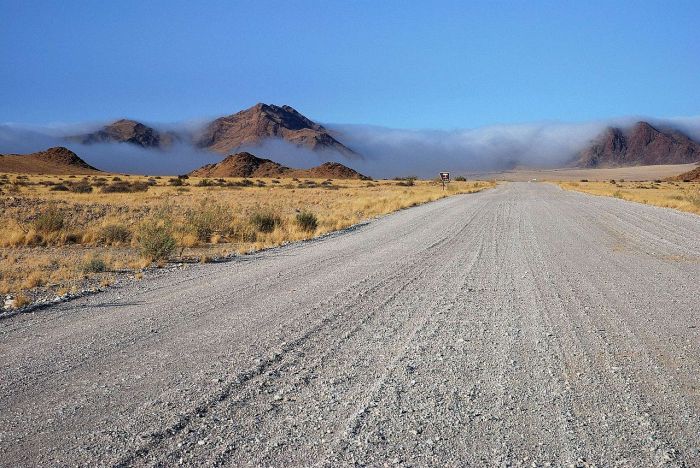
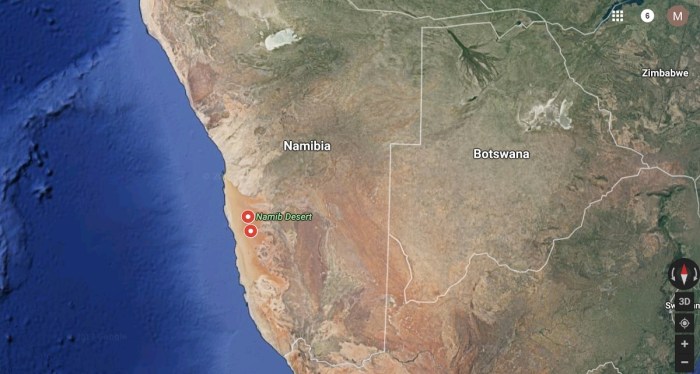
The Namib is a coastal desert in southern Africa. The name Namib is of Nama origin and means “vast place”. According to the broadest definition, the Namib stretches for more than 2,000 kilometres (1,200 mi) along the Atlantic coasts of Angola, Namibia, and South Africa, extending southward from the Carunjamba River in Angola, through Namibia and to the Olifants River in Western Cape, South Africa.
The desert geology consists of sand seas near the coast, while gravel plains and scattered mountain outcrops occur further inland. The sand dunes, some of which are 300 metres (980 ft) high and span 32 kilometres (20 mi) long, are the second largest in the world after the Badain Jaran Desert dunes in China.
Winds coming from the Atlantic Ocean are pressed down by hot air from the east; their humidity thus forms clouds and fog. Morning fogs coming from the ocean and pushing inwards into the desert are a regular phenomenon along the coast, and much of the life cycle of animals and plants in the Namib relies on these fogs as the main source of water.
A Lovecraftian poster for an odd 1960s mermaid thriller starring Dennis Hopper with a freaky cameo appearance by Marjorie Cameron, the bohemian witch of Los Angeles.
This is a sampling from a private collection of rare, massive 40” x 60” posters that were printed on cardstock for drive-In movie theaters.
An American distributor purchased a historical film and repackaged it as a Nazisploitation thrill; the fact that the movie was years old at this point was sold to the audience as the film having been “censored until now!”
A towel-clad Brigitte Bardot stuns in this incredible 1961 Pop Art poster.
A giant poster advertising a 1966 Hammer double-feature where theatregoers would get their own Rasputin beard!
After stabbing her mother’s boyfriend, a teenager escapes from reform school amid a barrage of attempted rape and lesbianism.
A psychedelic graphic for a 1971 camp film marketed as druggy horror to capitalize on the Charles Manson trials.
This 1963 poster lured theater goers over to listen to the whispering of a rocky-skinned slime monster.
Vincent Price narrates this “travel documentary” exploring bizarre cultural practices.
Hammer horror classic with the busty Ingrid Pitt as Carmilla, the original prototype of the lesbian vampire.
An Italian dramatic film released in the United States with a decidedly sexy marketing campaign.
Mario Bava directed this 1964 film that created the template for the “body count” slasher films of the 1980s.
In 1967, the first Argentinian vampire film offers viewers a unique experience called “Erotomania!”
The dismembered hand of an astronaut possessed by an evil alien intelligence goes on a killing spree. Luckily a hungry cat saves everyone at the end. Burt Reynolds screen tested twice for this film and was turned down both times.
Deranged: The confessions of a Necrophile is loosely based on serial killer Ed Gein and features a man using corpses for various aspects of home décor.
H.P. Lovecraft presented with the patina of 1960s cinema.
A hallucinogen-paranoid tale of espionage and psychedelic “acting.”
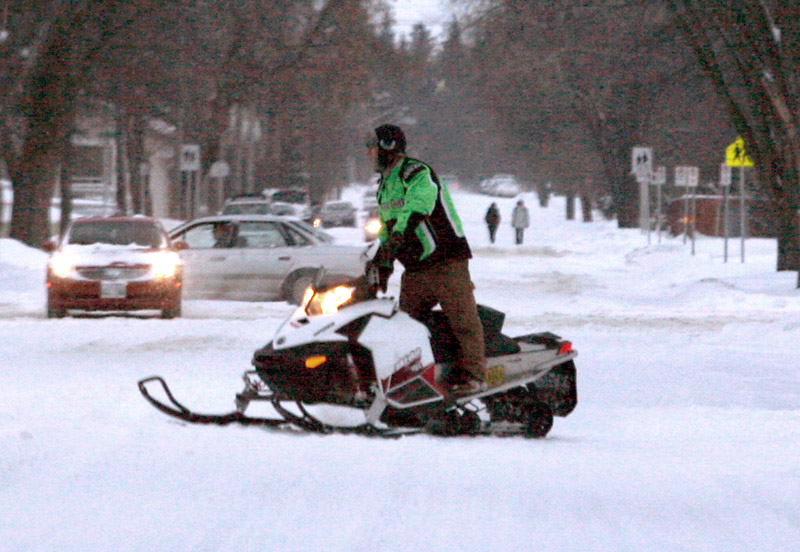
A Winnipeg man on a stolen snowmobile led police on a four-hour chase through the southeastern part of the city Sunday afternoon.
Police said they were called around noon Sunday about a man illegally operating a snowmobile — later determined to be stolen — in a residential St. Norbert neighbourhood.
The suspect, identified as a man who was already the subject of a warrant for firearms-related charges, managed to evade police throughout an “extensive” area, until he was arrested around 3:45 p.m.
The 40-year-old was taken into custody and faces charges of failing to comply with conditions of a release order, three counts of property obtained by crime over $5,000, and fleeing while pursued by a peace officer.
T.A.M.I. Show is a 1964 concert film released by American International Pictures. It includes performances by numerous popular rock and roll and R&B musicians from the United States and England. The concert was held at the Santa Monica Civic Auditorium on October 28 and 29, 1964. Free tickets were distributed to local high school students. The acronym “T.A.M.I.” was used inconsistently in the show’s publicity to mean both “Teenage Awards Music International” and “Teen Age Music International”.
Rising global temperatures might be causing hailstorms to become more violent, with larger chunks of ice and more intense downpours. But just how big can a hailstone get?
It was the height of summer in the UK and the country found itself in the grip of a heatwave. In Leicestershire, in the midlands of England, children on their school holidays played in paddling pools to stay cool. Then the sky darkened.
In the early evening of 21 July 2021, hailstones the size of golf balls pelted suddenly from the sky, smashing windows and battering cars. Gardens that were a few moments earlier filled with people soaking up the evening sun, were left badly damaged by the downpour of ice.
While the hailstorm – caused by strong updrafts of cloud high in the atmosphere – was unusual in its severity, it was mild compared to a hailstorm that struck Calgary in Canada in June 2020. Hailstones the size of tennis balls caused damage to at least 70,000 homes and vehicles, destroyed crops and left the area facing a C$1.2bn (US$940m/£720m) repair bill. The 20-minute hailstorm was one of the country’s most costly weather events.
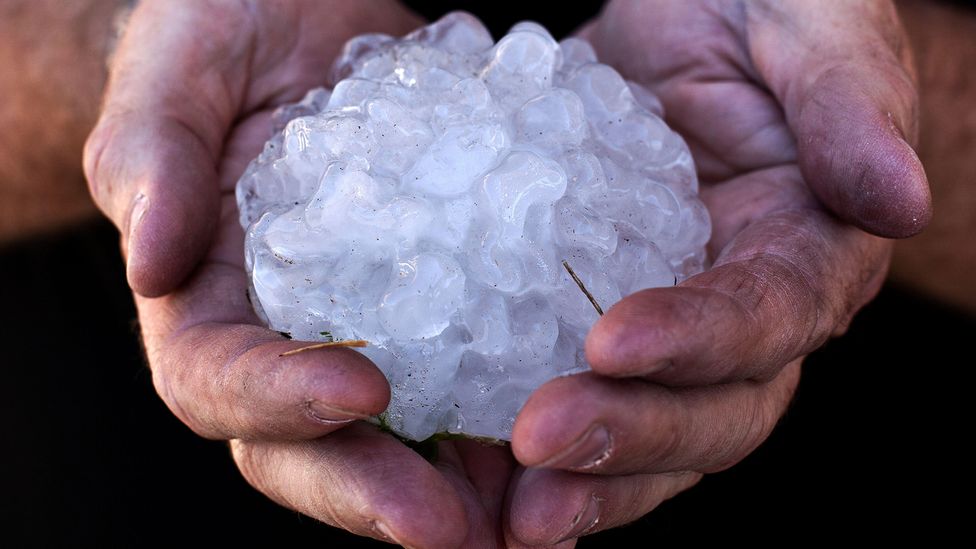
And climate change is altering the pattern of hailstorms. In Texas, Colorado and Alabama the records for largest hailstone have been broken in the last three years, reaching sizes of up to 16cm (6.2 inches) in diameter. In 2020, Tripoli, the capital of Libya, was struck by hailstones nearly 18cm (7.1in) across.
While giant hailstones – classed as those with a diameter greater than 10cm (3.9in) – are extremely rare, they are an indicator and hail damage in the US now averages more than $10bn (£7.6bn) a year.
But why might global warming be causing an increase in the amount of ice falling from the sky? And are their limits to just how big a hailstone can grow?
Some large hailstones form as smaller ones collide and fuse together as they are buffeted around in a storm (Credit: Nature Picture Library/Alamy)
Hail forms as droplets of water are carried upward into a thunderstorm. Updraughts carry them into parts of the atmosphere where the air is cold enough to freeze the droplets. Moisture from the air accumulates on the outside of the drops of ice as it moves through the air, causing the hailstone to grow in onion-like layers.
How fast a hailstone grows depends on the amount of moisture in the air. It will continue to grow until the updraught is no longer strong enough to keep it aloft. A 103km/h (64mph) updraft supports hail the size of a golf ball, while one 27% faster can create hailstones the size of baseballs, according to the US National Oceanic and Atmospheric Administration (although as we will see in a moment, the size of a hailstone doesn’t always directly relate to its weight). More humid air and more powerful updraughts will bring bigger hailstones. Often larger hailstones will fall closer to the updraught while smaller hailstones will fall further away, often blown there by cross winds.
Destructive storms that produce hailstones more than 25mm (1in) in diameter require a specific set of conditions, says Julian Brimelow, a physical sciences specialist at Environment and Climate Change Canada, a department of the Canadian government, who has studied how climate change affects hail formation. They require enough moisture, powerful updraughts, and a “trigger factor”, typically a weather front. This is why serious hailstorms are usually confined to particular regions such as the Great Plains in the US and Australia’s Gold Coast. Typically such regions have cool, dry air in the upper atmosphere above warm, humid surface air. This unstable situation leads to strong updraughts and the formation of thunderstorms.
Such locations are particularly prone to a type of thunderstorm known as supercells, which can produce very large hail due to the powerful rotating updraughts they create.
But as climate change alters the temperature of the Earth’s atmosphere, so too is the amount of moisture in the air. Warmer air can hold more water vapour while higher temperatures also mean more water is evaporated from the Earth’s surface. This is predicted to lead to heavier rainfall and more extreme storms in parts of the world.
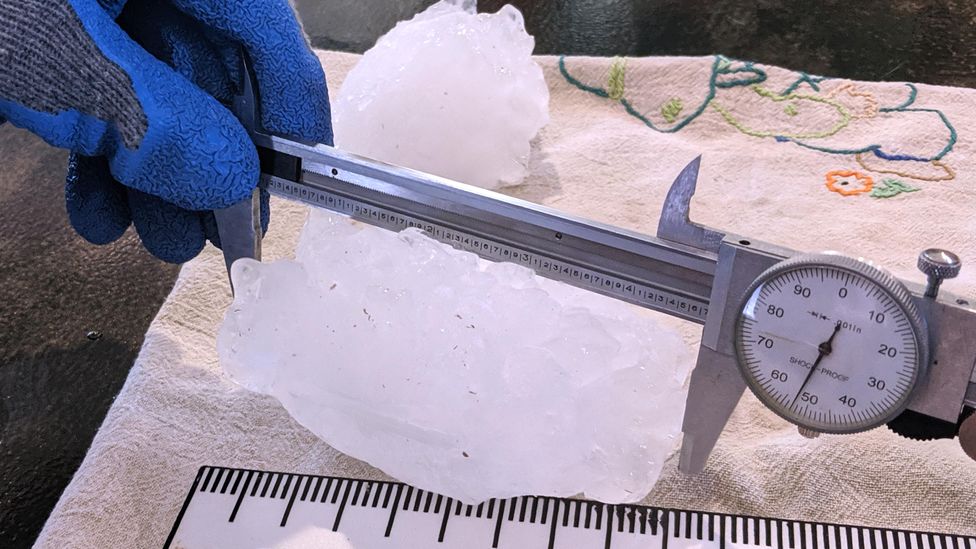
A hailstone measuring 4.83in (12cm) at its widest point was collected after a storm in Bethune, Colorado, US, in 2019 (Credit: National Weather Service, Goodland Forecast Office)
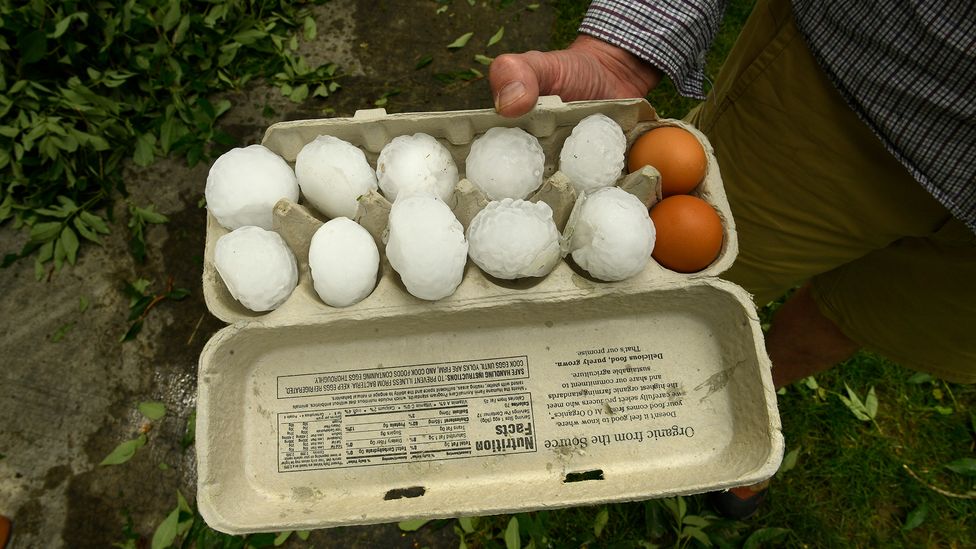
Hailstones as big as eggs – like these that fell in Louisville, Colorado, in 2018 – are not uncommon in severe storms (Credit: Helen H Richardson/The Denver Post/Getty Images)
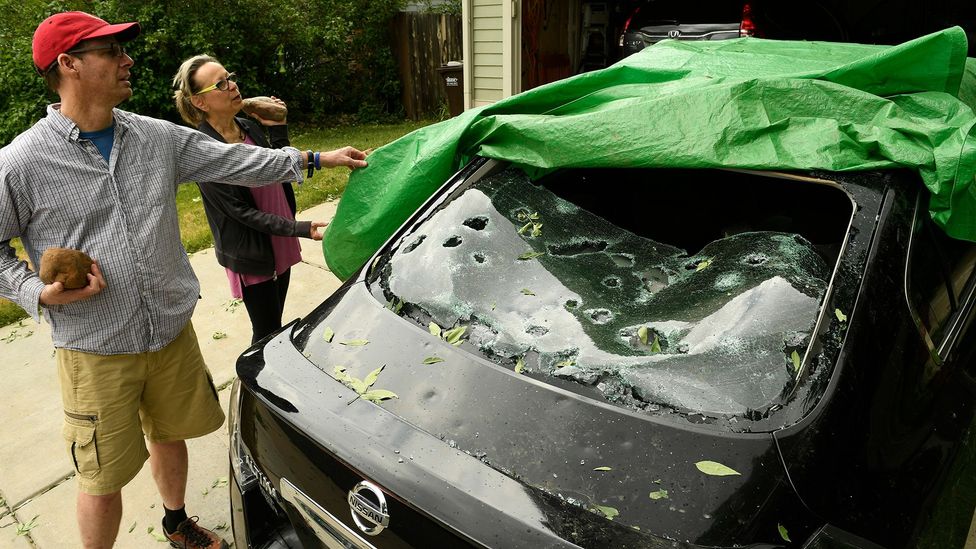
Damage caused by large hail downpours can cause damage to vehicles and buildings costing billions (Credit: Helen H Richardson/The Denver Post/Getty Images)
Due to the multiple benefits from cattle, there are varying beliefs about cattle in societies and religions. In some regions, especially Nepal and some states in India, the slaughter of cattle is prohibited and their meat may be taboo. Cattle are considered sacred in world religions such as Hinduism, Jainism, Zoroastrianism and others. Religions in Ancient Egypt, Ancient Greece, Ancient Israel and Ancient Rome held similar beliefs.
Due to millions of sauntering cows, it is likely that India has the world’s greatest number of moving road impediments, and little sits between these roaming dangers and the many people on the country’s roads.
Hollywood and Bollywood depictions of India routinely feature comical transport situations involving tok-toks, assorted quadrupeds and buses packed like freeze-dried coffee.
While there is truth in humor, mounds of corpses from India’s road accidents are devastating, not at all funny.
The Indian government’s estimate of 130,000 traffic-related deaths per year makes the country a near-world leader in road fatalities, just behind China, but the World Health Organization (WHO) puts the figure closer to 231,000—a number equal to the population of Orlando, Fla.
Hindus consider cows sacred animals, and their slaughter is banned throughout most of India. Cows are frequently allowed to wander where they please, even in cities, where Indians tend to view them much the way Americans and Europeans regard pigeons — an unpleasant but intractable part of the urban landscape.
To remedy the cows in the streets predicament, ‘Cow Catchers’ are used to remove cattle from the cities.
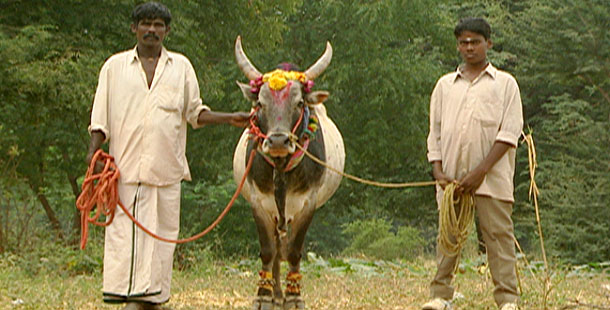
It’s becoming a routine ritual on the crowded, colorful streets of Delhi, India: A small team of men surrounds a wandering cow, attempting to coax it on to a waiting truck for a trip to a suburban reserve. But the cow catchers need to be careful: To India’s millions of Hindus, the cow is a holy animal that cannot be harmed.
The tender treatment is just one example of our complicated relationship with cows — a historic partnership detailed by NATURE’s Holy Cow. From a source of meat and milk to a provider of labor and religious inspiration, cows often play a central role in modern life.
Today, in heavily Hindu nations like India and Nepal, milk continues to hold a central place in religious rituals. And in honor of their exalted status, cows often roam free. Indeed, in some places, it is considered good luck to give one a snack, a bit of bread, or fruit before breakfast. On the other hand, a citizen can be sent to jail for killing or injuring a cow.
But as cities have grown more crowded, cow-friendly policies have posed problems. Delhi’s 13 million residents, for instance, share the streets with an estimated 40,000 cows — leading to some complaints. One is that the grazing cows spread trash as they rip open garbage bags in search of tasty morsels. Another is that they dangerously snarl traffic.
“What is the greatest traffic hazard in Delhi today? Cows,” Bibek Debroy, a columnist for India’s Financial Express, wrote in a pointed 2003 essay. “As our national animal, the tiger may be close to extinction. But the cow is very much around and many soon become our new national animal.”
To solve the problem, Debroy offered one tongue-in-cheek solution. “Let them have reflectors and, if not license plates, at least identity cards. Only genuine Delhi cows should be eligible for social security and other benefits.”
City officials, meanwhile, have adopted a different approach: the cow catchers. Under pressure to reduce cow populations, Delhi has hired nearly 100 of the urban cowboys, who are charged with catching and shipping cows outside the city limits, sometimes to special reserves where the animals are cared for.
But the work isn’t easy. And it can be downright dangerous. The cows often sport sharp horns, and life on the street has made them savvy and sometimes ornery. Some can recognize the sound of the transport trucks and perform a kind of bovine ballet to avoid the catchers. Still, city leaders say they won’t give up until the vast majority of the cows have been moved. Skeptics note that some of the animals return to their home turfs within days of being moved.










![namib-desert-meets-sea-4[2]](https://markozen.com/wp-content/uploads/2017/10/namib-desert-meets-sea-42.jpg?w=700)
![namib-desert-meets-sea-2[2]](https://markozen.com/wp-content/uploads/2017/10/namib-desert-meets-sea-22.jpg?w=700)
![namib-desert-meets-sea-7[2]](https://markozen.com/wp-content/uploads/2017/10/namib-desert-meets-sea-72.jpg?w=700)



















 The MarkoZen Blog