Boombox is a common term for a portable cassette or CD player with two or more loudspeakers and a carrying handle. Other commonly used terms are ghetto blaster, stereo, jambox, boomblaster, Brixton briefcase, and radio-cassette. A boombox is a device typically capable of receiving radio stations and playing recorded music (usually cassettes or CDs, usually at a high volume).
The first boombox was developed by the inventor of the audio compact cassette, Philips of the Netherlands. Their first ‘Radiorecorder’ was released in 1966. The Philips innovation was the first time that radio broadcasts could be recorded onto cassette tapes without the cables or microphones that previous stand-alone cassette tape recorders required. Although sound quality of early tape recordings was poor, improvements in technology and the introduction of stereo recording, chromium tapes, and noise reduction made hifi quality devices possible. Several European electronics brands, such as Grundig, also introduced similar devices.
Boomboxes were soon also developed in Japan in the early 1970s and became popular there due to their compact size and impressive sound quality. The Japanese brands soon took over a large portion of the European boombox market and were often the first Japanese consumer electronics brands that a European household might purchase. The Japanese innovated by creating different sizes, form factors, and technology, introducing such advances as stereo boomboxes, removable speakers, in-built TV receivers, and inbuilt CD players.
The boombox was introduced to the American market during the mid-1970s, with the bulk of production being carried out by Panasonic, Sony, Marantz, and General Electric. It was immediately noticed by the urban adolescent community and soon had a large market, especially in metropolitan centers such as New York, Los Angeles, and Washington D.C.
The earlier models were a hybrid that combined the booming sound of large in-home stereo systems and the portability of small portable cassette players; they were typically small, black or silver, heavy, and capable of producing high volumes. The effective AM/FM tuner the coupling of devices such as microphones and turntables.
The development of audio jacks brought the boombox to the height of its popularity, and as its popularity rose, so did the level of innovation in the features included in the box. Consumers enjoyed the portability and sound quality of boomboxes, but one of the most important features, especially to the youth market, was the bass. The desire for louder and heavier bass led to bigger and heavier boxes.
Regardless of the increasing weight and size, the devices continued to become larger to accommodate the increased bass output; newer boombox models were affixed with heavy metal casings to handle the vibrations from the bass.
The 1990s were a turning point for the boombox in popular culture. The rise of the Walkman and other advanced electronics eliminated the need to carry around such large and heavy audio equipment, and boomboxes quickly disappeared from the streets. As boombox enthusiast Lyle Owerko puts it, “Towards the end of any culture, you have the second or third generation that steps into the culture, which is so far from the origination, it’s the impression of what’s real, but it’s not the full definition of what’s real. It’s just cheesy.” The Consumer Electronics Association reported that only 329,000 boombox units without CD players were shipped in the United States in 2003, compared to 20.4 million in 1986.
Although many boomboxes had dual cassette decks and included dubbing, line, and radio recording capabilities, the rise of recordable CDs, the decline of audio cassette technology, and the popularity of high-density MP3 players and smart phones have reduced the popularity of high-quality boomboxes to such an extent that it is difficult to find a new dual-decked stereo. Dubbing remains popular among audiophiles, bootleggers, and pirates, though most tasks are now accomplished through digital means or analog-to-digital conversion technology.
Starting in mid-2010, there are new lines of boomboxes that use Bluetooth technology known as Stereo Bluetooth, or A2DP (Advanced Audio Distribution Profile). They use the wireless Bluetooth technology to “stream” audio to the boombox from a compatible Bluetooth device, such as a mobile phone or Bluetooth MP3 player. An example of this is the JAMBOX, which is marketed as a “Smart Speaker” as it can also function as a speakerphone for voice calls in addition to being an audio playback device.
Interesting cloud formation over the South Dakota Badlands.
Young Orangutan uses a leaf for shelter during a rain storm. Bali, Indonesia.
Cheetah’s scanning for prey on a mound in Kenya. Shift change, when the second one arrived, the first one left the perch.
Wild fox at Chernobyl. Looks like it may be suffering from radiation poisoning.
Coloured mountains in China. Various minerals in the soil create the striking colours.
Massive tornado in Colorado. It narrowly missed the farm yard.
Godafoss Falls, Iceland.
Sunset in Greece.
Beautiful ice cave in Iceland.
Iranian girls on the Iran-Iraq border. A destroyed tank left over from the Iran-Iraq War of the 1980’s. The girl on top of the tank opened her arms in the direction of Iraq in a gesture of defiance.
Mother Cheetah protecting her five cubs, a sixth had been killed by a lion.
Combines in formation, Minnesota.
Beautiful fjord in Norway.
Great scenery on the Polish-Slovakian border.
Salt terraces in Peru.
Terraces in Vietnam.
Striking scenery, Albania.
Whitmore Hot Springs, California.
Wildebeests crossing a river on the Serengeti.
Residential zoning in Tibet. Except for a few holy Monk buildings, nothing gets built to the right of the line.
‘The Revenant’ was a box office breaking movie and most reviews are that it was very good. In the movie the Leonardo DiCaprio character gets attacked and mauled by a mean mother grizzly bear. It is a riveting scene. But not the best bear attack scene in movies. Back in 1997 a movie was released called ‘The Edge.’ It received little fanfare and sort of faded away into oblivion. A few years ago I caught it on TV and was mesmerized.
The survivors are stranded in the Alaska wilderness and ultimately get stalked and attacked by a giant Kodiak bear. This Kodiak (Kodiaks are giant grizzlies) chases them for miles and the characters barely escape until the final showdown. Sensational bear attack scenes.
The Edge is a 1997 American survival drama film directed by Lee Tamahori and starring Anthony Hopkins and Alec Baldwin. Bart the Bear, a trained Kodiak bear known for appearances in several Hollywood movies, also appears in the film as a vicious grizzly; this was one of his last film roles.
Chocolate topography exists on the planet. It is the color of these high areas that lead to the names. There is one in the Philippines and one in California.
The Chocolate Hills
The Chocolate Hills (Filipino: Tsokolateng Burol) are a geological formation in the Bohol province of the Philippines. There are at least 1,260 hills but there may be as many as 1,776 hills spread over an area of more than 50 square kilometres (20 sq mi). They are covered in green grass that turns brown (like chocolate) during the dry season, hence the name.
The Chocolate Hills form a rolling terrain of haycock hills – mounds of a generally conical and almost symmetrical shape. Estimated to be from 1,268 to about 1,776 individual mounds, these cone-shaped or dome-shaped hills are actually made of grass-covered limestone. The domes vary in sizes from 30 to 50 metres (98 to 164 ft) high with the largest being 120 metres (390 ft) in height.
The Chocolate Hills are conical karst hills similar to those seen in the limestone regions of Slovenia, Croatia, northern Puerto Rico, and Pinar del Río Province, Cuba. These hills consist of Late Pliocene to Early Pleistocene, thin to medium bedded, sandy to rubbly marine limestones. These limestones contain the abundant fossils of shallow marine foraminifera, coral, mollusks, and algae. These conical hills are geomorphological features called cockpit karst, which were created by a combination of the dissolution of limestone by rainfall, surface water, and groundwater, and their subaerial erosion by rivers and streams after they had been uplifted above sea level and fractured by tectonic processes.
The Chocolate Mountains
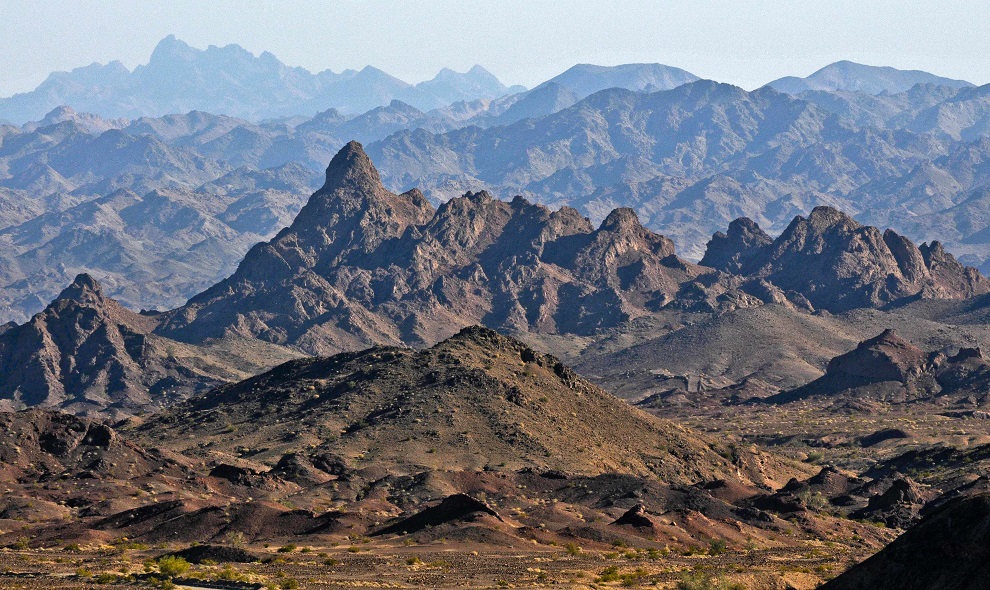
The Chocolate Mountains of California are located in Imperial and Riverside counties in the Colorado Desert of Southern California. The mountains stretch more than 60 miles (100 km) in a northwest to southeast direction, and are located east of the Salton Sea and south and west of the Chuckwalla Mountains and the Colorado River. To the northwest lie the Orocopia Mountains.
The Chocolate Mountains form the northeast boundary of the Salton Trough extending as a narrow range some 80 miles (130 km) southeast from the Orocopia Mountains to the Colorado River valley. The mountains are located about 30 miles (48 km) west of the Chocolate Mountains of Arizona, but the two ranges are not connected. The range reaches an elevation of 2,475 feet (754 m) at Mount Barrow, and serves as a drainage divide for the Salton Watershed to the west.
The mountain range is occupied by the Chocolate Mountain Aerial Gunnery Range, an aerial and gunnery practice area used by the US Navy and Marines. A large part of the Chocolate Mountains lies within the gunnery range, and is closed to the public.
As desktop towers have given way to today’s sleek laptops and even sleeker mobile devices, all glued shut to preclude even the possibility of tinkering, we’ve lost something valuable: the art of the case mod. Thankfully, over in Japan, Hiroto Ikeuchi is keeping the craft alive in spectacular fashion.
Ikeuchi spent the better part of the last year building this incredible machine, a creation that isn’t so much a case mod as full-blown diorama. It’s a deliriously detailed little world that just happens to take place in and around a functioning computer. It also redefines the idea of what it means to have a cluttered desk.
Ikeuchi, a designer by trade, likes to call it his “secret base.” Inspired by mecha anime like Gundam and Macross, every surface is packed with something to discover. Soldiers tend to intricate, forbidding machinery. Mechs await repair. The work seamlessly blends plastic toys, gizmo components, and scraps of other materials with the computer itself. Atop the tower, the shell of a DSLR is repurposed as a laser cannon.
Love him or hate him, Peter Nygard’s private 727 flying into Winnipeg.
McCarran Airport in Las Vegas. Notice the unmarked 737 aircraft in the background. That is Janet airlines, the secret airline that flies workers back and forth between Vegas and the Infamous Area 51.
‘Cause I’m T.N.T., I’m dynamite’
Everything is crowded in China, including runways.
















 The MarkoZen Blog