
Upsurge in violence aboard commercial airline flights.



Upsurge in violence aboard commercial airline flights.
GOAT stands for Greatest of All Time.
Kim Price / AP
Simone Biles during the women’s qualification for the artistic gymnastics final at the 2020 Summer Olympics at Ariake Gymnastics Centre in Tokyo on July 25, 2021.















A Dynastic Totalitarian Dictatorship.
The North Korean cult of personality surrounding its ruling family, the Kim family, has existed in North Korea for decades and can be found in many examples of North Korean culture. Although not officially recognized by the North Korean government, many defectors and even Western visitors claim there are often stiff penalties for those who criticize or do not show “proper” respect for the regime. The personality cult began soon after Kim Il-sung took power in 1948, and was greatly expanded after his death in 1994.
While other countries have had cults of personality to various degrees (such as Joseph Stalin’s in the Soviet Union), the pervasiveness and extreme nature of North Korea’s personality cult surpasses that of Stalin or Mao Zedong. The cult is also marked by the intensity of the people’s feelings for and devotion to their leaders, and the key role played by a Confucianized ideology of familism both in maintaining the cult and thereby in sustaining the regime itself.


Stadium with participants holding large cards.
The cult of personality surrounding the Kim family requires total loyalty and subjugation to the Kim family and establishes the country as a one-man dictatorship through successive generations. The 1972 constitution of the DPRK incorporates the ideas of Kim Il-sung as the only guiding principle of the state and his activities as the only cultural heritage of the people. According to New Focus International, the cult of personality, particularly surrounding Kim Il-sung, has been crucial for legitimizing the family’s hereditary succession, and Yong-soo Park noted in the Australian Journal of International Affairs that the “prestige of the Suryong [supreme leader] has been given the highest priority over everything else in North Korea”.
North Korean authorities have co-opted portions of Christianity and Buddhism, and adapted them to their own uses, while greatly restricting all religions in general as they are seen as a threat to the regime. An example of this can be seen in the description of Kim Il-sung as a god, and Kim Jong-il as the son of a god or “Sun of the Nation”, evoking the father-son imagery of Christianity. According to author Victor Cha, during the first part of Kim Il-sung’s rule, the state destroyed over 2,000 Buddhist temples and Christian churches which might detract from fidelity to Kim. There is even widespread belief that Kim Il-sung “created the world” and that Kim Jong-il controlled the weather. Korean society, traditionally Confucian, places a strong emphasis on paternal hierarchy and loyalty. The Kims have taken these deeply held traditions and removed their spiritual component, replacing them with loyalty to the state and the ruling family in order to control the population. Despite the suppression of traditional religions, however, some have described Juche, sociologically, as the religion of the entire population of North Korea.
According to a 2013 report by New Focus International, the two major North Korean news publications (Rodong Sinmun and the Korean Central News Agency) publish around 300 articles per month relating to the “cult of Kim”. The report goes further and suggests that with the death of Kim Jong-il, the average North Korean citizen is growing weary of the vast amount of propaganda surrounding the Kims. DailyNK likewise published in 2015 that the younger generation is more interested in the outside world and that the government is finding it difficult to secure the loyalty of the “jangmadang” (marketplace) generation and promoting the idolization of Kim Jong-un.
The DPRK government claims there is no cult of personality, but rather genuine hero worship.

Mansudae Grand Monument

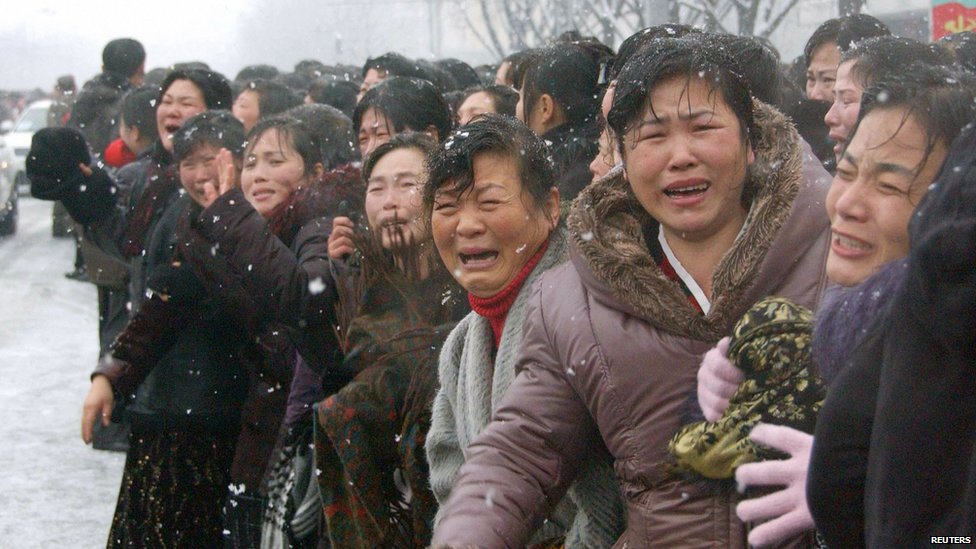
After his death on December 17, 2011, the Korean Central News Agency (KCNA) said that layers of ice ruptured with an unprecedentedly loud crack at Chon Lake on Mount Paektu and a snowstorm with strong winds hit the area. A political paper by his son, Kim Jong-un, sought to solidify his father as the “Eternal General Secretary of our Party.” Many had been seen weeping during the 100-day mourning period, which is typical of Korean Confucian society, and an analyst at South Korea’s Korea Institute for National Unification determined that much of the public grief evidenced during the mourning period was a genuine expression of sorrow. Yet, there has been some doubt as the genuine nature and depth of the displays of grief.
Kim Jong-un, the grandson of North Korea’s founder, was largely absent from the public and government service until the mid-2000s. In 2010 he began being referred to as the “Young General” and by late 2011 as “Respected General”. Like his father, he lacks any formal military training or service. With the death of his father, state media began to refer to him as the “Great Successor.” Although he is still a new ruler, the development of his own personality cult is well underway, with large numbers of posters, signs, and other propaganda being placed all over the country. Some commentators have noted that his striking likeness in appearance to Kim Il-sung has helped solidify him as the undisputed ruler in the minds of the people.
Kim Jong-un marks the third generation of Kim family dynastic leadership. According to Daily NK, people who criticized the succession were sent to re-education camps or otherwise punished and, after the mourning period of Kim Jong-il, government authorities began to increase their efforts on building the idolization of Kim Jong-un.
After Kim Jong-il’s death the president of the Presidium announced that “Respected Comrade Kim Jong-un is our party, military and country’s supreme leader who inherits great comrade Kim Jong-il’s ideology, leadership, character, virtues, grit and courage.”
Shortly after the new leader came to power, a 560 metres (1,840 ft)-long propaganda sign was erected in his honor near a lake in Ryanggang Province. The sign, supposedly visible from space, reads “Long Live General Kim Jong-un, the Shining Sun!”
In 2013, the Workers’ Party of Korea amended the Ten Principles for the Establishment of a Monolithic Ideological System, which in practice serves as the primary legal authority and framework of the country, to demand “absolute obedience” to Kim Jong-un.
Kim Jong-un’s uncle, Jang Sung-taek, was executed on December 12, 2013. His death was attributed, in part, to undermining the Kim family personality cult. His death has also been seen as a move by Kim Jong-un to consolidate his own cult.
In 2015, at the end of the formal three-year mourning period for the death of Kim Jong-il, Kim Jong-un ordered the construction of new monuments to be built in every county of North Korea. Extensive renovations to the Kumsusan Memorial Palace have also been ordered. According to The Daily Telegraph, analysts “say the order to erect more statues to the Kim family will be a heavy financial burden on an economy that is already struggling due to years of chronic mismanagement and international sanctions”.


Familism is a type of collectivism in which the one is expected to prioritize the needs of the greater society or family over the needs of the individual. This plays out on a large scale in North Korea, where the Great Leader Kim Il-Sung is Father and the Communist Party is Mother. Thus, not only are the people expected to cherish their birth parents and treat them with all the respect demanded of traditional Confucian filial piety, but they must cherish and adore the ruling Kim family and the Mother Party even more so.
Familism in North Korea stems from a combination of the traditional East Asian Confucian value of filial piety (upmost respect for parents and grandparents as well as elder uncles and aunts), the communist system of collectivism, and the Kim cult of personality. As a traditional East Asian and Confucian value, the importance of family has come to resonate through all aspects of North Korean life, from politics to the economy to education and even to interpersonal relationships between friends and enemies.
When the Soviet Union first entered North Korea in 1945 to start its occupation, it had to start almost from scratch in establishing a communist base in the capital region of Pyongyang. In fact, the Soviets’ ideologies of communism and socialism were likely as foreign to the Koreans of Pyongyang as the Soviets themselves. However, by emphasizing family and a father-child relationship between the Soviet Union and Korea, and later between Kim Il-Sung and the North Korean people, Kim not only managed to apply Western Marxism to an Asian state, but also to secure his own personality cult, thereby constructing a sense of unquestioning loyalty toward him amongst the North Korean people when North Korea was at its most vulnerable to unwelcome western influences.
I’m sure Kim-Jong Un is waiting for his statue.

Hawaii Public Radio

APA robotic dog called Spot trots during a Honolulu Police Department demonstration to reporters Friday, May 14, 2021. (AP Photo/Jennifer Sinco Kelleher)
HONOLULU — If you’re homeless and looking for temporary shelter in Honolulu, expect a visit from a robotic police dog that will scan your eye to make sure you don’t have a fever.
That’s just one of the ways public safety agencies are starting to use Spot, the best-known of a new commercial category of robots that trot around with animal-like agility.
The handful of police officials experimenting with the four-legged machines say they’re just another tool, like existing drones and simple wheeled robots, to keep emergency responders out of harm’s way as they scout for dangers. But privacy watchdogs — the human kind — warn that police are secretly rushing to buy the robots without setting safeguards against aggressive, invasive or dehumanizing uses.
In Honolulu, the police department spent about $150,000 in federal pandemic relief money to buy their Spot from robotics firm Boston Dynamics for use at a government-run tent city near the airport.
“Because these people are houseless it’s considered OK to do that,” said Jongwook Kim, legal director at the American Civil Liberties Union of Hawaiʻi. “At some point it will come out again for some different use after the pandemic is over.”
Acting Lt. Joseph O’Neal of the Honolulu Police Department’s community outreach unit defended the robot’s use in a media demonstration earlier this year. He said it has protected officers, shelter staff and residents by scanning body temperatures between meal times at a shelter where homeless people could quarantine and get tested for COVID-19. The robot is also used to remotely interview individuals who have tested positive.
“We have not had a single person out there that said, ‘That’s scary, that’s worrisome,’” O’Neal said. “We don’t just walk around and arbitrarily scan people.”
Police use of such robots is still rare and largely untested — and hasn’t always gone over well with the public. Honolulu officials faced a backlash when a local news organization, Honolulu Civil Beat, revealed that the Spot purchase was made with federal relief money.
“One of the big challenges is accurately describing the state of the technology to people who have never had personal experience with it,” Michael Perry, vice president of business development at Boston Dynamics, said in an interview. “Most people are applying notions from science fiction to what the robot’s doing.”
For one of its customers, the Dutch national police, explaining the technology includes emphasizing that Spot is a very good robot — well-behaved and not so smart after all.
“It doesn’t think for itself,” Marjolein Smit, director of the special operations unit of the Dutch national police, said of the remote-controlled robot. “If you tell it to go to the left, it will go to the left. If you tell it to stop, it will stop.”
Earlier this year, her police division sent its Spot into the site of a deadly drug lab explosion near the Belgian border to check for dangerous chemicals and other hazards.
Perry said the company’s acceptable use guidelines prohibit Spot’s weaponization or anything that would violate privacy or civil rights laws, which he said puts the Honolulu police in the clear. It’s all part of a year-long effort by Boston Dynamics, which for decades relied on military research grants, to make its robots seem friendlier and thus more palatable to local governments and consumer-oriented businesses.
By contrast, a lesser-known rival, Philadelphia-based Ghost Robotics, has no qualms about weaponization and supplies its dog-like robots to several branches of the U.S. military and its allies.
“It’s just plug and play, anything you want,” said Ghost Robotics CEO Jiren Parikh, who was critical of Boston Dynamics’ stated ethical principles as “selective morality” because of the company’s past involvement with the military.
Parikh added that his company doesn’t market its four-legged robots to police departments, though he said it would make sense for police to use them. “It’s basically a camera on a mobile device,” he said.
There are roughly 500 Spot robots now in the wild. Perry said they’re commonly used by utility companies to inspect high-voltage zones and other hazardous areas. Spot is also used to monitor construction sites, mines and factories, equipped with whatever sensor is needed for the job.
It’s still mostly controlled by humans, though all they have to do is tell it which direction to go and it can intuitively climb stairs or cross over rough terrain. It can also operate autonomously, but only if it’s already memorized an assigned route and there aren’t too many surprise obstacles.
“The first value that most people see in the robot is taking a person out of a hazardous situation,” Perry said.
Kim, of the ACLU in Hawaiʻi, acknowledged that there might be many legitimate uses for such machines, but said opening the door for police robots that interact with people is probably not a good idea. He pointed to how Dallas police in 2016 stuck explosives on a wheeled robot to kill a sniper, fueling an ongoing debate about “killer robots” in policing and warfighting.
“There’s the potential for these robots to increase the militarization of police departments and use it in ways that are unacceptable,” Kim said. “Maybe it’s not something we even want to let law enforcement have.”
.
TAVARUA, FIJI — Larry Page, the co-founder of Google, has spent much of the COVID-19 pandemic on tropical islands in Fiji, entering the country via a government system that allows wealthy individuals to avoid COVID-19 travel restrictions, according to Business Insider.
Page has stayed mostly on Tavarua island, to the west of the main Fijian island, according to two different people who have seen him there in the past year, cited by Insider. Fiji has closed its borders to tourists and business passengers during the pandemic. However, it has made an exception for ‘for yachts and pleasure craft wanting to explore our islands,’ in the form of what it calls “Blue Lanes.”
Under the system of Blue Lanes, yacht owners can enter the country with minimal restrictions, including a negative COVID test. They must quarantine for 14 days, but this includes time spent travelling on their vessels. Page’s time in Fiji has been largely unreported, however a donation of COVID medical supplies he made to the country was briefly made public by a journalist at Fijian Broadcasting Company News. Citing a person familiar with the story, Business Insider reports that Fijian health authorities asked the network to take the information down, saying it should not be public.
Bigfoot made a surprise appearance at the gathering and terrified the tots in attendance. According to a local media report, the amusing moment occurred earlier this week as the McPherson family were celebrating daughter Blaynee Mae’s sixth birthday. Since they were on vacation at the time, the girl’s mom was unable to procure an elaborate cake for the event and, instead, came up with what she thought was a clever idea in the form of a visit from a performing ‘Bigfoot.’ “I mean she came with balloons and a bow and a tutu, so I thought ‘oh this will be cute and fun,” Brett McPherson recalled, “well my kids did not have that reaction.”
When the tutu-clad cryptid, who goes by the name ‘Cinnamon,’ arrived on the scene and peered into the window, the children at the party were understandably taken aback by the Sasquatch surprise. Sheer terror soon spread throughout the gathering as some of the kids burst into tears at the frightening sight while others simply screamed in fright. “They hit the ground like a tornado was coming. It was like they were on fire or something,” Brett told a local TV station, “we just never expected that kind of reaction.” Fortunately, the kids managed to calm down after the ‘creature’ was let into the house and the adults in attendance gave their proverbial stamp of approval to the unexpected party guest.










 The MarkoZen Blog