
Alaskan Brown Bears Fishing

Yellowstone Grizzly feeding on Bison carcass with the Birds looking for morsels

Bison and Elk side by side in the Grand Tetons

Cougar caught on a trail cam

Jackson, Wyoming
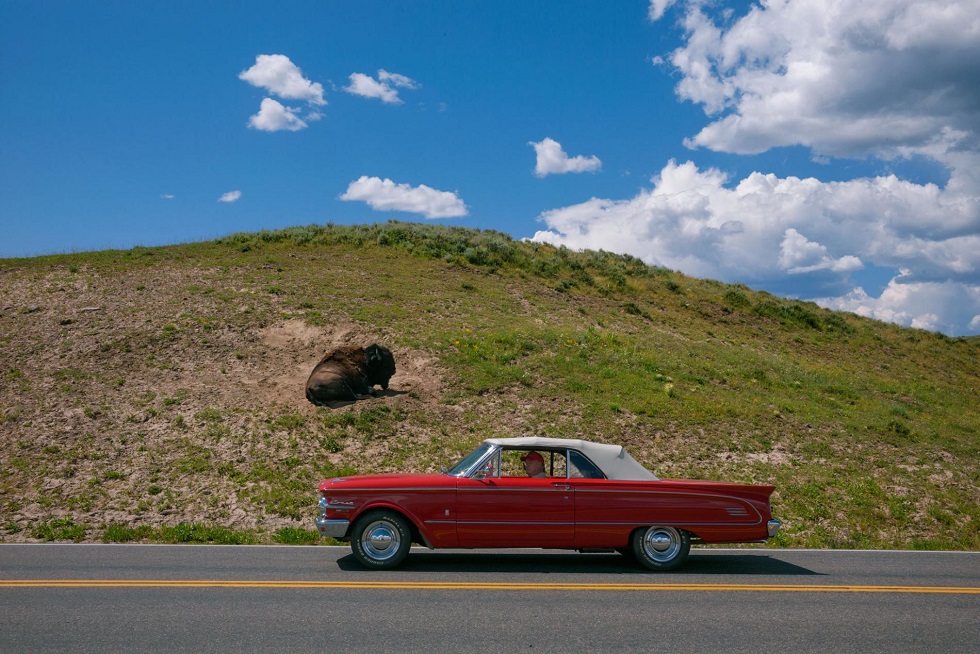
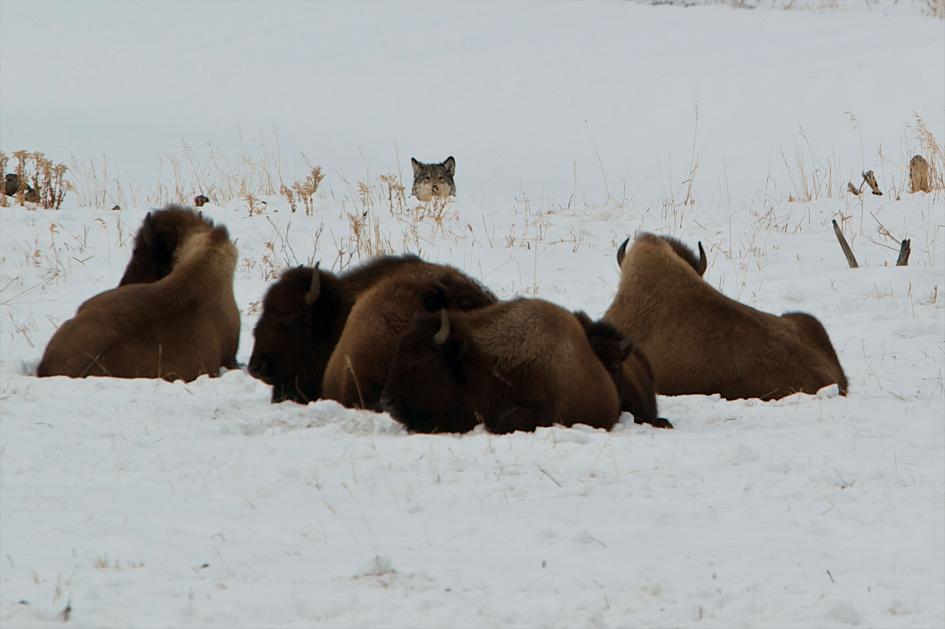
Hungry Wolves in Yellowstone


Grand Tetons
Grand Tetons
A deep sea diver has captured life in the Caribbean like never before – by attaching a camera to the body of a hammerhead shark by hand.
Andy Casagrande, an award-winning wildlife cinematographer, captured the extraordinary scenes just off the coast of Bimini, in the Bahamas.
The GoPro camera stayed on the shark’s fin for almost three hours and took in a tour of the sea bed to give Mr Casagrande, 37, a unique viewpoint of the creature’s adventures.

Hammerheads routinely make top ten lists of world’s most deadly sharks, but it didn’t stop Mr Casagrande diving in to attach the camera.
Mr Casagrande, who has worked with sharks for 15 years, said he hoped the footage would help give a greater understanding of hammerheads’ natural lifestyle.
He said: ‘Bimini is the worldwide hot spot for hammerheads so we knew we had a chance of getting some good shots. I’m fascinated by the secret life of sharks and I’ve wanted to film them on the GoPro for some time.
‘It was actually more of a struggle than I thought it might. I had to grab the shark’s head to stabilise it and then take a chance with attaching the GoPro.
‘Hammerheads are quite a timid shark usually but this one was hard to get close to.
‘We have to build up trust but it’s pretty awesome just getting up close and observing these guys. When it finally came close enough I put the camera’s clamps around the dorsal fin and off it went.
‘The clamps are harmless because they’re designed to dissolve in salt water after a few hours.’
Mr Casagrande then sat back and waited for the GoPro to release itself and tracked it hundreds of metres away using a high-frequency radio.
The device – a GoPro Hero 4 provided by his sponsors – had floated to the surface of the crystal-clear water and the footage was edited at his home in the U.S.


Mr Casagrande, who lives with wife Emma, 32, and their two children in Naples, Florida, dismissed some online critics who claimed that the project was harmful to sharks.
Mr Casagrande, an Emmy award winner with more than 100 wildlife filming credits to his name, said: ‘I’m trying to engage people to care about sharks and conservation. The whole reason I got into this was because I care about sharks.
‘This was 100 per cent non-invasive. It seemed pretty chilled out once the GoPro was on. It just turned on its side and took off.
‘I deployed it on a few of them and this one just stuck. It cruised all around the area.
‘Bimini is a pretty small island but it went out to some deeper water and through some pretty different habitats. I’m really happy with the footage and I’d love to do more of this.’
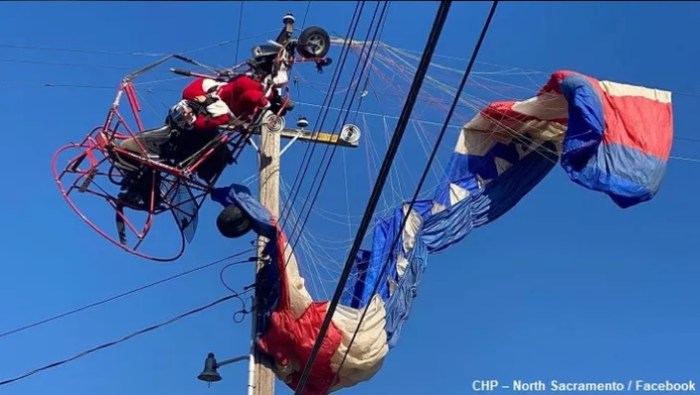
A California man clad in a Santa Claus costume and strapped to a paraglider wound up needing to be rescued by firefighters after his ride went wildly awry. The bizarre yuletide incident reportedly occurred in the community of Rio Linda on Sunday morning when the unnamed individual took to the skies over the town with the intention of distributing candy canes to local children. Shortly after takeoff, however, the powered parachute suffered a malfunction and the faux Saint Nick’s journey hit a literal snag when he was swept up in some power lines.
Initially thinking that perhaps the strange calls about Santa being stuck in some power lines were a prank, police eventually realized that the reports were genuine and dispatched firefighters to go and save the man who was dangling upside down over a road. As one might imagine, the weird scene drew quite a crowd as resident Colleen Bousliman marveled that “half the town was down here,” including several children hoping to catch a glimpse of the elusive Father Christmas.
Fortunately, the youngsters were spared the therapy-inducing scenario of seeing Santa Claus fried by some power lines as firefighters cut the electricity to the area and safely brought the jolly pilot, who was uninjured in the event, back down to terra firma. “It’s a good thing they caught him, but didn’t electrocute him,” Bousliman said in what may be the understatement of the holiday season. Reflecting on the “unfortunate” incident, firefighter Chris Vestal commended the man for wanting to spread some cheer in the community by way of his well-intentioned, but ill-fated candy cane misadventure.

Amber Waves
April Fills
Lance Romance
Punnani Lova
Pimpin Hairpies
Michael J. Cocks
Buck Naked
Beverly Hills
Peter North
Dixie South
Bronc Johnson
Lance Alot
Johny Cockring
Harry Dickensider
Jack Hammer
Billy Club
Dick Fitzwell
Miles Long
Betsy Onnerback
Alfred Hugecock
Buster Hyman
Ivana Bigone
Ivana Spankin
Lady Likesitfast
Mike McCrank
Sharon Partners
Sharon Peters
Sharen Cox
Holden McGroin
Ben Withmany

Johnny Depth
Lott O’Toole
Cherry McGee
Holden McGroyne
Poke My Hontas
Dick Rambone
Rocky Balboner
Bill Clitton
Ben Dover
Cherry Poppins
Rod Longstaff
Justine Beaver
ABC News’ David Wright, Bonnie McLean and Lauren Effron report:
Just down the road from Area 51, the infamous U.S. military base in Nevada, where top-secret alien autopsies were supposedly conducted, is a new business.
It’s a galactic-themed brothel that brings to life sci-fi geeks’ wildest fantasies, incorporating sex into an array of settings from famous sci-fi films and TV shows. It’s what you might call the XXX-Files. And it’s legal.
“The Trekkers are going to line up for miles,” said owner Dennis Hof.
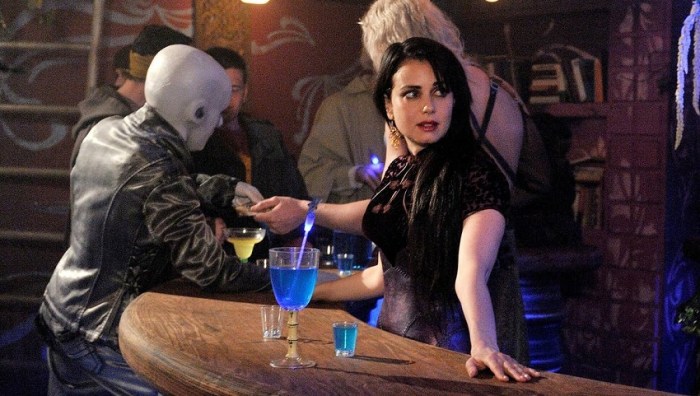
Hof is already the most successful brothel entrepreneur in the state, were prostitution is legal. His Moonlite Bunny Ranch in Carson City, Nev., is the most profitable brothel in the country and is featured on HBO’s “Cathouse.”
Hof believes he has a new Nevada gold mine in this alien-esqe “Cathouse” idea, and he imagines his new brothel will be something like the bar from “Star Wars.”
And for the right price, any “Star Wars” enthusiast can spend a steamy moment with Princess Leia dressed in chains and her iconic gold bikini. If they prefer, clients can also dress up – as Darth Vadar – and have their way with a lady in a Storm Trooper costume.
In a landscape that already looks a bit like the Star Wars planet Tatooino, it is truly the middle of nowhere, the brothel property also houses a gas station, a truck stop and a convenience store.
While the place is still under construction, Hof said he has big plans. He wants to build a “Captain Kirk” room that would have the actual chair from the Starship Enterprise used in the TV series “Star Trek.”
Hof’s muse and partner in this particular enterprise is his old friend Heidi Fleiss, the former Hollywood Madame who was arrested in the ’90s for running a high-price prostitution ring. Now she fashions herself as the alien Madame, right down to designing and ordering skimpy spacesuit costumes and props for the employees. She draws some of her inspiration from an unusual film choice: “Avatar.”
“You want sexy, ‘Avatar’ sexy aliens,” she said. “Sexy aliens that’s the way we are going.”
While some critics might say the brothel exploits women, or that some things, like “Star Trek,” are just too sacred to be messed with, Hof and Fleiss aren’t fazed.
“In a way it’s always fun to have those people against you,” Fleiss said. “It does make you rise up a little bit and grow to a higher level in way.”
And Hof is convinced he will have plenty of customers, such as guys like on the hit TV show “Big Bang Theory,” whose sexual fantasies run towards “Battlestar Galactica.”
“A lot of our business at the Bunny Ranch is gamers,” Hof said. “Because of the computers and because of games men sometimes don’t develop the social skills that they used to.”
And those guys might well need the confidence boost that comes from a costume.
“The biggest sex organ is right here – it’s all in our head,” Hof said. “It’s not as much physical as it is mental, and the fact that you can try living out fantasies- it doesn’t hurt anybody. You just have a little fun, and then you go home.”

A talented chainsaw artist in South Dakota has created what is believed to be the world’s tallest wooden Bigfoot sculpture. According a local media report, the monstrous piece was unveiled over the weekend at the community of Keystone’s ‘Bigfoot Bash’ event. The man behind the enormous Sasquatch is Jarrett Dahl, who began fashioning the individual parts of the sculpture out of pieces of pine, cedar and cottonwood back in October. Alongside a crew of workers from Kentucky, he assembled the complete sculpture over the course of eight days.
At the ‘Bigfoot Bash,’ the Keystone Chamber of Commerce measured the artwork and determined that it is “exactly 22.8 feet from sitting on his butt to the top of his head.” The epic size of the statue has the community feeling confident that can now boasting having the “world’s largest wooden chainsaw sculpture of Bigfoot.” While they very well may hold that specific record, it’s worth noting last month’s unveiling of ‘Gasquatch’ in Oklahoma, which measures a whopping 30 feet tall and, therefore, likely still holds the title for the world’s tallest depiction of Bigfoot.
Whether or not you believe in Bigfoot or Sasquatch, there’s no denying that the existence of this half-man/half-beast has been the subject of conversation for the better part of 180 years when reports of this creature first surfaced in the Pacific Northwest back in the 1840s.
And while there’s never been any definitive proof of Bigfoot, except for a grainy photograph or shaky home movie, one thing is certain – all 50 states (except Hawaii) have reported sightings over the years – including South Dakota.
According to numbers compiled by the Bigfoot Field Researchers Organization (BFRO), the Mount Rushmore State is on the board with 19 reported Bigfoot encounters over the years.
And while that number may be disturbing to some, it’s among the fewest sightings in America, the ninth-lowest to be exact.

Just a reminder, experts estimate that for every reported sighting there are 2-3 sightings that go unreported. Some people don’t want the ridicule.

Hurling is an outdoor team game of ancient Gaelic and Irish origin, administered by the Gaelic Athletic Association (GAA). The game has prehistoric origins, has been played for over 3,000 years. One of Ireland’s native Gaelic games, it shares a number of features with Gaelic football, such as the field and goals, the number of players, and much terminology.
The objective of the game is for players to use a wooden stick called a hurley to hit a small ball called a sliotar between the opponents’ goalposts either over the crossbar for one point, or under the crossbar into a net guarded by a goalkeeper for one goal, which is equivalent to three points. The sliotar can be caught in the hand and carried for not more than four steps, struck in the air, or struck on the ground with the hurley. It can be kicked or slapped with an open hand (the hand pass) for short-range passing. A player who wants to carry the ball for more than four steps has to bounce or balance the sliotar on the end of the stick and the ball can only be handled twice while in his possession.

No protective padding is worn by players. A plastic protective helmet with a faceguard is mandatory for all age groups, including senior level, as of 2010. The game has been described as “a bastion of humility”, with player names absent from jerseys and a player’s number decided by his position on the field.
Hurling is played throughout the world, and is popular among members of the Irish diaspora in North America, Europe, Australia, New Zealand, South Africa and Argentina, and South Korea. In many parts of Ireland, however, hurling is a fixture of life.


Seen out of context, it looks like a ship silently slinking under the waves, like the final scene in a disaster movie.
But have no fear, this is simply a very special U.S Navy ship, taking a ‘flip’ as it celebrates 50 years of cartwheels.
With an ability to drift over the ocean like a ship – yet transform into a vertical buoy in pursuit of scientific research – the Navy’s Floating Instrument Platform (FLIP) is one of the most unique ships on (or under) the water.

Ready to flip: This ship looks fairly conventional at this point – but see what happens next..

Up and away: The Floating Instrument Platform begins to rise out of the water

Lifting… Lifting… If you look closely, you can see crewmembers leaning back on the top of the ship

…And vertical: The ship stands tall in the water, looking like a ship that is about to slip under the waves
The ship conducts investigations in a number of fields, including acoustics, oceanography, meteorology and marine mammal observation.
Dr Frank Herr, head of ONR’s Ocean Battlespace Sensing Department, said: ‘FLIP’s unique characteristic of a low-profile, stable observational platform has proven particularly useful over the years.
‘It will continue to be a research vessel of choice for our naval scientists.’

What makes the vessel so special is that it can partially submerge like a sinking ship by filling ballast tanks in its stern with water.
When in its vertical position, FLIP’s visible floating platform extends 55 feet above the ocean surface while the rest of the hull reaches 300 feet below the water.
Because so much of the vessel is submerged when it sits upright, the platform is impervious to the ocean waves, providing a stable environment for researchers to do their work.
‘I’m so thankful that ONR and Scripps have been able to maintain FLIP as an active platform,’ said Dr. C. Linwood Vincent, a recently retired ONR division director who managed a number of projects that employed the vessel.
Now on the faculty at the University of Miami, Vincent added, ‘It would be very difficult to conduct these studies on a rocking ship.’
Built in 1962, the steel-hulled platform accommodates 11 researchers and a crew of five for up to 30 days.
It does not have its own propulsion and must be towed to research locations in the ocean, where it ‘flips’ into vertical position in approximately 20 minutes.
FLIP, designed by Scripps scientists Fred Spiess and Fred Fisher, operates in two modes, drifting with the currents or moored to the sea floor, and supports the deployment of a variety of sensors and instruments.
‘FLIP was originally designed to study underwater acoustics – the bending of sound,’ said William Gaines, the program manager at Scripps.
‘In recent times, we’ve done a lot of the marine mammal research because FLIP has the ability to be very quiet in the vertical position. We can place hydrophone arrays far below the surface and put marine mammal observers up top to correlate the signals from the animals to the visual observations.’
In 2010, researchers used FLIP for a set of experiments called High Resolution Air-Sea Interaction project, which measured wind and swell conditions. That data is helping to improve weather models and other ocean-atmosphere databases.
‘FLIP was the pivotal platform for that project, which also included research done by traditional research ships and remotely piloted aircraft,’ said Tim Schnoor, the program officer who oversees ONR’s research vessel programs.
Naval Research Laboratory scientists recently employed FLIP for oceanographic work using lasers. Additional studies are in the works, and FLIP will continue to support scientists in their research endeavors.
‘It’s in good material condition,’ said Schnoor. ‘We’ve continued to invest in maintenance and preservation of the platform, including taking hull thickness measurements to ensure hull integrity. There’s no reason it can’t continue to serve research needs as long as we have users to exploit her unique capabilities.’

No detail overlooked: Naturally, if you need a toilet break when the ship is vertical, you will need a different sink – and be careful to pack your toiletries up properly



 The MarkoZen Blog