Areas of the World where there are no Snakes

Growing up on a farm in rural Manitoba I encountered garter snakes many times. Even though the little varmints are harmless as a flea, I would almost jump out of my skin when I noticed the creepy crawly.  It was the slippery motion through the grass that was so bizarre and unsettling.  It would take 5 minutes before my nerves settled.  However I found out that there are places on the planet with no indigenous snakes. Snake-less nirvana.


Top places with no snakes:


Newfoundland

asnake1


Newfoundland, the remote province on the Canadian east coast, is a great place to go because it’s blessed with no native snakes whatsoever. The island was completely frozen over during the last ice age and so had to go through a big phase of species recolonization in its aftermath. Many animals came to Newfoundland and prospered, snakes however did not. Several garter snakes have been spotted in recent times unfortunately but it is unclear whether they were introduced, maybe as an extravagant pet or snuck in in crates or imported hay bales.


Hawaii

asnake2


Hawaii is a snake-haters paradise. Beautiful rainforests and warm climates are normally laden with snakes, but not in Hawaii. The islands may be a U.S. state but they’re very remote geographically, making it impossible for snakes to slither/swim there That was until a few decades ago anyway. Pre-1980s Hawaii was excellent for avoiding snakes, 1980s Hawaii onwards not so much. An increased number of imports at that time resulted in some unwelcome stowaways arriving in shipping containers and inadvertently Hawaii welcomed species like the poisonous brown tree snake to its shores. There’s actually also one native snake but it’s not on land, the yellow-bellied sea-snake is occasionally recorded off the Hawaiian coast although chances of seeing one is unlikely.


Ireland

asnake3


The lack of snakes in Ireland isn’t just common knowledge, it’s legendary. According to folklore, St Patrick supposedly chased all the snakes out in around A.D. 400 and made quite a name for himself in the process. Scientists will tell a different story, something to do with an ice age, a vanishing land bridge and snakes being cut-off in Scotland by the sea. The 90’s messed that up however, snakes became popular as status symbols in the good times but when the economic downturn hit, many were simply released into the wild. Yet despite the odd news story surfacing about a rogue tame rattlesnake or viper slithering around, Ireland is a good place to be for snake-fearers. There’s actually only one reptile native to the entire Emerald Isle, the harmless viviparous lizard.


Cape Verde and the Azores

asnake4


In the North Atlantic, there are two great candidates for snake-free paradises. Sovereign state Cape Verde and the Portuguese-governed Azores are blessed with no native snakes, despite their sunny climate and tropical vibes. This is entirely down to their distance from the mainland, Cape Verde is far enough west of Africa to not have any snake infestations while the Azores are far enough west of the European mainland. So what’s the catch? Well, there isn’t one. Not yet anyway. But stories from similar islands serve as a warning about what could happen if controls don’t hold firm, the Canary Islands for instance being blighted by a major influx of imported Californian king snakes.


New Zealand

asnake5


Remarkably, despite its size and subtropical climate, New Zealand is completely absent of snakes on land. This is down to the islands’ very remote nature, continental drift pushed the country far out into the Pacific many millions of years ago, well out of the reach of the serpents lingering on big land masses like Australia. In order to preserve its fragile endemic wildlife, the New Zealand authorities make sure to keep it that way and take their no snakes policy very seriously. It’s strictly prohibited for anyone to keep a snake and a jail sentence may await for anyone looking to rebel. Regrettably, although the land laws are very much anti-snake, not much can be done about any sea snakes lurking around the coasts. Thankfully though sightings are rare and only two species have ever been recorded in New Zealand’s oceans, the yellow-bellied sea snake is seen infrequently and the other, the banded sea krait, is incredibly rare.

This is strange considering New Zealand’s neighbour to the northeast, Australia, is infested with every type of poisonous killer snake ever imagined. The poor Aussies also have to deal with big fat grumpy pythons that bite and try to strangle people to death.


Iceland

asnake6


A small, isolated, island nation in the Atlantic, Iceland is one of the very few places on Earth that never encounters a wild snake. That is unless you choose to believe in the mythical serpent-like Lagarfljótsormur creature of course, which has supposedly been spotted swimming around the country’s lakes since A.D. 1345. Tall tales aside, Iceland is probably never going to have any snakes and if any did somehow make it there, it’s not likely they’d survive long in the cool climate. Escaped pets aren’t even an issue here, exotic animals (and therefore reptiles) are banned and it’s a law that’s rarely broken.


Antarctica

asnake7


Perhaps an obvious number one but for good reason. The only continent without reptiles, Antarctica is the coldest place on Earth and so not exactly the most welcoming of environments. There’s no way a snake could warm itself up there (even at the height of summer) and because there are no resident human populations on Antarctica, there are no homes from snakes to escape from. The difficult thing (aside form the cold) is finding a way of being able to stay there. The only people really able to enjoy the 365-day a year snake-free lifestyle are scientists so if you’re desperate enough to avoid snakes, a career in glaciology or polar biology is probably the best way to go.


Check out any of these places if you want to avoid snakes.  No worries about dying a brutally painful death from toxic poison. Or meeting your maker in the manner below:


anaconda-1997-movie-review-jon-voight-serone-eaten-by-snake


Multifarious Photos

space2 Cuanza river, angola cambambe dam

Cuanza River, Angola


africa


boom

Sonic boom


red fukishima japan

Fukishima, Japan


red omaha fire

Mounted cop in Omaha, Nebraska riding past a burnt out bar.


red quebec

Tobogganing in Quebec City


red

Yellowstone Bison


construct

Canadian construction workers in Winnipeg, operating in -30 Celsius blistering temperatures.


red1

Psycho wave


red2

London


red3 norway

Sculpture monument in Norway.


rio

Rio


russia_parade

Moscow military parade.


space1 colorado river

Colorado River from space.


space5 crotia galesnjak island of love

Island of Love, Croatia.


space7 namib desert namibia sossusville area

Namibia sand dunes from space.


step

Mountaineering in the Andes.

Bela Lugosi: a man of many monsters

Béla Ferenc Dezső Blaskó (20 October 1882 – 16 August 1956) commonly known as Béla Lugosi, was a Hungarian actor of stage and screen.  He was best known for playing Count Dracula in the Broadway play and subsequent film version. In the last years of his career he was featured in several of Ed Wood’s low budget films.

But Bela wasn’t limited to playing the handsome and hypnotically charming blood-sucker.  Although this was and is his trademark role.

In Son of Frankenstein Lugosi played the grunting assistant Ygor opposite Boris Karloff and Basil Rathbone.


In 1943, he played the role of Frankenstein’s monster in Universal’s Frankenstein Meets the Wolfman.


Bela played another homicidal maniac in The Ape Man 1943.


Bela Lugosi was however most associated with the cunning vampire. He recreated the role of Dracula a second and last time on film in Abbott and Costello Meet Frankenstein in 1948.


Late in his life, Béla Lugosi again received star billing in movies when filmmaker Ed Wood, a fan of Lugosi, found him living in obscurity and near-poverty and offered him roles in his films, such as Glen or Glenda and as a Dr. Frankenstein-like mad scientist in Bride of the Monster.


Bela Lugosi appeared in approximately 200 movies. The early ones were made in Hungary while the last two thirds were American productions.  He played dozens of fiends, ghouls, ghastly creatures and monsters. Truly a superstar in the world of horror entertainment.

Crikey Mate Bloody Close Call

Australian Man Fends Off Venomous Snake While Driving

Video below

In a wild story out of Australia, a motorist was forced to fend off a venomous snake that appeared in his truck as he was speeding down the highway. According to a report from the Queensland Police, the incredible incident occurred last month as a driver identified only as ‘Jimmy’ was cruising down the road at approximately 76 miles per hour. The drive took a terrifying turn when he noticed that an eastern brown snake, one of the world’s deadliest species of venomous snakes, had somehow gotten into his vehicle and was lingering near his feet.

His attempts to stop the truck seemed to agitate the deadly animal and it began striking at the driver’s seat. Amazingly, Jimmy continued driving the vehicle at a high rate of speed while simultaneously fighting off the snake with a seat belt and a knife. Eventually he managed to kill the creature, but by then he was convinced that it had likely bitten him during the chaotic tussle. Concerned that he had mere moments to live, Jimmy put the pedal to the metal and sped down the highway towards the nearest hospital.

Shortly thereafter, he was stopped by the highway patrol and, when asked why he was driving so fast, shared the harrowing story with the attending officer, who was initially incredulous until he saw the dead snake in the back of the truck. The cop subsequently called for an ambulance and medical personnel quickly arrived on the scene. Fortunately for the shaken driver, they determined that he had not been bitten by the creature and was only suffering from shock over what he had just experienced.

Exotic Animal Ranches that Offer Hunting

Only in Texas, this is just too crazy!

Beyond Joe Exotic: On a private ranch in Texas Hill Country, about 30 scimitar-horned oryx gallop across a field. This is more than exist in the wild. Welcome to the $2 billion exotic animal ranching industry, where an adult female Cape buffalo or giraffe could sell for $200,000. Not all ranches offer hunting, but it’s what underpins the industry—customers pay big fees to shoot rare, exotic animals without having to travel abroad. Under the law, these exotic animals are considered private property, in the same category as livestock. Ranchers and hunters argue that there’s conservation value in these herds as “insurance populations,” but it’s a claim many conservationists and animal advocates reject, Nat Geo’s Douglas Main reports. Pictured above, Brian Gilroy, owner of an exotic wildlife ranching business, feeds giraffes in Mountain Home, Texas.

National Geographic

Some of the Best Bigfoot Videos

If this Sasquatch creature does exist, how does it stay so well hidden for so long? It has utterly amazing abilities of stealth and concealment.  But it does get photographed and videotaped. Footprints are found that have dermal ridges very similar to great apes. Thousands of witnesses. Many of the eye witnesses sightings are probably misidentified stumps, logs and bears etc.

But many witnesses are law enforcement people, university professors, doctors, game wardens and just average people that have nothing to gain by reporting a sighting. Just the opposite, by coming forward and admitting that a they saw one of these creatures, it opens up the witness to ridicule and the subsequent grief that comes with that. One investigator put forward the thesis that only 10-20 percent of people who see these things report it. Therefore there are many thousands of eye witness sightings that go unreported. If you were by yourself and you saw one of these big hairy monsters, would you say anything? The Bigfoot phenomenon is confusing, mysterious, illogical and just plain weird.


The Silver Star Mountain sighting from a few years ago in Washington state.

biggy1

biggy3

biggy5

The Silverton, Colorado train sighting from 2011.

train

train1

The Masked Women of Iran

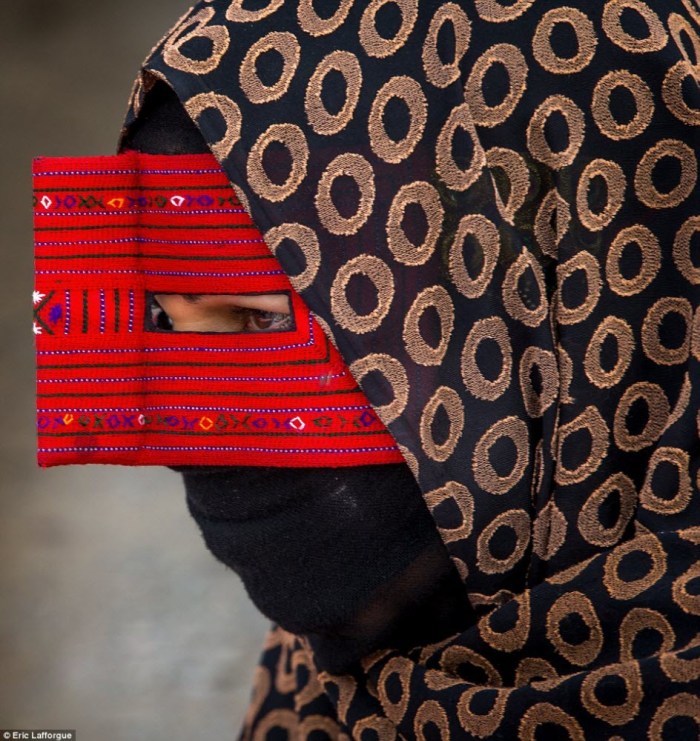
Head covering, veils and burqas are common sight among many Muslim communities around the world. There are a lot of different styles and each have their own name, but none of these come even remotely close to the vibrancy of the boregheh mask.

These colorful masks are donned by the women of the Hormozgan Province in southern Iran. They are available in a variety of shapes and styles, but the most common ones are rectangular, pinched between the eyebrows to create a sort of vertical wall running along the bridge of the nose and across the forehead. A rectangular slit over the eyes allows the wearer to see. They are most gorgeously decorated with embroidery and beads.

boregheh mask

Photo: Eric Lafforgue

The styles usually vary according to region, ethnicity, and religious affiliation. Shia women wear red rectangular masks, while those of Sunni women are black or indigo with gold and of less geometric shapes. One peculiar design is shaped like eyebrows and moustache. It is said that this mask was designed centuries ago as a ruse to fool potential invaders into thinking that the women they spied from a distance were in fact men.

The masks are thought to have practical and cultural purposes. They shield the skin and the eyes from the sun which can be very harsh in the Persian Gulf.

The masks are worn by young girls as soon as they hit puberty. They are also worn at social events and gatherings.

These pictures were captured by photographer Eric Lafforgue, who spent time travelling around to meet the women who make and wear these masks.

boregheh mask

Photo: Eric Lafforgue

boregheh mask

Photo: Eric Lafforgue

boregheh mask

Photo: Eric Lafforgue

boregheh mask

Photo: Eric Lafforgue

Sleuth finds the truth in ghost stories

ghost

A scene from the 2008 movie “Shutter” shows a ghostly shape in a photo.


Paranormal investigator Joe Nickell has busted a lot of ghostly myths over the past 40 years — but the spookiest part of his job comes when he actually catches a ghost red-handed.

No, we’re not talking about spirits of the dead: These “ghosts” are hotel clerks who flick the lights to keep the guests talking about the place’s ghost story. Or a mischievous child who plays tricks on his parents. Or maybe a camera crew catching weird-looking “orbs” floating through the frame — orbs they didn’t notice until they looked at the pictures later.


“Much of what so-called ghost hunters are detecting is themselves,” Nickell, the author of “The Science of Ghosts,” told me this week. “If they go through a haunted house and stir up a lot of dust, they shouldn’t be surprised if they get a lot of orbs in their photographs.”

The orbs are actually out-of-focus reflections from a camera flash, created by dust particles floating in front of the lens. The clumping noises that ghost hunters hear often turn out to be the footsteps of crew members elsewhere in the building, or even someone on a stairway next door. And those weird readings they pick up with thermal imagers? They’re typically left behind by the flesh-and-blood visitors.

A tough job
Tracking down the truth behind spooky sightings is a tough job, but somebody’s got to do it, Nickell said.

“It takes only a moment for someone to say that they saw something,” he said, “but it can take a huge expenditure for someone to fly somewhere, and they might never re-create that one little moment.”


ghost1

Paranormal investigator Joe Nickell appears to be surrounded by an aura in a photograph that was created to duplicate a spooky effect.


Nickell, a former professional magician and detective, has been that someone for Skeptical Inquirer magazine and the Committee for Skeptical Inquiry since the 1970s. “I’ve been in more haunted houses than Casper,” he joked. And the truth is that there are worse jobs in the world.

“I wouldn’t want anyone ever to know this, but it really is a great deal of fun to do what I do,” Nickell said.

In “The Science of Ghosts,” Nickell spins a series of tales about his worldwide travels. His first haunted-house investigation, in 1972, took place at Toronto’s Mackenzie House, where residents reported seeing apparitions hovering over their bed, and hearing footsteps when no one else was in the house. Nickell ascribed the apparitions to “waking dreams,” a phenomenon that leads people to see things when they’re half-asleep or in an idle reverie. And as for those footsteps: Nickell found out that there was an iron staircase in the building next door. The strange sounds were traced to a late-night cleanup crew tromping up and down those stairs.

Nickell learned a lot from that first case. “You must go on site, and you must investigate just like any other piece of detective work,” Nickell said. “You can treat the house as a sort of crime scene.”

Other cases involved spirit photographs, such as the ones that show orbs or bright streaks. One family called Nickell in to explain a series of pictures that showed bright, hazy loops of energy in the foreground. Nickell eventually figured out that the loops were created when a flash bounced off a camera strap dangling in front of the lens. “Now we know about the camera-strap effect,” Nickell said.

Taking on TV psychics
Nickell also takes on psychic mediums who claim to speak with the dead. In the book, he traces his encounters with TV-show medium John Edward, who uses so-called “cold reading” techniques to draw information out of a crowd. (For example, “I feel like someone with a J- or G-sounding name has recently passed. …”)

“The people who profess to be able to talk to the dead tend to be either fantasy-prone personalities, or charlatans, or possibly a bit of both,” Nickell declared. “They would be harmless if they didn’t mislead so many people.”

Nickell totally understands why a belief in ghosts and the afterlife is so important to people. “If ghosts exist, then we don’t really die, and that’s huge. … It appeals to our hearts,” he said. “We don’t want our loved ones to die. We have this whole culture that we’re brought up with, that encourages this belief in ghosts.”

Once a ghost story gets attached to a place or a situation, then almost anything that happens can be interpreted as supporting that story, he said. That’s one reason why ghostbusting can be a thankless job. Another reason is that it’s so hard to wrap your arms around the evidence — or, more appropriately, the lack thereof.

“No one is bringing you a ghost trapped in a bottle,” Nickell said. “What they’re offering is, ‘I don’t know.’ Over and over, they’re saying something like this: ‘We don’t know what the noise in the old house was, or the white shape in the photo. So it must be a ghost.’ These are examples of what’s called an argument from ignorance. You can’t make an argument from a lack of knowledge. You can’t say, ‘I don’t know, therefore I do know.’… If I could just teach people a little bit about the argument from ignorance, I think we could give the ghosts their long-needed rest.”

People love to believe in this type of stuff. But if you use your logic and common sense it becomes apparent that there is absolutely, without a doubt, no solid evidence to support ghost claims.  Just watch Ghost Hunters and this lack of evidence becomes crystal clear.


creep2

If only this was real. It would make reality so much more exciting!