Congress Finally Allocates Limited Funds for Trump’s Great Wall

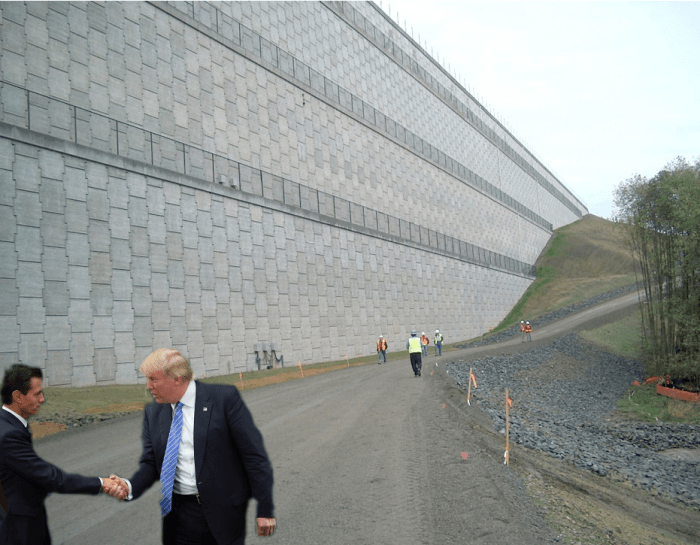
The US Congress has started to provide money for Trump’s Mexican wall. In a unanimous decision yesterday the House of Representatives and the Senate allocated $650.00 towards Trump’s pet project. Trump tweeted: “This is the beginning of a fabulous project, a project that will make America safe again. A first class initiative, a beautiful great wall. … A wall like no other wall, nothing sad about this wall, there will be no leaking through this wall. Nice!”

Photo of the placing of the first pieces of the “Great Wall”.

wall3

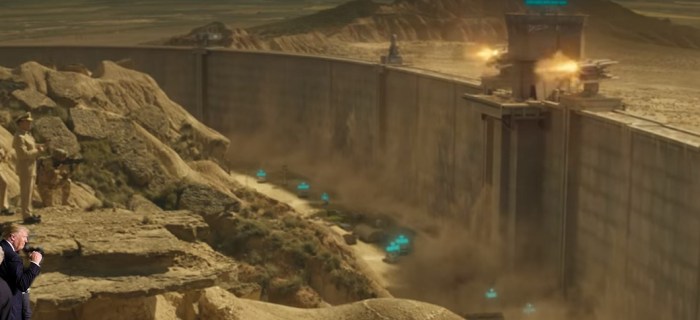
The Wall in the deepest recesses of Trump’s mind.

wall11

wallxxxx

The Mail Must Get Delivered

The Grumman C-2 Greyhound is a twin-engine, high-wing cargo aircraft, designed to carry supplies and mail to and from aircraft carriers of the United States Navy. Its primary mission is carrier onboard delivery (COD). The aircraft provides critical logistics support to carrier strike groups. The aircraft is mainly used to transport high-priority cargo, mail and passengers between carriers and shore bases, and can also deliver cargo like jet engines and special stores.

grey

grey2

grey3

grey5

Role Carrier-capable transport / Carrier onboard delivery
National origin United States
Manufacturer Grumman Northrop Grumman
First flight 18 November 1964
Introduction 1966
Retired 1987, C-2A
Status 39 C-2(R) in service
Primary user United States Navy
Produced C-2A: 1965-1968 C-2A(R): 1985-1989
Number built 58
Unit cost
US$38.96 million
Developed from Northrop Grumman E-2 Hawkeye

Saskatchewan Roughriders Sleek New Stadium

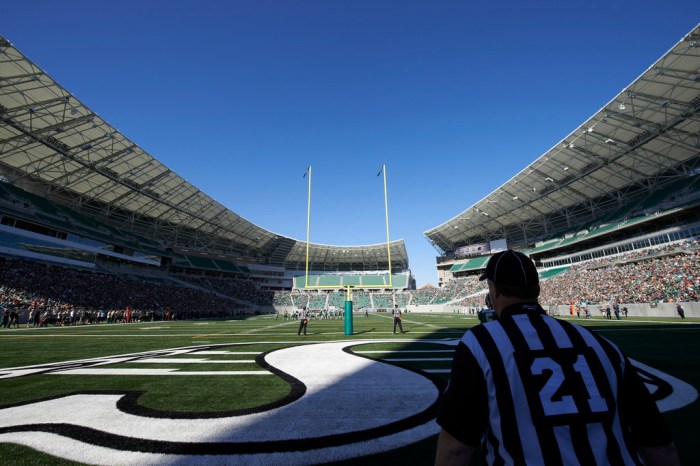
The Roughriders are a team in the Canadian Football League. They play in the western conference and are based in the capital city of Saskatchewan, Regina. They are unveiling a  new stadium this year.

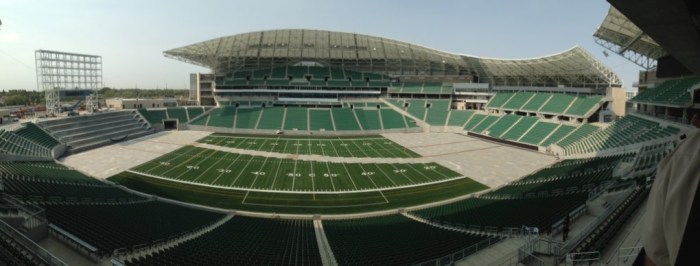
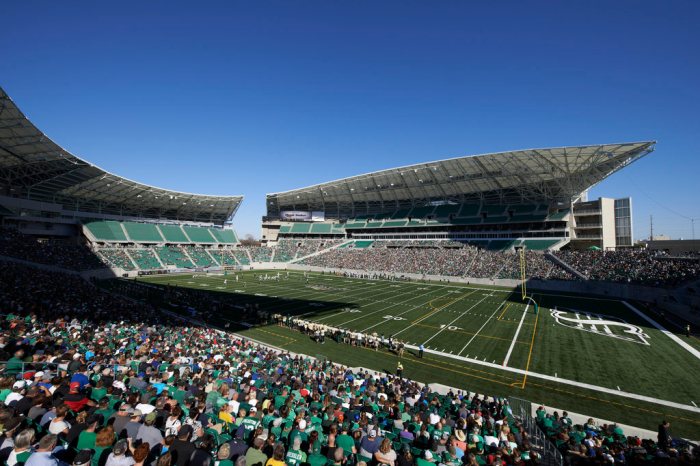
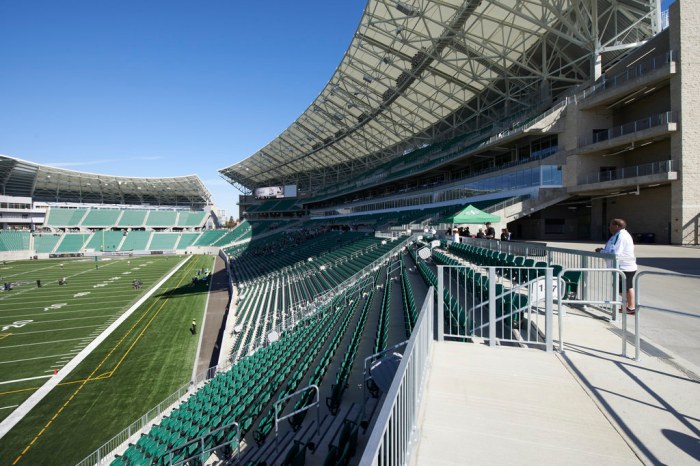
Mosaic Stadium is an open-air stadium in Regina, Saskatchewan. Announced on July 14, 2012, the stadium replaced Mosaic Stadium at Taylor Field as the home field of the Canadian Football League’s Saskatchewan Roughriders.

mosaica

Capacity 33,000 (expandable to 40,000 for special events)
Surface FieldTurf Revolution 360

mosaic1

mosaic2

mosaic3

mosaic4

mosaic5

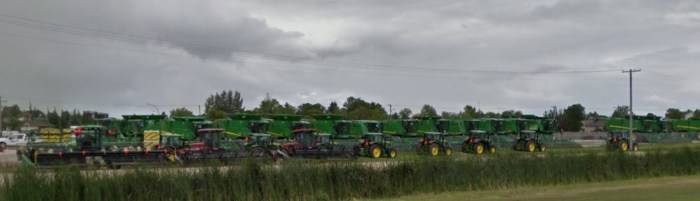
The fans of the Roughriders are mostly farmers. Saskatchewan is a predominately agricultural society and thus economy. And those farmers and cattle ranchers love their Riders. When a game is on they hightail it to the big city of Regina to cheer them on.

The parking lot of the stadium shows the demographic of the fans and the vehicles they drive.

Below are some shots of the parking lots around the stadium during the first game that was played late last year.

Parking lot Alpha

mosaic9

Parking lot Zulu

mosaic6

Parking lot X-ray

mosaic7

If the pickup won’t start, those stubble jumpers will leap into the tractor or combine to make the game.

Hissing Geese and possible Bigfoot sighting

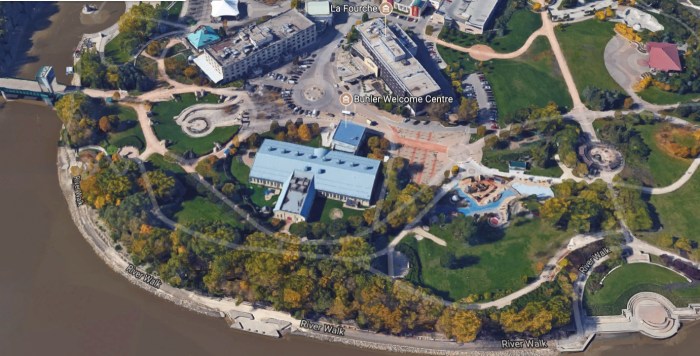
I took a walk to The Forks today. The Forks is a historic site, meeting place and green space in Downtown Winnipeg located at the confluence of the Red River and Assiniboine River. For at least 6000 years, the Forks has been the meeting place for early Aboriginal peoples, and since European contact has also been a meeting place for European fur traders, Métis buffalo hunters, Scottish settlers, riverboat workers, railway pioneers and tens of thousands of immigrants.

Forks

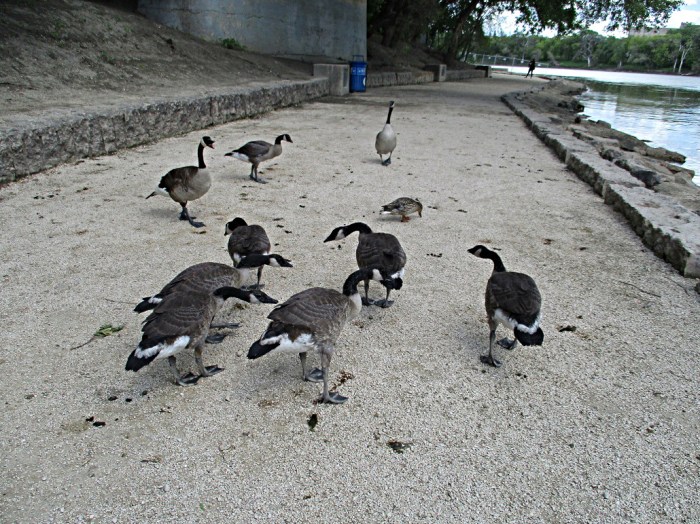
While on the River Walk came across some feisty geese.

The geese have claimed this area as their own.

goose

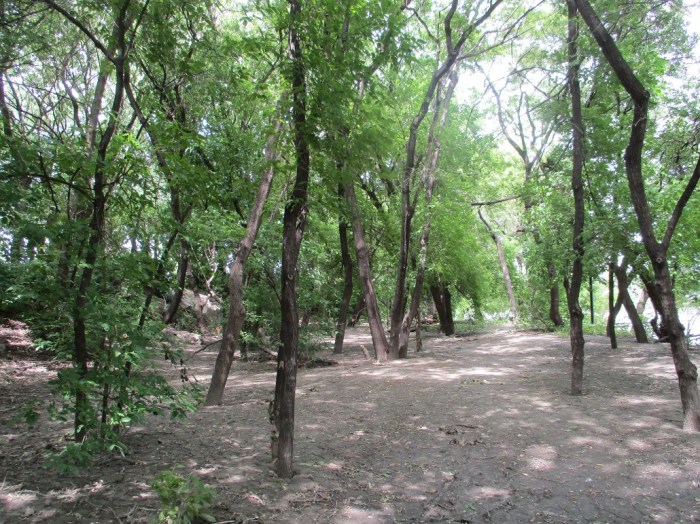
Further down I ventured into the forested river bank.

bank

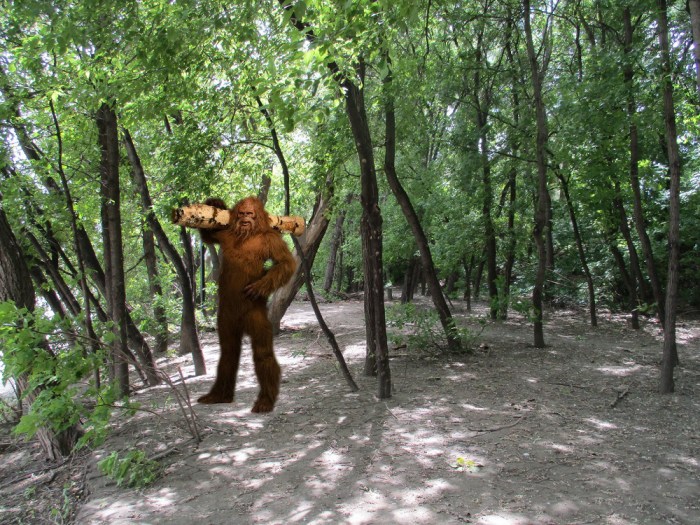
What I think I saw next nearly blew my mind!

squatchx

Standing there with a log on its shoulder was what appeared to be a reddish coated Sasquatch. Oh my Lord!

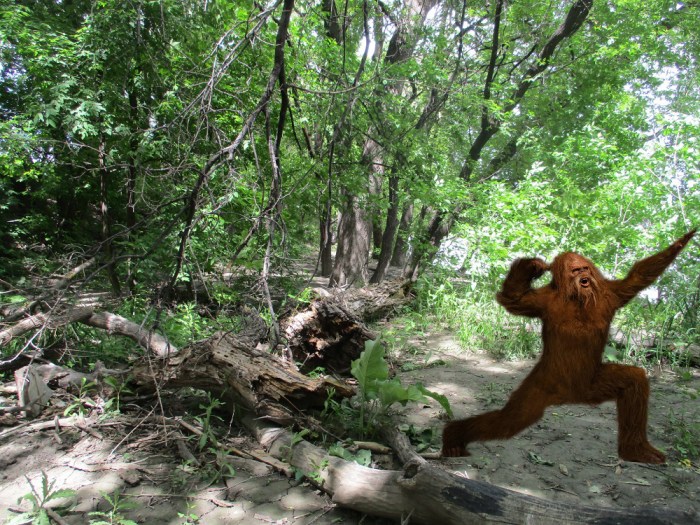
But that wasn’t it.

squatch1xx

An almost identical, but smaller Squatch doing what looked like Tai Chi!

Being a skeptic, I have to attribute these sightings to Pareidolia.  Pareidolia (parr-i-DOH-lee-ə) is a psychological phenomenon in which the mind responds to a stimulus (an image or a sound) by perceiving a familiar pattern where none exists.
Common examples are perceived images of animals, faces, or objects in cloud formations, the man in the moon, the moon rabbit, hidden messages within recorded music played in reverse or at higher- or lower-than-normal speeds, and hearing indistinct voices in random noise such as that produced by air conditioners or fans.

Whatever happened, it was an interesting and enjoyable day.


Heavy Lift Ships and their Incredibly Massive Cargoes

When you need to transport large cargo, goods, and materials from one place to another, the ship is the ideal choice even though they are extremely slow. Thousands of cargo carriers ply the world’s seas and oceans each year, and they handle the bulk of international trade. Then there are heavy lift ships that are designed to carry excessively large loads that even cargo ships cannot bear, such as other ships, drilling rigs or anything else too large or heavy to be easily transported on a conventional ship.

Heavy lift ships are of two types: semi-submerging capable of lifting another ship out of the water and transporting it; and vessels that augment unloading facilities at inadequately equipped ports. Semi-submerging are more commonly known as a “flo/flo” for float-on/float-off. These vessels have a long and low well deck that can go down under water allowing oil platforms, other vessels, or other floating cargo to be moved into position for loading. The tanks are then pumped out, and the well deck rises higher in the water, lifting its cargo, and is ready to sail wherever in the world the cargo needs to be transported.


 The world’s first heavy lift vessel was MV Lichtenfels (118 long tons; 132 short tons) constructed in the 1920s by the Bremen based shipping company DDG Hansa. After World War II, DDG Hansa became the world’s largest heavy lift shipping company. Today that title is owned by Dockwise which currently operates 19 heavy lift ships – the world’s largest fleet of semi-submersible vessels of various sizes and types.

The flo/flo industry’s largest customer base is the oil industry. They have transported many oil drilling rigs from their construction site to the drilling site at roughly three to four times the speed of a self-deploying rig.

In 1988, the heavy lift ship Mighty Servant 2 towed the guided missile frigate USS Samuel B. Roberts, which was nearly sunk by a naval mine in the central Persian Gulf. Eleven years later, MV Blue Marlin transported the U.S. guided missile destroyer USS Cole from Aden, Yemen to Pascagoula, Mississippi, after the warship was damaged in a bombing attack on 12 October 2000.

In 2004, Blue Marlin carried the world’s largest semi-submersible oil platform, 60,000 tonne semi-submersible production rig, Thunder Horse, over 15,000 nautical miles from Okpo, Korea to Corpus Christi, Texas.

Many of the larger ships of this class are owned by the company Dockwise, including Mighty Servant 1, MV Blue Marlin, and MV Black Marlin. The company is currently building another heavy weight named the Vanguard that will have 50% greater lifting capacity and 70% greater deck area than the largest heavy lift ship now in service, the Blue Marlin. At 275 meters (902 feet) long and 70 meters (230 feet) wide, the Vanguard can lift 110,000 tonnes and travel across oceans at 14 knots.


Dockwise Tern in the process of loading an oil platform


The heavy lift vessel MV Blue Marlin with its deck cargo of the Sea-Based X-Band Radar enters Pearl Harbor, Hawaii, after completing a 15,000-mile journey from Corpus Christi, Texas, on January 9, 2006.


MV Mighty Servant 2 carries USS Samuel B. Roberts from Dubai to Newport, R.I., in 1988.  The ship struck an underwater mine in the Persian Gulf.


The Five Most Inaccessible Monasteries in the World

Buddhist monasteries are usually located in remote places far from the hub-bub of cities and towns. It takes more than a mild determination to reach them, but some of these are decidedly inaccessible. The idea is to keep all but only the most dedicated followers from reaching these holy places, while they also make the monks feel like they were closer to God in a place of peace and solitude. Today, however, most of these monasteries are tourist attractions and in favor of the tourists, several accessible methods like ropeways and stairs have been added. They still look formidable and require hundreds of meters of vertical trekking.

Monasteries of Meteora, Greece

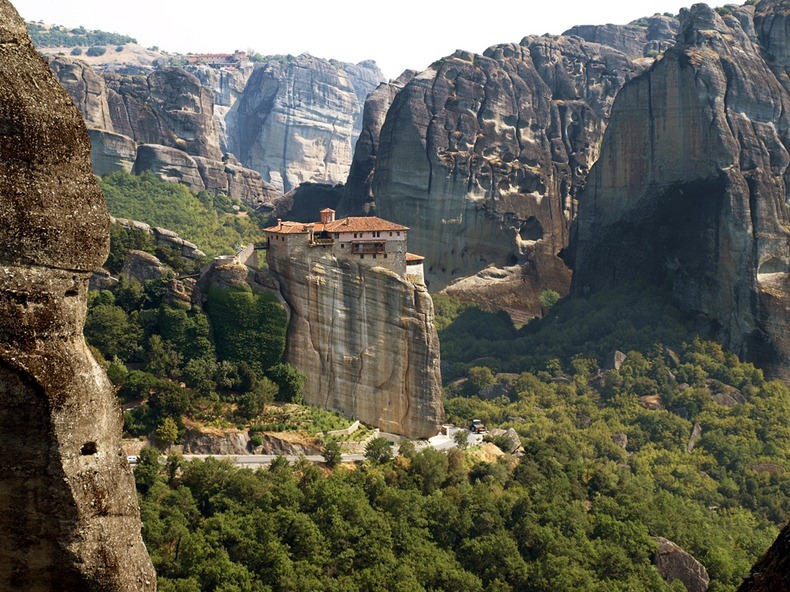
The Metéora (Greek for “suspended in the air” or “in the heavens above”) is a group of six monasteries and one of the largest and most important complexes of Eastern Orthodox monasteries in Greece. The six monasteries, built on natural sandstone rock pillars, are one of the most powerful examples of the architectural transformation of a site into a place of retreat, meditation and prayer.


amon


The monasteries are built on rock pinnacles of deltaic origin, known as Meteora, which rise starkly over 400 m above the Peneas valley and the small town of Kalambaka on the Thessalian plain. During the fearsome time of political instability in 14th century the monasteries were systematically built on top of the inaccessible peaks so that by the end of the 15th century there were 24 of them. They continued to flourish until the 17th century. Today, only four monasteries – Aghios Stephanos, Aghia Trias, Varlaam and Meteoron – still house religious communities.

Access to the monasteries was originally and deliberately difficult, requiring either long ladders lashed together or large nets used to haul up both goods and people. This required quite a leap of faith – the ropes were replaced, so the story goes, only “when the Lord let them break”. In the 1920s there was an improvement in the arrangements. Steps were cut into the rock, making the complex accessible via a bridge from the nearby plateau.


aamon


aamon1


Taung Kalat Monastery, Burma

The monastery of Taung Kalat is located on a top of a volcanic plug that rises 737 meters from the surrounding in central Burma (Myanmar) about 50 km southeast of Bagan, and near the extinct volcano Mount Popa. The monastery can be accessed by exactly 777 steps and those who reach the top are rewarded by a spectacular view.

To the north-west opens a view to distant temples of Bagan, and to the east is towering the forested Taung Ma-gyi summit. There is a big caldera, 610 metres wide and 914 metres in depth so that from different directions the mountain takes different forms with more than one peak. Many Macaque monkeys live here that have become a tourist attraction on Taung Kalat.


aamon2


aamon3


Taktsang Palphug Monastery, Bhutan

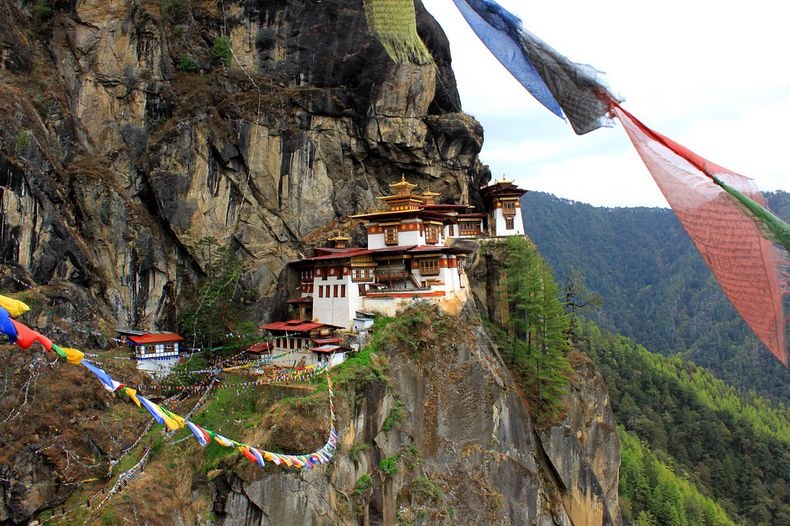
Taktshang monastery, also known as The Tiger’s Nest, is located on a precipitous cliff about 900 metres above the Paro valley, in Bhutan. The rock slopes are very steep – almost vertical – and the monastery buildings are built into the rock face. Though it looks formidable, the monastery complex has access from several directions, such as the northwest path through the forest, from the south along the path used by devotees, and from the north. A mule track leading to it passes through pine forest that is colourfully festooned with moss and prayer flags. On many days, clouds shroud the monastery and give an eerie feeling of remoteness.


00mon


00mon1


Sümela Monastery

The Sumela Monastery is built into the rock cliffs of the Altmdere Valley in Turkey. At an altitude of about 1,200 metres it is a major tourist attraction of Altındere National Park.

The monastery was founded in 386 AD during the reign of the Emperor Theodosius I (375 – 395). Legend has it that two priests undertook its creation after discovering a miraculous icon of the Virgin Mary in a cave on the mountain. During its long history, the monastery fell into ruin several times and was restored by various emperors. It reached its present form in the 13th century after gaining prominence during the reign of Alexios III.

The monastery was abandoned after World War I and the start of the population exchanges between Greece and Turkey that forced some 2 million ethnic Greeks and Turks to leave their long-established communities in Turkey or Greece and return to their ethnic homelands. It lay empty for decades before being partially restored and returned to life as a museum.


aamon4


aamon5


aamon6


Hanging Monastery, China

The Hanging Monastery or Hanging Temple is located in a canyon at the foot of the Mountain Heng in the province of Shanxi, China. The temple is built into the cliff side about 75 meter above the ground, and stands propped up by hidden rocks corridor and wooden beams inserted into the mountain. Over 40 halls, cabinets and pavilions within an area of 152.5 square meters are connected each other by corridors, bridges and boardwalks. They are evenly distributed and well balanced in height. Inside the temple are more than 80 bronze cast statues, iron cast statues, and clay sculptured statues and stone carvings banded down from different dynasties.

The temple was build to avoid the terrible flood, and use the mountain as protection from rain, snow and sunshine. Today, it is one of the main tourist attractions and historical sites in the Datong area.


aamon7


aamon8

Star Trek becomes reality as Microsoft ‘Universal Translator’ turns spoken English into any of 26 different languages

  • Software speaks in user’s own voice
  • Can translate into languages from Spanish to Mandarin
  • Speaks smoothly in sentences, not individual words
  • Could be built into smartphone language apps

It has long been used by James T Kirk to speak to aliens and blue women from space – but now Microsoft is on the brink of making a real, working Universal Translator.

Frank Soong and Rick Rashid have created software which converts English language speech into any of 26 foreign languages – and which ‘speaks’ in the user’s own voice.

All the user has to do is speak English into the machine and it will convert it into anything from Spanish to Mandarin.


William Shatner as James T Kirk: The new device is similar to the Universal Translator used in Star Trek, and takes around one hour to get used to a person’s voice then works by comparing the words that have been recorded with stock models for the target language.


The hope is that the device will one day allow visitors to foreign countries to have conversations with other people, even though they do not speak the same language – just like in Star Trek.

Mr Soong told Technology Review that his breakthrough could help language students and might also work with navigational devices.

In theory it could one day be installed into a smart phone meaning tourists have a ready made translation device sitting in their pockets.

Mr Soong said: ‘We will be able to do quite a few scenario applications. ‘For a monolingual speaker traveling in a foreign country, we’ll do speech recognition followed by translation, followed by the final text to speech output in a different language, but still in his own voice’.

Mr Soong and Mr Rashid work at Microsoft’s HQ in Redmond, Washington. They created the system with colleagues at Microsoft Research Asia in Beijing, the company’s second-largest research lab.


In Star Trek it was supposedly introduced in the late 22nd century and helped the crew of the Enterprise communicate with aliens as the explored the universe.

Mr Soong and Mr Rashid however have made their version today, even if the voice which comes out in the foreign language still sounds a little mechanical.

Their device needs around one hour to get used to a person’s voice then works by comparing the words that have been recorded with stock models for the target language.

The technology has been designed so that it does not just translate words, which would give it a computerised and disjointed sound.

Instead the sounds are carefully manipulated to mimic real speech as realistically as possible.

‘Neon’ movie posters of cult films by Quentin Tarantino, Dario Argento, Stanley Kubrick and more

posters

The Shining (Stanley Kubrick, 1980) neon movie poster

Using the art of “one point perspective” (an approach to art that began as early as the 15th century in Europe that utilizes a “vanishing point” on the horizon point of the image) two Italian twin brothers (working under the moniker Van Orton Design) took on the task of digitally reimagining movie posters based on cult films from directors like Dario Argento and Wes Anderson, in vivid electric neon color schemes.


movie

Suspiria (Dario Argento, 1977)


movies

Pulp Fiction (Quentin Tarantino, 1994)


Although the twins used modern methods to obtain their striking results, there is a distinct old-school feel to their posters that homage some of cinema’s greatest achievements of the past 50 years. The brothers, who appear to prefer to remain nameless and obscure their faces with masks, have also managed to have the films be seen through fresh eyes due to their unique presentation and interpretation of different, unforgettable scenes in the films themselves. Such as the moment Marcellus Wallace unfortunately strolled in front of the beat up Honda that Butch Coolidge was driving in Pulp Fiction (pictured above) before everything goes to shit for both of them.


movies1

The Grand Budapest Hotel (Wes Anderson, 2014)


amovie

2001: A Space Odyssey (Stanley Kubrick, 1968)


amovie1

Big Trouble in Little China (John Carpenter, 1986)


amovies1

Army of Darkness ( Sam Raimi, 1992)


aamovie

Deep Red (Dario Argento, 1975)


aaamovy

The Shining (Stanley Kubrick, 1980)

Dangerous Minds

Bureaucrats from around the world

Bureaucratics by Dutch photographer Jan Banning is a comparative photographic study of the culture, rituals and symbols of state civil administrations and its servants in eight countries on five continents. Jan traveled to Bolivia, China, France, India, Liberia, Russia, Yemen and the United States to snap photographs of civil servants – from fiscal authorities to police, from governors to local clerks – seated behind his or her desk. The result is a fascinating look at the lives of bureaucrats.

India, Bihar

Sushma Prasad (b. 1962) is an assistant clerk at the Cabinet Secretary of the State of Bihar (population 83 million) in The Old Secretariat in the state capital, Patna. She was hired “on compassionate grounds” because of the death of her husband, who until 1997 worked in the same department. Monthly salary: 5,000 rupees ($ 110, euro 100).


Surinder Kumar Mandal (b. 1946) is circle inspector of taxes in Thakurganj block, collecting taxes in a specific part of Kishanganj district, State of Bihar. Monthly salary: 9,500 rupees ($ 208, 189 euro). Surinder Kumar Mandal (b. 1946) is “circle inspector” van belastingen in Thakurganj Block, Kishanganj district, State of Bihar. Maandsalaris: 9,500 rupees (euro 189, US$ 208).

China, Shandong


Qu Shao Feng (b. 1964) is chief general of Jining Public Security Bureau Division of Aliens and Exit-Entry Administration in Jining City, Shandong province. Monthly salary: 3,100 renminbi (US$ 384, 286 euro).


Wang Ning (b. 1983) works in the Economic Affairs office in Gu Lou community, Yanzhou city, Shandong province. She provides economic assistance to enterprises in her region and is the liaison officer between the government and local enterprises. Wang Ning is not married. She lives at home with her parents. Monthly salary: 2,100 renminbi (US$ 260, euro 228).

France, Auvergne


Roger Vacher (b. 1957) is a narcotics agent with the national police force in Clermont-Ferrand, Puy-de-Dome department, Auvergne region. Monthly salary: euro 2,200 (US$ 2,893).


Maurice Winterstein (b. 1949) works in Clermont-Ferrand for the Commission for the Advancement of Equal Opportunity and Citizenship at the combined administrative offices of the Auvergne region and the Puy-de-Dome department. He also is in charge of the portfolio of religious affairs, Islam in particular. Monthly salary: euro 1,550 (US$ 2,038). The young lady next to him is Linda Khettabi (b. 1989), an intern pursuing training as a secretary.

Liberia


Major Adolph Dalaney works in the Reconstruction Room of the Traffic Police at the Liberia National Police Headquarters in the capital Monrovia. Traffic accident victims at time are willing to pay a little extra if Dalaney’s department quickly draws up a favorable report to present to a judge. Monthly salary: barely 1,000 Liberian dollars ($18, €17).


Henry Gray (1940), acting commissioner for Gbaepo district, Kanweaken, River Gee County. During the Civil War, the office was completely looted and destroyed: only one wall remained. Gray has 11 personnel, of whom only 4 are paid. The rest are volunteers. He has no budget and over two years salary owing. Yesterday, he went to the capital Fishtown to collect last two months salary, two times 975 Liberian dollars (2x US$ 17, 2x euro 16). All he got was 600 dollars (US$ 11, euro 10). Gray is father to 34 children (sic), 13 of them depending, and has 18 grandchildren.

Russia, Siberia


Marina Nikolayevna Berezina (b. 1962), a former singer and choir director, is now the secretary to the head of the financial department of Tomsk province”s Facility Services. She does not want to reveal her monthly salary.


Nikolajevich Ilyich Volkov (b. 1954) is administrator of the village of Alexandrovskoye (some 1,000 inhabitants), Tomsk province. Monthly salary: 9,000 rubles (US$ 321, euro 243).

U.S.A., Texas


Rudy Flores (b. 1963) is one of the 118 Texas Rangers, state law enforcement officers who cover 254 counties between them. He is based in Palestine, Anderson County, Texas, and is responsible for three counties. Monthly salary: $5,000 (€3,720).


Dede McEachern (b. 1969) is director of licensing, Texas Department of Licensing and Regulations, in the state capital, Austin. Monthly salary: US$ 5,833 (euro 4,240).

Yemen


Ali Abdulmalik Shuga (b. 1964) is responsible for the archives of the Ministry of Trade and CommerceÍs governorate s office in the city of Taizz, Taizz Governorate. Monthly salary: 30,500 rial (US$ 171, euro 117).


Nadja Ali Gayt is an adviser at the Ministry of Agriculture’s education center for rural women in the district of Manakhah, Sana’a Governorate. Monthly salary: 28,500 rial ($160, €110).

Bolivia, Potosi


Constantino Ayaviri Castro (b. 1950), previously a construction worker, is a police officer, third class, for the municipality of Tinguipaya, Tomas Frias province. The police station does not have a phone, car or typewriter. Monthly salary: 800 bolivianos ($100, €189).


Marcial Castro Revollo (b. 1942) is shopkeeper and, at the desk in the back, civil servant for the Registry of Births, Deaths and Marriages in the village of Millares (350 inhabitants), municipality of Betanzos, Cornelio Saavedra province, Department Potosi. Also, at the desk in the front, he is responsible for the polling station of the Corte Departemental Electoral de Potosi (elections office). Monthly salary: 500 bolivianos (euro 55, US$ 62).