Asides
National Geographic Photos

Elephant and Queleas, Tanzania

Base jumping, Yosemite national park, California

Water Buffalo India

Great White checking out the shark cage

Cheetahs in Kenya checking out the tourists
.

Leopard (left) stealing a Cheetahs kill

Elephants moving through the Serengeti
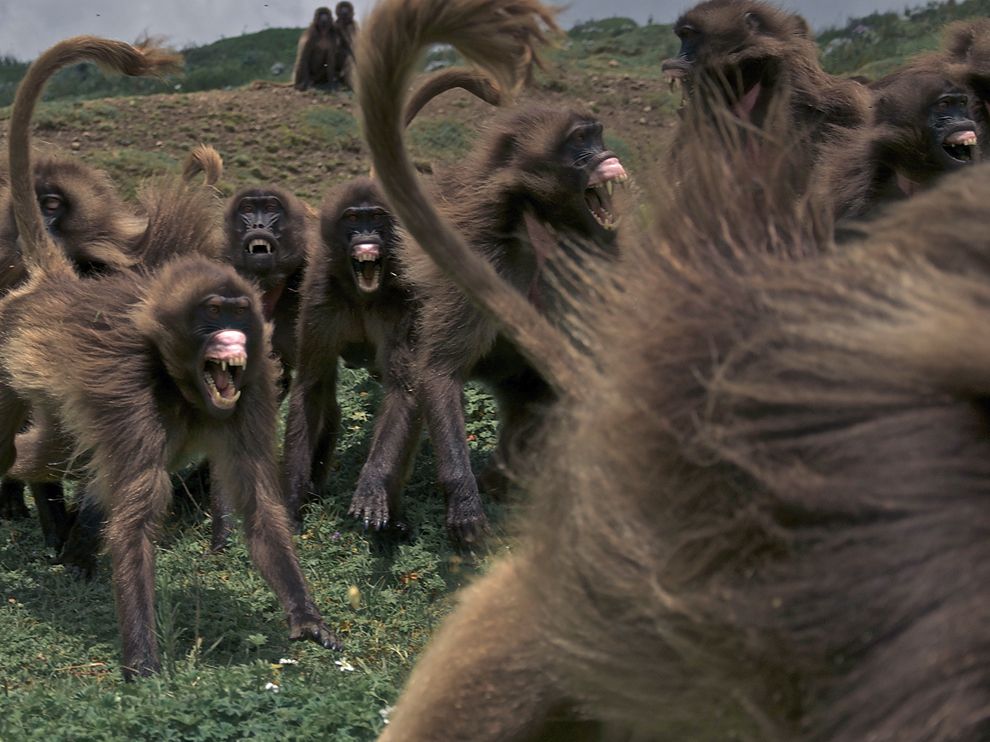
Geladas monkeys Ethiopia

Giraffes and Gazelles Namibia

Child and buffalo in Vietnam

Harvesting Kash flowers India

Kyrgyz girls Afghanistan

Mountain gorilla and baby

Chicken farm Pennsylvania

Climbing redwood trees in California

Lions in the Serengeti

Sleeping white lion South Africa

Tigers India

Free rock climbing Yosemite California

Lake Wakatipu New Zealand

Lions chilling out in Tanzania
Mandelbrot Fractals: Hunting the Hidden Dimension

It was in January OF 1944 that Benoit Mandelbrot fell in love with geometry, “in its most concrete and sensual form.”
”That part of geometry in which mathematics and the eye meet.”
During a math class, when Mandelbrot was nineteen years of age, at the Lycee du Parc in Lyon, young Benoit realized he could visualize algebra as geometric images. The class professor had been discussing a mathematical problem when Mandelbrot became instantly aware that he had the ability to change algebra into pictures. He then realized that once you can see pictures, the answer to a problem is obvious.
In 1958, Mandelbrot left France and joined IBM in America. It was here that Mandelbrot’s knowledge of visualizing problems was to prove very important.
Engineers at IBM had found an issue with transmitting computer information over telephone lines. Mandelbrot graphed the noise data, and noticed something that surprised him—no matter the time scale the graph looked similar, whether over one day, one hour, or one minute, or one second, the pattern remained constant. This reminded Mandelbrot of the Cantor Set, where a line is broken down into infinite recurring sets, and Helge von Koch’s “Snowflake,” where an iteration of a triangle creates an infinite length. Koch’s “Snowflake” is the earliest form of fractal.
Bringing these elements together, Mandelbrot developed a “theory of roughness” which he used to show that another dimension existed between 2-D and 3-D, this suggested there was a mathematical order to the seeming mess/chaos of the natural world. With the use of IBM computers, Mandelbrot proved his theory by producing a set of fractals in 1979.
Mandelbrot set images are made by sampling complex numbers and determining for each whether the result tends towards infinity when a particular mathematical operation is iterated on it. Treating the real and imaginary parts of each number as image coordinates, pixels are colored according to how rapidly the sequence diverges, if at all. Did you get that?






‘Lake Monster’ Filmed in Taiwan
A paddle board instructor in Taiwan captured some rather remarkable footage of a sizeable ‘mystery creature’ that suddenly appeared near him in the water. According to a local media report, the wild encounter occurred earlier this month at a location known as Sun Moon Lake as Lai Yongli was teaching a pair of tourists. During the lesson, he noticed that something seemingly out of the ordinary had emerged from the depths of the water and was lurking near the surface. Intrigued by the puzzling sight, Yongli paddled over to it and was left astounded by what he saw.
Captured on video by the man, the oddity in question was a monstrous fish measuring around six-and-a-half feet long. Yongli deduced the length of the creature by observing that it was more than double the size of his three-foot-long paddle board. Thanks to the miracle of modern technology, the instructor was able to capture some fantastic footage of the wondrous sight. The video, which puts the average Nessie sighting to shame by virtue of just how close the man was able to get to the creature before it swam away, shows a long fish sporting what appear to be white fins.
An instructor at the lake for quite some time, Yongli marveled that he had never seen such a creature at the site before and promptly posted the footage to social media. Not unlike here in America, the video quickly went viral and was covered by several national news outlets in China. As for what the ‘monster’ could have been, the clarity of Yongli’s footage allowed for the mystery to be solved fairly quickly as experts were able to identify the creature as most likely being a speckled longfin eel.
Galaxy: Leviathan of the Air
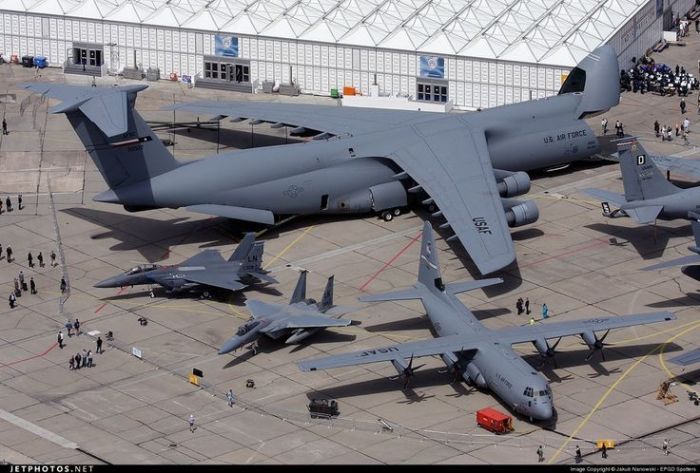
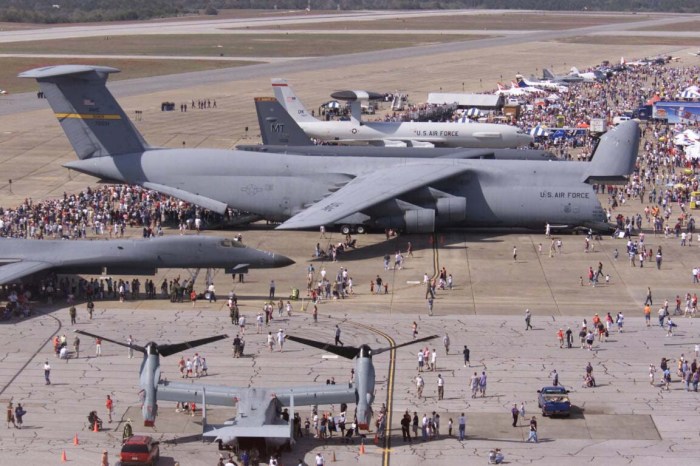
The Lockheed C-5 Galaxy is a large military transport aircraft originally designed and built by Lockheed, and now maintained and upgraded by its successor, Lockheed Martin. It provides the United States Air Force (USAF) with a heavy intercontinental-range strategic airlift capability, one that can carry outsize and oversize loads, including all air-certifiable cargo. The Galaxy has many similarities to its smaller Lockheed C-141 Starlifter predecessor, and the later Boeing C-17 Globemaster III. The C-5 is among the largest military aircraft in the world.
General characteristics
Crew: 7 typical (aircraft commander, pilot, two flight engineers, three loadmasters)
4 minimum (pilot, copilot, two flight engineers)
Payload: 270,000 lb (122,470 kg)
Length: 247 ft 1 in (75.31 m)
Wingspan: 222 ft 9 in (67.89 m)
Height: 65 ft 1 in (19.84 m)
Wing area: 6,200 ft2 (576 m2)
Empty weight: 380,000 lb (172,371 kg)
Useful load: 389,000 lb (176,450 kg)
Loaded weight: 769,000 lb (348,800 kg)
Max. takeoff weight: 840,000 lb (381,000 kg) ; [N 2]
Powerplant: 4 × General Electric TF39-GE-1C high-bypass turbofan, 43,000 lbf (190 kN) each
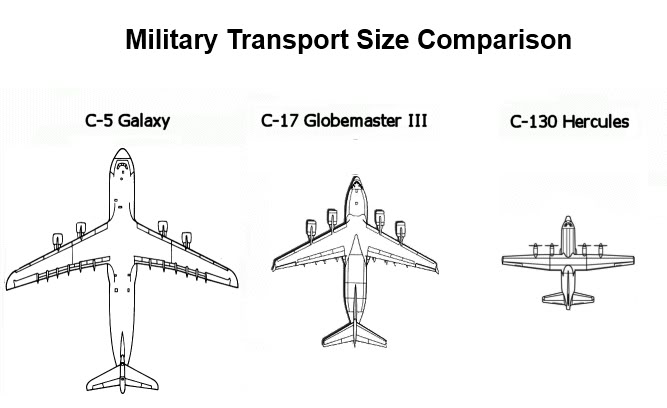
There are currently 52 C-5’s in US air force service


Galaxy getting refueled by a KC-10 tanker, a very large aircraft itself

The workhorse of the air force these days is the C-17 Globemaster III, there are 279 in service today

Side by side comparison of the two

Moose Eats Snow Off Hood Of Car
Video below

A woman on a cross-country ski trip in Maine recently had a face-to-face meeting with a moose.
Margo Lukens was driving in the Caribou Bog Conservation Area when she saw lines of cars stopped on both sides of the road.
She also pulled over and then spotted a young moose which came right up to her and started eating the snow and licking the ice off the hood of her vehicle.






Englishman snaps a very close-up photo of JFK in the early summer of 1963
Photo below
Forest Row is one of those blink-and-you’ll-miss-it kinds of places. It’s just a dot on the map in the middle of green forests and English farmland. And in the center of town, there’s a plaque.
“This stone commemorates the visit of John Fitzgerald Kennedy, 35th President of the United States of America, to Forest Row on Sunday, the 30th of June, 1963.”
As short as Kennedy’s tenure as president was, he still managed to squeeze in over a dozen foreign visits at the height of the Cold War, and one of the last included a trip to this tiny English village in rural Sussex, just south of London, to attend Sunday Mass.
President Kennedy was en route back to Washington from visits to Germany and Ireland when he stopped in Britain for a quick meeting with then British Prime Minister Harold Macmillan at his country estate, named Birch Grove.
Old newsreels from the day report that the stopover lasted a mere 24 hours. With such a tight schedule, Kennedy’s visit to Forest Row’s only Catholic church for Sunday service would have been brief — not much longer than the Mass itself.
Lifelong resident Harold Waters, who was 23 years old then, says it was a big deal for the village. He and his wife grabbed the new color camera they’d bought for their honeymoon and went out to watch the president’s motorcade arrive.
Kennedy come through,” says Waters from the same corner he stood on fifty years ago. “My wife was five months pregnant at the time with our first daughter. So we came down here and waited and, eventually, we saw the cars coming down the road — an unmarked police car at the front, and two security cars and Kennedy’s limousine. He came down the road [and] very slowly went around the corner.”
So Waters was well positioned to see the president. He holds up a rare, crystal clear, color photograph taken so close you can see the reflection of the crowd in the side of the car as Kennedy waves from inside.
“I nipped across to the traffic island that’s just over there, had a word with the policeman and the security man, and said, ‘Can I take a picture of President Kennedy from here? Is that alright?’ And they said, ‘Yes.’ So I stood there and I got the picture I wanted,” recalls Waters. “It wasn’t until he was assassinated that I realized that he’d only been three or four feet from me with no bulletproof glass or anything between us.”
Indeed, the car was the same Lincoln Continental Kennedy rode in when he was assassinated less than five months later.

 The MarkoZen Blog