Inside Google’s Giant Data Centers 


Inside the internet: Google allows first ever look at the eight vast data  centres that power the online world

  • Data centres range from vast warehouses in  Iowa to a converted paper mill in Finland
  • Buildings are so large Google even provides  bicycles for engineers to get around them
  • Street View tour of North Carolina facility  reveals Stormtrooper standing guard

Google has given a rare glimpse inside the  vast data centres around the globe that power its services.

They reveal an intricate  maze of computers that process Internet search requests, show  YouTube video  clips and distribute email for millions of people.

With hundreds of thousands of servers,  colourful cables and even bicycles so engineers can get around quickly, they  range from a converted paper mill in Finland to custom made server farms in  Iowa.

One of Google’s server farms in Council Bluffs, Iowa, which provides over  115,000 square feet of space for servers running services like Search and  YouTube

‘Very few people have stepped inside Google’s  data centers, and for good reason: our first priority is the privacy and  security of your data, and we go to great lengths to protect it, keeping our  sites under close guard,’ the firm said.

‘While we’ve shared many of our designs and  best practices, and we’ve been publishing our efficiency data since 2008, only a  small set of employees have access to the server floor itself.

‘Today, for the first time, you can see  inside our data centers and pay them a virtual visit.

‘On Where the Internet lives, our new site  featuring beautiful photographs by Connie Zhou, you’ll get a never-before-seen  look at the technology, the people and the places that keep Google  running.’

The site features photos from inside some of  the eight data centers that Google Inc. already has running in the U.S., Finland  and Belgium.

Google is also building data centers in Hong  Kong, Taiwan, Singapore and Chile.

Virtual tours of a North Carolina data center  also will be available through Google’s ‘Street View’ service, which is usually  used to view photos of neighborhoods around the world.

The photographic access to Google’s data  centers coincides with the publication of a Wired magazine article about how the  company builds and operates them.

The article is written by Steven Levy, a  journalist who won Google’s trust while writing ‘In The Plex,’ a book published  last year about the company’s philosophy and evolution.

Google colour codes its servers depending on their location, while piping in the  buildings is coded depending on what it carries – with cool water in blue tubes  and warm in red

Google’s Douglas County data centre in Georgia is so large the firm provides  Google branded bicycles for staff to get around on

The data centers represent Google’s  nerve  center, although none are located near the company’s headquarters  in Mountain  View, Calif.

As Google blossomed from its roots in a Silicon Valley garage, company co-founders Larry Page and Sergey Brin  worked  with other engineers to develop a system to connect low-cost  computer servers  in a way that would help them realize their ambition to provide a digital  roadmap to all of the world’s information.

Initially, Google just wanted enough  computing power to index all the websites on the Internet and deliver  quick  responses to search requests. As Google’s tentacles extended into  other  markets, the company had to keep adding more computers to store  videos, photos,  email and information about their users’ preferences.

A street view tour published by Google also reveals a hidden surprise – A  Stormtrooper standing guard over a server in Google’s North Carolina server farm

The insights that Google gathers  about the  more than 1 billion people that use its services has made the  company a  frequent target of privacy complaints around the world.

The latest missive came Tuesday in  Europe,  where regulators told Google to revise a 7-month-old change to  its privacy  policy that enables the company to combine user data  collected from its  different services.

Google studies Internet search  requests and  Web surfing habits in an effort to gain a better  understanding of what people  like. The company does this in an effort to show ads of products and services to  the people most likely to be  interested in buying them. Advertising accounts  for virtually all of  Google’s revenue, which totaled nearly $23 billion through  the first  half of this year.

Even as it allows anyone with a Web  browser  to peer into its data centers, Google intends to closely guard  physical access  to its buildings. The company also remains cagey about  how many computers are  in its data centers, saying only that they house  hundreds of thousands of  machines to run Google’s services.

Google’s need for so many computers  has  turned the company a major electricity user, although management  says it’s  constantly looking for ways to reduce power consumption to  protect the  environment and lower its expenses.

Here hundreds of fans funnel hot air from the server racks into a cooling unit  to be recirculated in Oklahoma. The green lights are the server status LEDs  reflecting from the front of the servers

The Iowa campus network room, where routers and switches allow data centers to  talk to each other. The fiber cables run along the yellow cable trays near the  ceiling.

Even the water pipes reflect Google’s brand: These colorful pipes are  responsible for carrying water in and out of an Oregon data center. The blue  pipes supply cold water and the red pipes return the warm water back to be  cooled.

In Hamina, Finland, Google chose to renovate an old paper mill to take advantage  of the building’s infrastructure as well as its proximity to the Gulf of  Finland’s cooling waters.

Google’s server farm in Douglas County, Iowa

Denise Harwood, a Google Engineer, diagnoses an overheated CPU. For more than a  decade, Google has built some of the world’s most efficient servers.

Each server rack has four switches, connected by a different coloured cable.  Colours are kept the same throughout data centres so staff know which one to  replace in case of failure.

Video shows red truck driving through tornado in central Texas

ELGIN, Texas – It was like a scene out of the movie “Twister” when a truck drove through a tornado in Central Texas on Monday.

The video above, shot by storm chaser Brian Emfinger of Live Storms Media, shows a red truck driving down a road in Elgin, Texas, as it gets blown over onto its side by a tornado. The truck was then spun around before getting flipped back upright onto its wheels.

Amazingly, the truck was able to drive away as the twister went on to knock down trees and power lines along the road.

Newly restored ‘American Dream’ limo breaks its own record as world’s longest car

‘I found the car ten years ago. It was rotting in New Jersey,’ says Mike Manning, who repaired the ride

CBC Radio · Posted: Mar 11, 2022 6:35 PM ET | Last Updated: March 14

On March 1, Guinness recertified the renovated American Dream limo at a length of 30.54 metres, about 4 centimeters longer than its first record, following its remodel by Mike Manning and his students. (Submitted by Mike Manning)

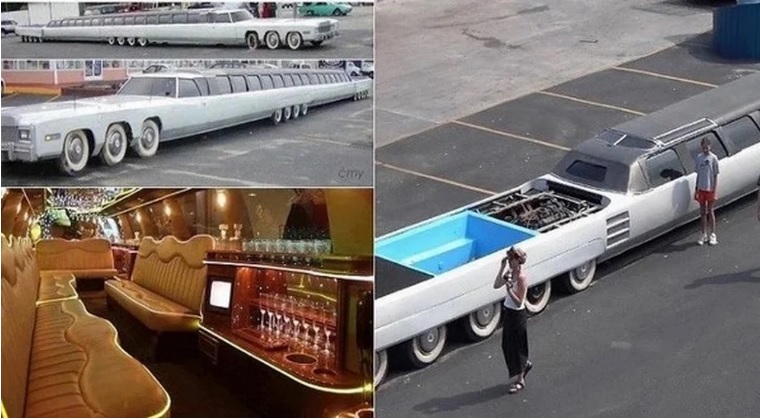
There is only one car out there that you can take for a spin, then lounge in its swimming pool, land on its helipad and golf on its putting green — and it’s called the American Dream.

The newly restored vehicle, built out of six 1976 Cadillac Eldorado limos, is a showstopper with 26 wheels and space for up to 75 people. Last week, Guinness World Records declared it the longest car in the world.

The American Dream rose to fame in the late 1980s, when it was first assembled by Hollywood’s favourite car designer Jay Ohrberg. But the limo was so long that it soon became difficult to drive and park.

“I found the car about 10 years ago,” Mike Manning, president of the automotive teaching museum Autoseum, told As It Happens guest host Gillian Findlay. “It was rotting in New Jersey.”

That’s when he decided to buy the rusty and long forgotten car — and dreamt of the day he’d bring it back to its former glory.

Just a decade ago, the American Dream was covered in graffiti with flat tires and broken windows. (Submitted by Mike Manning)

A rough road to recovery

Just a decade ago, the American Dream was covered in graffiti with flat tires and broken windows.

“You’d look at it and say this is junk, just call it up and get rid of it,” Manning said. “But I always knew that it had some value. Not so much the money value, but just a history…. I knew it couldn’t be destroyed.”

He started to restore the Caddy with his students at the technical teaching museum, but ran out of money to support the project. Then the museum lost the lease on its space in Nassau County, N.Y.

Manning couldn’t find another place to store the American Dream, so he gave it up and listed it on eBay.

In 2019, a real estate developer with an enormous car collection bought it — and came up with a plan to pay Manning and his students to complete the restoration process in Orlando, Fla.

Michael Dezer owns the Dezerland Park Car Museum and Tourist Attractions, which is where the American Dream will soon be showcased.

Manning and his students had their work cut out for them. The windshield was broken, the dashboard deteriorated and every panel of the car’s exterior had to be reassembled and bent to the shape of the car, before they could even start on the interior. (Submitted by Mike Manning)

The new and improved American Dream

Manning and his students had to replace a lot of the limo with donor parts from Cadillac Eldorados because, over time, the car had become so badly destroyed.

The windshield was broken, the dashboard deteriorated and every panel of the car’s exterior had to be reassembled and bent to the shape of the car.

His team then redid the roof, all the glass, the interior, the tires and the brakes. Once the body was ready, they got the engine running, fixed the gas tank and lights.

“It was something that was impossible and I felt that I could do it,” Manning said. “People said I was crazy for even trying it, but … you see it and you just don’t want to let it go.’

“You kind of look back on things when you grew up; it’s nostalgia. And once they’re gone, they’re gone. So to be able to preserve something like that was very important.”

The newly restored vehicle, built out of six 1976 Cadillac Eldorado limos, is a showstopper with 26 wheels and space for up to 75 people. (Submitted by Mike Manning.)

Manning went on to explain how the lengthy limo was never really built to be driven around, but as more of a showpiece.

Now that it’s fixed, though, he can confirm that it is ready to ride.

“We drive it basically in a straight line,” he said. “We can drive it, but we have to get it to [somewhere] like an airport … because you need a big turn radius.”

The American Dream actually broke its own record for longest car in the world.

In 1986, Guinness measured the newly built limo to be 18.28 metres (60 feet). The original designer later extended it to 30.5 metres (or 100 feet) long.

On March 1, Guinness recertified the renovated ride at a length of 30.54 metres, just under four centimetres longer than its first record.

Mike Manning is the president of Autoseum, an automotive teaching museum in Mineola, New York. (Submitted by Mike Manning.)

Currently, there is a big spot in the Dezerland Park Car Museum waiting for the longest limo to park its wheels.

“I had a very small operation in New York City and people would come see it from all over the place,” Manning said. “I think people will come … it’s something definitely [to] see when you’re down there.”

Canadian Fisherman Snags Monstrous 10-Foot-Long Sturgeon

Video below

A jaw-dropping video from Canada shows a fishing guide hauling in a massive 10-foot-long sturgeon that could easily be mistaken for some kind of mythical monster. The incredible catch reportedly occurred earlier this month along British Columbia’s Fraser River as Yves Bisson was assisting angler Dan Lallier on a trip to the popular fishing location. Their day took a memorable turn when the pair snagged a huge fish that left even the seasoned guide amazed. “After jumping out of the water two times during the fight, we all looked at each other in disbelief at the enormous size,” Bisson marveled, “we knew it was something special.”

After reeling in the impressive catch, it was determined that the sizeable fish was a sturgeon that measured approximately ten feet long and weighed a whopping 600 pounds. Remarkably, the creature is believed to be around 100 years old and sported no tags, which surprised the pair because it suggests that this was the first time that the denizen of the deep had ever been captured. Since sturgeons are an endangered species in Canada, the mighty fish fortunately did not wind up becoming a meal and, instead, it was tagged and released back into the water where, Bisson mused, “I’m sure it will live for another 100 years.”

Footage of the fantastic fish (which can be seen above) was posted to social media and quickly went viral as viewers could not believe their eyes upon seeing the staggering catch. For fans of mysterious creatures, the Bisson’s video is particularly instructive as the sturgeon is very often considered a strong candidate for various ‘monsters’ spotted in aquatic locations around the world. While the idea of a really big fish being mistaken for a curious cryptid akin to Nessie may sound implausible, one look at Bisson’s video shows how just such a scenario might easily unfold.

This Russian takes Crazy to a whole new level 

Charges for Russian after stunts atop Toronto skyscraper

An “urban explorer” has been charged after he was seen in an online video leaping and doing somersaults atop a downtown Toronto skyscraper.

In a video posted to YouTube, Russian stuntman Oleg Cricket can be seen leaping, sliding and rolling on the ledge of a skyscraper. In another shot, he appears to be jumping between beams, with the CN Tower as his backdrop. In one of the final shots, Cricket is shown doing a handstand on a ledge, high above city streets.

Police arrested Cricket on Nov. 12, 2021. He has been charged with breaking and entering and mischief, Toronto police say.

Cricket is well-known for his vertigo-inducing acrobatic feats atop skyscrapers in various cities. He records his stunts and puts them on YouTube and other social media channels, where his followers number in the hundreds of thousands.

Another man who was allegedly with Cricket is facing the same charges.

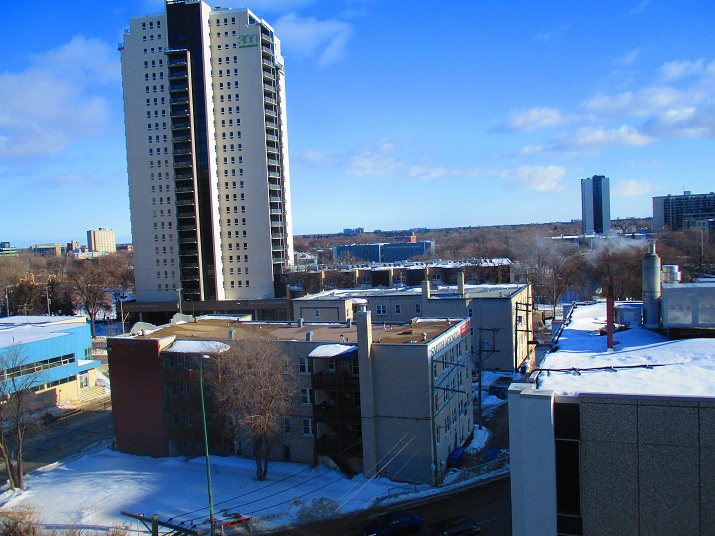
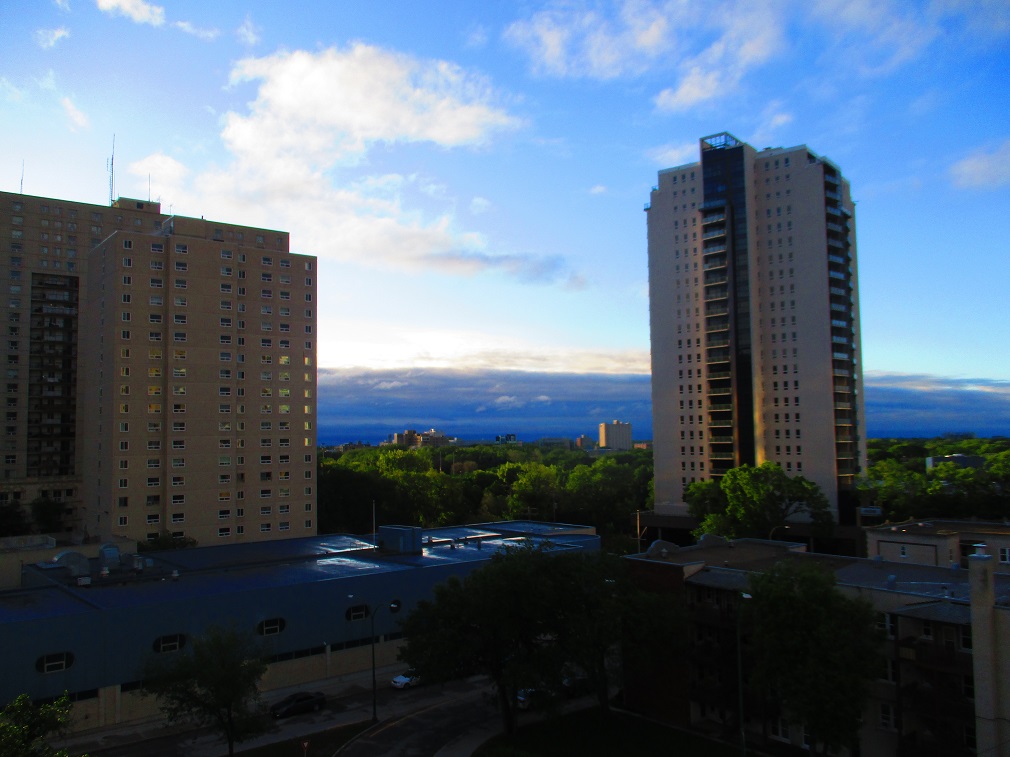
The building, 8 Mercer Street