Great Big Strange Rock in Columbia

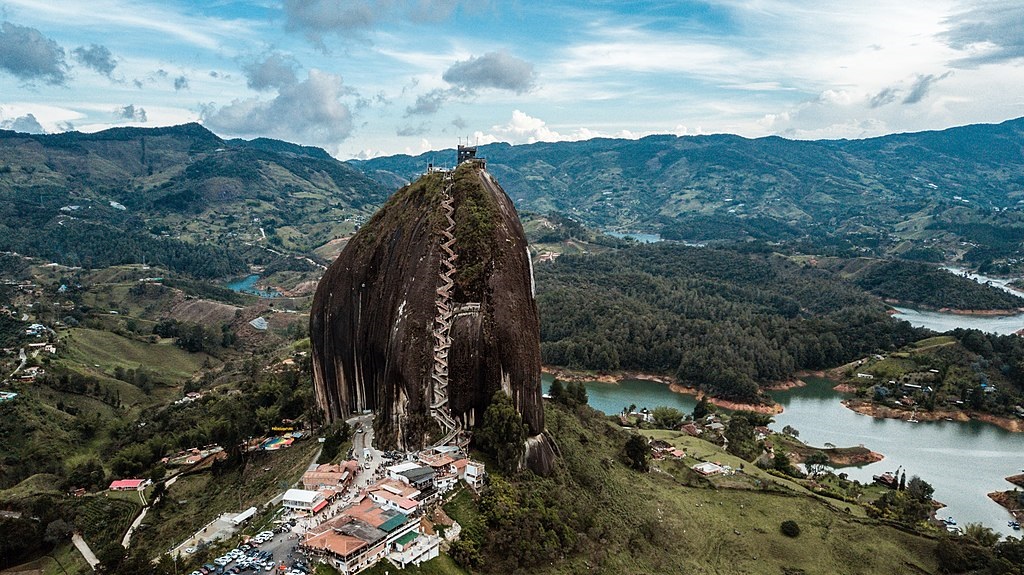
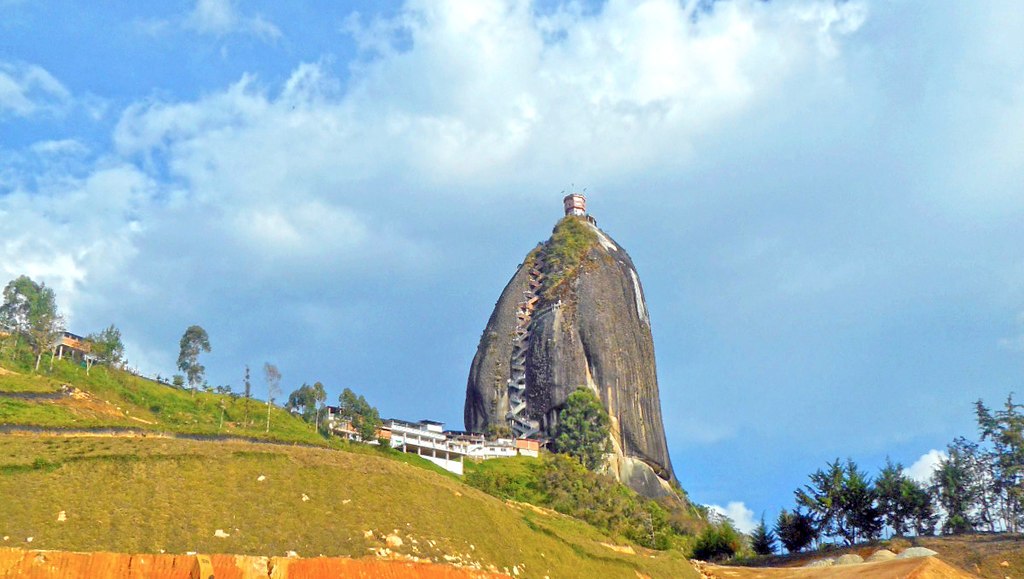
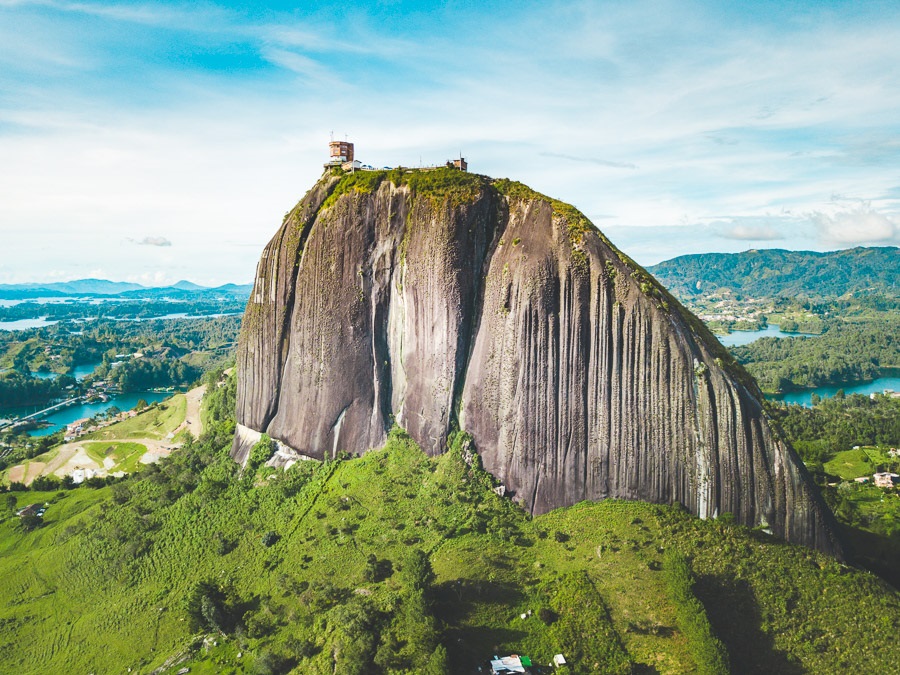
The Rock of Guatapé is a landmark inselberg in Colombia. It is located in the town and municipality of Guatapé, Antioquia. It is also known as The Stone of El Peñol, or simply La Piedra or El Peñol, as the town of El Peñol, which borders Guatapé, has also historically claimed the rock as their own and thus has led to different names for the site.

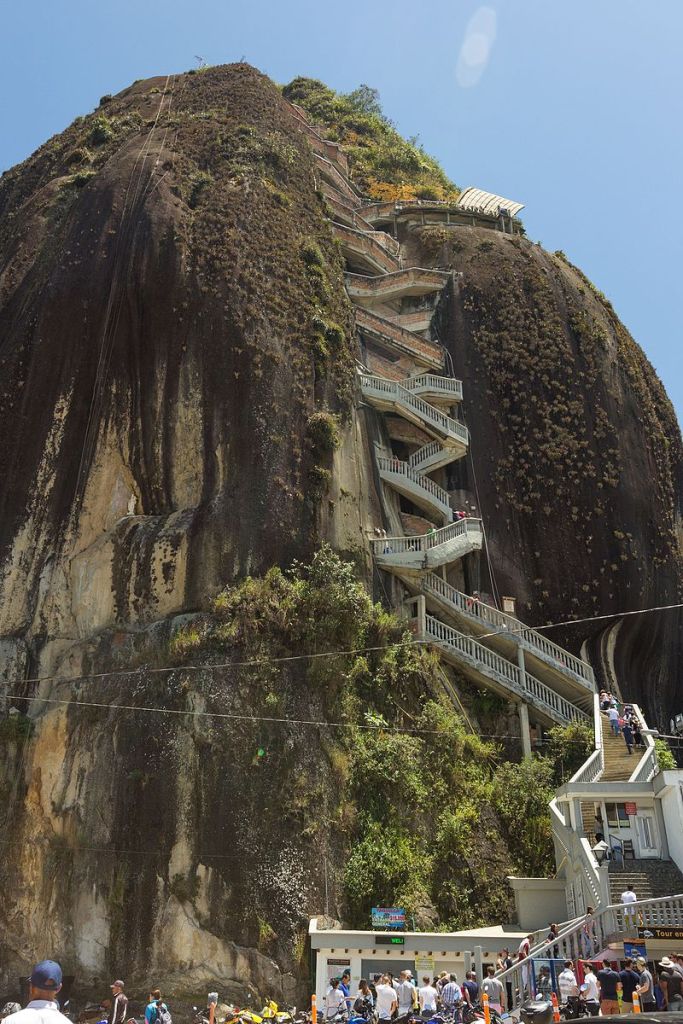
The landform is a granitic rock remnant that has resisted weathering and erosion, likely as result of being less fractured than the surrounding bedrock. The Peñón de Guatapé is an outcrop of the Antioquia Batholith and towers up to 200 meters (656 feet) above its base. Visitors can scale the rock via a staircase with 708 steps built into one side.

An inselberg or monadnock is an isolated rock hill, knob, ridge, or small mountain that rises abruptly from a gently sloping or virtually level surrounding plain.

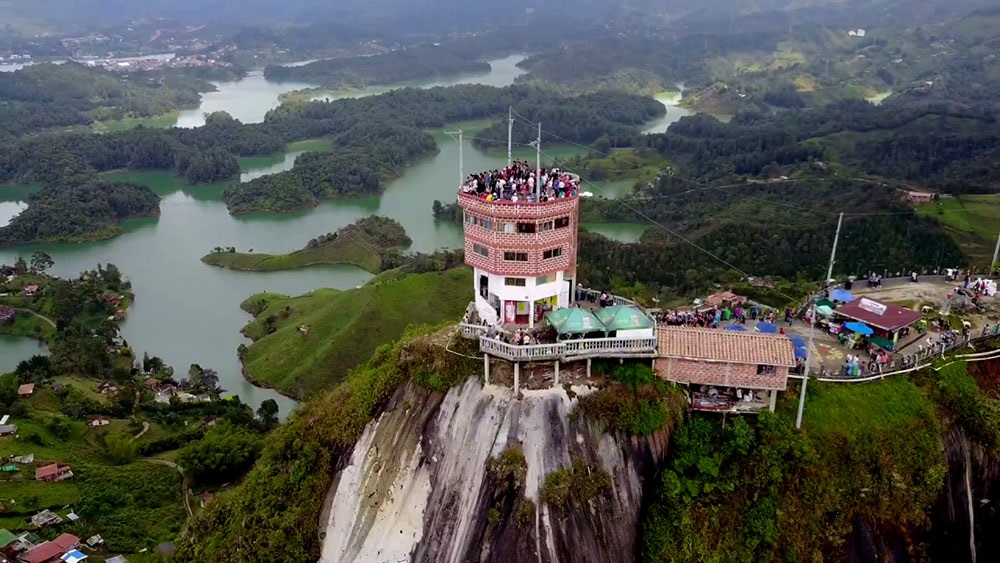
Near the base of the Rock, there are food and market stalls for shopping. About halfway up the stairs, there is a shrine to the Virgin Mary. The summit contains a three-story viewpoint tower, a convenience store, and a seating area.

The rock was first officially climbed in July 16, 1954, when Luis Eduardo Villegas López, Pedro Nel Ramírez, and Ramón Díaz climbed the rock in a five-day endeavor, using sticks that were fixed against the rock’s wall.

A new species of plant, named Pitcairnia heterophylla by a German scientist, was found on the top of the rock.

A viewing spot was built on top of the rock, where it is possible to acquire handicrafts, postcards, and other local goods. It is possible to see the 500 km shore-perimeter dam. There are 649 steps to the uppermost step atop the building at the summit, a fact reinforced by yellow numbers also seen in the climb up the stairs.

In the 1940s, the Colombian government declared it a National Monument.

Images of Very Big Industry 

industrial-bonaire-west-indies-aerial-view-01

Bonaire Island, West Indies, Brine Salt Mine

industry-mito%20newtown%20mega%20solar%20park%20in%20japan

Mito Solar Power Complex, Japan

industrial-chicken-farm-michigan

Industrial Chicken Farm, Michigan, USA

54.0440701, -128.6608887

Pulp and Paper Operation, Kitimat, British Columbia

industry-aerial_boeing_everett_factory_october_2011

Main Boeing Aircraft Production Facility, Washington State

industrial-aston-martin-gaydon-englandfacility-aerial-view

Aston Martin Factory, Haydon, England

Aerials Beef City, Darking Downs, Queensland, South Est Queensland, Australia

Aerials Beef City, Darking Downs, Queensland, South Est Queensland, Australia

industrial-150601-aerial-image-of-future-poti-seaport-georgia-final-stage

Poti Seaport, Republic of Georgia

industrial-fertilizer1

Fertilizer Plant, Fort Saskatchewan, Alberta

industrial-bingham-copper-heffernan1

Bingham Copper Mine, Utah. Partial collapse 3 years ago.

Der Antriebssystem- und Energieanlagenspezialist Tognum stellt sein Produktionsnetz internationaler auf und richtet deshalb in Aiken im US-Bundesstaat South Carolina ein neues Montage- und Fertigungswerk für Motoren der Tognum-Marke MTU ein. die Tognum-Gruppe hat dazu vom Antriebskomponentenhersteller SKF ein bestehendes Gebäude samt Gelände gekauft. The specialist for propulsion and power solutions Tognum is expanding its international production network with a new MTU engines assembly and manufacturing plant in Aiken, South Carolina (USA). The Tognum Group has now purchased an existing building and the associated premises for this purpose from the drive component manufacturing company SKF.

Automobile Engine Plant, South Carolina

industry-refinery-edmonton-untitled

Petroleum Refinery, Edmonton, Alberta

industrial-the_san_ardo_oil_field_from_the_coast_starlight__6132948846

San Ardo Oil Field, California

CP rail yards. July 3, 2012 (BORIS MINKEVICH / WINNIPEG FREE PRESS)

CP Rail Yards Winnipeg

Four sisters with a combined age of 389 years earn Guinness World Record

Sisters Arlowene Johnson Overskei, Marcene Johnson Scully, Doris Johnson Gaudineer and Jewell Johnson Beck earned a Guinness World Record when their combined age was verified at more than 389 years.

Sept. 26 (UPI) — A quartet of Wisconsin-native sisters with a combined age of 389 years were awarded the Guinness World Record for highest combined age of four living siblings.

Arlowene Johnson Overskei, 101; Marcene Johnson Scully, 99; Doris Johnson Gaudineer, 96; and Jewell Johnson Beck, 93, were awarded the title when Guinness World Records verified their combined age of 389 years and 197 days as of Aug. 22.

The sisters took the record from the Goebel family, who were verified as having a combined age of more than 383 years earlier this year.

“We are still living, and that’s something to celebrate,” Gaudineer told the Madison Daily Leader.

Canadian Landmark ‘Teacup Rock’ Wiped Away by Hurricane Fiona

A beloved rock formation in Canada is no more after Hurricane Fiona swept over the eastern part of the country over the weekend. According to a local media report, the natural landmark dubbed ‘Teacup Rock’ sat on the shore of Prince Edward Island’s Thunder Cove Beach and had become something of an iconic location which was photographed countless times by awestruck travelers and people celebrating milestone occasions in their life. However, the teacup-shaped chunk of sandstone was no match for the massive storm that battered the island on Saturday and when the proverbial dust finally settled, it was sadly discovered that the formation had been wiped away by the hurricane.

The demise of ‘Teacup Rock’ led to several people venturing to Thunder Cove Beach on Sunday to see the shocking sight for themselves and to mourn the loss of the landmark. One visitor observed that, in her travels, she had “seen many great things,” such as the Great Wall of China and the Giza Pyramid, but she found that the formation was “more magnificent” than those sites, since “she formed herself from nature.” This sadness was echoed by another person who regrets that future visitors to the island “will not get to experience the ‘wow’ factor of coming around the rocks through the water to see the Teacup.”

While the famous formation vanishing from the landscape is undeniably jarring, it would seem that local residents have been expecting this turn of events for the last few years due to the precarious way in which the sandstone sat upon the beach. “Every year, every fall, we think, ‘Oh it’s gonna be gone this winter,'” explained resident Katie McCrossin, “you always think it’s gonna be the ice that takes it. But Hurricane Fiona was quite the storm.” To that end, she mused that, while the disappearance of Teacup Rock was unfortunate, it was also a natural occurrence not unlike how it came to be in the first place as “the coastline is forever changing.”

Futuristic concept aircraft carriers 

Aircraft carriers have always evoked awe and amazement with their size and capabilities of launching airplanes from their giant decks.  Today the giant carriers that patrol the oceans belong to the United States Navy.  These ships displace 100,000 tons and are over a thousand feet long.  The U.S. currently has 11 of these super carriers with another under construction.  Other countries have aircraft carriers but nothing approaching the size of the American ships.

France has carriers less than half the size of the U.S. carriers.  The U.K. has carriers with a displacement of 65,000 tons.  Other than the U.K and France there a few other countries with smaller carriers.  But there are two countries with very big carriers.  Not as big as the U.S. but bigger than the U.K and French ships.  Russia has one and China has another one. 

Admiral Kuznetsov is the Russian carrier.  It displaces 65,000 tons and does limited patrolling in the Mediterranean. 

There was a second carrier of the same design that apparently has landed up in the hands of the People’s Liberation Army Navy of China,  the Varyag.

Varyag being towed in Istanbul.

Varyag was to be an Admiral Kuznetsov class multirole aircraft carrier of the Soviet Union. She was known as Riga when her keel was laid down at Shipyard 444 (now Nikolayev South) in Nikolayev December 6, 1985.  Design of the carrier was undertaken by the Nevskoye Planning and Design Bureau.  She was launched December 4, 1988, but she was renamed Varyag (Varangian) in late 1990, after the famous Russian cruiser.

Construction stopped by 1992, with the ship structurally complete but without electronics. With the dissolution of the Soviet Union, ownership was transferred to Ukraine; the ship was laid up, unmaintained, then stripped. In early 1998, she lacked engines, a rudder, and much of her operating systems, and was put up for auction.

It was purchased at auction for US$20 million by Chong Lot Travel Agency, a company widely believed to be a front for Chinese People’s Liberation Army Navy (PLAN) Chong Lot stated that the ship would become a floating entertainment center and casino in the Chinese SAR of Macau. However, this has been proven incorrect as the ship is docked in Dalian and painted PLAN grey. The Chinese Navy has reportedly named the carrier Shi Lang and received delivery of the ship in October 2010.  Defense News and Intelligence sources claim that the ship has been refitted and will be put through Sea Trials in the summer of 2011.

Now that China is about to have an aircraft carrier in its inventory, there are some futuristic concept carrier designs showing up on-line with Chinese colours and aircraft. 

This catamaran design would be very fast in the water and allows for basically 2 carrier megastructures to be fused together.

These giant ships would be giant targets also.  The enemy would throw everything they had at the beast.  These ships would be very susceptible to U.S. cruise missiles and torpedoes.

Taking the futuristic carrier concept to a whole new level is the idea of an aircraft carrier that could fly itself.  A big nuclear powered platform that could fly at high altitude and launch fighter jets and helicopters while airborne.

These renderings show the power plants as giant fans along the sides of these leviathans.  It would be a lot of tonnage to keep in the sky for extended periods.

These giant flying ships would also be very detectable to radar and other sensors.  But maybe they would have a cloaking capability, which would allow them to pass into enemy airspace undetected and unleash the wrath of the fighter bombers zooming off the decks. 

The one below has the power fans running down the centre of the ship.  It looks like a Chinese design.