The Space Launch System (abbreviated as SLS) is an American super heavy-lift expendable launch vehicle developed by NASA starting in 2011. The first launch, designated Artemis 1, occurred on November 16, 2022 from Kennedy Space Center. It replaces the Ares I and Ares V launch vehicles, which were cancelled along with the rest of the Constellation program, a previous program aimed to return to the Moon. The SLS is the successor to the retired Space Shuttle, and the primary launch vehicle of NASA’s deep space exploration plans through the 2020s. The SLS has the highest payload capacity of any currently operational launch vehicle and the second-highest capacity of any rocket ever to reach orbit, trailing the Saturn V. Crewed lunar flights are planned as part of the Artemis program, leading to a possible human mission to Mars. The SLS is being developed in three major phases with increasing capabilities: Block 1, Block 1B, and Block 2. As of August 2019, SLS Block 1 launch vehicles are to launch the first three Artemis missions and[29] five subsequent SLS flights are planned to use Block 1B, after which all flights will use Block 2.
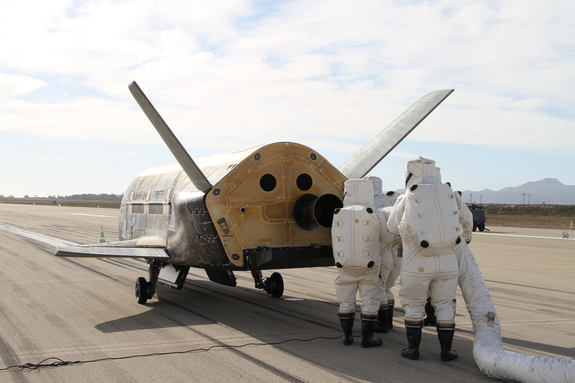
The U.S. military’s mysterious X-37B has returned to Earth following a record-setting 908 days in orbit around the planet, though what it was doing for all that time largely remains a closely guarded secret. The curious unmanned craft reportedly touched down at NASA’s Kennedy Space Center early Friday morning and was preceded by a pair of powerful sonic booms that rattled residents, who were left scratching their heads until the source of the sounds was ultimately revealed. The landing marked the conclusion of the X-37B’s sixth mission, which began when it was launched back in May of 2020.
While details surrounding the X-37B mission are somewhat scant, a U.S. Space Force press release touting the craft’s return gave some insight into some of the work that had been conducted during the 908 days it was orbiting the Earth. They revealed that one experiment aboard the space plane “successfully harnessed solar rays outside of Earth’s atmosphere and aimed to transmit power to the ground in the form of radio frequency microwave energy.” Meanwhile, a NASA study utilizing the craft’s marathon mission length looked at “the effect of long-duration space exposure on seeds.” The space plane’s 908 days in orbit smashed the record previously set by the X-37B fifth mission, which lasted 780 days.
Okay, so maybe this isn’t a real thing yet… but, c’mon, you know it’s coming! With the tagline “Bringing eye contact back to the 21st century” the Texting Hat is here to solve all your phone zombie problems. What a great invention. You look like you actually care when in reality who gives a f#@k!
Right now they’re not for sale, but the Texting Hat website encourages you to just make your own goddamned hat:
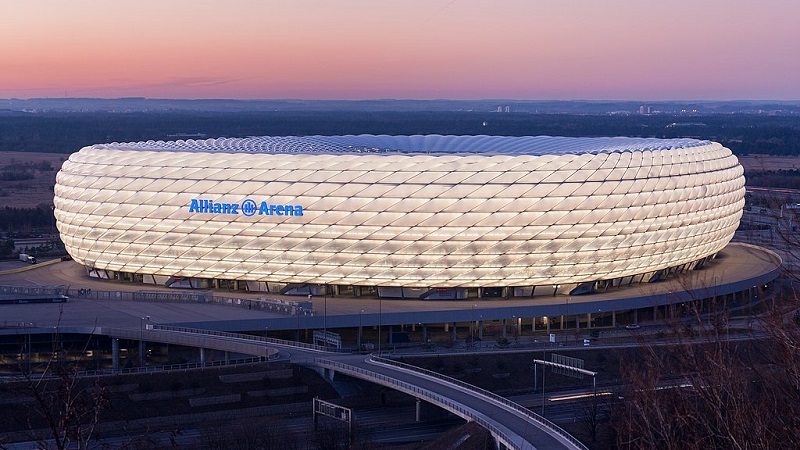
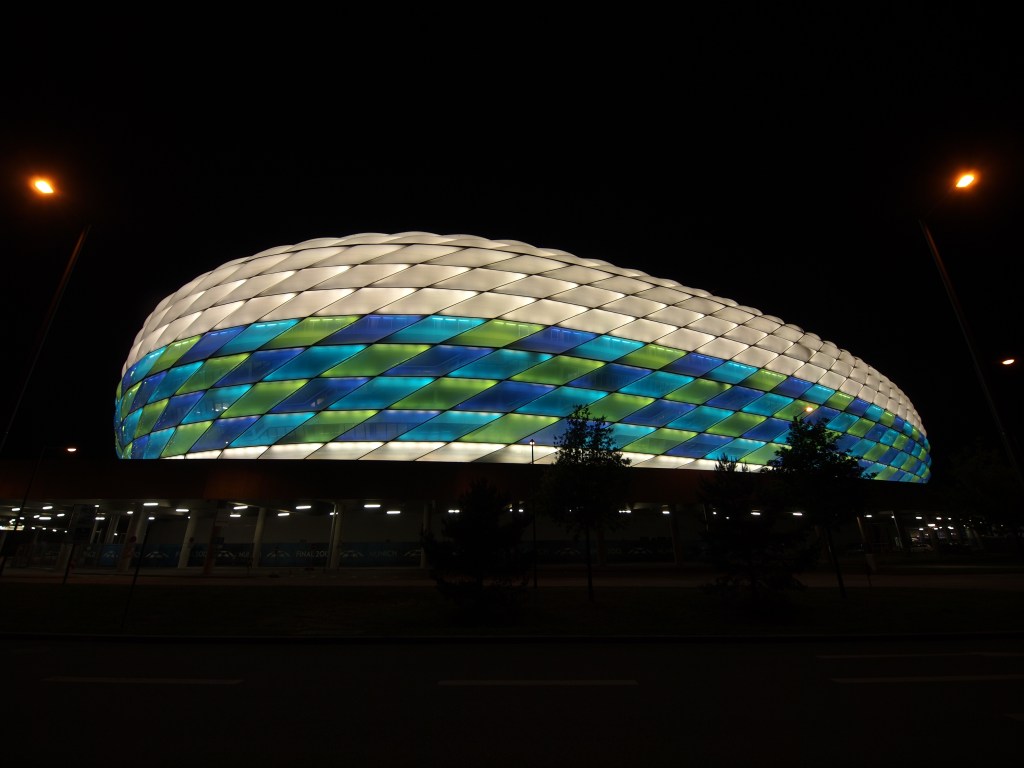
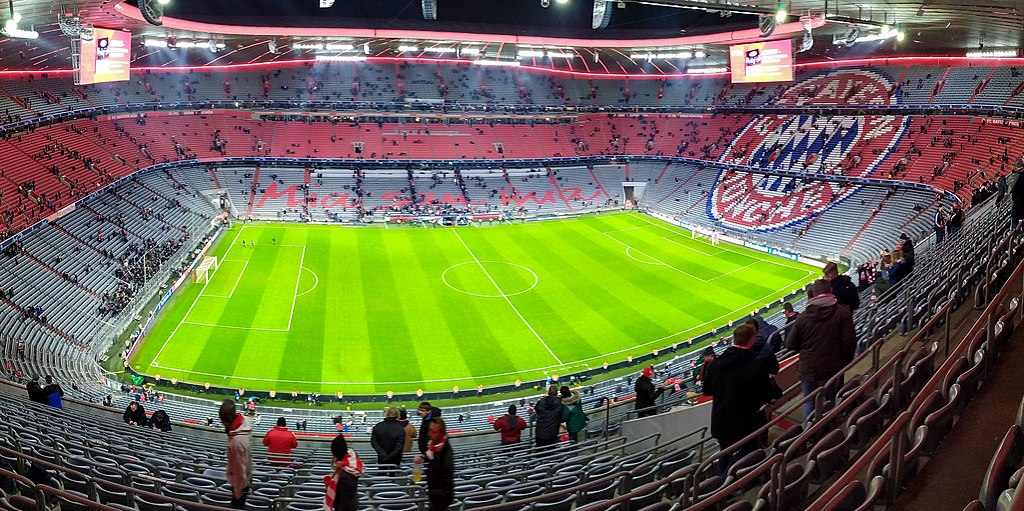
Allianz Arena is a football stadium in Munich, Bavaria, Germany with a 70,000 seating capacity for international matches and 75,000 for domestic matches. Widely known for its exterior of inflated ETFE plastic panels, it is the first stadium in the world with a full colour changing exterior. Located at 25 Werner-Heisenberg-Allee at the northern edge of Munich’s Schwabing-Freimann borough on the Fröttmaning Heath, it is the second-largest arena in Germany behind Westfalenstadion in Dortmund.
In-Q-Tel (IQT), formerly Peleus and known as In-Q-It, is an American not-for-profit venture capital firm based in Arlington, Virginia. It invests in high-tech companies for the sole purpose of keeping the Central Intelligence Agency, and other intelligence agencies, equipped with the latest in information technology in support of United States intelligence capability. The name, “In-Q-Tel” is an intentional reference to Q, the fictional inventor who supplies technology to James Bond.
The firm is seen as a trend-setter in the information technology industry, with the average dollar invested by In-Q-Tel in 2012 attracting nine dollars of investment from other companies.
Originally named Peleus and known as In-Q-It, In-Q-Tel was founded by Norm Augustine, a former CEO of Lockheed Martin and by Gilman Louie, who was In-Q-Tel’s first CEO. In-Q-Tel’s mission is to identify and invest in companies developing cutting-edge technologies that serve United States national security interests. Origins of the corporation can be traced to Dr. Ruth A. David, who headed the Central Intelligence Agency Directorate of Science & Technology in the 1990s and promoted the importance of rapidly advancing information technology for the CIA. In-Q-Tel now engages with entrepreneurs, growth companies, researchers, and venture capitalists to deliver technologies that provide superior capabilities for the CIA, DIA, NGA, and the wider intelligence community. In-Q-Tel concentrates on three broad commercial technology areas: software, infrastructure and materials sciences.
Former CIA director George Tenet says,
We [the CIA] decided to use our limited dollars to leverage technology developed elsewhere. In 1999 we chartered … In-Q-Tel. … While we pay the bills, In-Q-Tel is independent of CIA. CIA identifies pressing problems, and In-Q-Tel provides the technology to address them. The In-Q-Tel alliance has put the Agency back at the leading edge of technology … This … collaboration … enabled CIA to take advantage of the technology that Las Vegas uses to identify corrupt card players and apply it to link analysis for terrorists [cf. the parallel data-mining effort by the SOCOM-DIA operation Able Danger ], and to adapt the technology that online booksellers use and convert it to scour millions of pages of documents looking for unexpected results.
In-Q-Tel sold 5,636 shares of Google, worth over $2.2 million, on November 15, 2005. The stocks were a result of Google’s acquisition of Keyhole, the CIA funded satellite mapping software now known as Google Earth.
As of August 2006, In-Q-Tel had reviewed more than 5,800 business plans, invested some $150 million in more than 90 companies, and delivered more than 130 technology solutions to the intelligence community. In 2005 it was said to be funded with about $37 million a year from the CIA.
In-Q-Tel is a Virginia-registered corporation, legally independent of the CIA or any other government agency. The corporation is bound by its Charter agreement and annual contract with the CIA, which set out the relationship between the two organizations. In-Q-Tel’s mission to support the Intelligence Community’s technical needs is promoted by the In-Q-Tel Interface Center (QIC), an office within the CIA that facilitates communication and relationships between In-Q-Tel and government intelligence organizations. While In-Q-Tel is a nonprofit corporation, it differs from IARPA (Intelligence Advanced Research Projects Activity) and other models in that its employees can profit from its investments.
Many companies listed on In-Q-Tel’s investment website page are secret. In-Q-Tel functions partially in public; however, what products it has and how they are used is strictly secret. According to the Washington Post, “virtually any U.S. entrepreneur, inventor or research scientist working on ways to analyze data has probably received a phone call from In-Q-Tel or at least been Googled by its staff of technology-watchers.”
The CIA has its tentacles in so many things it’s mind-boggling. I just discovered the existence of In-Q-Tel today. It was laying low, keeping its profile below the radar. What other things is the CIA, NSA, DIA etc. involved in and with? Many secrets in the labyrinth that is the world of intelligence and espionage.
A couple and their two teenage daughters decided to get away from it all. They were living in the Los Angeles area and got fed up with the fast pace, noise and crazy traffic. Husband and wife are both professionals in television and commute back to L.A. a few days a week. But their home is now located dab smack in the barren desert of Death Valley, California.
There are no neighbours for over 20 miles. The nearest town is 35 miles away. They are out there with the coyotes and eagles. Complete isolation. Strangely enough, it does look quite peaceful, yet invigorating. After all, they are out there with nature in its most pure state.
The house derives most of its power from solar panels. Water is provided from a natural spring nearby.
The desert sun keeps the house perpetually bright.
No swimming pool, but a little hot tub to cool off during the day, or warm up at night.





 United States
 China
China India
India Russia
 Canada
 Germany
 Australia
 Argentina
 South Africa
 France
 Brazil
 Japan
Japan Italy
Italy Ukraine
 Romania
 Poland
 United Kingdom
 Mexico
 Spain
Spain Kazakhstan



 The MarkoZen Blog