Security Guard Filmed Talking to Ghost?

Video below.

An intriguing video from Argentina shows the moment when a hospital security guard claims to have greeted a visitor that he later learned was seemingly the ghost of a patient who had died earlier that night. The remarkable incident reportedly occurred last Saturday at the Finochietto Sanatorium in the city of Buenos Aires. At around three in the morning, the guard says that he was at the hospital’s front desk when an elderly woman entered through the automatic doors and explained that she had left something behind in her room. He subsequently took down her information and directed her into the building to retrieve the forgotten item. When the woman did not return a few hours later, he called the floor where she was headed and received an stunning response.

The security guard was informed that no such woman had visited the floor that night, which understandably piqued his curiosity. Going back to his paperwork from when she entered the building, he told them the name of the woman and that she had stayed in room 915. In what was likely an Earth-shattering experience for the man, the staff on the floor told him that person was a patient who had died three hours before he had encountered her in the front lobby. While this would normally be a fantastic tale worthy of an evening around the campfire, what makes the guard’s account particularly compelling is that his exchange with the woman was actually filmed by the hospital’s security camera.

In the bewildering video, seen above, the security guard stands up from the desk as the doors to the building open and, although no one can be seen entering, he grabs his clipboard and walks forward as if to speak to someone. For several seconds, the man appears to carry on a conversation which culminates with him ushering the invisible individual into the building and offering them a wheelchair, which they apparently declined. Since appearing online over the weekend, the confounding footage has gone viral on social media in Argentina with many wondering if the security guard’s eerie account is genuine.

In response to the furor surrounding the video, a skeptical official at the hospital indicated that they are investigating the matter and offered one particularly curious note about that night. He explained that a check of the security footage showed multiple instances wherein the possibly faulty automatic doors were seemingly triggered by nothing in particular. It was only in the one instance wherein the guard claims to have spoken to the woman that he responded as if someone had entered the building. That said, it has also been suggested that the video and accompanying tale might be an elaborate hoax orchestrated by the guard.

The Camouflaged Military Bunkers of Switzerland

Switzerland is a politically neutral country, yet it has a strong military. All across the Swiss alps are military installation and bunkers carefully hidden so as to blend into the surrounding landscape. Some of them are camouflaged as huge rocks, others as quiet villas or barns that could open up in the event of an emergency to reveal cannons and heavy machine guns that could blow any approaching army to smithereens. Enormous caverns are dugout on the mountain side to function as ad-hoc airbases with hangars. Every major bridge, tunnel, road and railway has been rigged so they could be deliberately collapsed, whenever required, to keep enemy armies out. Highways can be converted into runways by quickly removing the grade separations in between the lanes.

hidden-swiss-bunkers-17

Is that a rock?

The country has nuclear fallout shelters in every home, institutions and hospitals, as well as nearly 300,000 bunkers and 5,100 public shelters that could accommodate the entire Swiss population if required. Switzerland also has one of the largest armies on a per capita basis, with 200,000 active personnel and 3.6 million available for service. Every male citizen under 34 years old (under 50 in some cases) is a reserve soldier. Soldiers are even allowed to take all personally assigned weapons to home. If anyone were to invade Switzerland, they would find a nation armed to the teeth.
In his 1984 book, La Place de la Concorde Suisse, acclaimed New Yorker author John McPhee quoted a Swiss officer as saying: “Switzerland doesn’t have an army, Switzerland is an army.” Indeed, Switzerland’s powerful citizen army has helped preserve the country’s neutrality and keep neighboring countries from invading Swiss territory. The country hasn’t been involved in any military conflict for 200 years.

hidden-swiss-bunkers-12

A bunker disguised as a house.

Fortification of the Swiss alpine region began in the 1880s. They were intensified and modernized during the World War and again during the Cold War period. But today, as a neutral country with no immediate threats to its borders, most of the bunkers lie empty and many are falling into disrepair. Some have been converted into shelters for homeless people, others house things like museums and hotels.

The Swiss government considered closing them down but the cost of decommissioning — an estimated $1 billion — far surpasses what it takes annually to maintain them. While the matter is still debated, the bunkers are likely to stay because they still provide use as fallout shelters. “Neutrality is no guarantee against radioactivity,” they say. In 1978, a law was passed requiring all new buildings to incorporate a shelter. If a family decides against building a shelter, they must pay for a place in the public shelter. Switzerland is the only country in the world that could provide protection to its entire population of 8 million, and more.

hidden-swiss-bunkers-2

Another bunker disguised as a barn.

hidden-swiss-bunkers-5
hidden-swiss-bunkers-19
hidden-swiss-bunkers-3
hidden-swiss-bunkers-4
hidden-swiss-bunkers-6
hidden-swiss-bunkers-7
hidden-swiss-bunkers-8
hidden-swiss-bunkers-9
hidden-swiss-bunkers-10
hidden-swiss-bunkers-11
hidden-swiss-bunkers-14
hidden-swiss-bunkers-15
hidden-swiss-bunkers-16
hidden-swiss-bunkers-18

The Darien Gap 

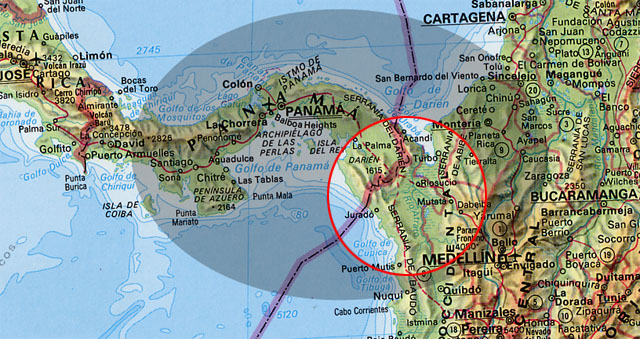
The Darién Gap is a break in the Pan-American Highway consisting of a large swath of undeveloped swampland and forest within Panama’s Darién Province in Central America and the northern portion of Colombia’s Chocó Department of South America. It measures just over 160 km (99 mi) long and about 50 km (31 mi) wide. Roadbuilding through this area is expensive, and the environmental toll is steep. Political consensus in favor of road construction has not emerged. Consequently there is no road connection through the Darién Gap connecting North/Central America with South America and it is the missing link of the Pan-American Highway.

The geography of the Darién Gap on the Colombian side is dominated primarily by the river delta of the Atrato River, which creates a flat marshland at least 80 km (50 mi) wide, half of this being swampland. The Serranía del Baudó occupy Colombia’s Pacific coast and extend into Panama. The Panamanian side, in sharp contrast, is a mountainous rainforest, with terrain reaching from 60 m (200 ft) in the valley floors to 1,845 m (6,053 ft) at the tallest peaks (Cerro Tacarcuna).

darien


The Pan-American Highway is a system of roads measuring about 48,000 km (30,000 mi) long that crosses through the entirety of North, Central, and South America, with the sole exception of the Darién Gap. On the South American side, the highway terminates at Turbo, Colombia. On the Panamanian side, the road terminus is the town of Yaviza at. This marks a straight-line separation of about 100 km (60 mi). In between is marshland and forest.

darien PanAmericanHwy

Efforts have been made for decades to remedy this missing link in the Pan-American highway. Planning began in 1971 with the help of United States funding, but this was halted in 1974 after concerns raised by environmentalists. Another effort to build the road began in 1992, but by 1994 a United Nations agency reported that the road, and the subsequent development, would cause extensive environmental damage. There is evidence that the Darién Gap has prevented the spread of diseased cattle into Central and North America, which have not seen foot-and-mouth disease since 1954, and since at least the 1970s this has been a substantial factor in preventing a road link through the Darién Gap. The Embera-Wounaan and Kuna have also expressed concern that the road would bring about the potential erosion of their cultures. The gap has been crossed by adventurers on bicycle, motorbike, all-terrain vehicle, and foot, dealing with jungle, swamp, insects, and other hazards.

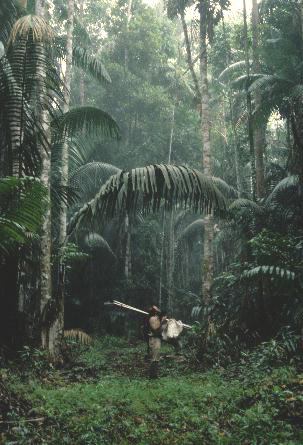
This place looks like a mosquito and snake infested hot box.

darien gapxx
Darien_National_Park
darien-gap-01

End of the road, Panama side.

darien1

Top Ten Zombie Killings

zombie-walk3

werewolves

Oh, all I want to know
All I want

With just a touch of my burning hand
I send my astro zombies to rape the land
Prime directive, exterminate
The whole human race

And your face drops in a pile of flesh
And then your heart, heart pounds
Till it pumps in death
Prime directive, exterminate
Whatever stands left

All I wanted to say
And all I gotta do
Who’d I do this for
Hey, me or you

And all I wanted to say
And all I gotta do
Who’d I do this for
Hey, me or you

Oh, all I want to know
All I want

With just a touch of my burning hand
I’m gonna live my life to to destroy your world
Prime directive, exterminate
The whole fuckin’ race

Then your face drops in a pile of flesh
And then your heart, heart pounds
And it pumps in death
Prime directive, exterminate
The whole fuckin’ place well

All I wanted to say
And all I gotta do
Who’d I do this for
Hey, me or you

And all I wanted to say
And all I gotta do
Who’d I do this for
Hey, me or you

Oh, all I want to know
All I want to know
All I want to know
All I want oh
Go

The Flemish Giant Rabbit, Very Big Bunny

Often weighing in at more than 10 kilograms (22 lbs), the Flemish Giant is by far the largest rabbit breed in the world. They are also extremely docile creatures and make great pets.

Originally a utility breed raised in Flanders, Belgium for its fur and meat, the Flemish Giant eventually became a show breed, due to its high bone-to-meat ratio. Today, they are considered one of the most docile and tolerant rabbit breeds in the world and can make great pets, if raised correctly. According to breed standards, a well-developed Flemish Giant has a large head, long, erect ears, a long and powerful body, and a nicely rounded rump. Unsurprisingly, the world’s largest rabbit is a Flemish Giant rabbit that weighs 49 lb (22 kg) and measures 1.3 m (4 ft 3 in.)

Due to its large size, the Flemish Giant, the “king of rabbits”, requires substantial living quarters, as well as large quantities of food compared to other breeds of domesticated rabbits.

The Flemish Giant is a very old breed of domesticated rabbit that can be traced back to the 16th century. It is believed to have descended from a number of meat and fur breeds, including the Steenkonijn, or Belgian Stone Rabbit.

Although the breed received little international attention until about 1910, when it started appearing at small livestock shows, its impressive size made it stand out. Today, it is still bred for its meat and fur, but it is more popular as a companion. If treated correctly, these gentle giants are very docile even around small children.