A No Go Zone for Vampires

cross2

The Hill of Crosses is a site of pilgrimage about 12 km north of the city of Šiauliai, in northern Lithuania. The precise origin of the practice of leaving crosses on the hill is uncertain, but it is believed that the first crosses were placed on the former Jurgaičiai or Domantai hill fort after the 1831 Uprising. Over the generations, not only crosses and crucifixes, but statues of the Virgin Mary, carvings of Lithuanian patriots and thousands of tiny effigies and rosaries have been brought here by Catholic pilgrims. The exact number of crosses is unknown, but estimates put it at about 55,000 in 1990 and 100,000 in 2006.

cross1

Over the generations, the place has come to signify the peaceful endurance of Lithuanian Catholicism despite the threats it faced throughout history. After the 3rd partition of the Polish–Lithuanian Commonwealth in 1795, Lithuania became part of the Russian Empire. Poles and Lithuanians unsuccessfully rebelled against Russian authorities in 1831 and 1863. These two uprisings are connected with the beginnings of the hill: as families could not locate bodies of perished rebels, they started putting up symbolic crosses in place of a former hill fort.

When the old political structure of Eastern Europe fell apart in 1918, Lithuania once again declared its independence. Throughout this time, the Hill of Crosses was used as a place for Lithuanians to pray for peace, for their country, and for the loved ones they had lost during the Wars of Independence.

The site took on a special significance during the years 1944–1990, when Lithuania was occupied by the Soviet Union. Continuing to travel to the hill and leave their tributes, Lithuanians used it to demonstrate their allegiance to their original identity, religion and heritage. It was a venue of peaceful resistance, although the Soviets worked hard to remove new crosses, and bulldozed the site at least three times (including attempts in 1963 and 1973). There were even rumors that the authorities planned to build a dam on the nearby Kulvė River, a tributary to Mūša, so that the hill would end up underwater.

On September 7, 1993, Pope John Paul II visited the Hill of Crosses, declaring it a place for hope, peace, love and sacrifice. In 2000 a Franciscan hermitage was opened nearby. The interior decoration draws links with La Verna, the mountain where St. Francis is said to have received his stigmata. The hill remains under nobody’s jurisdiction; therefore people are free to build crosses as they see fit.

cross

cross4

cross3

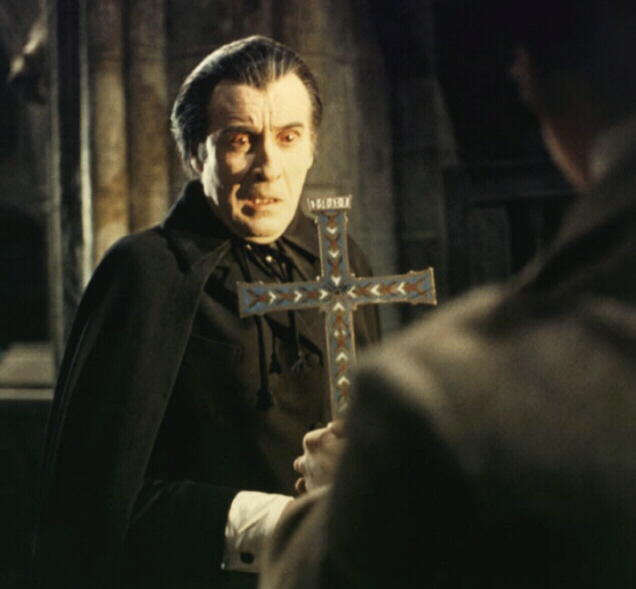
The vampires will be destroyed if they venture near this holy hill.

cross5

Wild and Unique Statues from around the World

Mustangs, Las Colinas, Texas

stats

Expansion, New York

stats1

The Monument of an Anonymous Passerby, Wroclaw, Poland

stats2

Salmon Sculpture, Portland, Oregon

stats3

People of the River by Chong Fah Cheong, Singapore

stats4

The Knotted Gun, Turtle Bay, New York

stats5

 Break Through From Your Mold, Philadelphia, Pennsylvania

stats6

Black Ghost, Klaipeda, Lithuania

stats7

stats8

Les Voyageurs, Marseilles, France

stats9

 Nelson Mandela, South Africa

stats10

 De Vaartkapoen, Brussels, Belgium

stats11

 Cattle Drive, Dallas, Texas, USA

stats12

Hippo Sculptures, Taipei, Taiwan

stats13

 Mihai Eminescu, Onesti, Romania

stats14

 Man Hanging Out, Prague, Czech Republic

stats15

Rundle Mall Pigs, Adelaide, Australia

stats16

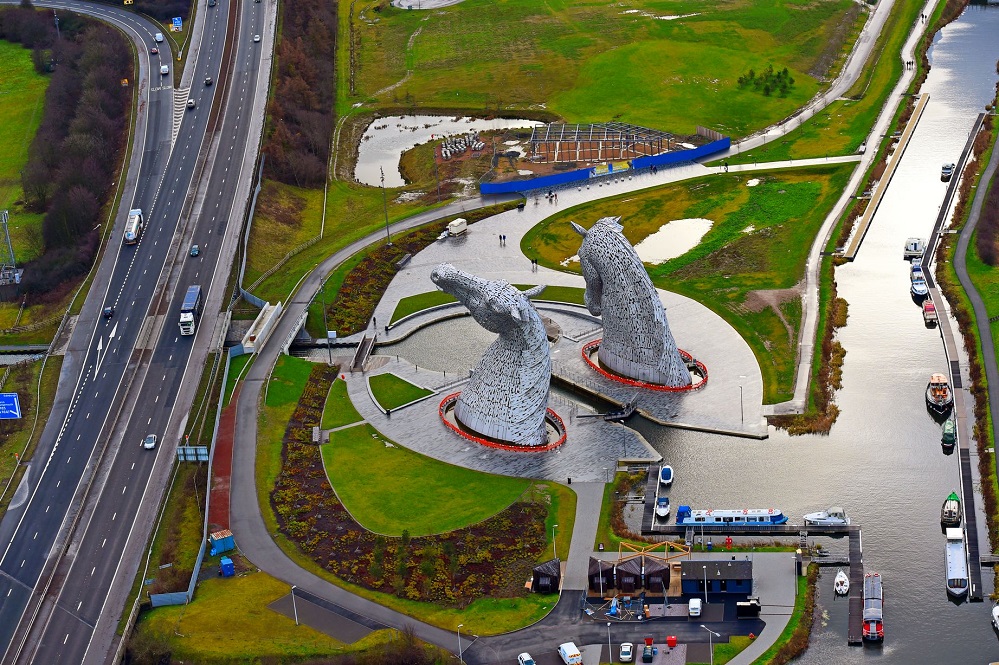
Kelpies, Grangemouth, UK (To put this into scale, note the man at the bottom, middle).

stats17

kelpies

Boxing gloves. Pan Am Boxing Club, Winnipeg, Canada.

box

box1

Wrong sub-titles on Swedish TV

Civic-minded Swedes who tuned in to a political debate early last year didn’t expect to witness an interplanetary underwater battle involving dinosaurs, but thanks to an innocent mixup at the SVT2 TV station, that’s what they got.It was probably more entertaining, not to say true-to-life, than what was actually happening in the debate, which involved Environmental Minister Åsa Romson, Liberal People’s Party leader Jan Björklund, Education Minister Gustav Fridolin, and Urban Ahlin, Speaker of the Riksdag, the national legislature of Sweden.

The subtitles depicted dialogue from the PBS children’s TV show Dinosaur Train.

The head of the channel’s subtitle department, Anna Zetterson, smells a rat (or is it a dinosaur?), it seems. It turns out that on some older television models you can swap out the “teletext” page from another channel while keeping the current image. On Facebook she wrote in Swedish, “On some older TVs can still choose the old teletext page for the different channels’ subtitles, while checking on a different channel. So SVT, or any operator, didn’t send these out. But it is something you can amuse yourself with on an older television set.”

We don’t care. Maybe nobody made a mixup and it was all a plot to tickle our brains. All we can say is, mission accomplished!

Via Dangerous Minds

Walls

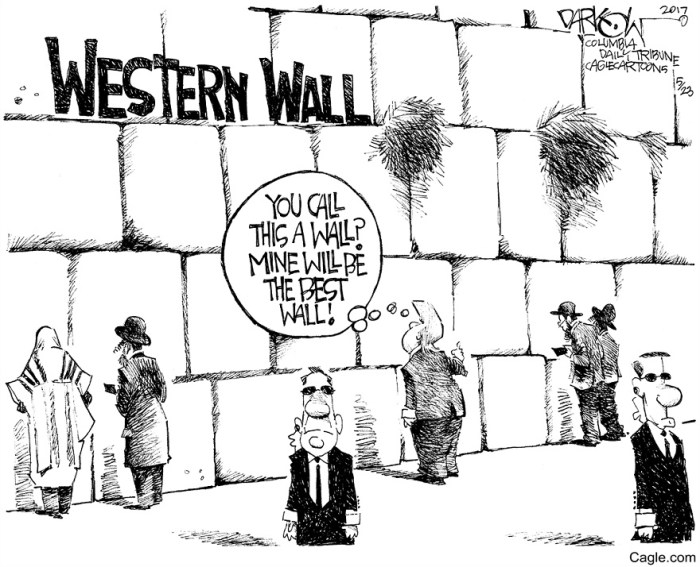
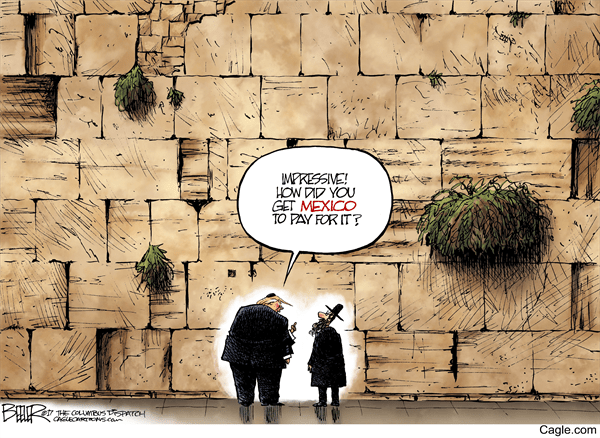
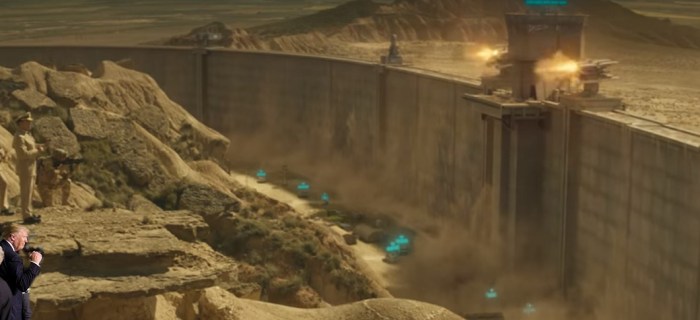
“I will build a great wall — and nobody builds walls better than me, believe me –and I’ll build them very inexpensively. I will build a great, great wall on our southern border, and I will make Mexico pay for that wall. Mark my words.”

Donald Trump

wallll

images

Trump on Border: ‘We’re Going to Build a Wall,’ It ‘Will Go Up So Fast Your Head Will Spin’

western wall

wall cop

wallxxxx

On Feb. 29, on Fox’s Hannity show, Trump said, “Well, look, we’re going to have a border. It’s going to be a real border, and we’re going to build a wall and it’s going to be a serious wall. Just remember that. And you remember I said it…. It’s going to be a serious wall. It’s going to be a real wall. It’s not going to be a wall that they just climb up, and you know, you see what they do, over.”

Trump’s Serious Wall

wall11

wall11a

there

Unique Airports

Courchevel International Airport (Courchevel, France)

Background:
Getting to the iconic ski resort of Courchevel requires navigating the formidable French Alps before making a hair-raising landing at Courchevel International Airport. The runway is about 1700 feet long, but the real surprise is the large hill toward the middle of the strip.
Why It’s Unique:
“You take off downhill and you land going uphill,” Schreckengast says. He adds that the hill, which has an 18.5 percent grade, is so steep that small planes could probably gain enough momentum rolling down it with no engines to safely glide off the edge. Landing at Courchevel is obviously no easy task, so pilots are required to obtain certification before attempting to conquer the dangerous runway.


Congonhas Airport (Sao Paulo, Brazil)

Background:
Most major cities have an airport, but rarely are they built just 5 miles from the city center, especially in metropolises like Sao Paulo. Congonhas’ close proximity to downtown can be attributed in part to the fact that it was completed in 1936, with the city experiencing rapid development in the following decades.
Why It’s Unique:
While having an airport only 5 miles from the city center may be a convenience for commuters, it places a strain on both pilots and air traffic control crews. “It becomes a challenge in terms of safety to just get the plane in there,” Schreckengast says. “Then you throw on noise restrictions and these terribly awkward arrival and departure routes that are needed to minimize your noise-print and it becomes quite challenging for pilots.” Fortunately, Sao Paulo’s many high-rise buildings are far enough away from the airport that they aren’t an immediate obstacle for pilots landing or taking off.


Don Mueang International Airport (Bangkok, Thailand)

Background:
From a distance Don Mueang International looks like any other midsize airport. However, smack-dab in the middle of the two runways is an 18-hole golf course.
Why It’s Unique:
Schreckengast, who has worked on consulting projects at this airport, says one of the major problems is that the only taxiways were located at the end of the runways. “We recommended that they build an additional taxiway in the middle, from side to side, and they said ‘absolutely not, that will take out a green and one fairway.’” The airport and the course were originally an all-military operation, but have since opened up to commercial traffic. Security threats, however, have limited the public’s access to the greens.


Madeira International Airport (Madeira, Portugal)

Background:
Madeira is a small island far off the coast of Portugal, which makes an airport that is capable of landing commercial-size aircraft vital to its development. This airport’s original runway was only about 5000 feet long, posing a huge risk to even the most experienced pilots and limiting imports and tourism.
Why It’s Unique:
Engineers extended the runway to more than 9000 feet by building a massive girder bridge atop about 200 pillars. The bridge, which itself is over 3000 feet long and 590 feet wide, is strong enough to handle the weight of 747s and similar jets. In 2004, the International Association for Bridge and Structural Engineering selected the expansion project for its Outstanding Structure Award, noting that the design and construction was both “sensitive to environmental and aesthetic considerations.”


Gibraltar Airport (Gibraltar)

Background:
Between Morocco and Spain sits the tiny British territory of Gibraltar. Construction of the airport dates back to World War II, and it continues to serve as a base for the United Kingdom’s Royal Air Force, though commercial flights land on a daily basis.
Why It’s Unique:
Winston Churchill Avenue, Gibraltar’s busiest road, cuts directly across the runway. Railroad-style crossing gates hold cars back every time a plane lands or departs. “There’s essentially a mountain on one side of the island and a town on the other,” Schreckengast says. “The runway goes from side to side on the island because it’s the only flat space there, so it’s the best they can do. It’s a fairly safe operation as far as keeping people away,” he says, “It just happens to be the best place to land, so sometimes it’s a road and sometimes it’s a runway.”


Kansai International Airport (Osaka, Japan)

Background:
Land is a scarce resource in Japan, so engineers headed roughly 3 miles offshore into Osaka Bay to build this colossal structure. Work on the manmade island started in 1987, and by 1994 jumbo jets were touching down. Travelers can get from the airport to the main island of Honshu via car, railroad or even a high-speed ferry.
Why It’s Unique:
Kansai’s artificial island is 2.5 miles long and 1.6 miles wide—so large that it’s visible from space. Earthquakes, dangerous cyclones, an unstable seabed, and sabotage attempts from protestors are just some of the variables engineers were forced to account for. As impressive as the airport is, Stewart Schreckengast, a professor of aviation technology at Purdue University and a former aviation consultant with MITRE, cautions that climate change and rising sea levels pose a very real threat to the airport’s existence. “When this was built, [engineers] probably didn’t account for global warming,” he says. “In 50 years or so, this might be underwater.”

Thomas Barbey: Photo Manipulation Artist before Photoshop

Thomas Barbèy (born 1958, Greenwich, Connecticut) grew up in Geneva, Switzerland, across the street from the “Caran D’ache” factory, the largest manufacturer of art supplies. He started drawing seriously at the age of 13, using black “encre de Chine” and gouaches for color. His influences were Philippe Druillet, Roger Dean and H.R. Giger.
After living in Geneva for 17 years and designing posters for musical bands, he decided to move to Italy. Thomas lived in Milan for 15 years making a living as a successful recording artist, lyricist and fashion photographer. Today, he resides in Las Vegas and travels the world, taking his camera wherever he goes.

Thomas has been a photographer for over twenty years now and prefers to use his old Canon AE1s when he shoots in 35mm or his RB67 when he shoots in medium format. More recently, he has been doing Black and White Photomontages for the sole purpose of doing Fine Art, without working for a specific client.

He’s combined several images taken over a period of twenty years to create surreal situations with the help of the enlarger in a dark room. His work has a specific style and is very characteristic. He only works with Black and White, including Sepia toning at times. Thomas exhibits in galleries throughout the world and is included in many private collections. 

cool-photo-manipulations-Thomas-Barbey-photoshop


Animated Art GIFs

arti1

The Graphics Interchange Format (better known by its acronym GIF) is a bitmap image format that was introduced by CompuServe in 1987 and has since come into widespread usage on the World Wide Web due to its wide support and portability.

The format supports up to 8 bits per pixel for each image, allowing a single image to reference its own palette of up to 256 different colors chosen from the 24-bit RGB color space. It also supports animations and allows a separate palette of up to 256 colors for each frame. These palette limitations make the GIF format less suitable for reproducing color photographs and other images with continuous color, but it is well-suited for simpler images such as graphics or logos with solid areas of color.

arti2

arti3

arti4

arti5

arti6

arti8

arti9

arti10

arti11

arti12

arti13