Clean energy

Clean energy
Many people are inclined to take the leap into the dark and deep abyss that is Video Lottery Terminal addiction. Once they sit down in front of the electronic bandits they can’t pull away until the mortgage payment or rent money has been swallowed up by the little mechanized devils. For a small percentage of the population VLT’s have become a major problem. A drain and burden financially and psychologically.

Since the widespread introduction of the gambling machines back in the early 1990’s in Canada provincial governments have become addicted to the revenue they generate. In Manitoba some half-hearted attempts have been made to reduce the negative impact the mesmerizing metal buckets inflict on addicts. Reducing the number of machines in establishments was one effort. Come to think about it, that was the only effort. Now hard-core VLT addicts have to drive around to different lounges and bars to find an open machine. But if that doesn’t work they can drive to one of the provincially run casinos where there are hundreds of the contraptions waiting to suck dry the last hundred dollars from a down and out addict.
But there may be an idea out there that will help control the out of control gamblers. The good people of Norway came up with the idea after experiencing many social problems caused by VLT addiction. It is a VLT gambling control card. VLT’s are configured where they can’t take coins or bills, only government issued cards. A player can only get credits of $400 to $500 on the card per month. When the $500 is used up the player has to wait until the 1st of the next month to get back into the action. $500 is still not pocket change, but some addicts report spending thousands of dollars a month on the hazardous machines.

But before this takes place the Libertarians will be screaming about more government regulations affecting the average Joe’s life. If the idiot can’t control his gambling urges tough luck. Stay out of our lives government, the strong and righteous will prevail. After all what is next? Spending limit cards on beer consumption. A person will only be allowed to spend $400 dollars a month on beer. Where does it end? Will there be spending limit cards on potato chips and chocolate bars? The government is trying to control every aspect of our lives. Vive laissez-faire!
But if this control card idea can stop the horrid gambling problems that certain people face let’s go ahead with it. Governments started this VLT blitz on society, it should be the government’s responsibility to help rectify gambling addiction.
In the United States, and the western world for the most part, if a person is very intelligent, ambitious, is a workaholic and has a burning desire to make tons of money, opulence can be achieved. A person can make many millions of dollars, or for that matter billions of dollars. What to do with all that wealth. The sky is the limit, i.e. private jets. But back on earth one can build or buy outrageously ostentatious mansions.
The mansion below is listed at 41 million dollars. It is 13,200 square feet and has everything a Saudi prince would desire.


A lap pool that runs around half of the house.


Glass walled garage

This is nuts!
The ramp leading up to a courtyard and the garage.


Beverly Hills, Oh my!

Aussies slur their words and use only two-thirds of their mouth to speak because early settlers spent most of their days DRUNK, academic says
The Australian accent developed because so many early settlers were drunk and slurring, an Australian academic has claimed.
The first British arrivals to the country were such big drinkers that the distortion to their speech caused a verbal hangover that persists to this day, according to Dean Frenkel, a communications expert at Victoria University in Melbourne.
Proud Australians may be offended by the claim, which comes on top of the unavoidable truth that Australia began its modern life as a penal colony for our criminals.

But academic Mr Frenkel unashamedly wrote in Australian newspaper The Age: ‘Let’s get things straight about the origins of the Australian accent.
‘The Australian alphabet cocktail was spiked by alcohol.
‘Our forefathers regularly got drunk together and through their frequent interactions unknowingly added an alcoholic slur to our national speech patterns.
‘For the past two centuries, from generation to generation, drunken Aussie-speak continues to be taught by sober parents to their children.’
Bemoaning the still ‘slurred’ Australian accent, Mr Frenkel continued: ‘The average Australian speaks to just two thirds capacity – with one third of our articulator muscles always sedentary as if lying on the couch; and that’s just concerning articulation.
‘Missing consonants can include missing “t”s (Impordant), “l”s (Austraya) and “s”s (yesh), while many of our vowels are lazily transformed into other vowels, especially “a”s to “e”s (stending) and “i”s (New South Wyles) and “i”s to “oi”s (noight).’
Concluding with a call for Australians to improve their diction, the academic added: ‘It is time to take our beer goggles off.
‘Australia, it is no longer acceptable to be smarter than we sound.’

The Australian alphabet that ‘was spiked by alcohol’ and that the distortion to their speech caused a verbal hangover that persists to this day
HISTORY OF THE AUSSIE ACCENT
1788 – Colonial settlement established. A new dialect of English begins to take shape
1830 – By the end of the early Colonial settlement era major features of the accent, called ‘General Australian’, had developed, wi the country’s love of abbreviated words became part of everyday language
1850 – The Gold Rush leads to internal migration, spreading the general dialect around the continent
1880 – Extensive migration from England led to an emphasis on elocution and British vowels, which formed the Broad Australian dialect
1914 to 1918 – Australia’s national identity was galvanized during WWI with the creation of terms like Anzac and digger. Australians start to become proud of their accent.
1950 – In the second half of the 20th century, any emphasis on Broad Australian dwindled because of weakening ties with Britain and the General Australian accent became widely accepted as the national norm
1964 – The term Strine was coined to describe the country’s accent, which the majority of people continue to speak today

Previous accent theories have included suggestions that the Australian accent is a true reflection of the 18th and 19th century accents of British arrivals, while the American accent reflects the way 17th century early settlers from Britain spoke.
The suggestion has been that it is native English accents which have changed, while former colonies have clung to old ways of speaking.
Winston Churchill described the Australian accent as ‘the most brutal maltreatment ever inflicted upon the mother tongue.’
Aussie Drinking Slang
Very strange brews indeed!


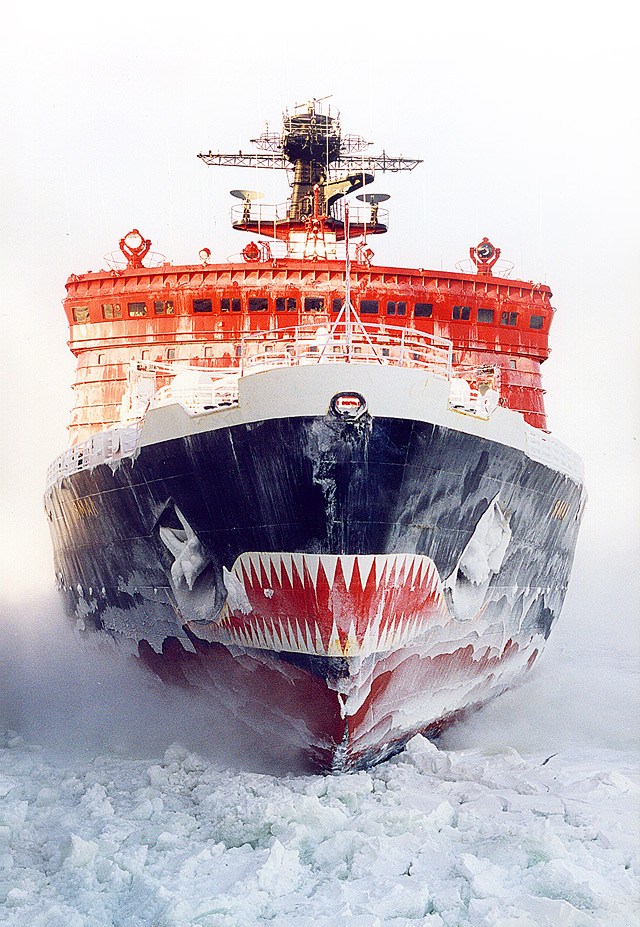
The NS Yamal is a Russian Arktika class nuclear-powered icebreaker operated by Atomflot (formerly by the Murmansk Shipping Company). It is named after the Yamal Peninsula in Northwest Siberia; the name means End of the Land in Nenets.
Laid down in Leningrad in 1986, and launched in October 1992, after the breakup of the Soviet Union, it never filled its designed role of keeping shipping lanes open. It has always carried passengers on arctic excursions. In July of 1994 Yamal took an excursion to the North Pole, with the NSF (National Science Foundation), to celebrate the Official Maiden Voyage. While at the exact north pole (verified by GPS & Inmarsat satellite coordinates) the crew and passengers celebrated with a barbeque – the ambient temperature was -10 degrees F (wind gusts were measured at -40 degrees F). Because of the ship 90/90 coordinates the ship captain (Smirnov) organized a swimming party with Mr. Will Rountree (USA) being recorded as the 1st person to ever swim there (21 Jul 94) – water temperature was below freezing, ranging from 28 degrees to 31 degrees F. The Yamal is the 12th surface ship ever to reach the north pole.

The Yamal is equipped with a double hull. The outer hull is 48 mm thick where ice is met and 25 mm elsewhere and has a polymer coating to reduce friction. There is water ballast between the inner and outer hulls which can be shifted in order to aid icebreaking. Icebreaking is also assisted by an air bubbling system which can deliver 24 m³/s of air from jets 9 m below the surface. The Yamal can break ice while making way either forwards or backwards.
Yamal is one of the Russian “Arktika” family of icebreakers, the most powerful icebreakers in the world. These ships must cruise in cold water to cool their reactors, so they cannot pass through the tropics to undertake voyages in the Southern hemisphere.

Yamal docked in Murmansk
Yamal carries one helicopter and several Zodiac boats. Radio and satellite communications systems are installed which can provide navigation, telephone, fax, and email services. Amenities include a large dining room (capable of holding all 100 passengers in one sitting), a library, passenger lounge, auditorium, volleyball court, gymnasium, heated indoor swimming pool, a sauna, and an infirmary. She is equipped with 50 passenger cabins and suites, all with toilets, exterior windows, a television, and a desk.
Yamal also played a significant role in creation of annual travel expeditions to the North Pole, being one of the few vessels capable of getting there and bringing tourists with it in safety. Since 1993 the icebreaker was operated by Murmansk Shipping Company and in 2001-2008 the operation was made by Murmansk Shipping Company and Poseidon Expeditions. Yamal has made a total of 47 voyages to the North Pole.

Sister ship 50 Let Pobedy, biggest icebreaker in the world
The Lunar Reconnaissance Orbiter (LRO) is a NASA robotic spacecraft currently orbiting the Moon in an eccentric polar mapping orbit. Data collected by LRO has been described as essential for planning NASA’s future human and robotic missions to the Moon. Its detailed mapping program is identifying safe landing sites, locating potential resources on the Moon, characterizing the radiation environment, and demonstrating new technologies.
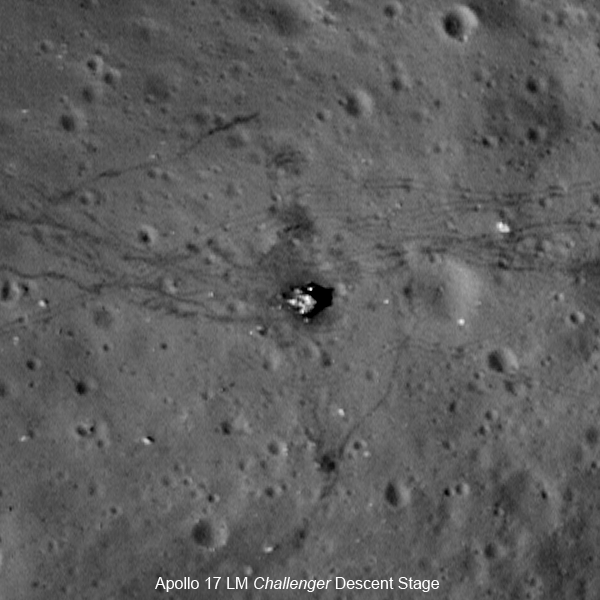
The probe has made a 3-D map of the Moon’s surface and has provided high resolution images of Apollo landing sites. The first images from LRO were published on July 2, 2009, showing a region in the lunar highlands south of Mare Nubium (Sea of Clouds).
Launched on June 18, 2009, in conjunction with the Lunar Crater Observation and Sensing Satellite (LCROSS), as the vanguard of NASA’s Lunar Precursor Robotic Program, LRO was the first United States mission to the Moon in over ten years. LRO and LCROSS were launched as part of the United States’s Vision for Space Exploration program.
Artist’s illustration of the LRO


Tycho Central Peak
Far side of the Moon

Near side of the Moon


Video at bottom.
Mono Lake is a large, shallow saline soda lake in Mono County, California. It is located in the eastern Sierra Nevada mountain range. The lake was the backdrop for the town Lago in the 1973 Clint Eastwood film “High Plains Drifter”.
Clint Eastwood riding towards the lake.


In 1991 another film was shot at Mono Lake. And one of the characters in that film was very big and hairy.
Back in 2008, a science teacher from Orange County, California came forward and presented to the Bigfoot community one of the most intriguing footage of Bigfoot they had seen in a long time. The teacher said his family had viewed the vacation video privately for almost 20 years– not knowing he had captured a possible Bigfoot until his daughter pointed it out to him. The home video was taken in 1991, around Mono Lake, near the base of the Sierra Nevada Mountains. In the video, a large, hairy, upright figure can be seen walking between two rock formations near the shore.

Investigators suggest that the figure in the video shows either a Bigfoot, or someone in a Bigfoot costume. According to the BFRO, if it was a person, it would have been someone who was wearing a large, full-length brown fur coat with excessively long furry sleeves.
The witness submitted his report to the BFRO on May 9, 2008 (17 years after filming the creature). Based on his credibility as a high school science teacher with absolutely nothing to gain by releasing the tape– the BFRO believes the film is authentic:
He is a science teacher at a high school in south Orange County, California. He has no incentive to fake this footage or to involve his family in an elaborate prank.
The animal seen strolling among the tufa spires appears to be upright and bipedal and muscular. It appears to have long arms and makes long strides with its legs. It does not appear to be a bear. It appears to be either a man in a bigfoot costume, or an actual bigfoot.
The profile of the cameraman, combined with the random circumstances of the videotaping, strongly suggest this is not a man in a costume — not a hoax.
On May 18, 1991, while on vacation in the Mammoth Lakes area in Northern California, my family took a short day hike to Mono Lake to do some sightseeing. It was overcast and very cold with a strong wind blowing. There was still snow on the surrounding peaks. Mono Lake is at the base of the Sierra Nevada mountains.
I do not recall the location at which we parked the car to begin our hike, but I do remember that ours was the only car in the parking area and that the spot was quite desolate. It was a cold Saturday morning and the area was deserted. At 9:17AM I began shooting VHS video footage of our trek, and after a short period of time we finally decided to leave because of the wind and cold. We went back to our hotel in June Lake, enjoyed the rest of the weekend and went home. The trip was quite uneventful (or so we assumed).

The tape went into our family home video collection and for 17 years, from 1991 to 2008, it has been watched countless times by family and friends. So much so that my kids have the dialog on much of the tape collection memorized. On April 19, 2008 my daughter (6 years old in the video and now 22) was watching the tape in the downstairs family room when she suddenly screamed out and began yelling for me to come downstairs. I thought something bad had happened and after racing down the staircase, found my daughter and my ex sitting in front of the television telling me to watch a segment from the tape. What I saw when we played it back made the hair stand up on the back of my neck. And it was something none of us had ever noticed in almost 17 years of watching this tape,
In the final few seconds of the Mono Lake segment just before I turned the camera off I caught something very large and black moving between two rock formations a short distance from where we had been hiking. It was completely black with no differentiation in color or texture and walked upright like a human but with a gate more like a primate. At first I thought it was a bear, but after going over the video many times and finally digitizing and sharpening it I am now unsure what to think. From examination of the footage of my family whose distance from the camera was comparable to that of the creature it is easy to see the distinct details and variation in clothing, hair, face and hands. In contrast, the creature caught on tape exhibits none of those distinctions. The shape of the body does not resemble a human. The head is too large and the arms are too long. And although it does resemble a bear at one particular angle in the clip, the stance and gate don’t add up. It is an intriguing mystery.
That we were able to go for 17 years without noticing this event on the tape seems unbelievable, but in retrospect it actually makes some sense. The segment lasts for only a couple of seconds and the focus is on the lake and mountains which is what I must have been filming at the time. I didn’t see it when I shot the tape and it has since gone unnoticed because one must really be looking for it to see it.

I am not a person who is prone to believing in conspiracy theories, alien abductions and bizarre events such as a purported Bigfoot sighting. I’ve seen various footage and photographs of Bigfoot/Sasquatch sightings over the years and have always been extremely skeptical of their authenticity. As an engineer who now teaches high school physics, I am highly educated and very level headed. If I see something I don’t understand my natural reaction is to analyze it rationally using the scientific method. I do not jump to conclusions based on faulty hypotheses. So in this case, I will suspend judgment pursuant to further investigation. But having shown this video to family and friends whose opinions I trust, the overall reaction seems to be a unanimous “Bigfoot!!” Wishful thinking? Maybe. Maybe not. Either way it is very intriguing and definitely warrants further investigation.
Your opinion and assistance in this matter would be appreciated.

Another strange encounter in the same range.


The debate over flying the Confederate flag has reignited in the US, but the American South isn’t the only place in the world you’ll see the emblem – it’s also proudly displayed in the rural Brazilian town of Santa Barbara D’Oeste.
Once a year, the descendants of about 10,000 Confederates that fled the United States to Brazil after the US Civil War have a sort of family reunion.
“They all take part in stereotypically southern things like square dances, eating fried chicken and biscuits, and listening to George Strait,” says Asher Levine, a Sao Paulo-based correspondent for Reuters.
“And a lot of Confederate flags everywhere, all over the place.

Despite being six or seven generations removed from their antebellum ancestry, many local Brazilians still maintain strong ties to Southern culture, and proudly wave the Confederate flag.
But for them, Levine says, the flag is much more of an ethnic symbol than a political one.
“They see themselves as ethnically American to some degree,” he says.
“At an Italian festival, you would see people waving an Italian flag. Or on Saint Patrick’s Day you see people waving the Irish flag. They see it that way. They don’t have any political affiliation to it whatsoever.”

Over time, the Southern white population has mixed with the Brazilians, resulting in people with a variety of different shades of skin colours waving the Confederate flag. Americans might be surprised by the resulting visual.
“A lot of people who are descendants of these confederates have African blood as well, so you’ll see at the party people with dark skin waving the Confederate flag.”
Levine says he talked to an American at the festival who was completely amazed at watching a young girl singing Amazing Grace – often sung in black churches across the US – while standing on top of a Confederate flag.

The banner is everywhere – kids wave mini-flags and women wear Confederate flag dresses.
“You know, the symbolism is totally lost on them, but for us it’s quite a contrast,” Levine says.
Despite being a very mixed-race country, Levine says that the killings in Charleston are being seen in Brazil as more of a gun safety issue than a racial issue.
“When they see an event like what happened in South Carolina last week, they wonder if it’s really so much better in the United States, safety-wise.”

After the end of the American Civil War, beginning in 1867, the region began to see immigration from the southern United States, these immigrants were known as the Confederados.
Today’s Confederados maintain affection for the Confederate flag even though they consider themselves completely Brazilian. In Brazil, the Confederate flag has not had the racial stigma that has been attached to it in the United States. Many modern Confederados are of mixed-race and reflect the varied racial categories that make up Brazilian society in their physical appearance. Recently the Brazilian residents of Americana, now of primarily Italian descent, have removed the Confederate flag from the city’s crest citing the fact that Confederados now make up only 10% of the city’s population. In 1972, then Governor (and future President) Jimmy Carter of Georgia visited the city of Santa Bárbara d’Oeste and visited the grave of his wife Rosalyn’s great-uncle, who was one of the original Confederados.
BBC