For many, the idea of receiving a free bottle of beer every day for the rest of their lives sounds like a dream and for a handful of ale drinkers in Belgium that fantasy has become a reality.
Brewer Xavier Vanneste could no longer stand the idea that hundreds of his trucks were damaging the medieval streets of his beloved Bruge and decided to hatch an audacious plan.
Mr Vanneste proposed to build a beer pipeline from his city brewery to a bottling plant outside of town two miles away.
The idea may have seemed mad, but after all, his beer is called the Madman of Bruges – or Brugse Zot in Dutch.
What at first seemed like an outrageous dream, began to seem possible when the brewer started talking to local beer enthusiasts.
‘Jokes were coming in fast, with people saying ‘we are willing to invest as long as we can have a tapping point on the pipeline,’ Vanneste said.
‘That gave us the idea to crowdfund the project.’
However, while some poked fun, others were happy to put their hands in their pockets.
‘You have to be a bit crazy – like the beer – to do such a project.
‘I just had the money for that, and I liked it. So I went crazy and gave the money to the brewery,’ said restaurant owner Philippe Le Loup, who poured $11,000 into the pipeline.
Thanks to Le Loup and others, Mr Vanneste is now staring at one end of the pipeline, which by autumn will start pumping some 1,060 gallons of beer an hour toward the bottling plant.
‘That is a lot of beer, more than you can drink in a lifetime,’ said the owner of De Halve Maan brewery, which in addition to Brugse Zot is also famous for its Straffe Hendrik brand.
Sending the pipeline along streets where customers could siphon off their favorite suds was too big a promise even for Vanneste, but he came up with the next best thing: IOUs with a lifelong drinking guarantee.
On March 23, 1847, the Indians of the Choctaw nation took up an amazing collection. They raised $170 for Irish Famine relief, an incredible sum at the time worth in the tens of thousands of dollars today.
They had an incredible history of deprivation themselves, forced off their lands in 1831 and made embark on a 500 mile trek to Oklahoma called “The Trail of Tears.” Ironically the man who forced them off their lands was Andrew Jackson, the son of Irish immigrants.
On September 27, 1830, the Treaty of Dancing Rabbit Creek was signed. It represented one of the largest transfers of land that was signed between the U.S. Government and Native Americans without being instigated by warfare. By the treaty, the Choctaws signed away their remaining traditional homelands, opening them up for European-American settlement. The tribes were then sent on a forced march
As historian Edward O’Donnell wrote “Of the 21,000 Choctaws who started the journey, more than half perished from exposure, malnutrition, and disease. This despite the fact that during the War of 1812 the Choctaws had been allies of then-General Jackson in his campaign against the British in New Orleans.’
Now sixteen years later they met in their new tribal land and sent the money to a U.S. famine relief organization for Ireland. It was the most extraordinary gift of all to famine relief in Ireland. The Choctaws sent the money at the height of the Famine, “Black 47,” when close to a million Irish were starving to death.
Thanks to the work of Irish activists such as Don Mullan and Choctaw leader Gary White Deer the Choctaw gift has been recognized in Ireland.
In 1990, a number of Choctaw leaders took part in the first annual Famine walk at Doolough in Mayo recreating a desperate walk by locals to a local landlord in 1848.
In 1992 Irish commemoration leaders took part in the 500 mile trek from Oklahoma to Mississippi. The Choctaw made Ireland’s president Mary Robinson an honorary chief. They did the same for Don Mullan.
Even better, both groups became determined to help famine sufferers, mostly in Africa and the Third World, and have done so ever since.
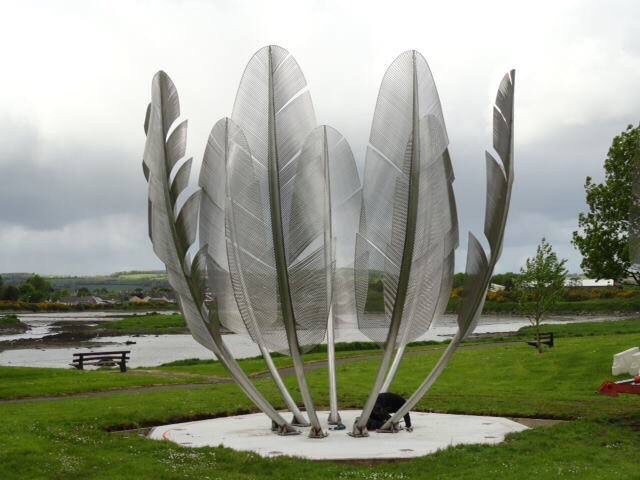
The gift is remembered in Ireland. The plaque on Dublin’s Mansion House that honors the Choctaw contribution reads: “Their humanity calls us to remember the millions of human beings throughout our world today who die of hunger and hunger-related illness in a world of plenty.”
Choctaw contribution memorial in Ireland
The Great Irish Famine led to the massive Irish migration to America.
Dec. 7 (UPI) — The owner of a Pennsylvania reptile sanctuary rescued a 3-foot alligator spotted by fishermen in the frigid waters of a river.
Christina Obrecht, owner of Christina’s Reptile and Animal Sanctuary in Palmerton, responded with volunteer Dana Ortiz when fisherman Logan Bauer and his father spotted the 3-foot gator in the water while they were fishing in the Lehigh River at Kimmett’s Lock, in the Allentown area.
“I never seen anything like it and couldn’t believe my dad when he told me it was in the water,” Bauer told WFMZ-TV.
Ortiz filmed video as Obrecht plucked the alligator out of the water.
“I went on the water, and was able to get in a little closer to grab him,” Obrecht told the Times News. “I grabbed him by the head, got him out and put him in the duffel bag for transportation.”
Obrecht said the gator didn’t put up much of a fight due to being exhausted from the cold.
“We knew that he would be very inactive, especially because alligators can withstand cooler temperatures, however once it gets too cold, they become severely inactive, so we knew that he wouldn’t act completely wild,” she said.
Obrecht said the alligator was likely a pet that was abandoned by its owner when it became too large to keep. She said the alligator wouldn’t have survived for very long in the river due to the cold temperatures.
“Sometimes these pet owners are even embarrassed to call a place. We definitely want to stress to never to be embarrassed. Everyone makes mistakes. Alligators do not make good pets. If you ever have an alligator, please call a facility. There’s always someone around to help,” Obrecht said.















 The MarkoZen Blog