
Statue in Poland
Statue in Poland
In the 1960’s there was a science fiction TV show called Voyage to the Bottom of the Sea. The show centered around the crew aboard a huge nuclear powered submarine named the Seaview. One of the more interesting features of the show was a mini flying sub that was housed in the nose of the Seaview. This little sub could bolt away from the Seaview, propel itself through the water to the surface, and take to the skies. Then land back on the water and go submersible and dock back up with the Seaview.


Americans love their high-technology gadgets. And the military is often at the forefront when it comes to developing cutting edge high technology systems. And believe it or not the U.S. military is looking into a real Flying Sub!
Irwin Allen, the creator of Voyage to the Bottom of the Sea would be very proud indeed.
From Newscientist.com
GUILLEMOTS and gannets do it. Cormorants and kingfishers do it. Even the tiny insect-eating dipper does it. And if a plan by the Pentagon’s Defense Advanced Research Projects Agency (DARPA) succeeds, a remarkable airplane may one day do it too: plunge beneath the waves to stalk its prey, before re-emerging to fly home.
The DARPA plan calls for a stealthy aircraft that can fly low over the sea until it nears its target, which could be an enemy ship, or a coastal site such as a port. It will then alight on the water and transform itself into a submarine that will cruise under water to within striking distance, all without alerting defences.
That, at least, is the plan. The agency is known for taking on brain-twistingly difficult challenges. So what about DARPA’s dipper? Is it a ridiculous dream? “A few years ago I would have said that this is a silly idea,” says Graham Hawkes, an engineer and submarine designer based in San Francisco. “But I don’t think so any more.”
DARPA, which has a $3 billion annual budget, has begun to study proposed designs. In the next year or so it could begin allocating funding to developers. Though the agency itself is unwilling to comment, Hawkes and others working on rival designs have revealed to New Scientist how they would solve the key problems involved in building a plane that can travel underwater – or, to put it another way, a flying submarine.
The challenges are huge, not least because planes and submarines are normally poles apart. Aircraft must be as light as possible to minimise the engine power they need to get airborne. Submarines are heavyweights with massive hulls strong enough to resist crushing forces from the surrounding water. Aircraft use lift from their wings to stay aloft, while submarines operate like underwater balloons, adjusting their buoyancy to sink or rise. So how can engineers balance the conflicting demands? Could a craft be designed to dive into the sea like a gannet? And how will it be propelled – is a jet engine the best solution, both above and below the waves?

The Utah Data Center (UDC), also known as the Intelligence Community Comprehensive National Cybersecurity Initiative Data Center, is a data storage facility for the United States Intelligence Community that is designed to store data estimated to be on the order of exabytes or larger. Its purpose is to support the Comprehensive National Cybersecurity Initiative (CNCI), though its precise mission is classified. The National Security Agency (NSA) leads operations at the facility as the executive agent for the Director of National Intelligence. It is located at Camp Williams near Bluffdale, Utah, between Utah Lake and Great Salt Lake and was completed in May 2014 at a cost of $1.5 billion.

Critics believe that data center has the capability to process “all forms of communication, including the complete contents of private emails, cell phone calls, and Internet searches, as well as all types of personal data trails—parking receipts, travel itineraries, bookstore purchases, and other digital ‘pocket litter’.” In response to claims that the data center would be used to illegally monitor email of U.S. citizens, in April 2013 an NSA spokesperson said, “Many unfounded allegations have been made about the planned activities of the Utah Data Center, … one of the biggest misconceptions about NSA is that we are unlawfully listening in on, or reading emails of, U.S. citizens. This is simply not the case.”
In April 2009, officials at the United States Department of Justice acknowledged that the NSA had engaged in large-scale overcollection of domestic communications in excess of the United States Foreign Intelligence Surveillance Court’s authority, but claimed that the acts were unintentional and had since been rectified.

In August 2012, The New York Times published short documentaries by independent filmmakers titled The Program, based on interviews with former NSA technical director and whistleblower William Binney. The project had been designed for foreign signals intelligence (SIGINT) collection, but Binney alleged that after the September 11 terrorist attacks, controls that limited unintentional collection of data pertaining to U.S. citizens were removed, prompting concerns by him and others that the actions were illegal and unconstitutional. Binney alleged that the Bluffdale facility was designed to store a broad range of domestic communications for data mining without warrants.
Documents leaked to the media in June 2013 described PRISM, a national security computer and network surveillance program operated by the NSA, as enabling in-depth surveillance on live Internet communications and stored information. Reports linked the data center to the NSA’s controversial expansion of activities, which store extremely large amounts of data. Privacy and civil liberties advocates raised concerns about the unique capabilities that such a facility would give to intelligence agencies. “They park stuff in storage in the hopes that they will eventually have time to get to it,” said James Lewis, a cyberexpert at the Center for Strategic and International Studies, “or that they’ll find something that they need to go back and look for in the masses of data.” But, he added, “most of it sits and is never looked at by anyone.”
The UDC was expected to store Internet data, as well as telephone records from the controversial NSA telephone call database, MAINWAY, when it opened in 2013.
In light of the controversy over the NSA’s involvement in the practice of mass surveillance in the United States, and prompted by the 2013 mass surveillance disclosures by ex-NSA contractor Edward Snowden, the Utah Data Center was hailed by The Wall Street Journal as a “symbol of the spy agency’s surveillance prowess”.
Binney has said that the facility was built to store recordings and other content of communications, not only for metadata.
According to an interview with Snowden, the project was initially known as the Massive Data Repository within NSA, but was renamed to Mission Data Repository due to the former sounding too “creepy”.

An article by Forbes estimates the storage capacity as between 3 and 12 exabytes in the near term, based on analysis of unclassified blueprints, but mentions Moore’s Law, meaning that advances in technology could be expected to increase the capacity by orders of magnitude in the coming years.
Toward the end of the project’s construction it was plagued by electrical problems in the form of “massive power surges” that damaged equipment. This delayed its opening by a year.
The finished structure is characterized as a Tier III Data Center, with over a million square feet, that cost over 1.5 billion dollars to build. Of the million square feet, 100,000 square feet are dedicated to the data center. The other 900,000 square feet are utilized as technical support and administrative space.

Google has given a rare glimpse inside the vast data centres around the globe that power its services.
They reveal an intricate maze of computers that process Internet search requests, show YouTube video clips and distribute email for millions of people.
With hundreds of thousands of servers, colourful cables and even bicycles so engineers can get around quickly, they range from a converted paper mill in Finland to custom made server farms in Iowa.
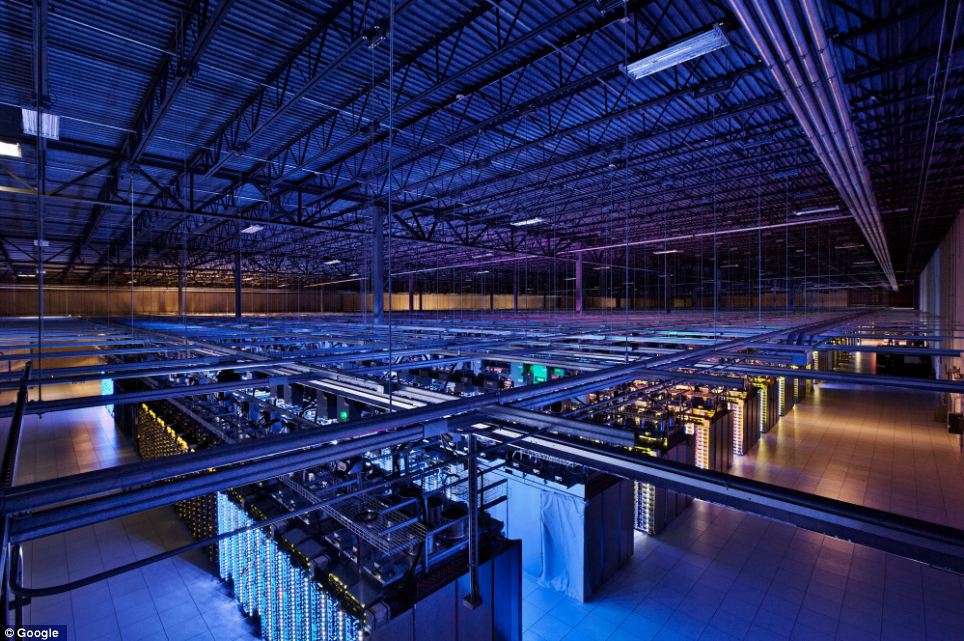
One of Google’s server farms in Council Bluffs, Iowa, which provides over 115,000 square feet of space for servers running services like Search and YouTube
‘Very few people have stepped inside Google’s data centers, and for good reason: our first priority is the privacy and security of your data, and we go to great lengths to protect it, keeping our sites under close guard,’ the firm said.
‘While we’ve shared many of our designs and best practices, and we’ve been publishing our efficiency data since 2008, only a small set of employees have access to the server floor itself.
‘Today, for the first time, you can see inside our data centers and pay them a virtual visit.
‘On Where the Internet lives, our new site featuring beautiful photographs by Connie Zhou, you’ll get a never-before-seen look at the technology, the people and the places that keep Google running.’
The site features photos from inside some of the eight data centers that Google Inc. already has running in the U.S., Finland and Belgium.
Google is also building data centers in Hong Kong, Taiwan, Singapore and Chile.
Virtual tours of a North Carolina data center also will be available through Google’s ‘Street View’ service, which is usually used to view photos of neighborhoods around the world.
The photographic access to Google’s data centers coincides with the publication of a Wired magazine article about how the company builds and operates them.
The article is written by Steven Levy, a journalist who won Google’s trust while writing ‘In The Plex,’ a book published last year about the company’s philosophy and evolution.
Google colour codes its servers depending on their location, while piping in the buildings is coded depending on what it carries – with cool water in blue tubes and warm in red

Google’s Douglas County data centre in Georgia is so large the firm provides Google branded bicycles for staff to get around on
The data centers represent Google’s nerve center, although none are located near the company’s headquarters in Mountain View, Calif.
As Google blossomed from its roots in a Silicon Valley garage, company co-founders Larry Page and Sergey Brin worked with other engineers to develop a system to connect low-cost computer servers in a way that would help them realize their ambition to provide a digital roadmap to all of the world’s information.
Initially, Google just wanted enough computing power to index all the websites on the Internet and deliver quick responses to search requests. As Google’s tentacles extended into other markets, the company had to keep adding more computers to store videos, photos, email and information about their users’ preferences.

A street view tour published by Google also reveals a hidden surprise – A Stormtrooper standing guard over a server in Google’s North Carolina server farm
The insights that Google gathers about the more than 1 billion people that use its services has made the company a frequent target of privacy complaints around the world.
The latest missive came Tuesday in Europe, where regulators told Google to revise a 7-month-old change to its privacy policy that enables the company to combine user data collected from its different services.
Google studies Internet search requests and Web surfing habits in an effort to gain a better understanding of what people like. The company does this in an effort to show ads of products and services to the people most likely to be interested in buying them. Advertising accounts for virtually all of Google’s revenue, which totaled nearly $23 billion through the first half of this year.
Even as it allows anyone with a Web browser to peer into its data centers, Google intends to closely guard physical access to its buildings. The company also remains cagey about how many computers are in its data centers, saying only that they house hundreds of thousands of machines to run Google’s services.
Google’s need for so many computers has turned the company a major electricity user, although management says it’s constantly looking for ways to reduce power consumption to protect the environment and lower its expenses.

Here hundreds of fans funnel hot air from the server racks into a cooling unit to be recirculated in Oklahoma. The green lights are the server status LEDs reflecting from the front of the servers

The Iowa campus network room, where routers and switches allow data centers to talk to each other. The fiber cables run along the yellow cable trays near the ceiling.

Even the water pipes reflect Google’s brand: These colorful pipes are responsible for carrying water in and out of an Oregon data center. The blue pipes supply cold water and the red pipes return the warm water back to be cooled.
In Hamina, Finland, Google chose to renovate an old paper mill to take advantage of the building’s infrastructure as well as its proximity to the Gulf of Finland’s cooling waters.

Google’s server farm in Douglas County, Iowa

Denise Harwood, a Google Engineer, diagnoses an overheated CPU. For more than a decade, Google has built some of the world’s most efficient servers.

Each server rack has four switches, connected by a different coloured cable. Colours are kept the same throughout data centres so staff know which one to replace in case of failure.
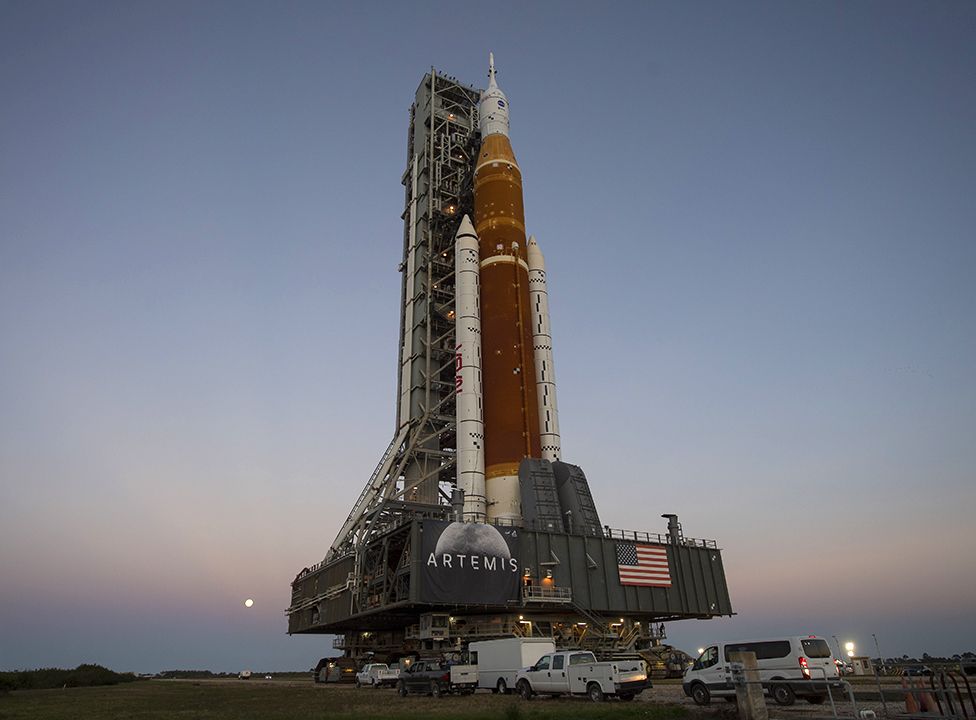
The American space agency has rolled out its new giant Moon rocket for the first time.
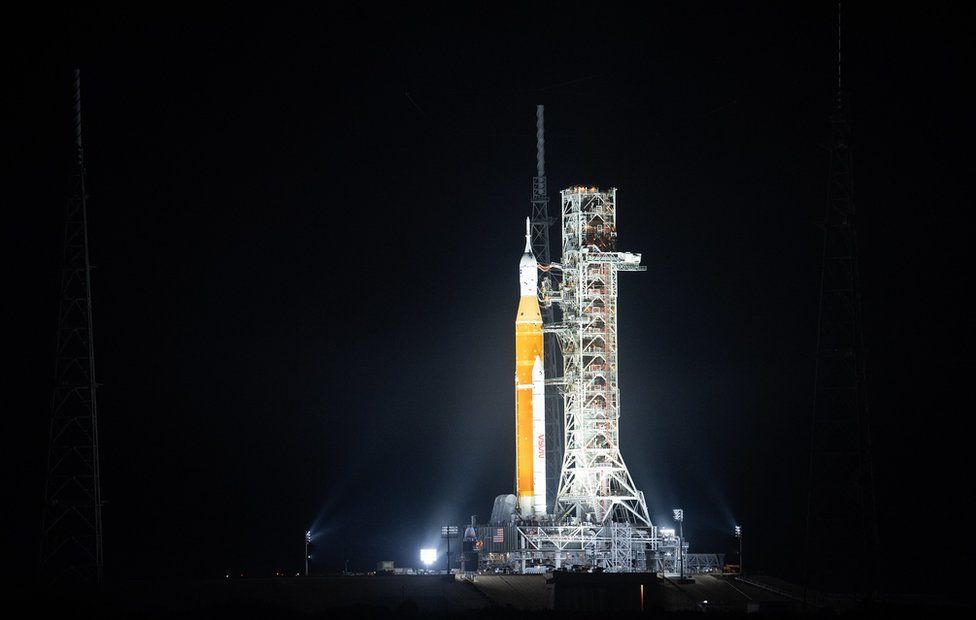
The vehicle, known as the Space Launch System (SLS), was taken to Pad 39B at the Kennedy Space Center in Florida to conduct a dummy countdown.
If that goes well, the rocket will be declared ready for a mission in which it will send an uncrewed test capsule around the Moon.
This could happen in the next couple of months.
 IMAGE SOURCE,NASA/KEEGAN BARBERImage caption,
Bill Nelson was a prime mover behind the rocket when he was a US Senator
Ultimately, it’s hoped astronauts would climb aboard later SLS rockets to return to the Moon’s surface sometime in the second half of this decade.
These missions are part of what Nasa calls its Artemis programme.
Watching the roll-out, agency administrator Bill Nelson said we were entering a golden era of human space exploration.
“The Artemis generation is preparing to reach new frontiers,” he told the spectator crowds gathered at Kennedy.
“This generation will return astronauts to the Moon and this time, we will land the first woman and the first person of colour on the surface, to conduct ground-breaking science.
“Nasa’s Artemis programme will pave the way for humanity’s giant leap (to) future missions to Mars.”
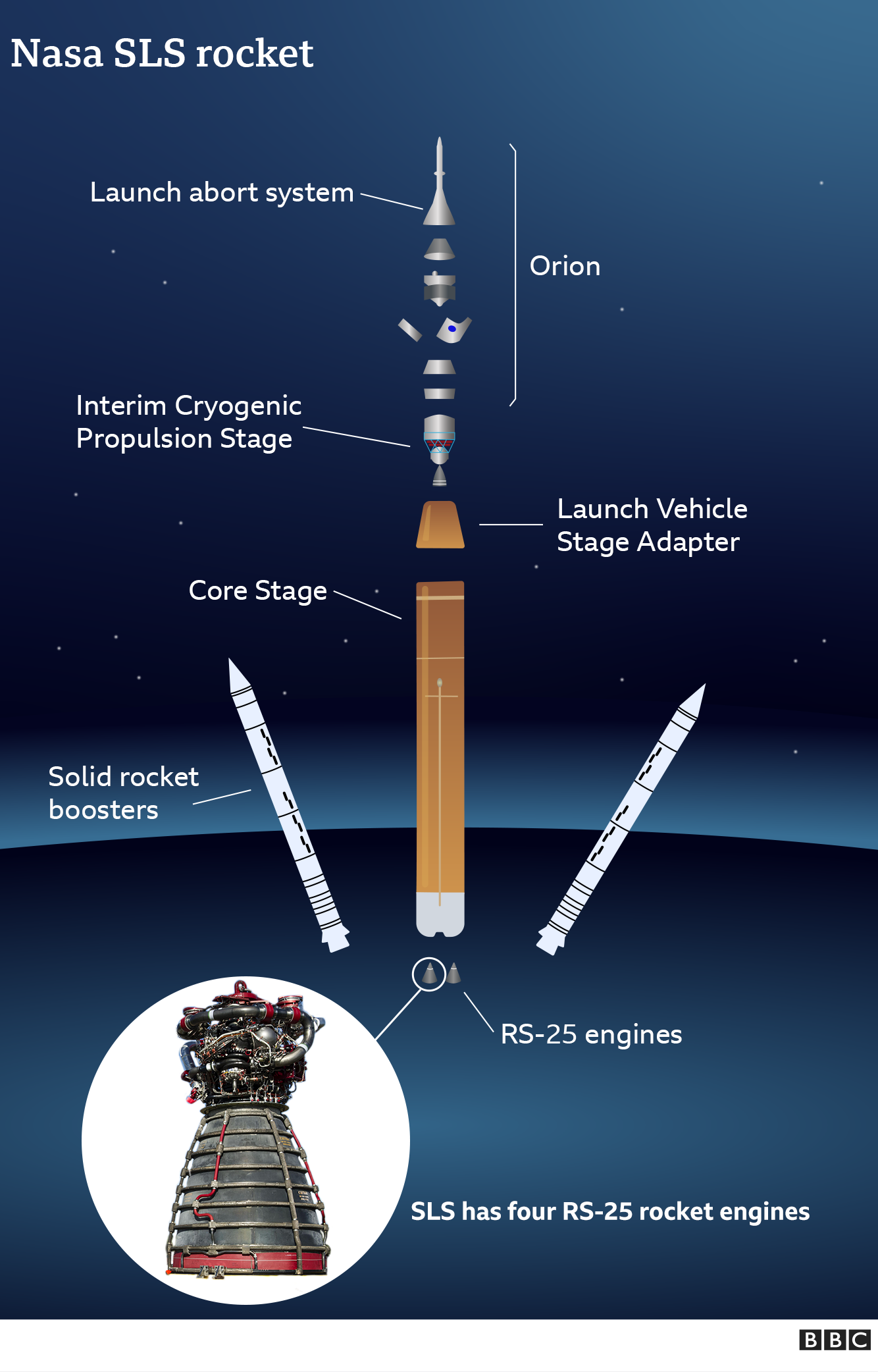
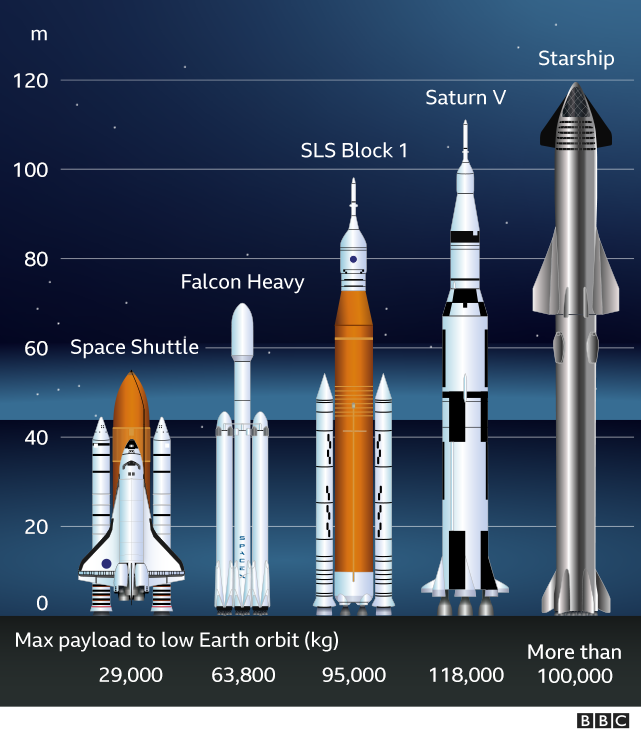
SLS is a colossus. A touch under 100m in height, it was designed to be more powerful than the Apollo Saturn vehicles of the late 1960s and early 1970s.
It will have the thrust to not only send astronauts far beyond Earth but additionally so much equipment and cargo that those crews could stay away for extended periods.
Thursday’s rollout from Kennedy’s Vehicle Assembly Building (VAB) is the rocket’s debut in the sense that it’s the very first time everyone has got to see all its different elements fully stacked together.
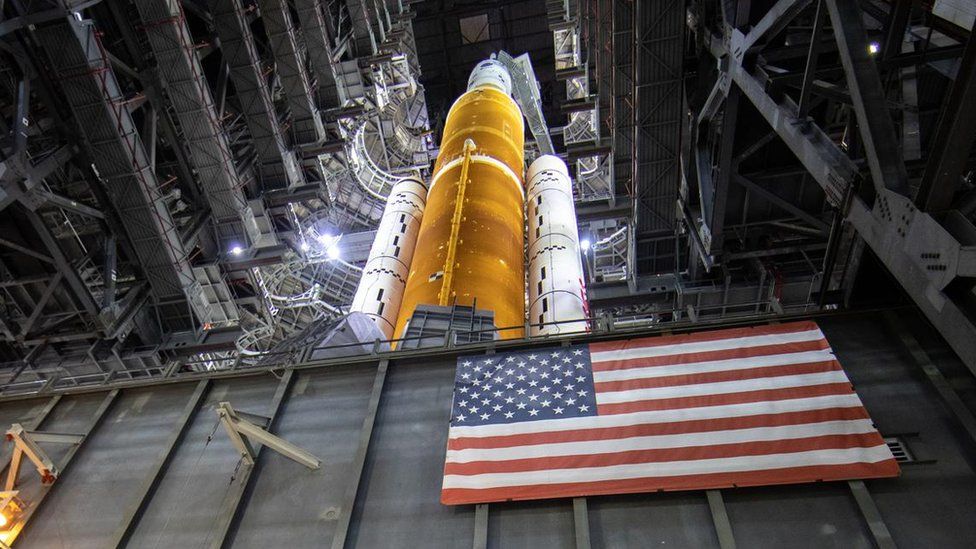
The SLS move from the VAB began 17:47 local Florida time.
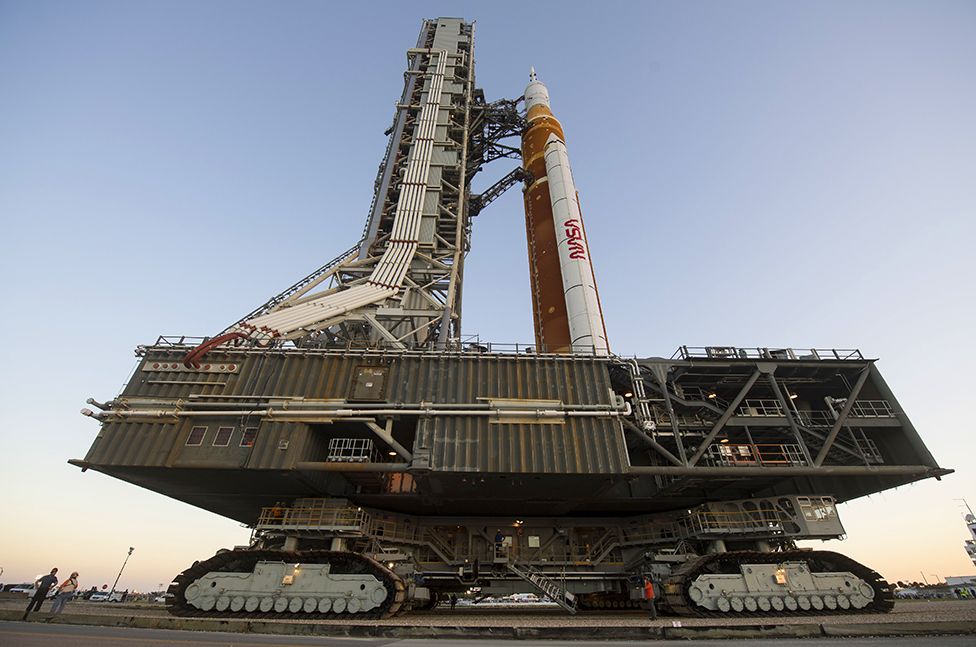
The rocket came out attached to a support gantry known as the Mobile Launcher. This structure, which is itself 120m high and weighs 5,000 tonnes, was sitting atop the same mammoth tractor that used to move the Saturn Vs back in the day, and later the space shuttles.
The Crawler Transporter goes very slowly, with a cruising speed of just over 1km/h (under 1mph). And after engineers had stopped and started the tractor for various checks, it was 04:15 on Friday morning by the time the procession had reached Pad 39B. A total journey distance of 6.75km.
SLS will now be prepared for a “wet dress rehearsal”, likely to occur on 3 April.
This will see the rocket loaded with propellants and taken through a practice countdown all the way to a mere 9.4 seconds from the moment of lift-off. The “scrub” point is just before they would normally light the four big shuttle-era engines under the rocket.
Assuming everything proceeds to the satisfaction of the engineers, Nasa will then be able to set a flight date.
The end of May remains a possibility, but more likely it will be June or July.
This mission, dubbed Artemis-1, will propel the rocket’s Orion crew capsule on a 26-day journey that includes an expanded orbit around the Moon. There will be no-one in the capsule for the test flight. This should happen on a second mission in a couple of years’ time.
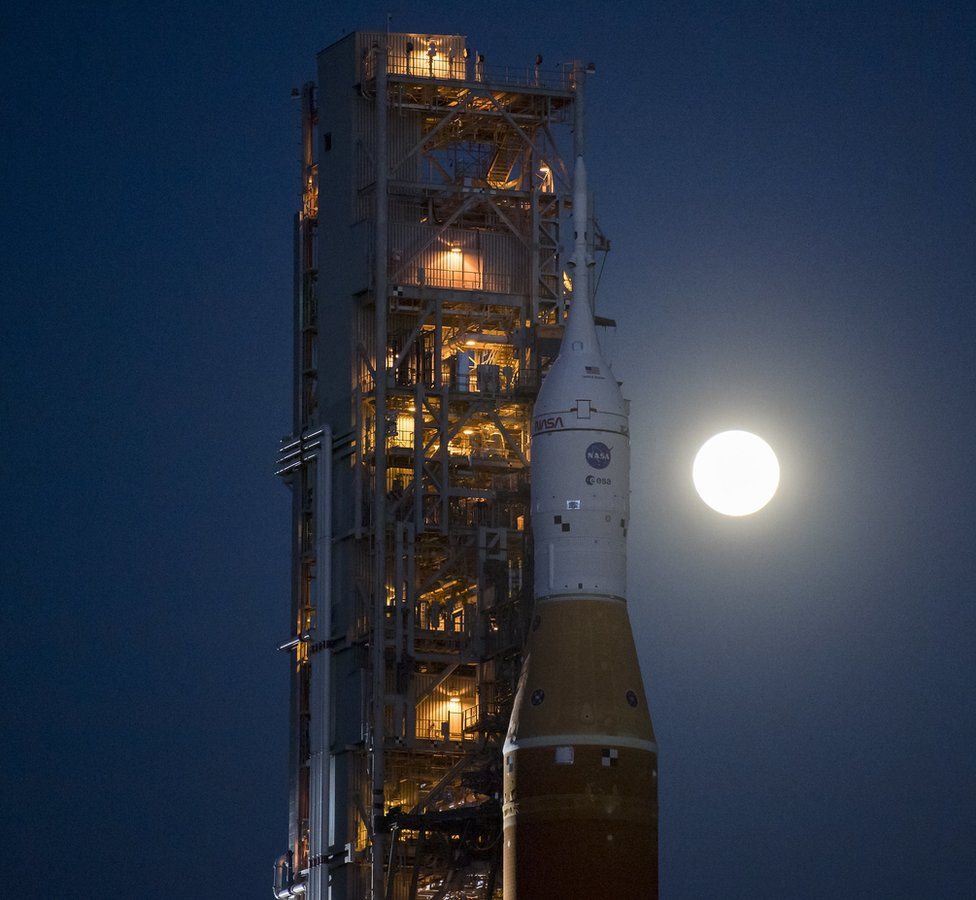 IMAGE SOURCE,NASA/AUBREY GEMIGNANIImage caption,
The Moon is the initial target, but eventually Nasa wants to get people to Mars
While Nasa is developing the SLS, the American rocket entrepreneur Elon Musk is preparing an even larger vehicle at his R&D facility in Texas.
He calls his giant rocket the Starship. Like SLS it has yet to have a maiden flight. Unlike SLS, Starship has been designed to be totally reusable and ought therefore to be considerably cheaper to operate.
A recent assessment from the Office of Inspector General, which audits Nasa programmes, found that the first four SLS missions would each cost more than $4bn to execute – a sum of money that was described as “unsustainable”.





This was an actual whiskey company ad from the 1940’s. They were spot on.




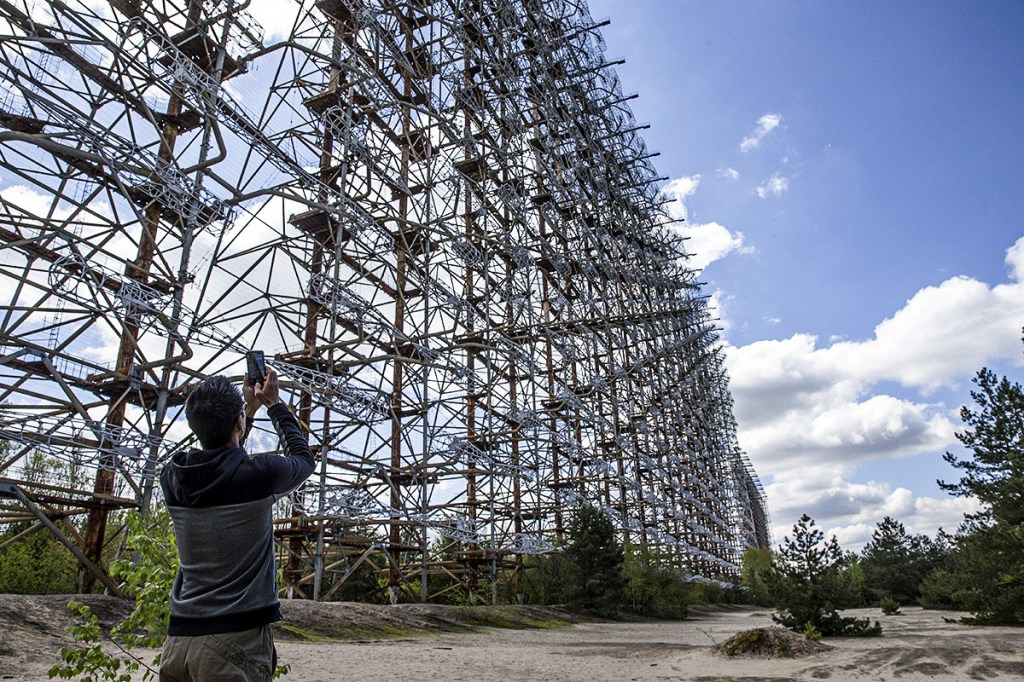
Duga-3 (NATO reporting name Steel Yard) was a Soviet over-the-horizon (OTH) radar system used as part of the Soviet ABM (anti-ballistic missile) early-warning network. The system operated from July 1976 to December 1989. Two Duga-3 radars were deployed, one near Chernobyl and Chernihiv, the other in eastern Siberia.
The Duga-3 systems were extremely powerful, over 10 MW in some cases, and broadcast in the shortwave radio bands. They appeared without warning, sounding like a sharp, repetitive tapping noise at 10 Hz, which led to it being nicknamed by shortwave listeners the Russian Woodpecker. The random frequency hops disrupted legitimate broadcast, amateur radio, commercial aviation communications, utility transmissions, and resulted in thousands of complaints by many countries worldwide. The signal became such a nuisance that some receivers such as amateur radios and televisions actually began including ‘Woodpecker Blankers’ in their design.
The unclaimed signal was a source for much speculation, giving rise to theories such as Soviet mind control and weather control experiments. However, many experts and amateur radio hobbyists quickly realized it to be an OTH system. NATO military intelligence had already photographed the system and given it the NATO reporting name Steel Yard. This theory was publicly confirmed after the fall of the Soviet Union.
The bigger array is 150 meters tall and 500 meters long. The smaller array is 90 meters tall.

The Soviets had been working on early warning radar for their anti-ballistic missile systems through the 1960s, but most of these had been line-of-sight systems that were useful for raid analysis and interception only. None of these systems had the capability to provide early warning of a launch, within seconds or minutes of a launch, which would give the defences time to study the attack and plan a response. At the time the Soviet early-warning satellite network was not well developed, and there were questions about their ability to operate in a hostile environment including anti-satellite efforts. An over-the-horizon radar sited in the USSR would not have any of these problems, and work on such a system for this associated role started in the late 1960s.
The first experimental system, Duga-1, was built outside Mykolaiv in Ukraine, successfully detecting rocket launches from Baikonur Cosmodrome at 2,500 kilometers. This was followed by the prototype Duga-2, built on the same site, which was able to track launches from the far east and submarines in the Pacific Ocean as the missiles flew towards Novaya Zemlya. Both of these radar systems were aimed east and were fairly low power, but with the concept proven work began on an operational system. The new Duga-3 systems used a transmitter and receiver separated by about 60 km.

Starting in 1976 a new and powerful radio signal was detected worldwide, and quickly dubbed the Woodpecker by amateur radio operators. Transmission power on some woodpecker transmitters was estimated to be as high as 10 MW equivalent isotropically radiated power.
Triangulation quickly revealed the signals came from Ukraine. Confusion due to small differences in the reports being made from various military sources led to the site being alternately located near Kiev, Minsk, Chernobyl, Gomel or Chernihiv. All of these reports were describing the same deployment, with the transmitter only a few kilometers southwest of Chernobyl (south of Minsk, northwest of Kiev) and the receiver about 50 km northeast of Chernobyl (just west of Chernihiv, south of Gomel). Unknown to civilian observers at the time, NATO was aware of the new installation, which they referred to as Steel Yard.
To combat this interference, amateur radio operators attempted to “jam” the signal by transmitting synchronized unmodulated continuous wave signals at the same pulse rate as the offending signal. They formed a club called The Russian Woodpecker Hunting Club.
Starting in the late 1980s, even as the U.S. Federal Communications Commission (FCC) was publishing studies of the signal, the signals became less frequent, and in 1989, they disappeared altogether. Although the reasons for the eventual shutdown of the Duga-3 systems have not been made public, the changing strategic balance with the end of the Cold War in the late 1980s likely had a major part to play. Another factor was the success of the Russian US-KS early-warning satellites, which entered preliminary service in the early 1980s, and by this time had grown into a complete network. The satellite system provides immediate, direct and highly secure warnings, whereas any radar-based system is subject to jamming, and the effectiveness of OTH systems is also subject to atmospheric conditions.
According to some reports, the Komsomolsk-na-Amure installation in the Russian Far East was taken off combat alert duty in November 1989, and some of its equipment was subsequently scrapped. The original Duga-3 site lies within the 30 kilometer Zone of Alienation around the Chernobyl power plant. It appears to have been permanently deactivated, since their continued maintenance did not figure in the negotiations between Russia and Ukraine over the active Dnepr early warning radar systems at Mukachevo and Sevastopol. The antenna still stands, however, and has been used by amateurs as a transmission tower (using their own antennas) and has been extensively photographed.
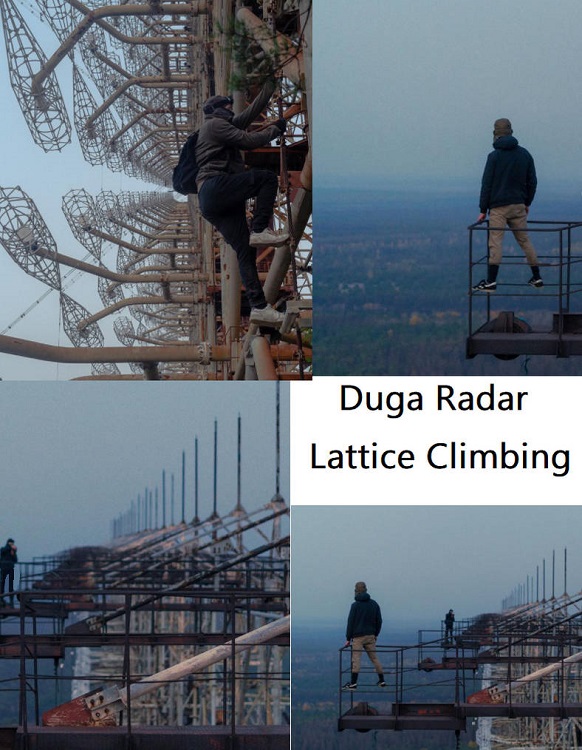
Always a few people that have to climb these things. “Now how do we get down”?
If you snooze you lose goes the old adage. Getting up early and starting the day bright eyed and bushy tailed is the way to success for the go-getters out there. The downside is having to get disrupted out of deep sleep by noisy contraptions. Here are some strange alarm clocks that will force a person to jump into the rat race at full speed.
The Sub Morning cleverly lures you to the bathroom, by forcing you to submerge it in water
Once you get to the bathroom, you’re basically in the shower already and, once you’re in the shower, the day has officially begun.
Clocky leaps off your nightstand and runs away, making you chase it around the room to shut off the damn beeping.
This sneaky little thing forces both your body and your wits into action.
If you are a sucker for shooting games, you must try this Target alarm clock. The rules are easy: the clock will sound the alarm based on the time you set, and you need to stop it by using the laser target gun to shoot the bullseye.
I.Q. test first thing in the morning


This Sonic Grenade alarm clock is guaranteed to get your sleepy children out of bed. Just pull the pin, throw the grenade into the room and get out of the way as it emits an ear-piercing noise.

The Rocket Launcher alarm clock will really “launch” you from your bed. When the alarm goes off, it shoots a rocket off in your room, and the only way to turn it off is to locate the rocket and place it back on the launch pad.

The toughest part about waking up for many people is physically getting out of bed. Luckily, the Carpet Alarm Clock helps you work through the hard part, by forcing you to stand up and step on the mat to turn it off.
Amazon’s wildly popular personal assistant Alexa is raising eyebrows once again after a stunned mother took to social media claiming that the device challenged her ten-year-old daughter to stick a coin into an electrical socket! Posting on Twitter this past weekend, an understandable concerned Kristin Livdahl revealed the unsettling instructions that came from her Echo speaker. Explaining that she and her daughter had been doing physical challenges to pass the time due to bad weather outside, the miffed mom said that they turned to Alexa for potential ideas and the device offered a stunning suggestion.
According Livdahl, when they asked the Echo for a challenge, the device responded with “here’s something I found on the web” and then it told them to “plug in a phone charger about halfway into a wall outlet, then touch a penny to the exposed prongs.” As one might imagine, the mom could not believe what she was hearing and, in retrospect, expressed relief that “I was right there to say ‘no,’ but I hope my daughter would have checked in with me anyway before trying it.” Livdahl’s story has since gone viral and Amazon reportedly indicated that they have excised the dangerous challenge from the Alexa system.
The troubling incident is not the first time that Alexa has wound up in the news by way of some odd statements or unnerving behavior. Back in 2018, multiple users reported hearing a creepy laugh coming from their device. A few weeks later, the personal assistant was ‘caught’ giving a conspiratorial answer to the question of ‘what are chemtrails’ when it replied that they are “chemical or biological agents deliberately sprayed at high altitudes for a purpose undisclosed to the general public in clandestine programs directed by government officials.” When word of the very weird response spread online, Amazon quickly changed it to a prosaic explanation for the controversial phenomenon.

The damn thing looks like a hockey puck. I would never let one of those eavesdropping mind control voodoo pucks anywhere near my front door.
 The MarkoZen Blog