Technology
The Pigeons Who Took Photos
At the turn of the last century, when aviation was still in its infancy, a German named Julius Neubronner submitted a patent for a new invention—a miniature camera that could be strapped to the breast of a pigeon so that the bird could take flight and snap pictures from the air.
Julius Neubronner was an apothecary who employed pigeons to deliver medications to a sanatorium located near his hometown Kronberg, near Frankfurt. An apothecary is one who makes medicines. A pharmacist is a more modern word, but in many German speaking countries, such as Germany, Austria and Switzerland, pharmacies are still called apothecaries.
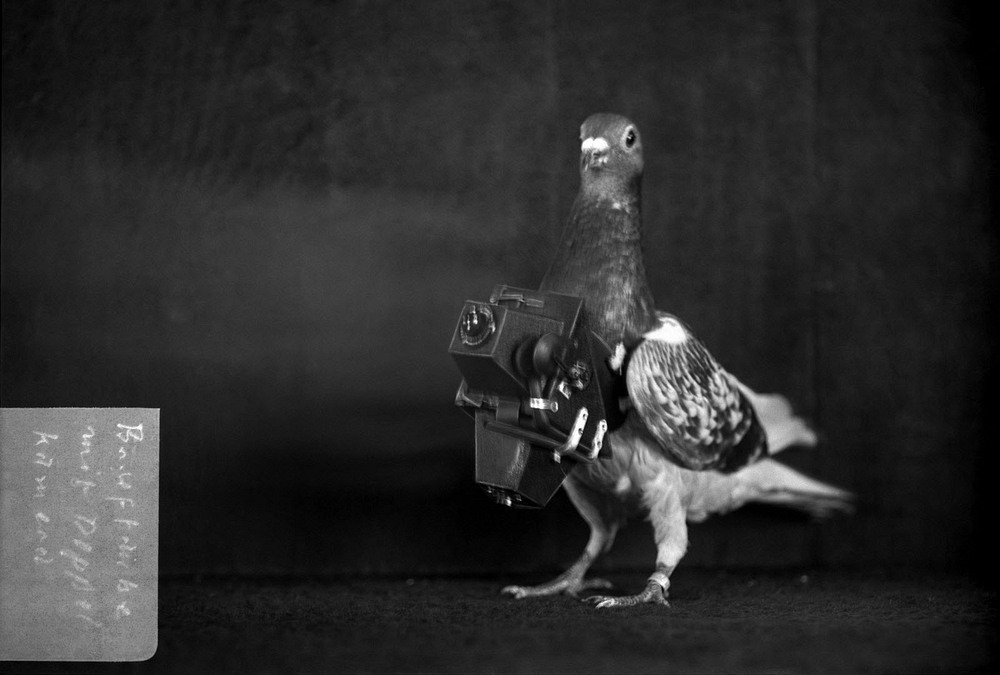
Apothecary was Julius Neubronner’s family profession. His father was an apothecary, and so was his grandfather. In those days, homing pigeons were used extensively to carry messages and small supplies. It was Julius’s father’s idea to use pigeons to receive prescriptions from the sanatorium and send out medicinal supplies in a hurry—a practice that continued for more than half a century until the sanatorium closed.
One day, Neubronner let out a pigeon on an urgent errand but it didn’t return. When several days passed and there was still no sign of the bird, Neubronner assumed the pigeon was lost, or it got caught and killed by predators. A month later, the lost messenger showed up unexpectedly at Neubronner’s place. The bird appeared well fed, which got Neubronner into thinking. Where had he gone? Who had fed him?
Neubronner decided that he would start tracking his pigeons’ future travels.
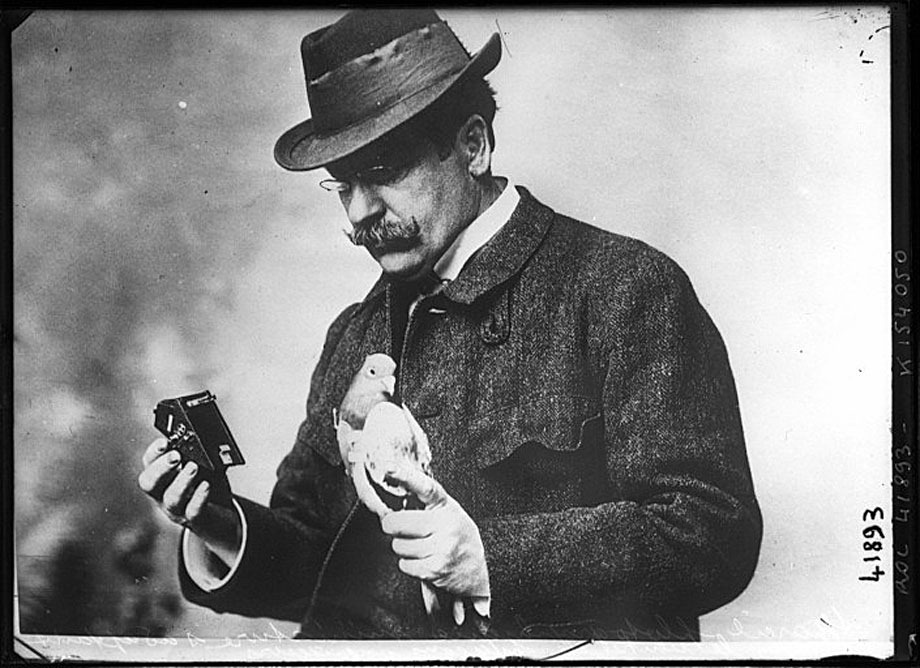
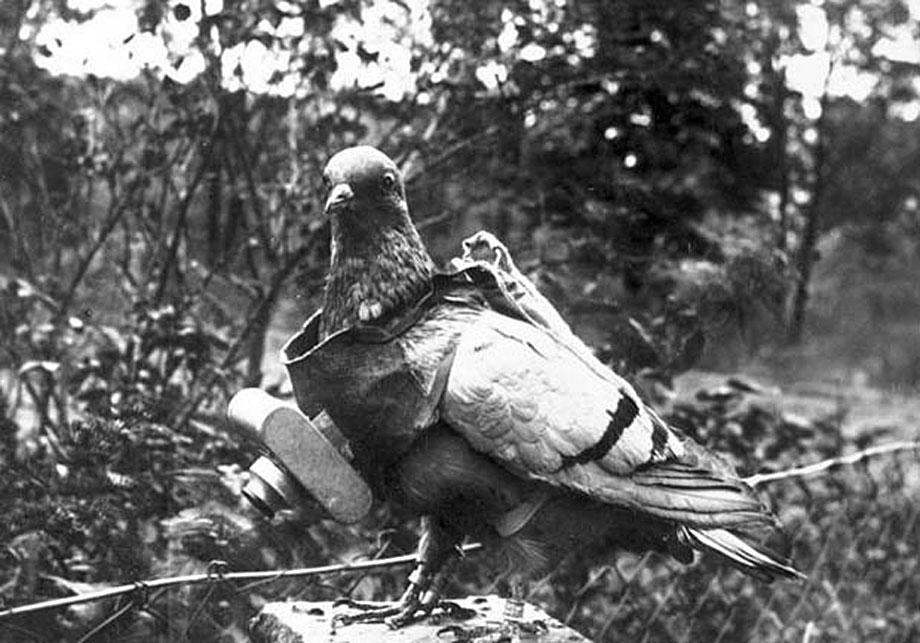
Julius Neubronner with one of his pigeons.
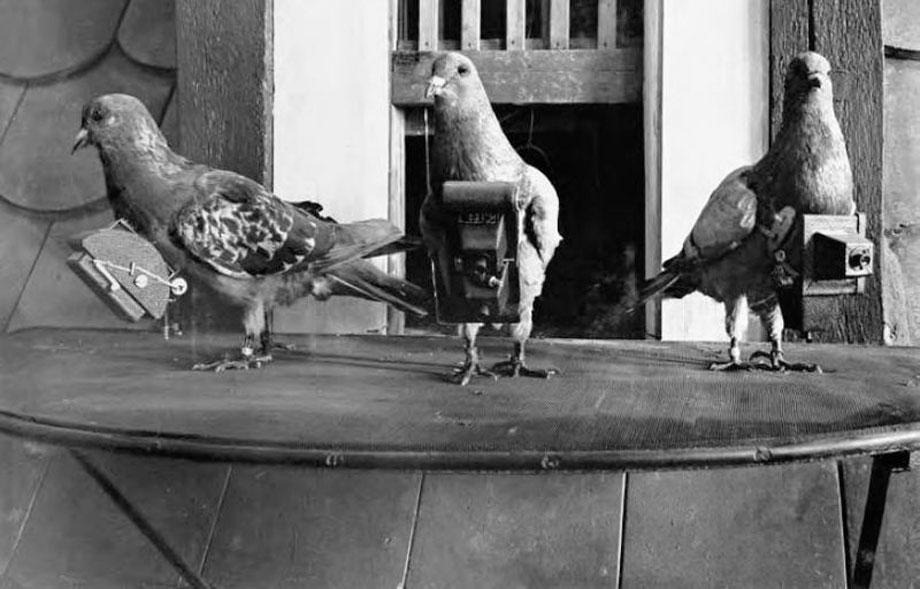
Being a passionate do-it-yourself amateur photographer, it didn’t take long for Neubronner to fashion a miniature wooden camera which he fitted to the pigeon’s breast by means of a harness and an aluminum cuirass. A pneumatic system in the camera opened the shutter at predetermined intervals and the roll of film, which moved along with the shutter, took as many as thirty exposures in a single flight. The entire rig weighed no more than 75 grams—the maximum load the pigeons were trained to carry.
The pictures turned out so good that Neubronner started making different models. One system, for instance, was fitted with two lenses pointing in opposite directions. Another one took stereoscopic images. Eventually, Neubronner applied for a patent, but the patent office threw out his application citing that such a device was impossible as they believed a pigeon could not carry the weight of a camera. But when Neubronner presented photographs taken by his pigeons, the patent was granted in 1908.
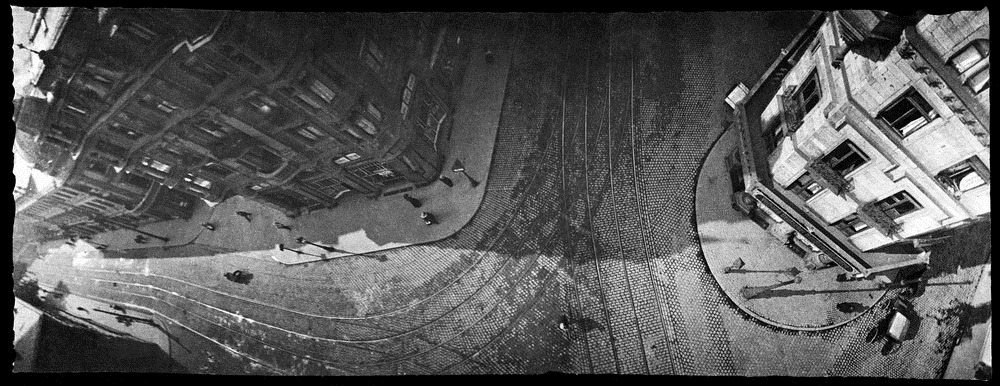
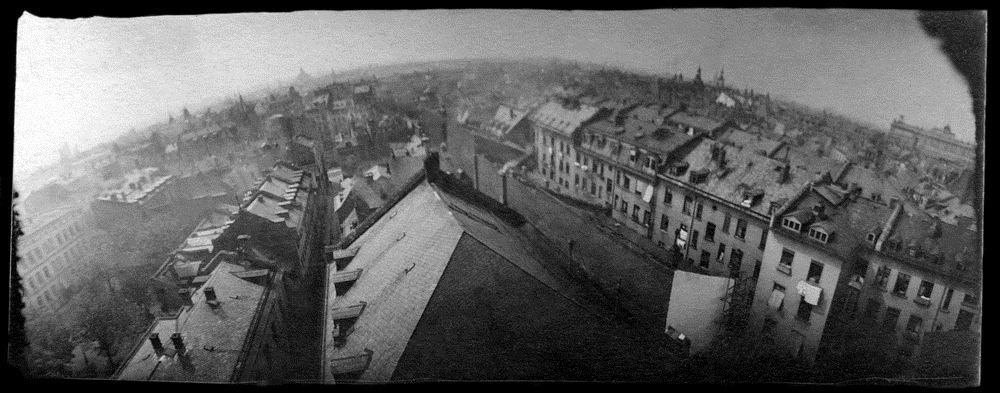
Aerial photograph of Frankfurt.
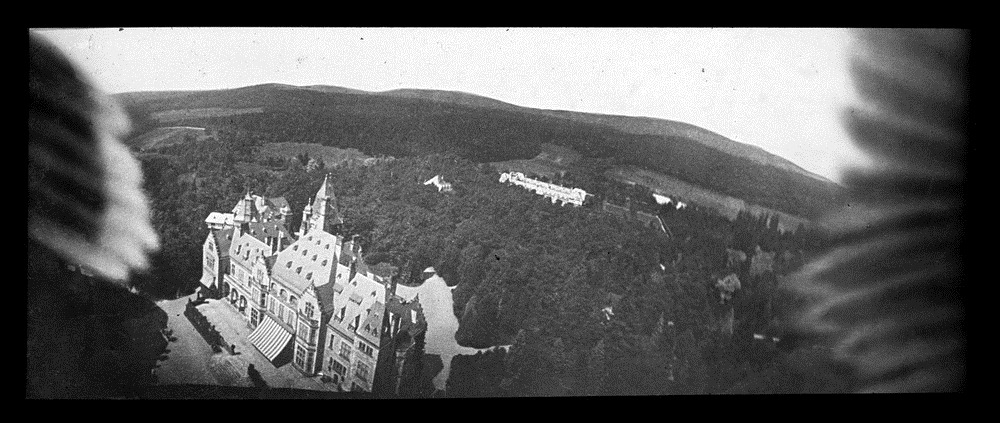
Aerial photograph of Schlosshotel Kronberg.
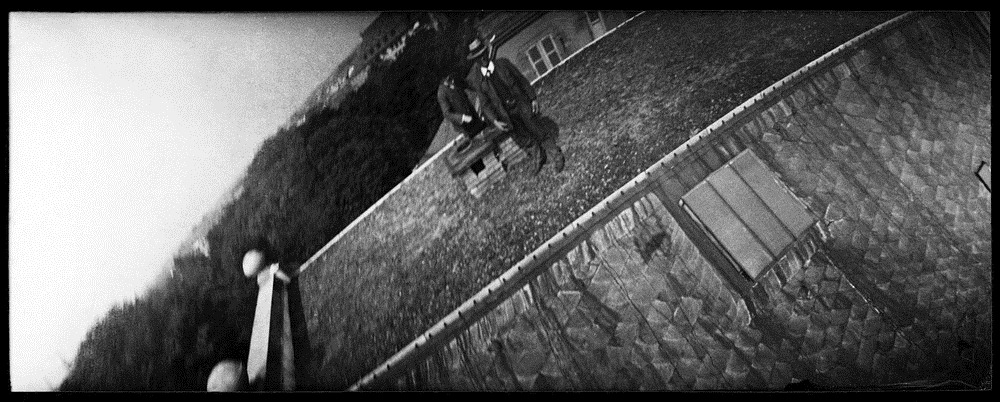
Neubronner exhibited his photographs in several international photographic exhibition gaining him accolades. In one such exhibition in Dresden, spectators watched as the camera-equipped carrier pigeons arrived at the venue, and the photos were immediately developed and turned into postcards which they could purchase.
The technology was soon adapted for use during the First World War, despite the availability of surveillance aircraft then. Pigeons drew less attention, could photograph enemy locations from a lower height, and were visibly indifferent to explosions on a battlefield.
Neubronner’s avian technology saw use in the Second World War too. The German army developed a pigeon camera capable of taking 200 exposures per flight. The French too claimed they had cameras for pigeons and a method to deploy them behind enemy lines by trained dogs. Around this time, Swiss clockmaker Christian Adrian Michel perfected a panoramic camera and an improved mechanism to control the shutter. Pigeon photography was in use as late as the 1970s, when the CIA developed a battery-powered pigeon camera, though the details of the camera’s use are still classified.
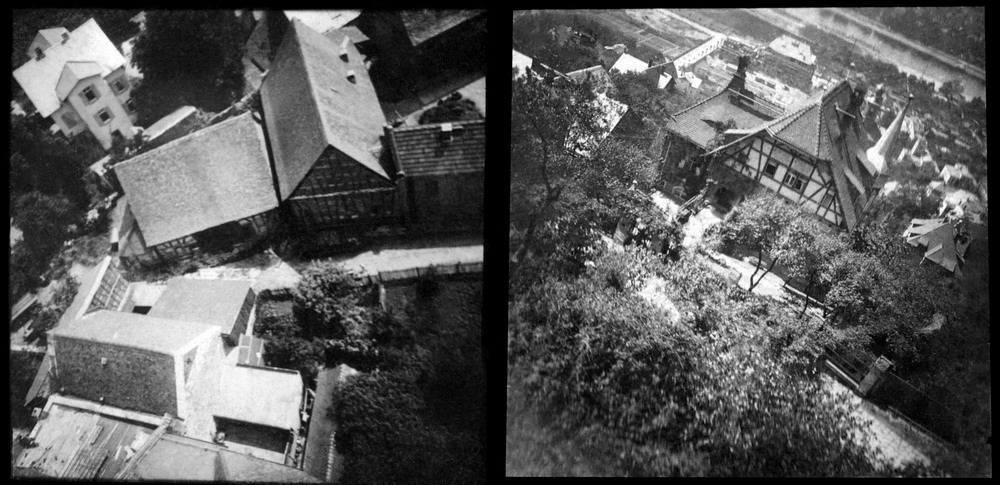
Aerial photographs of Dresden.
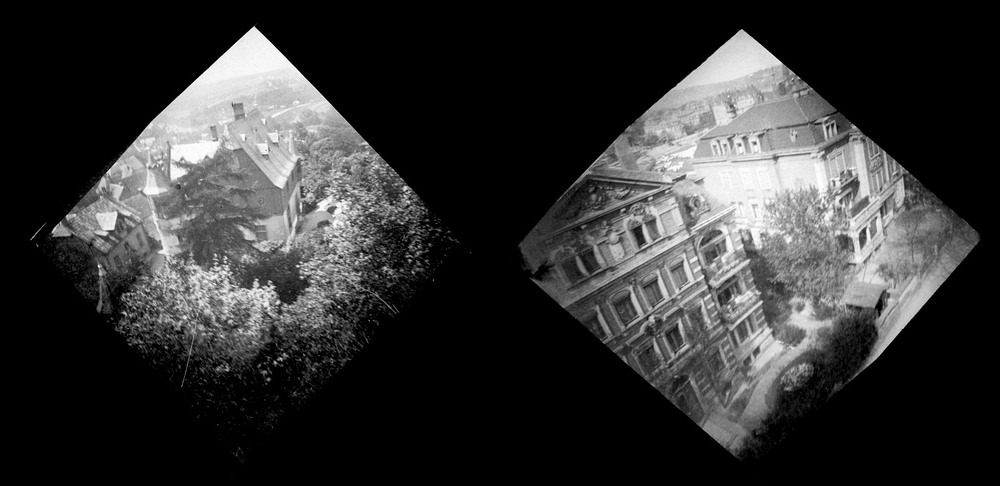
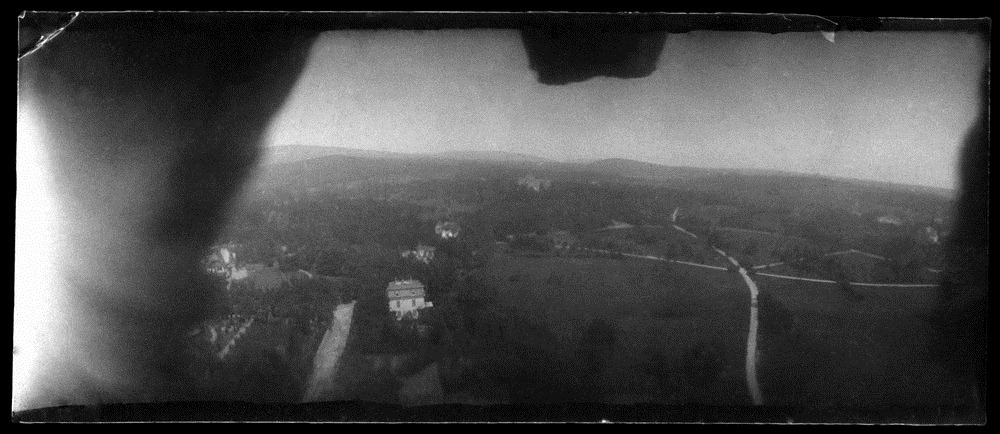
Today, aerial photography has been replaced by aircrafts, satellites, and more recently, by affordable drones. But the legacy of Julius Neubronner’s pigeon photography lives on in these images which are among the very early photos taken of Earth from above.
Bonus fact: So what happened to Neubronner’s pigeon who stayed away from the owner for a month and returned fattened up? It had flown away to Wiesbaden, some twenty kilometers away, and was taken care of by a restaurant chef.
Predictions that got one right and one wrong
From 1953.

New York Times from 1939.

Speaking of television, TV goggles from the early 1950’s.

Unique aerial cable car in Bratislava
A unique aerial cable car, constructed specifically for the Volkswagen Slovakia (VW SK) car manufacturing plant in Bratislava keeps on moving. This one-of-a-kind aerial lift, which transports cars between the assembly hall and the test track, dominates the silhouette of the plant.
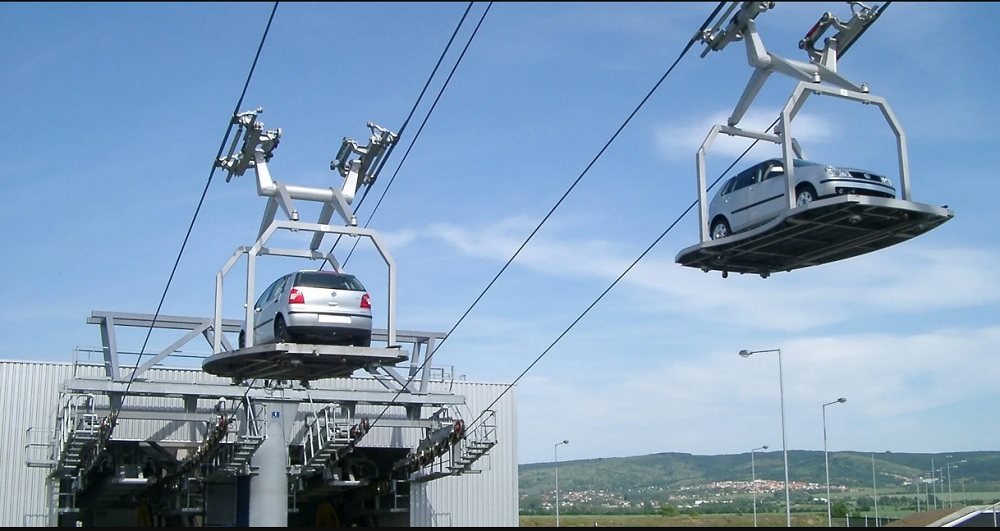
The lift is unique even within the entire Volkswagen operation; it was designed and constructed in connection with the arrival of the Volkswagen Touareg, for the purpose of transporting large numbers of vehicles from the assembly hall to the test track. A lot of innovation went into the project, as no similar cable car existed before it, VW SK wrote in a press release.
The aerial cable car war designed as a new transport carriage prototype on which the cars are transported to other loading stations. It is 455 metres in length, and runs 99.5 percent of the time that the factory is in operation. The trip from one station to the next lasts about 4.5 minutes, with a maximum speed of three metres per second. The steel cable on which the gondolas hang is 8-stranded and anticlockwise, and was used on this cable car for the very first time. Eight transport carriages are hung, each weighing 2.5 tons and bear a load capacity of an additional 2.5 tons.
Boston Dynamics reveals new ‘SpotMini’ robot that can help around the kitchen

The robotics firm has revealed its latest creation – a dog-like robot designed to help around the house. Best known for its impressive humanoid ‘Atlus’ and infamous gas-guzzling ‘BigDog’ robots, the company has now come up with something a little more consumer-friendly. Known as ‘SpotMini’, this quadrupedal contraption looks a bit like a small dog and is equipped with a special arm attachment that can enable it to do everything from dropping empty cans in the bin to putting dirty glasses in to a dishwasher. A recently released YouTube video also shows how the robot is able to climb up stairs and recover from a fall – a feature hilariously demonstrated thanks to a conveniently placed banana skin. Whether the robot will ever be available for consumer purchase however, epecially given Boston Dynamics’ recent financial difficulties, remains to be seen.
The First Cellular Phone, and It was Big!
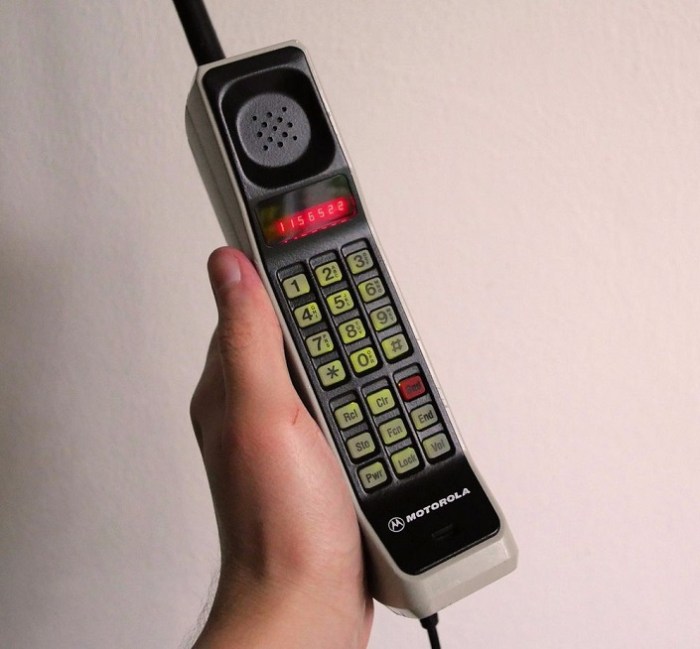
DynaTAC is a series of cellular telephones manufactured by Motorola, Inc. from 1983 to 1994. The Motorola DynaTAC 8000X commercial portable cellular phone received approval from the U.S. FCC on September 21, 1983. A full charge took roughly 10 hours, and it offered 30 minutes of talk time. It also offered an LED display for dialing or recall of one of 30 phone numbers. It was priced at $3,995 in 1984, its commercial release year, equivalent to $9,831 in 2019. DynaTAC was an abbreviation of “Dynamic Adaptive Total Area Coverage.” It weighed 1.75 lb., stood 13 in. high.
Several models followed, starting in 1985 with the 8000s, and continuing with periodic updates of increasing frequency until 1993’s Classic II. The DynaTAC was replaced in most roles by the much smaller Motorola MicroTAC when it was first introduced in 1989, and by the time of the Motorola StarTAC’s release in 1996, it was obsolete.

Martin Cooper of Motorola made the first publicized handheld mobile phone call on a prototype DynaTAC model on April 3, 1973. This is a reenactment in 2007.
The first cellular phone was the culmination of efforts begun at Bell Labs, which first proposed the idea of a cellular system in 1947, and continued to petition the Federal Communications Commission (FCC) for channels through the 1950s and 1960s, and research conducted at Motorola. In 1960, electrical engineer John F. Mitchell became Motorola’s chief engineer for its mobile communication products. Mitchell oversaw the development and marketing of the first pager to use transistors.
Motorola had long produced mobile telephones for cars that were large and heavy and consumed too much power to allow their use without the automobile’s engine running. Mitchell’s team, which included Martin Cooper, developed portable cellular telephony, and Mitchell was among the Motorola employees granted a patent for this work in 1973; the first call on the prototype was completed, reportedly, to a wrong number.
While Motorola was developing the cellular phone itself, during 1968–1983, Bell Labs worked on the system called AMPS, while others designed cell phones for that and other cellular systems. Martin Cooper, a former general manager for the systems division at Motorola, led a team that produced the DynaTAC 8000x, the first commercially available cellular phone small enough to be easily carried, and made the first phone call from it. Martin Cooper was the first person to make an analog cellular mobile phone call on a prototype in 1973.



2022 Rogers Communications outage
On July 8, 2022, Canadian telecom provider Rogers Communications experienced a major service outage; it affected Rogers’ cable internet and cellular networks, including subsidiary brands Rogers Wireless, Fido, and Chatr. It also impacted internet service providers with wholesale access to the Rogers network, such as TekSavvy, as well as various other information systems nationwide that rely on the Rogers network, including Interac and some federal government services. Multiple international web monitoring companies observed the outage.
Rogers had begun to slowly restore service that evening, but CEO Tony Staffieri stated there was no estimated time for when services would become fully operational again. The next day, Rogers stated that it had restored service to the “vast majority” of its customers; however not all service has been restored across the country.
A report by Cloudflare suggested that the outage was due to internal, rather than external, causes. It identified spikes in BGP updates, as well as withdrawals of IP prefixes, noting that Rogers was not advertising its presence, causing other networks to not find the Rogers network. As of the day after the outage, the cause remained unknown. Public Safety Canada stated that it was not a cyberattack. The outage was later said to be caused by a maintenance upgrade that caused routers to malfunction.
Will this fruit-picking robot transform agriculture?
Creating a machine that can perform the delicate work of picking an apple is tricky – and farmworkers say it could be a benefit.
Robots can do a lot. They build cars in factories. They sort goods in Amazon warehouses. Robotic dogs can, allegedly and a little creepily, make us safer by patrolling our streets. But there are some things robots still cannot do – things that sound quite basic in comparison. Like picking an apple from a tree.
“It’s a simple thing” for humans, says robotics researcher Joe Davidson. “You and I, we could close our eyes, reach into the tree. We could feel around, touch it, and say ‘hey, that’s an apple and the stem’s up here’. Pull, twist. We could do all that without even looking.”
Creating a robotic implement that can simply pick an apple and drop it into a bin without damaging it is a multimillion-dollar effort that has been decades in the making. Teams around the world have tried various approaches. Some have developed vacuum systems to suck fruit off trees. Davidson and his colleagues turned to the human hand for inspiration. They began their efforts by observing professional fruit pickers, and are now working to replicate their skilled movements with robotic fingers.
Their work could help to transform agriculture, turning fruit-picking – a backbreaking, time-consuming human task – into one that’s speedy and easier on farm workers.
These efforts have gained impetus recently as researchers point to the worsening conditions for farm workers amid the climate crisis, including extreme heat and wildfire smoke, and also a shortage of workers in the wake of the pandemic. The technology could lead to better working conditions and worker safety. But that outcome depends on how robots are deployed in fields, farm workers’ organizations say.
Elon Musk says he would allow Donald Trump back on Twitter
Trump was barred from the platform in January 2021 in the final days of his presidency amid unrest following the Jan. 6 attack on the U.S. Capitol.
Tech billionaire Elon Musk said Tuesday that he would allow former President Donald Trump back on Twitter after Musk completes his plan to buy the company, giving the most concrete example yet of how his vision of social media would play out in reality.
Musk said at an event sponsored by The Financial Times that it was “morally bad” and “foolish in the extreme” for Twitter to “permanently suspend” Trump in January 2021 after Trump’s supporters violently stormed the U.S. Capitol, according to a video of the event posted online.
“I do think that it was not correct to ban Donald Trump,” Musk, the CEO of Tesla, said at the newspaper’s Future of the Car event by remote video.
“I think that was a mistake, because it alienated a large part of the country and did not ultimately result in Donald Trump not having a voice,” he said, citing Trump’s newly launched tech platform, Truth Social.
“I would reverse the permanent ban,” Musk said.

The bizarre history of cellphone towers disguised as trees
/cdn.vox-cdn.com/uploads/chorus_image/image/46154008/3098732719_b0d5d40125_o.0.0.jpg)
They’re tall. They’re totally absurd. And they’re everywhere.
Over the past few decades, as cellphone networks have grown, thousands of antenna towers designed to look vaguely like trees have been built across the United States. Although these towers are intended to camouflage a tower’s aesthetic impact on the landscape, they typically do the opposite: most look like what an alien from a treeless planet might create if told to imagine a tree.
:no_upscale()/cdn.vox-cdn.com/uploads/chorus_asset/file/3618342/161320313.0.jpg)
A “pine” in Colorado. (Brian Brainerd/the Denver Post via Getty Images)
In the 1980s, soon after cellphone companies started building antennas in the United States, they sought to hide them, as well, often in response to aesthetic complaints from local residents.
Initially, most concealed antennas were simply hidden on church steeples or water towers, but in 1992, a company called Larson Camouflage — which had previously made fake habitats for Disney World and museums — built a “pine” tower in Denver. The world was changed forever.
Soon afterward, companies in South Carolina and South Africa began building similar “trees.” In the US, the Telecommunications Act of 1996 restricted municipalities’ ability to block tower construction, so as demand for cell service spread, it meant that towers would inevitably be built in historic districts and other areas where locals might object.
:no_upscale()/cdn.vox-cdn.com/uploads/chorus_asset/file/3618364/1326219.0.jpg)
A “tree” in Cambridge, Massachusetts. (Darren McCollester/Getty Images)
Still, municipalities have often tried to block construction, leading companies to offer “trees” instead of towers as a compromise. Some localities even require new towers be camouflaged as part of their zoning requirements.
There’s no good data on how many of these “trees” now exist, but in 2013, Mergen estimated there were between 1,000 and 2,000 nationwide. The company Stealth Concealment says it builds about 350 new “trees” per year. They’re most often built in suburbs, where residents have the time and urge to war with companies over new towers, and there’s enough incentive for carriers to invest in “trees.”
Why these “trees” look so ridiculous
There are actually good reasons why these towers seldom actually look like real trees.
One is height. Towers are built to hold antennas higher than surrounding structures to ensure good reception, so they have to be taller than what’s nearby. This is why you often see surreally tall “pines” or “palms” towering over normal trees.
:no_upscale()/cdn.vox-cdn.com/uploads/chorus_asset/file/3618352/2263592418_d62d8c669b_o.0.jpg)
Another is cost. These “trees” are normal cellphone towers, which are then sent to companies like Larson or Stealth Concealment for plastic, fiberglass, or acrylic “bark,” “branches,” and “needles” to be added. This process is customized and expensive: it can add $100,000 or so to the baseline $150,000 cost of a tower.
As Ryan McCarthy of Larson told Bernard Mergen, “A pine tree that has 200 branches will be more appealing than one of the same height that has 100. However, the customer will not only incur the cost of 100 extra branches, but the extra wind load from the branches will also require that the pole be designed more stoutly.”
:no_upscale()/cdn.vox-cdn.com/uploads/chorus_asset/file/3618360/8576531832_70a13ceba8_o.0.jpg)
This is also why you so seldom see towers designed as deciduous trees, even in areas where they’re much more common than pines — their branching structure makes them more complex and more expensive to build. Pines, palms, and cacti are much easier to approximate in plastic and fiberglass.
In terms of blending in, the most successful towers are probably “saguaros,” which can plausibly be built in deserts where there are no trees that they have to tower over — and don’t have expensive branches or needles that need to be attached.
:no_upscale()/cdn.vox-cdn.com/uploads/chorus_asset/file/3618380/14298850772_97c14a3774_o.0.jpg)

Vox.com
 The MarkoZen Blog