Sleuth finds the truth in ghost stories

ghost

A scene from the 2008 movie “Shutter” shows a ghostly shape in a photo.


Paranormal investigator Joe Nickell has busted a lot of ghostly myths over the past 40 years — but the spookiest part of his job comes when he actually catches a ghost red-handed.

No, we’re not talking about spirits of the dead: These “ghosts” are hotel clerks who flick the lights to keep the guests talking about the place’s ghost story. Or a mischievous child who plays tricks on his parents. Or maybe a camera crew catching weird-looking “orbs” floating through the frame — orbs they didn’t notice until they looked at the pictures later.


“Much of what so-called ghost hunters are detecting is themselves,” Nickell, the author of “The Science of Ghosts,” told me this week. “If they go through a haunted house and stir up a lot of dust, they shouldn’t be surprised if they get a lot of orbs in their photographs.”

The orbs are actually out-of-focus reflections from a camera flash, created by dust particles floating in front of the lens. The clumping noises that ghost hunters hear often turn out to be the footsteps of crew members elsewhere in the building, or even someone on a stairway next door. And those weird readings they pick up with thermal imagers? They’re typically left behind by the flesh-and-blood visitors.

A tough job
Tracking down the truth behind spooky sightings is a tough job, but somebody’s got to do it, Nickell said.

“It takes only a moment for someone to say that they saw something,” he said, “but it can take a huge expenditure for someone to fly somewhere, and they might never re-create that one little moment.”


ghost1

Paranormal investigator Joe Nickell appears to be surrounded by an aura in a photograph that was created to duplicate a spooky effect.


Nickell, a former professional magician and detective, has been that someone for Skeptical Inquirer magazine and the Committee for Skeptical Inquiry since the 1970s. “I’ve been in more haunted houses than Casper,” he joked. And the truth is that there are worse jobs in the world.

“I wouldn’t want anyone ever to know this, but it really is a great deal of fun to do what I do,” Nickell said.

In “The Science of Ghosts,” Nickell spins a series of tales about his worldwide travels. His first haunted-house investigation, in 1972, took place at Toronto’s Mackenzie House, where residents reported seeing apparitions hovering over their bed, and hearing footsteps when no one else was in the house. Nickell ascribed the apparitions to “waking dreams,” a phenomenon that leads people to see things when they’re half-asleep or in an idle reverie. And as for those footsteps: Nickell found out that there was an iron staircase in the building next door. The strange sounds were traced to a late-night cleanup crew tromping up and down those stairs.

Nickell learned a lot from that first case. “You must go on site, and you must investigate just like any other piece of detective work,” Nickell said. “You can treat the house as a sort of crime scene.”

Other cases involved spirit photographs, such as the ones that show orbs or bright streaks. One family called Nickell in to explain a series of pictures that showed bright, hazy loops of energy in the foreground. Nickell eventually figured out that the loops were created when a flash bounced off a camera strap dangling in front of the lens. “Now we know about the camera-strap effect,” Nickell said.

Taking on TV psychics
Nickell also takes on psychic mediums who claim to speak with the dead. In the book, he traces his encounters with TV-show medium John Edward, who uses so-called “cold reading” techniques to draw information out of a crowd. (For example, “I feel like someone with a J- or G-sounding name has recently passed. …”)

“The people who profess to be able to talk to the dead tend to be either fantasy-prone personalities, or charlatans, or possibly a bit of both,” Nickell declared. “They would be harmless if they didn’t mislead so many people.”

Nickell totally understands why a belief in ghosts and the afterlife is so important to people. “If ghosts exist, then we don’t really die, and that’s huge. … It appeals to our hearts,” he said. “We don’t want our loved ones to die. We have this whole culture that we’re brought up with, that encourages this belief in ghosts.”

Once a ghost story gets attached to a place or a situation, then almost anything that happens can be interpreted as supporting that story, he said. That’s one reason why ghostbusting can be a thankless job. Another reason is that it’s so hard to wrap your arms around the evidence — or, more appropriately, the lack thereof.

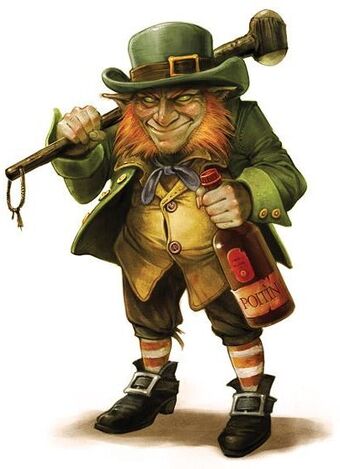
“No one is bringing you a ghost trapped in a bottle,” Nickell said. “What they’re offering is, ‘I don’t know.’ Over and over, they’re saying something like this: ‘We don’t know what the noise in the old house was, or the white shape in the photo. So it must be a ghost.’ These are examples of what’s called an argument from ignorance. You can’t make an argument from a lack of knowledge. You can’t say, ‘I don’t know, therefore I do know.’… If I could just teach people a little bit about the argument from ignorance, I think we could give the ghosts their long-needed rest.”

People love to believe in this type of stuff. But if you use your logic and common sense it becomes apparent that there is absolutely, without a doubt, no solid evidence to support ghost claims.  Just watch Ghost Hunters and this lack of evidence becomes crystal clear.


creep2

If only this was real. It would make reality so much more exciting!

Spooky Paranormal Winnipeg

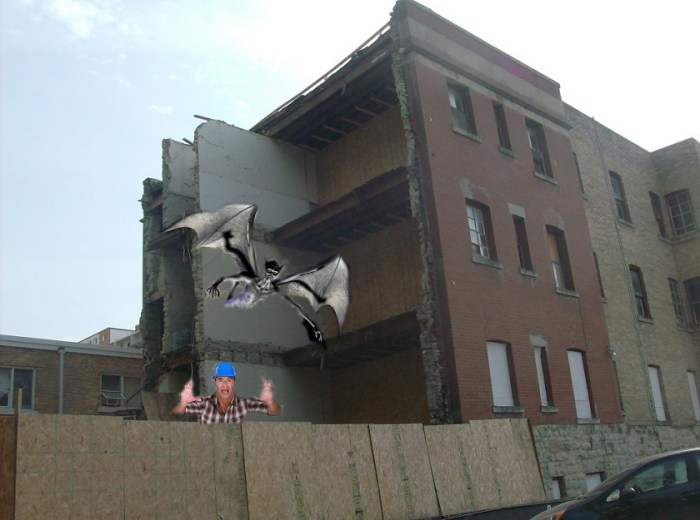
There was an old apartment building in downtown Winnipeg dubbed the Demon Hotel.

As they were tearing it down workers would get spooked by spectres and other phantasma. Then is burned down.

A photograph of a panicked worker with an otherworldly entity harassing him below.

For an extensive description and stories about the Demon Hotel, there is a dedicated blog regarding the unholy structure.

https://demonhotelofhargrave.blogspot.com/


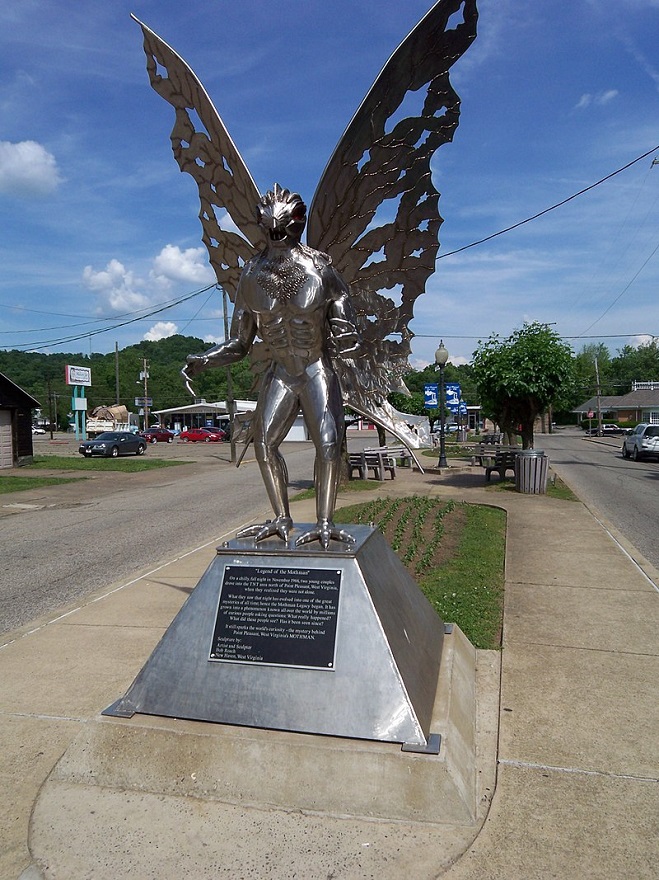
Cool Mothman Statue

In West Virginia folklore, the Mothman is a creature reportedly seen in the Point Pleasant area from November 12, 1966, to December 15, 1967. The first newspaper report was published in the Point Pleasant Register dated November 16, 1966, titled “Couples See Man-Sized Bird … Creature … Something”. The national press soon picked up the reports and helped spread the story across the United States.

The Mothman was introduced to a wider audience by Gray Barker in 1970 and later popularized by John Keel in his 1975 book The Mothman Prophecies, claiming that there were supernatural events related to the sightings, and a connection to the collapse of the Silver Bridge.

The Mothman appears in popular culture. The 2002 film The Mothman Prophecies, starring Richard Gere, was based on Keel’s book. An annual festival in Point Pleasant is devoted to the Mothman legend.

Point Pleasant held its first Annual Mothman Festival in 2002. The Mothman festival began after brainstorming creative ways for people to visit Point Pleasant. The group organizing the event chose the Mothman to be center of the festival due to its uniqueness, and as a way to celebrate its local legacy in the town.

According to the event organizer, Jeff Wamsley, the average attendance for the Mothman is an estimated 10-12 thousand people per year.

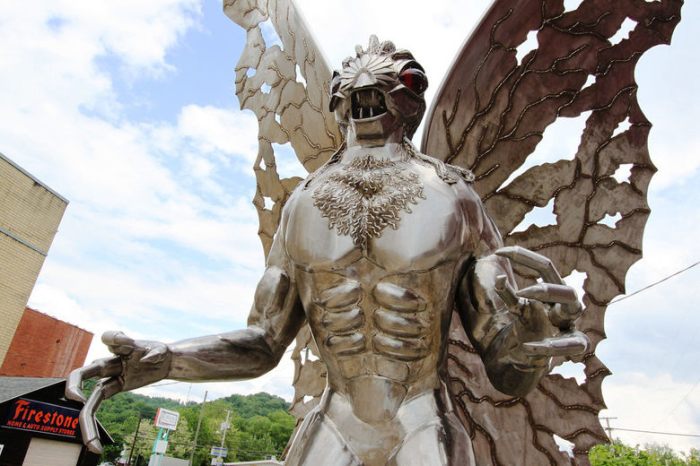
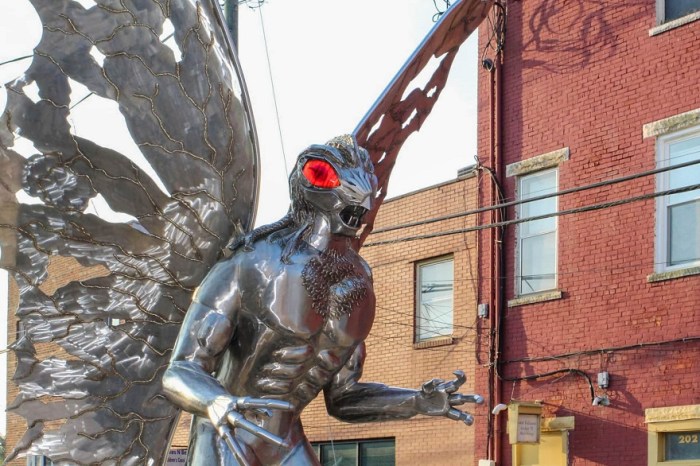
A 12-foot-tall metallic statue of the creature, created by artist and sculptor Bob Roach, was unveiled in 2003. The Mothman Museum and Research Center opened in 2005. The festival is held on the third weekend of every September, hosting guest speakers, vendor exhibits, pancake-eating contests, and hayride tours of locally notable areas.


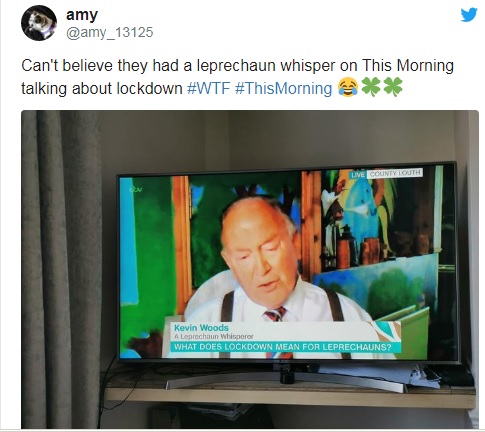
Leprechaun whisperer says the mythical Irish fairies ‘don’t have a problem’ with lockdown

IRELAND’S LAST living leprechaun whisperer says the mythical Irish fairies are coping well with lockdown and “don’t have a problem” with the restrictions in place. 

Kevin Woods from Carlingford in Co Louth, is a prominent leprechaun advocate and activist with a history of campaigning for leprechaun rights. 

In the past, he has successfully lobbied for the mythical Irish fairies to receive EU protection. 

He also happens to run a tour business named Last Leprechauns Of Ireland, and considers himself an authority and “custodian” of the iconic Irish sprites.  

With Ireland caught up in the current coronavirus global health crisis, Woods sought to reassure the public that Ireland’s leprechauns are doing just fine, during an appearance on ITV’s This Morning. 

According to the leprechaun whisperer, the Irish fairies are doing just fine, even though their numbers have dwindled in recent times 

“There were millions of them here in Ireland and they all died apart from 236 of them,” he explained to hosts Ruth Langford and Eamon Holmes. 

I’m really the custodian of them and their lives and I’ve been doing that since I got them a protected species.” 

During the interview, Mr Woods explained that while most people cannot see the leprechauns, he has special powers that mean they appear to him and communicate “through an out of body experience”. 

Asked how leprechauns are coping with Ireland’s lockdown restrictions, Mr. Woods confirmed “they don’t have a problem with it”. 

While Mr. Woods’ tour business has taken a hit in the past few months, he’s not worried. 

“It’s not really business to me, I have enough access to the gold,” he explained.  

“I don’t need the business. I do it to tell people the story is true.” 

He also sought to assure viewers that his dalliances with the little Irish fairies have not broken any of the government’s lockdown measures. 

“Leprechauns are spirits, they manifest themselves to me as leprechauns. I visit them each day, I haven’t broken the restrictions,” he said. 

“I communicate with them through an out of body experience, everyone knows what I mean and I can transfer my spirit up there.” 

Unfortunately, not everyone is quite so convinced, with a flood of This Morning viewers taking to Twitter to criticise and question his appearance on the show 

One wrote: “Can’t believe they had a leprechaun whisper on This Morning talking about lockdown. “ 

A second commented: “Ruth trying to keep a straight face when your mans talking about ‘ leprechauns’ is killing me.” 

A third, meanwhile, said: “You know you’ve been in the house too long when you’re watching an interview of Ireland’s last leprechaun whisperer.” 

Japanese spa offers ‘exorcism’ for your dog

Rascal, a Chinese Crested, is poses for a portrait after competing in the World's Ugliest Dog Competition in Petaluma, California on June 26, 2015. Quasi Modo went on to win first prize as the ugliest dog in the competition.  AFP PHOTO/JOSH EDELSON        (Photo credit should read Josh Edelson/AFP/Getty Images)


A Japanese dog spa has taken pet pampering to a whole new level by offering “exorcisms” for their furry guests.

The D+Kirishima spa not only offers the latest in formal kaiseki doggy-owner dinners and spa baths together (yes, together in the same bath), but also a package called the “Pet Dog Exorcism Plan.”

A senior Shinto priest will come to the spa to conduct a ceremonial blessing to rid your pup of bad spirits and pray for its future health.

The ceremony is especially suggested for dogs in their “unlucky health years.”

“Seven-year-old, 10-year-old, and 13-year-old dogs need to be careful of their health, as it’s easier in those years for them to gets diseases of aging,” according to the spa’s pitch for the package.

“The exorcism for your dog is celebrated along with its owner at the Shingariyu shrine within the hotel.”

It only takes 30 minutes, according to the site. And it costs $430 — room and pet-owner dinner included.


dog


dogs


The Japanese must have something similar for cats. Some need help.


cats


There seems to be something out there.

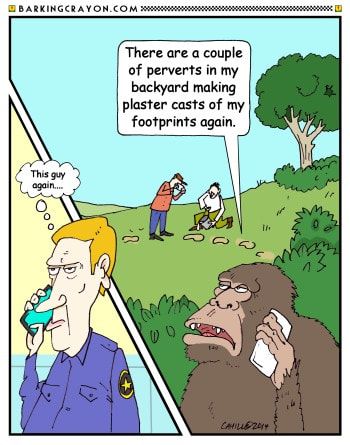
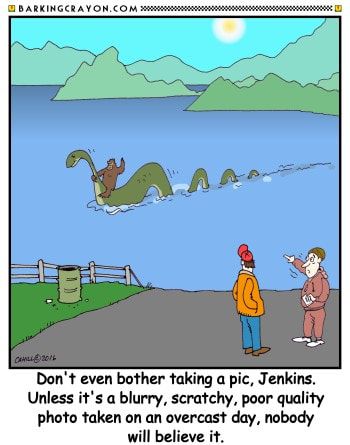
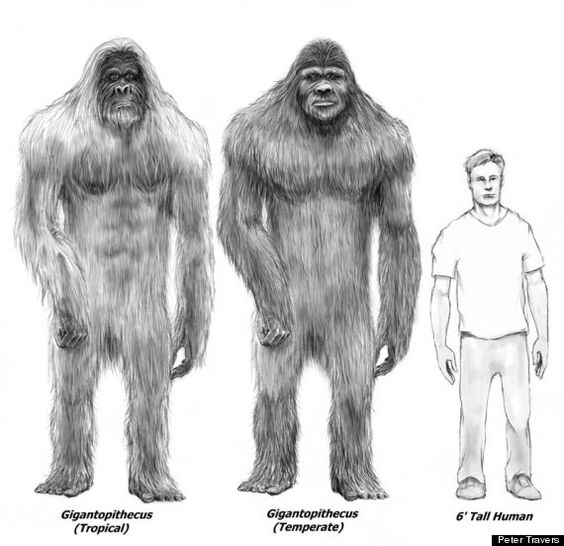
Over 10,000 reported Sasquatch sightings in North America over the last 70 years. Some experts put forward that only 10-20 percent of sightings are reported out of fear of being ridiculed. You could then extrapolate that there may be 100,000 sightings. Could 10,000 people be hallucinating, not to mention the footprints, hair samples, nests, tree knocks and other sounds. DNA from hair samples have come back: unknown species.

Sasquatch expert, the late John Green, was in northern California in 1969 checking on Bigfoot reports. He was at a road construction camp and checked the area around the camp. The next day a worker called him to report footprints found 75 yards from the camp. Green immediately went to the camp. Down a steep slope at the edge of a small pond he found up to 800 sasquatch footprints. Different sizes. Green had checked that area the previous day and there were no prints.  The construction workers heard nothing. The prints had impressions up to three quarters of an inch deep. Something heavy made them. To hoax such prints Green contends it would have taken some type of machine to press them into the ground.  Green wrote three different entities made the footprints.

I definitely believe there is a great possibility that an ape (that walks on 2 legs) of some sort is out there. Whatever they are, they are extremely elusive.

The Broken Technology of Ghost Hunting

The Atlantic

The best tools for tracking down spirits have always been the ones fallible enough to find something.

The small, Syracuse, New York-based company K-II Enterprises makes a number of handheld electronic devices—including the Dog Dazer (a supposedly safe, humane device that deters aggressive dogs with high-pitched radio signals)—but it is best known for the Safe Range EMF. The size of a television remote, the Safe Range EMF detects electromagnetic fields, or EMF, measuring them with a bright LED array that moves from green to red depending on their strength. Designed to locate potentially harmful EMF radiation from nearby power lines or household appliances, the Safe Range has become popular for another use: detecting ghosts.

Since its appearance in the show Ghost Hunters, where the ghost hunter Grant Wilson claimed that it has been “specially calibrated for paranormal investigators,” the Safe Range (usually referred to as a K-II meter) has become ubiquitous among those looking for spirits. Search for it on Amazon, and many listings will refer to it as a “ghost meter,” an indispensable tool in the ghost hunter’s arsenal. It isn’t alone among EMF meters: Of the best-selling EMF meters on Amazon, two out of the top three are explicitly marketed as ghost meters.


ghosthunters-jason-grant-cartoon-390x220


Scanning the various product descriptions and reviews, though, what becomes clear is that the K-II Safe Range is a relatively unreliable electromagnetic field meter. It operates only on one axis (you have to wave it around to get a proper reading), and it’s unshielded, meaning that it can be set off by a cell phone, a two-way radio, or virtually any kind of electronic device that occasionally gives off electromagnetic waves. The reviewer Kenny Biddle found he could set it off with, among other things, a computer mouse and a camera battery pack.

Yet it’s precisely because it’s not particularly good at its primary purpose that makes it a popular device for ghost hunters. Erratic, prone to false positives, easily manipulated, its flashy LED display will light up any darkened room of a haunted hotel or castle. Which is to say, its popularity as a ghost hunting tool stems mainly from its fallibility.

The K-II isn’t the only consumer-electronic item used by ghost hunters. Often it’s sold in kits that contain other devices, such as a Couples Ghost Hunt Kit, with two of everything, so you can build “trust and lasting memories when the two of you, alone in some spooky stakeout, look to each other for confirmation of your findings and reassurance!” There are devices that have been engineered specifically for ghost hunters, like a ghost box, which works by randomly scanning through FM and AM frequencies to pick up spirits’ words in the white noise. But mostly, ghost hunters use pre-existing technology: not just EMF meters, but also run-of-the-mill digital recorders, used to capture electronic voice phenomena, or EVP. An investigator records her or himself asking questions in an empty room, with the hope that upon playback ghostly voices will appear.

All of this technology—both the custom and the repurposed—works along more or less the same principle: generating a lot of static and random effects, hoping to capture random noise and other ephemera. The ghost hunter, in turn, looks for patterns, momentary convergences, serendipity, meaningful coincidence. For the believer, this is where ghosts live: in static, in glitches and in blurs. 

ghost1


Electronic voice phenomena have continued to rank among the most prominent “evidence” offered of paranormal activity, it seems, precisely because humans are hardwired to dredge meaning out of chaos. Evolutionarily, we have long needed to discern the sight or sound of a predator despite its camouflage, which has led us to look for patterns where they might not be immediately evident. The quirks and shortcomings of technology plays directly into this biological need: throwing out random static and noise that is primed to be transmuted into meaningful signals. Ghost hunters work through confirmation bias. Looking for proof of the paranormal, they will find it in anything, but most readily in static, gibberish, and errata—technological noise in which we’re hardwired to find false positives.

The only thing that’s changed recently is the proliferation of consumer electronics associated with ghost hunting. In an age of iPhones and Fitbits, ghost hunters are just one more niche market, lapping up the latest and greatest gadgets for sale. But there’s one crucial difference: most purveyors of consumer electronics keep their consumers happy by constantly refining them until they’re free of bugs. Ghost tech works the other way, by actively engineering glitches—the more, the better.

Such seekers can easily be written off as kooks and outliers, but there’s something paradigmatic in their use of faulty devices. The rise of the internet and other new technologies promised a new Information Age, one in which data, truth, and knowledge were the new currency, where the future would be built on information itself. Twenty years on, there’s an endless labyrinth of conspiracy theories, fake memes, trumped up stats, and fabricated evidence. The world’s knowledge is just a Google search away, but it comes to us inextricably intertwined with the world’s bullshit.


ghost_hunters_cartoon_by_malevolentnate

The 21st-century media consumer is always working to sift through the noise in search of a signal. Whether it’s a cousin’s anti-vax Facebook post, the endless Farmville requests that have to be filtered out of a feed, or the colossal avalanche of half-truths and lies dumped during the last election, most people’s primary challenge online these days is blocking out the endless assault of static, trying to torture it into some kind of meaning.