Just add air – Inflatable Sex Doll Ads from the 1970’s

05inflatbl4.jpg

Let’s imagine it’s 1973. I have my bachelor pad, my 28” color TV, swivel chair, hi-fi stereo gear, fondue set and my corduroy bellbottoms. I live in a Space Age world. I have everything I ever wanted. But somehow I feel empty. I feel I’ve mortgaged my happiness on things I don’t really need. I have a lifestyle but no life. There’s something missing. I’m lonely. I’m missing that certain someone special to share all this luxury with.

But relationships are messy. They’re downright difficult. And I don’t know if I’m ready to commit, you know what I mean? I really need someone who is always ready to please, always ready for me and what I want. When I want it. But where can I find such a person? Do they even exist?

I flick thru the latest issue of Man’s World where I find an ad for a life-size inflatable doll…

Just add air…Life-like in every detail…Snuggle up to your own Love Maid.

Eight dollars ninety-five. It all seems too good to be true. But I know nothing about “Love Maids.” I know nothing about inflatable love dolls…but maybe I might know a man who does. Bryan Ferry. He sang about inflatable dolls. He’s the man to ask. Maybe I should call him up?

Bryan, I live in this perfect world, all mod cons, everything I need, but why, why do I have this utter sense of loneliness?

Bryan (for it is he….): In every dream home a heartache… And every step I take. Takes me from heaven.

What do you mean by “heaven,” Bryan?

Bryan: The perfect companion. Deluxe and delightful.

You seem to know a lot about this, brah. Way too much…

Looking for a playmate? Well, here I am. I’m Lori, the latest, wildest, party-time sensation and I’m ready for action…

Bryan: Inflatable doll. Disposable darling… My breath is inside you… I dress you up daily. I blew up your body… But you blew my mind.

Ew. Too much information, man…

The earliest sex doll is credited to Dutch sailors in the 17th century, who used a dame de voyage—a masturbatory doll made of cloth for relieving sexual stress on long voyages. In 1908, the first recorded “manufactured” sex doll made its appearance in psychiatrist Iwan Bloch‘s The Sexual Life of Our Time. Bloch described this doll as “Vaucansons” intended for fornicatory purposes. These were made from:

…rubber and other plastic materials, prepare entire male or female bodies, which, as hommes or dames de voyage, subserve fornicatory purposes. More especially are the genital organs represented in a manner true to nature. Even the secretion of Bartholin’s glans is imitated, by means of a “pneumatic tube” filled with oil. Similarly, by means of fluid and suitable apparatus, the ejaculation of the semen is imitated. Such artificial human beings are actually offered for sale in the catalogue of certain manufacturers of “Parisian rubber articles.”

During the Second World War, it was long rumored but never actually proven that Nazi leader Adolf Hitler ordered sex dolls to be supplied to German troops fighting on the front line. The real change in sex dolls took place in the 1960s with the development of the vinyl inflatable doll with realistic “openings.” These became very popular in the 1970s, as can be seen by the following selection of bizarre adverts.

04Caper1969.jpg

03trueMenStories1971.jpg

02inflatabll.jpg

Dangerous Minds

The Lighthouse Hotel

Described by some as the “loneliest hotel in Germany,” the Roter Sand lighthouse, some 30 miles off the coast of Bremerhaven, Lower Saxony, has been welcoming guests for over 10 years. But the lighthouse itself is 125 years old.

The Roter Sand was built in 1885, and was considered a technical marvel at that time as it was the first ever structure built on the sea floor at a depth of 22 metres. For almost 80 years the red, white and black lighthouse was the first thing sailors saw on their way into the port city, and the last thing millions of emigrants saw before their ships reached the North Sea on their journey to the New World. But by 1964 its steel foundations became unstable and the lighthouse was decommissioned.

roter-sand1

In1987, a spectacular rescue action restored the 31-metre tall building’s foundation, and following a restoration of the interior, the German Foundation for Monument Protection (DSD) worked to open the protected lighthouse to the public. Since the first visitors scaled the stairs of the Roter Sand in 1999, the lighthouse has welcomed some 5,500 day trippers and 800 overnight guests.

Earlier the lighthouse keepers were hauled up to the lighthouse in a large basket. Guests are however afforded the luxury of a step-bridge between the structure and a tugboat to enter which is more secure than traveling on a basket.

roter-sand3

A picture from 1929 shows the use of the basket.

With room for up to six overnight guests, the tower comprises one communal bedroom, a combined kitchen and living area, and a bathroom. Guests must supply their own sleeping bags and towels but will arrive to find a fully-stocked kitchen, although they must do their own cooking. There is also no electricity or heating.

There is also a ban on alcohol in the lighthouse due to the 70 well-worn steps between this room and the toilet.

roter-sand5

Day trips to the Roter Sand run around €75. Two days with one overnight stay are a little pricier at €488 per person, and three days with two nights costs €573 per person. But those hoping to visit the Roter Sand will have to be patient. The tugboat “Goliath” can only make the trip to the lighthouse on calm seas, which means that bookings – available only June through September – can be cancelled at the last minute. The guests who stay in the lighthouse can also get stuck if the weather turns bad overnight preventing their pickup the next day.

The Roter Sand celebrated its 125th birthday on November 1, last year. In honor of the lighthouse’s birthday, the German tourism board plans to spend €150,000 on renovations next year.

roter-sand2

A postcard from 1907.

roter-sand10

roter-sand9

roter-sand7

Image credit: Dharion

roter-sand8

Image credit: Lemark

Amusing Planet

VLT gambling control card could stop a lot of grief 2 comments

Many people are inclined to take the leap into the dark and deep abyss that is Video Lottery Terminal addiction.  Once they sit down in front of the electronic bandits they can’t pull away until the mortgage payment or rent money has been swallowed up by the little mechanized devils.  For a small percentage of the population VLT’s have become a major problem.  A drain and burden financially and psychologically.

Since the widespread introduction of the gambling machines back in the early 1990’s in Canada provincial governments have become addicted to the revenue they generate.  In Manitoba some half-hearted attempts have been made to reduce the negative impact the mesmerizing metal buckets inflict on addicts.  Reducing the number of machines in establishments was one effort.  Come to think about it, that was the only effort.  Now hard-core VLT addicts have to drive around to different lounges and bars to find an open machine.  But if that doesn’t work they can drive to one of the provincially run casinos where there are hundreds of the contraptions waiting to suck dry the last hundred dollars from a down and out addict.

But there may be an idea out there that will help control the out of control gamblers.  The good people of Norway came up with the idea after experiencing many social problems caused by VLT addiction.  It is a VLT gambling control card.  VLT’s are configured where they can’t take coins or bills, only government issued cards.  A player can only get credits of $400 to $500 on the card per month.  When the $500 is used up the player has to wait until the 1st of the next month to get back into the action.  $500 is still not pocket change, but some addicts report spending thousands of dollars a month on the hazardous machines.

But before this takes place the Libertarians will be screaming about more government regulations affecting the average Joe’s life.  If the idiot can’t control his gambling urges tough luck.  Stay out of our lives government, the strong and righteous will prevail.  After all what is next?  Spending limit cards on beer consumption.  A person will only be allowed to spend $400 dollars a month on beer.  Where does it end?  Will there be spending limit cards on potato chips and chocolate bars?  The government is trying to control every aspect of our lives. Vive laissez-faire!

But if this control card idea can stop the horrid gambling problems that certain people face let’s go ahead with it.  Governments started this VLT blitz on society, it should be the government’s responsibility to help rectify gambling addiction.

Australian Accent Is All Down To Early Settlers ‘Getting DRUNK Every Day’

Aussies slur their words and use only two-thirds of their mouth to speak because early settlers spent most of their days DRUNK, academic says

  • The Australian language developed because early settlers were often drunk
  • Academic claims the constant slurring of words distorted the accent
  • The average Australian speaks to just two thirds capacity
  • The drunken speech has been passed down from generation to generation

The Australian accent developed because so many early settlers were drunk and slurring, an Australian academic has claimed.

The first British arrivals to the country were such big drinkers that the distortion to their speech caused a verbal hangover that persists to this day, according to Dean Frenkel, a communications expert at Victoria University in Melbourne.

Proud Australians may be offended by the claim, which comes on top of the unavoidable truth that Australia began its modern life as a penal colony for our criminals.

drunk_kangaroo1

But academic Mr Frenkel unashamedly wrote in Australian newspaper The Age: ‘Let’s get things straight about the origins of the Australian accent.

‘The Australian alphabet cocktail was spiked by alcohol.

‘Our forefathers regularly got drunk together and through their frequent interactions unknowingly added an alcoholic slur to our national speech patterns.

‘For the past two centuries, from generation to generation, drunken Aussie-speak continues to be taught by sober parents to their children.’

Bemoaning the still ‘slurred’ Australian accent, Mr Frenkel continued: ‘The average Australian speaks to just two thirds capacity – with one third of our articulator muscles always sedentary as if lying on the couch; and that’s just concerning articulation.

‘Missing consonants can include missing “t”s (Impordant), “l”s (Austraya) and “s”s (yesh), while many of our vowels are lazily transformed into other vowels, especially “a”s to “e”s (stending) and “i”s (New South Wyles) and “i”s to “oi”s (noight).’

Concluding with a call for Australians to improve their diction, the academic added: ‘It is time to take our beer goggles off.

‘Australia, it is no longer acceptable to be smarter than we sound.’

drunk1

The Australian alphabet that ‘was spiked by alcohol’ and that the distortion to their speech caused a verbal hangover that persists to this day

HISTORY OF THE AUSSIE ACCENT

1788 – Colonial settlement established. A new dialect of English begins to take shape

1830 – By the end of the early Colonial settlement era major features of the accent, called ‘General Australian’, had developed, wi the country’s love of abbreviated words became part of everyday language

1850 – The Gold Rush leads to internal migration, spreading the general dialect around the continent

1880 – Extensive migration from England led to an emphasis on elocution and British vowels, which formed the Broad Australian dialect

1914 to 1918 – Australia’s national identity was galvanized during WWI with the creation of terms like Anzac and digger. Australians start to become proud of their accent.

1950 – In the second half of the 20th century, any emphasis on Broad Australian dwindled because of weakening ties with Britain and the General Australian accent became widely accepted as the national norm

1964 – The term Strine was coined to describe the country’s accent, which the majority of people continue to speak today   

  • Information from Macquarie University and Oxford English Dictionary

australia-day-funny-25

Previous accent theories have included suggestions that the Australian accent is a true reflection of the 18th and 19th century accents of British arrivals, while the American accent reflects the way 17th century early settlers from Britain spoke.

The suggestion has been that it is native English accents which have changed, while former colonies have clung to old ways of speaking.

Winston Churchill described the Australian accent as ‘the most brutal maltreatment ever inflicted upon the mother tongue.’

Aussie Drinking Slang

Words for “beer”:

  • grog (can mean any alcohol)
  • piss

Words for “drunk”:

  • legless
  • off one’s face
  • maggot (really drunk)
  • pissed

Different sized drinks:

  • schooner – 425ml glass of beer, except in SA where it is a 285ml glass
  • middy – half-pint of beer / same as a pot
  • pot – 285ml glass of beer in QLD or VIC
  • pint – 570ml glass of beer
  • long-neck – 750ml bottle of beer
  • tinnie – can of beer
  • stubby – bottle of beer
  • slab – 24 pack of beer


More drinking terms:

  • esky – a cooler
  • goon – cask or box wine
  • shout – to buy someone a drink
  • bottle shop / bottle-o – a liquor store
  • chunder – vomit
  • drink with the flies – drink alone
  • rage – party
  • skull/skol a beer – drink a whole beer without stopping

Pigeon ‘caught with backpack of drugs’

Pigeon found carrying drugs in Kuwait

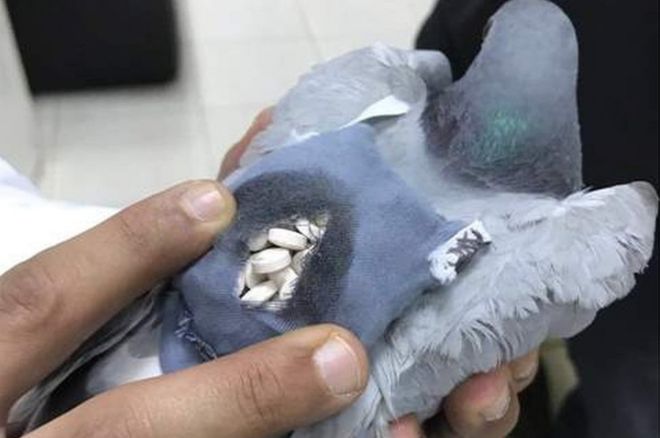
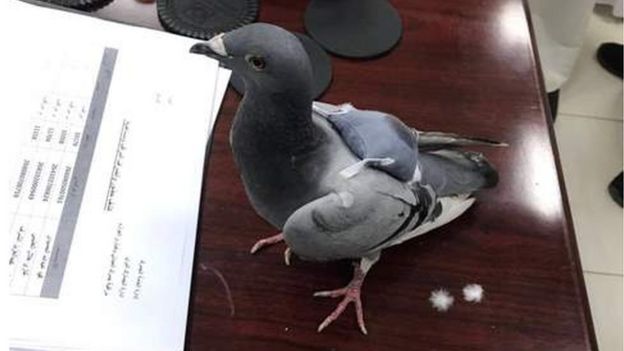
Customs officials in Kuwait have apprehended a pigeon carrying drugs in a miniature backpack, Kuwaiti newspaper al-Rai reports.

A total of 178 pills were found in the fabric pocket attached to its back, the newspaper says.

The bird was caught near the customs building in Abdali, close to the border with Iraq.

An al-Rai journalist said the drugs were a form of ketamine, an anaesthetic also used as an illegal party drug.

Abdullah Fahmi told the BBC that customs officials already knew pigeons were being used to smuggle drugs, but this was the first time they had caught a bird in the act.

Pigeon found carrying drugs in Kuwait

Law enforcement officials elsewhere have, however, identified previous cases where pigeons have been used to carry lightweight high-value narcotics.

In 2015, prison guards in Costa Rica caught a pigeon carrying cocaine and cannabis in a zipped pouch.

And in 2011, Colombian police discovered a pigeon that was unable to fly over a high prison wall because of the weight of a package of cocaine and marijuana strapped to it.

Pigeons have been used to carry messages since Roman times, using their powerful “homing” ability.

Racing pigeons can return to their lofts from distances of hundreds of kilometres.

BBC

Wrong sub-titles on Swedish TV

Civic-minded Swedes who tuned in to a political debate early last year didn’t expect to witness an interplanetary underwater battle involving dinosaurs, but thanks to an innocent mixup at the SVT2 TV station, that’s what they got.It was probably more entertaining, not to say true-to-life, than what was actually happening in the debate, which involved Environmental Minister Åsa Romson, Liberal People’s Party leader Jan Björklund, Education Minister Gustav Fridolin, and Urban Ahlin, Speaker of the Riksdag, the national legislature of Sweden.

The subtitles depicted dialogue from the PBS children’s TV show Dinosaur Train.

The head of the channel’s subtitle department, Anna Zetterson, smells a rat (or is it a dinosaur?), it seems. It turns out that on some older television models you can swap out the “teletext” page from another channel while keeping the current image. On Facebook she wrote in Swedish, “On some older TVs can still choose the old teletext page for the different channels’ subtitles, while checking on a different channel. So SVT, or any operator, didn’t send these out. But it is something you can amuse yourself with on an older television set.”

We don’t care. Maybe nobody made a mixup and it was all a plot to tickle our brains. All we can say is, mission accomplished!

Via Dangerous Minds