Why The Soviet Union Exchanged Warships For Pepsi

The American soft drink giant Pepsi has a long presence in Russia dating back to the early 1970s when Russia was still a part of the Soviet Union. It was the first capitalistic product to gain entry into the communist market. At that time rivalry between the two countries was high, so how did an American soft drink company get its foot in the door to build a major market in Russia?

Bottles of Soviet Pepsi at a Moscow-based plant, 1991. Photo: Vladimir Akimov/Sputnik

The story of how Pepsi came to be sold widely in Russia began in 1959, when the then-Vice President Richard Nixon came visiting the Soviet Union for an exhibition in Sokolniki Park, Moscow, and met with Soviet leader Nikita Khrushchev. The American National Exhibition was organized to promote American art, fashion, cars, and capitalism. Among many other things, the exhibition featured an entire model American house filled with modern conveniences and recreational devices such as washing machine, vacuum cleaners and color television. It was there, standing inside the mock-up of an American kitchen, the two leaders had a heated debate on the merits and demerits of communism and capitalism.

“You plan to outstrip us, particularly in the production of consumer goods. If this competition is to do the best for both of our peoples and for people everywhere, there must be a free exchange of ideas,” Nixon told Khrushchev. Later, Nixon led Khrushchev over to a booth dispensing Pepsi and gave Khrushchev a glass of the brown, fizzy, sugary drink that the Russian had never tasted before.

Richard Nixon and Nikita Khrushchev at the infamous “Kitchen Debate.” Photo: National Archives

The Pepsi booth had two different versions of the drink—one made with American water and another made with Russian water. Khrushchev declared that the one made with Russian water was clearly superior and “quite refreshing”. As Khrushchev drank he insisted that his Russian colleagues around him partake in the sugary tonic, and photographers surrounding the small group fired off their flash bulbs.

No amount of advertising spend could have brought Pepsi this much publicity what these photographs brought when they were published all over America and Soviet Russia. It eventually catapulted Kendall from an executive at the Pepsi-Cola Corporation to the company’s CEO in 1965.

Kendall did play a larger role in the events of 1959 than the photos implied. Nixon bringing Khrushchev to the Pepsi fountain and Kendall serving the addictive drink to the Soviet leader was not an impromptu move, after all. It was Kendell’s idea, and so was Pepsi’s participation at the exhibition against the wishes of his superiors, who felt that trying to sell an American product to a Communist country was wastage of effort and money. The night before, Kendall met with Nixon, with whom he shared a long-term friendship, and told him that he “had to get a Pepsi in Khrushchev’s hand.”
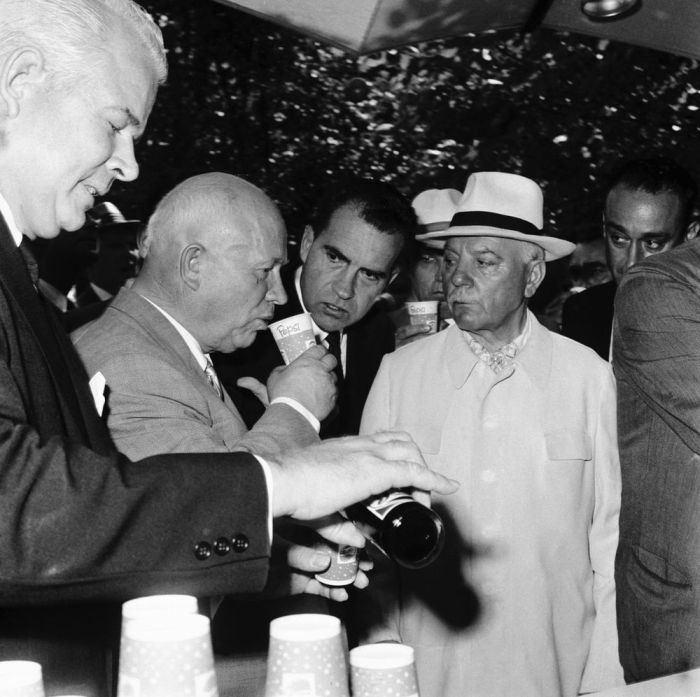
Nikita Khrushchev takes a sip of Pepsi in 1959 at the U.S. National Exhibition in Moscow, while U.S. Vice President Richard Nixon watches and Donald Kendall pours another glass. Photo: Fai/Legion Media

Thirteen years later, in 1972, Kendall scored an exclusive deal with the the Soviet Union shutting out Coke from the communist market. There was, however, a snag—Soviet currency was worthless outside the USSR, because the Soviet ruble did not function like a real currency in a market economy, but more like tokens or company vouchers because the value of the currency was determined by the government and not by market forces. As a result, Kendall had to use an alternative method of payment—the good old barter system.

It was decided that in exchange for the manufacture and sale of Pepsi in the Soviet Union, Pepsi would obtain exclusive distribution rights for Stolichnaya vodka in the US. The company would profit only from vodka sales in the US. It was not to receive any benefit from Pepsi sales in the Soviet Union.

A salesman shows a bottle of Stolichnaya vodka. Photo: Getty Images

Pepsi’s market grew by leaps and bounds and by the late 1980s, the company had more than twenty bottling plants in the USSR, and the Russians were drinking one billion servings a year—far more than the Americans were drinking Stolichnaya vodka. The American vodka market being limited, Kendall began to look for other Soviet products to procure in exchange of Pepsi. What about decommissioned warships? the Soviet Union suggested.

So in 1989, Kendall signed a new agreement, according to which the Soviets would transfer to PepsiCo an entire armada consisting of 17 submarines, a cruiser, a frigate, and a destroyer. Some joked that at that point in time Pepsi owned the world’s sixth largest Navy. On the contrary, these vessels were hardly sea worthy. Pepsi quickly sold them for scrap. Each submarine fetched them $150,000.

“We’re disarming the Soviet Union faster than you are,” Kendall once quipped to Brent Scowcroft, President George H.W. Bush’s national security adviser.
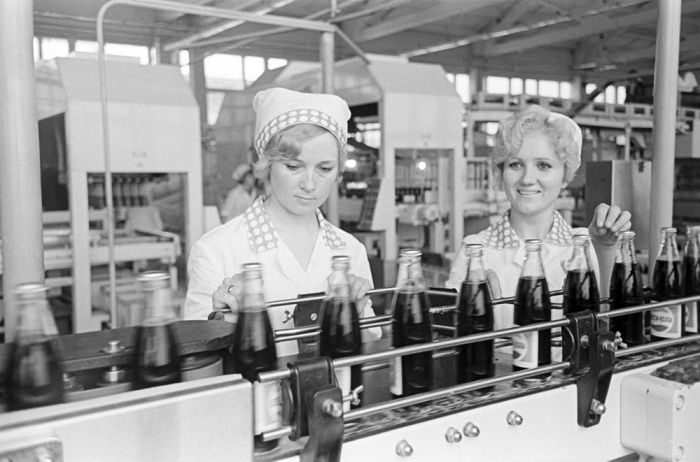
Workers inspect Pepsi bottles at a bottling plant somewhere in the Soviet Union. Photo: N. Arkhangelskiy/Sputnik

The following year, PepsiCo signed an even bigger deal with the Soviet Union, amounting to USD 3 billion worth of soda. As payment, the Soviet Union would build at least 10 ships, mostly oil tankers, which would be sold or leased by PepsiCo on the international market. The deal would have doubled PepsiCo’s sale of its sugary drink in Russia to nearly a billion dollars. A year later, the Soviet Union broke up and the deal fell though.

Russia is still Pepsi’s second biggest market outside of the United States, but most Russians today prefer to drink Coca-Cola instead. Pepsi has a market share of only 18 percent (as of 2013), against their rival Coca-Cola which holds twice as much. Pepsi now sells less than many domestic beverages.

Teenagers celebrate the end of school, Moscow, 1981. Photo: Ivan Vtorov
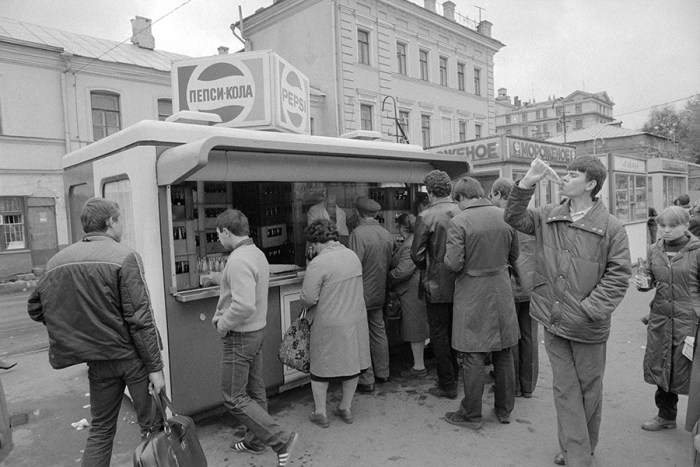
A Pepsi stand in Moscow, 1983. Photo: Getty Images

Atomic Bomb Tourism

Between 1951 and 1992, there were a total of 928 announced nuclear tests at Nevada Test Site. Of those, 828 were underground.  (Sixty-two of the underground tests included multiple, simultaneous nuclear detonations, adding 93 detonations and bringing the total number of NTS nuclear detonations to 1,021, of which 921 were underground.)  The site is covered with subsidence craters from the testing. The Nevada Test Site was the primary testing location of American nuclear devices; 126 tests were conducted elsewhere (many at the Pacific Proving Grounds in the Marshall Islands).

During the 1950s, the mushroom clouds from these tests could be seen for almost 100 mi (160 km) in either direction, including the city of Las Vegas, where the tests became tourist attractions. Americans headed for Las Vegas to witness the distant mushroom clouds that could be seen from the downtown hotels.


Rare and Unique Historical Photos


rare 1913 gettysburg

Union and Confederate Veterans in 1913. 50th Anniversary of the Battle of Gettysburg.


rare 1956 queen and marilyn 30 years old

Queen Elizabeth and Marilyn Monroe 1956.  They are both 30 years old.


rare 1963 16 year old arnie

Arnie in 1963 when he was 16 years old.


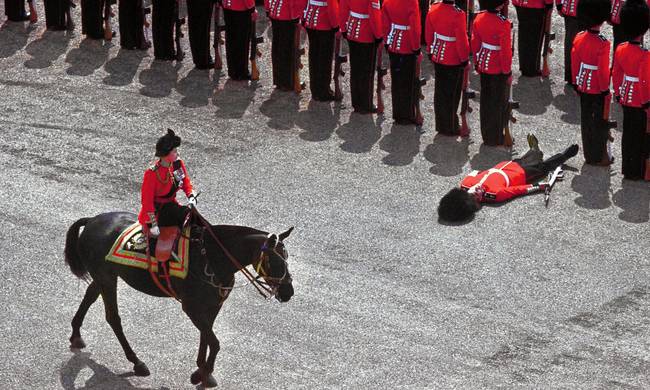
rare 1970 soldier passes out

1970 Queen Elizabeth rides by a guard who passed out. Embarrassing.


rare abe and general george mcclellan

Abe Lincoln and General George McClellan during the Civil War.


rare atari space invaders championship 1980

Atari Space Invaders tournament in 1980.


rare b-25 sinks jap destroyer

B-25 bomber sinks a Japanese destroyer in WW II.


rare clinton lewinsky 1995

Bill Clinton and Monica Lewinsky 1995. Chemistry is bubbling with lust.


rare dr no 1962

Sean Connery signing a coconut on the set of Dr. No 1962.


rare einstein's desk 1955 after he died

Albert Einstein’s desk right after he died in 1955.


rare FIlming the MGM lion

Filming the MGM Lion 1920’s.


rare gadget first atomic bomb

World’s first atomic bomb named ‘Gadget’.


rare Germans testing a Messerschmitt Bf 109 E3, 1940

German Messerschmitt BF 109 E3 testing 1940.


rare robin williams 1974

1974 a photographer took a photo of two mimes in Central Park, one turned out to be Robin Williams.


rare gustav railgun 1942 hitler

1942 Hitler watches testing of the monstrous Gustav rail gun.


rare hw bush 1991 texas rangers

George H. W. Bush throwing out the first pitch at a Texas Rangers game 1991. Sort of a girly looking throw.


rare june 17 1991 Mt. pinutubo pyroclastic flow

June 17, 1991 guy in truck is scrambling to outrun pyroclastic volcanic flow from Mt. Pinatubo, Philippines. No word on whether he made it or not. Update, he did make it.


rare soldiers-onions

World War II British soldiers wearing gas masks while peeling onions.


rare The Hoover Dam before it was flooded

Hoover Dam before it was flooded 1936.


rare woodstock

Crowd at original Woodstock gig 1969.

London’s Deep Level Air Raid Shelters

When the Second World broke out in Europe, and London became the prime bombing target, people began to pour into the platforms of the London Underground —the city’s subway system— every night to escape the nightly bombings of the 1940 London Blitz. As these underground sanctuaries became increasingly crowded, the British government decided to construct proper air raid shelters far below the ground. The idea was to build ten shelters and place them slightly below and near existing subway stations with the intention that these newly built tunnels will be eventually absorbed into the Underground once the war was over.


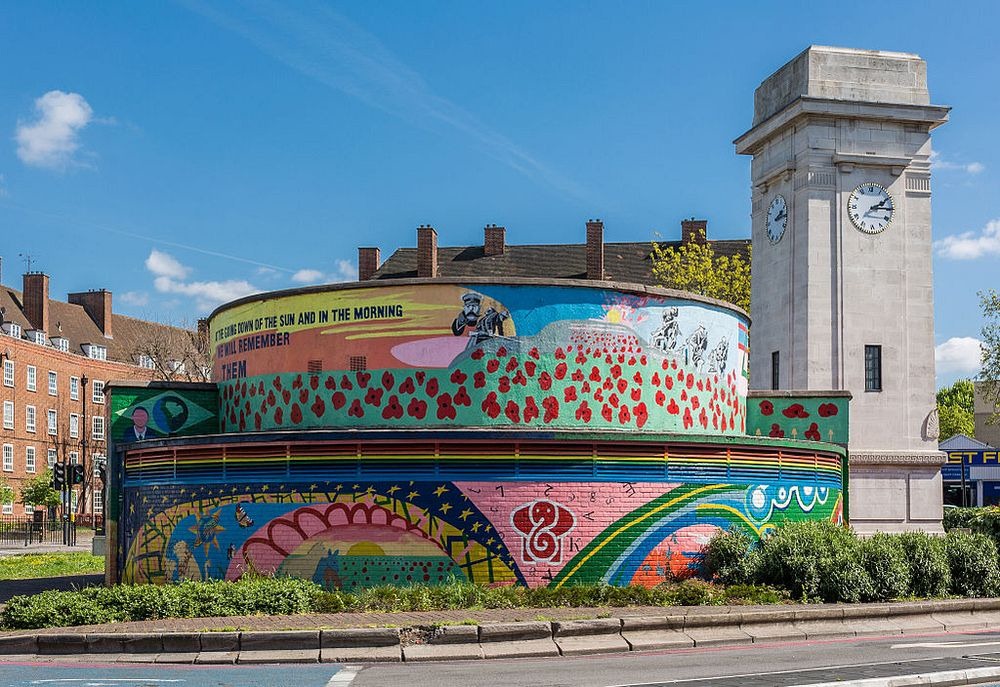
deep-level-air-raid-shelters-london-11

The Stockwell deep level shelter entrance in London, now decorated as a war memorial. 


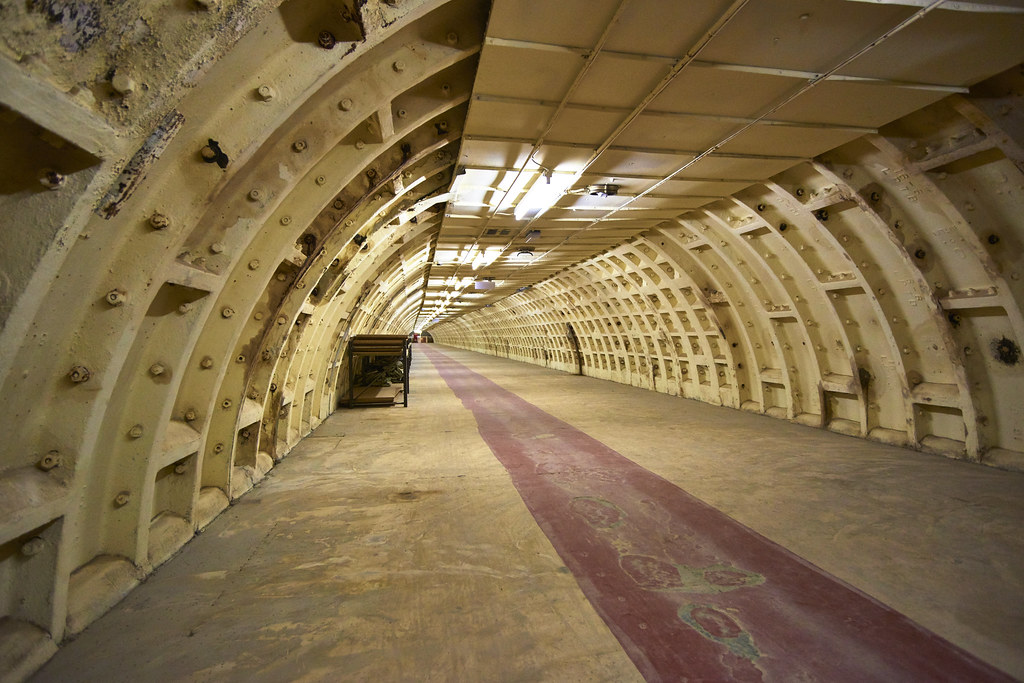
Work on the shelters began in November 1940. Each shelter consisted of a pair of parallel tunnels 16 feet 6 inches in diameter and 1,200 feet (370 m) long. Each tunnel was subdivided into two decks, fully equipped with bunks, medical posts, kitchens and sanitation. Above ground, each shelter’s shafts were protected by specially constructed ‘pill box’ buildings to prevent any bombs that directly hit the location from going underground. Each pill box housed lift machinery and provided the cover for spiral staircases down to the shelter’s tunnels.

Originally ten shelters were planned, but only eight got built —one each at Belsize Park, Camden Town, Goodge Street, Chancery Lane, Stockwell, Clapham North, Clapham Common, and Clapham South tube stations. The final capacity of each shelter was also reduced to 8,000 from the planned 10,000.

The shelters were ready by 1942, but when the time came to open them to the public, the government got surprisingly cold feet. The worst of the bombings were already over, they argued, and the cost of maintaining the shelters would be too high once opened. Despite mounting pressure from the public, the authorities decided that the shelters would not be opened until the bombing intensified.


Clapham South Deep-level shelter

The arrival of the flying bombs, the V1 and the V2, finally moved the government to open the shelters to the public. Five of the shelters were opened and the remaining three continued to be used for various government use such as holding troops. Access to the shelters was controlled by tickets, but the demand was not high. The highest recorded nightly population was 12,297 on July 24, 1944, about one third of total capacity. After the scare of the flying bombs were over, the shelters closed once again and people returned back to the tube stations.

The shelters were used for their original purpose for less than a year. After the war, some of the shelters became temporary accommodation for the army in transit or were used as storage facilities. The Clapham South shelter used to house post-war immigrants from the West Indies. In 1951, it became the Festival Hotel providing cheap stay for visitors to the Festival of Britain. The Clapham North shelter is now a hydroponic farm and the rest are owned by Transport for London, and are still used for archival storage. The Clapham South shelter is now open for pre-booked tours arranged by the London Transport Museum.


deep-level-air-raid-shelters-london-14

A busy night at Clapham South in July 1944, many of the original shelter signs are still in place today.


deep-level-air-raid-shelters-london-15

Wherever possible families were kept together in the shelter often utilizing the cross bunks where two pairs faced each other. Shelter residents are seen hear making up their bunks on the upper floor.


deep-level-air-raid-shelters-london-7

These stairs led to a tunnel connecting to Clapham South Tube station. It was built so that London Underground could connect the shelters and use them as part of an “express Northern Line” after the war. This never happened.


deep-level-air-raid-shelters-london-6


deep-level-air-raid-shelters-london-10

Control room of Clapham South deep level shelter.


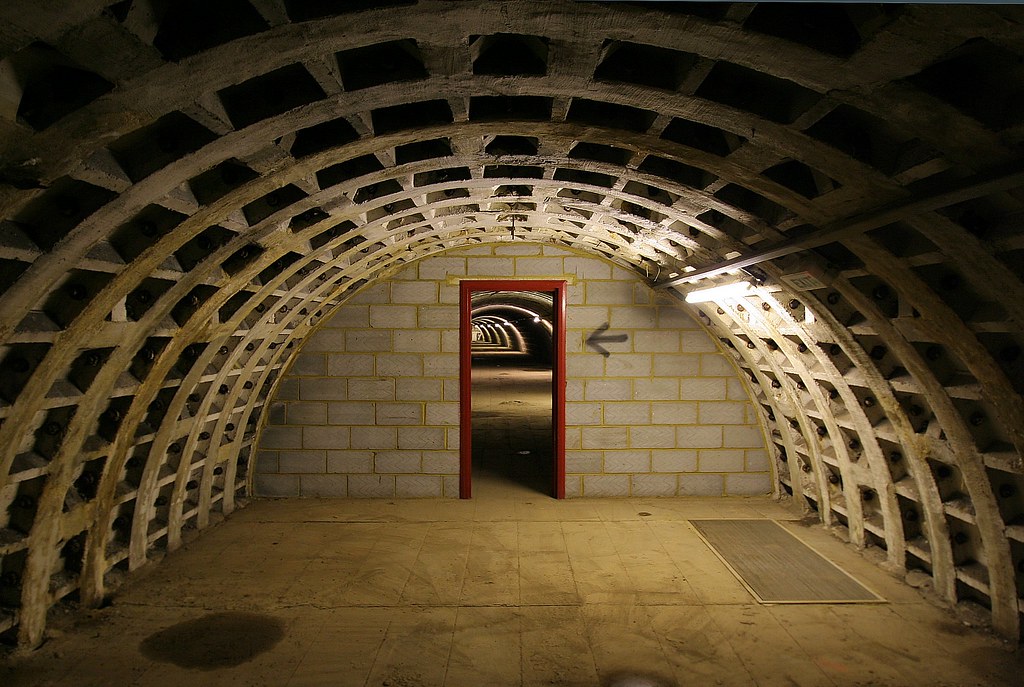
Breeze Blocks

deep-level-air-raid-shelters-london-1

Clapham Common deep level shelter now houses an underground farm.


deep-level-air-raid-shelters-london-3

Entrance to the  Clapham Common deep level shelter.

The Only Man to Be Buried on the Moon

Image for post
Eugene Shoemaker (Source: Atlas Obscura)

Humanity has seen only a handful of people that actually had the honor to step on earth’s natural satellite, but at present, there is only one person who is “buried” on an astronomical body orbiting Earth. The name of the soul that now rests on the Moon is Eugene Shoemaker, an astrogeologist who had worked with NASA since the 1960s and became famous when a comet that crashed on Jupiter in 1994 received his name (Shoemaker-Levy Comet).

The reason this comet became so famous is that this was the first time in human history that we had the chance to witness a planetary collision. This event was mainly reported by Eugene Shoemaker and David Levy, hence the two monikers within the comet’s name.

A long-lived passion

As an astrogeologist, he had always been fascinated by space and the idea of humans colonizing the earth’s natural satellite. Eugene was also schooled in the world of geology and this is where he used both of high interests to research the Moon and prepare astronauts for the type of soil/rock they would land on. As much as he loved the idea of traveling to the Moon he always knew that he may not be able to make it as he was the brain and not the muscle of NASA.

He was also very famous in the United States not only due to his intensive studies of craters around the state but also for founding the Program for archeological studies within the US in the 1960s. All of his knowledge was a very valuable element in the success of the Apollo missions and other NASA projects. In fact, the origins of what’s now known as Meteor Crater in Arizona had been uncertain before his Ph.D. dissertation settled the matter. This was the same crater that most astronauts that took part in the Apollo missions were trained in as it was quite similar to the terrain on the Moon.

The better the astronauts understood the terrain they were about to face the better they could get prepared for what was ahead. Getting to the Moon was only half of the mission. As mentioned before, Eugene’s long dream since he first approached astronomy was to go to the Moon to see our beautiful world from a different perspective. However, his focus was on his own work, he knew he was more valuable as an astronomist and geologist than as an astronaut.

Reaching his final destination

Sadly, his life was cut short due to a car accident that took place on the 18th of July 1997. However, this wasn’t going to be Eugene’s final journey. A close work colleague had the idea to actually send his corpse to the Moon as she knew this was his life-long dream. NASA thought that this was a very good idea to show their appreciation for his work over the years. His body was cremated as transporting his ashes would have been much easier than transporting his corpse.

Image for post

Eugene Shoemaker and his team also led geology field trips for astronauts-in-training in 1967. (Source: Science Source)

His ashes were loaded on the Lunar Prospector, a rocket which launched on the 6th of January 1998 with the goal of reaching the South pole of the Moon. Eugene Shoemaker’s ashes were inside a special polycarbonate capsule produced by a company called Celestis that was actually specializing in sending dead people to space but never onto the Moon. The outside of the capsule was marked with his name, his date of birth, and date of death as well as a picture of him training astronauts in a geology field trip (the same picture you can see above).

The Luna prospector reached the moon on the 31st of July 1999. On the same day, they launched the capsule containing Shoemaker’s ashes which crashed onto the moon, thus “burying” Eugene Shoemaker in the place he had always wanted to reach.

From: medium.com

The Maunsell Sea Forts

The Maunsell Sea Forts were small fortified towers built in the Thames and Mersey estuaries during the Second World War to help defend the United Kingdom. They were named after their designer, Guy Maunsell. The forts were decommissioned in the late 1950s and later used for other activities. One became the Principality of Sealand; boats visit the remaining forts occasionally, and a consortium called Project Redsands is planning to conserve the fort situated at Redsand.

Maunsell sea forts, built in the Thames estuary and operated by the Royal Navy, were to deter and report German air raids following the Thames as a landmark, and attempts to lay mines by aircraft in this important shipping channel.

There were four naval forts:

  • Rough Sands (HM Fort Roughs) (U1)
  • Sunk Head (U2)
  • Tongue Sands (U3)
  • Knock John (U4)


The design was a concrete construction; a pontoon barge on which stood two cylindrical towers on top of which was the gun platform mounting two 3.75-inch guns and two 40 mm Bofors guns. They were laid down in dry dock and assembled as complete units. They were then fitted out — the crews going on board at the same time for familiarisation — before being towed out and sunk onto their sand bank positions in 1942.

The naval fort design was the latest of several that Maunsell had devised in response to Admiralty inquiries. Early ideas had considered forts in the English Channel able to take on enemy vessels.

Knock John sea fort

Amazing historical photos

(COLORIZED) Lt. Custer and Union Troops (1862)

hist


Bombs dropped on Kobe, Japan (1945)


hist1


Hitler looking at the Gustav Railway gun (1942)


hist3


JFK and LBJ during the Cuban Missile Crisis (1962)


hist4


Joseph and Magda Goebbels on their wedding day. Best man- Adolf Hitler (1931)


hist5


Ruby Bridges, first African-American to attend a white elementary school in the South (Nov. 14th, 1960)


hist8


San Francisco (1958)


hist9


The dog of General George S. Patton on the day of his death (1945)


hist11


The SAS storming the Iranian Embassy to free hostages taken by terrorists. London. 1980
 

hist12


Thich Quang Duc Vietnam (1963) Buddhist anti-government protest


hist13


Three Archers, Japan (ca. 1870-1880)


hist14


Last photo taken of the Titanic (1912)


hist15


Hitler was ‘exorcised’ by Pope Pius XII, new book reveals

ITALIAN journalist Fabio Marchese Ragona has a new book out that reveals that Eugenio Pacelli who became Pope Pius XII – regarded by many as an anti-Semitic Nazi sympathizer – actually performed exorcisms ‘from a distance’ on Adolf Hitler.