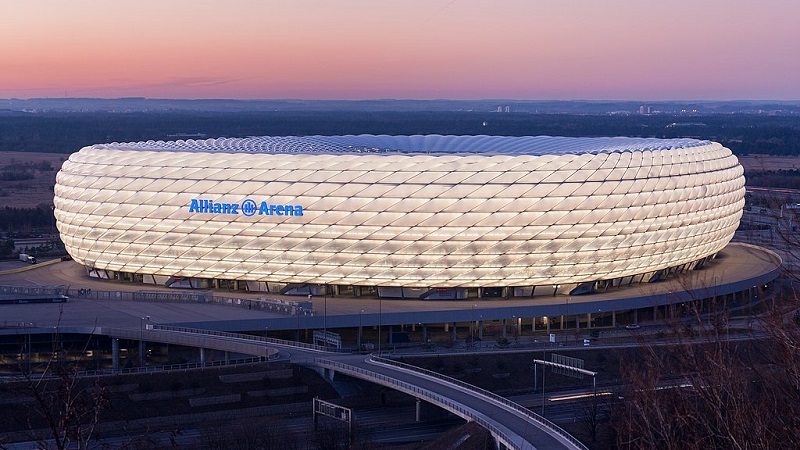
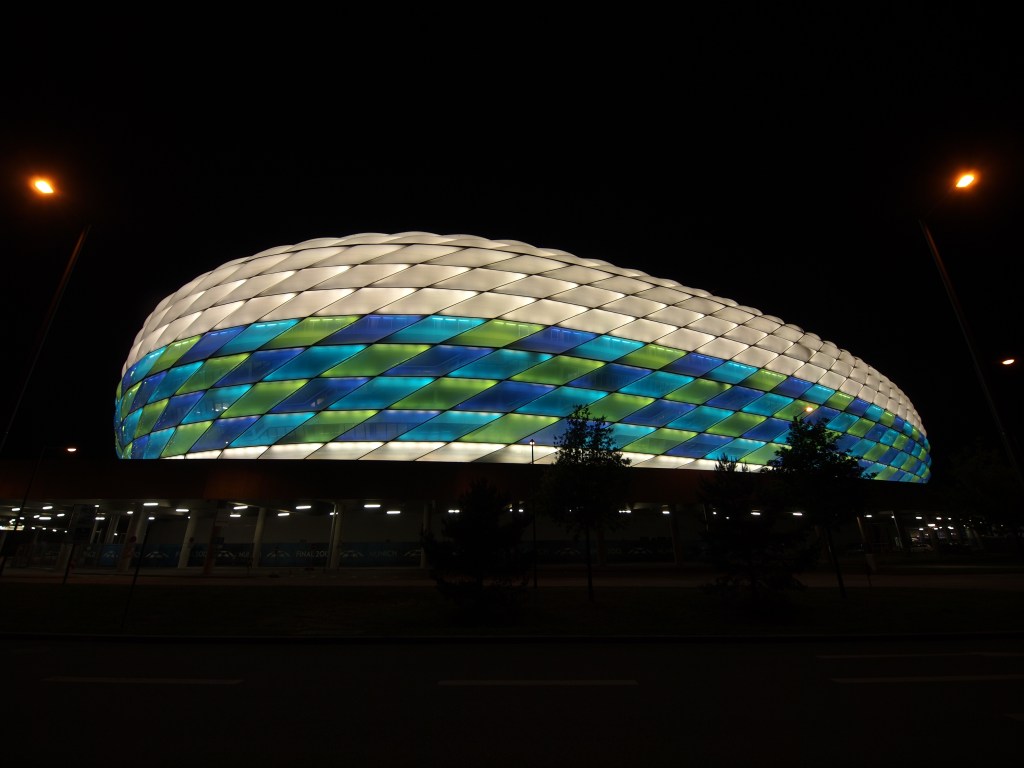
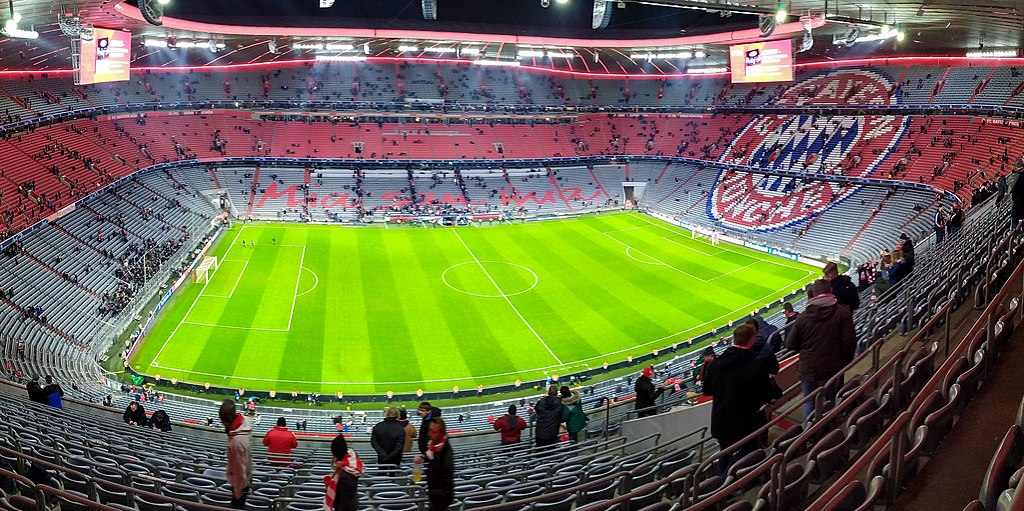
Allianz Arena is a football stadium in Munich, Bavaria, Germany with a 70,000 seating capacity for international matches and 75,000 for domestic matches. Widely known for its exterior of inflated ETFE plastic panels, it is the first stadium in the world with a full colour changing exterior. Located at 25 Werner-Heisenberg-Allee at the northern edge of Munich’s Schwabing-Freimann borough on the Fröttmaning Heath, it is the second-largest arena in Germany behind Westfalenstadion in Dortmund.
A couple and their two teenage daughters decided to get away from it all. They were living in the Los Angeles area and got fed up with the fast pace, noise and crazy traffic. Husband and wife are both professionals in television and commute back to L.A. a few days a week. But their home is now located dab smack in the barren desert of Death Valley, California.
There are no neighbours for over 20 miles. The nearest town is 35 miles away. They are out there with the coyotes and eagles. Complete isolation. Strangely enough, it does look quite peaceful, yet invigorating. After all, they are out there with nature in its most pure state.
The house derives most of its power from solar panels. Water is provided from a natural spring nearby.
The desert sun keeps the house perpetually bright.
No swimming pool, but a little hot tub to cool off during the day, or warm up at night.
(UPI) — The new owners of an unusual shoe-shaped Pennsylvania house built in 1948 announced the facility is now available to rent for short-term accommodations.
Waylon and Naomi Brown purchased Hellam Township’s Haines Shoe House in July and they announced on Facebook the house is now available for short-term rentals on Vrbo.
The house was built in 1948 to promote Mahlon Haines’ chain of shoe stores and it has since gone through multiple owners and served as a honeymoon suite, an ice cream shop and a tourist attraction.
The house was renovated by the Browns. Its three bedrooms, which are all filled with shoe memorabilia, have been dubbed “Shoelace Space,” “Instep Suite” and “Ankle Abode.”
“We really tried to help preserve some of the original features, like the stained-glass windows, in order to make sure that it lives on for many more years for people to enjoy,” Naomi Brown told WGAL-TV.
Reservations, which are currently available through the end of the year, start at $269 per night.
To live in New York City, and especially Manhattan, is very expensive. And space is money. An average 600-700 square foot apartment in the city costs roughly $4,000 a month. Therefore to create affordable housing for people who don’t make $100,000 a year mayor Bloomberg is putting forth a plan to create micro-apartments.
(Reuters) – Could apartments in New York City get any smaller? Mayor Michael Bloomberg hopes so.
On Monday he announced a competition for architects to submit designs for apartments measuring just 275 to 300 square feet (25.5 to 28 square meters) to address the shortage of homes suitable and affordable for the city’s growing population of one- and two-person households.
“People from all over the world want to live in New York City, and we must develop a new, scalable housing model that is safe, affordable and innovative to meet their needs,” the mayor said in a statement announcing the “adAPT NYC” competition.
Bloomberg said the city plans to waive zoning requirements at a city-owned lot in the Kips Bay neighborhood of Manhattan to allow the construction of a building filled with the “micro-units.”
They will be about four times the size of a typical prison cell and about one-fortieth the size of the mayor’s Upper East Side townhouse.
Officials say there are about 1.8 million one- and two-person households in New York City, but only about a million studio and one-bedroom apartments – a sign, they say, that the city’s housing stock has not kept up with its changing demographics.
Young, single New Yorkers in particular can find it hard to find an affordable apartment as demand outstrips supply.
Floor plan of a micro-apartment
The mayor is calling for proposals over the next two months for a building containing about 80 micro-units, all of which must have kitchens and bathrooms.
Ideally, they should also have “substantial access to light and air to create a sense of openness,” according to the competition announcement.
The apartments, once built, will be sold or rented on the open market. The city will not be subsidizing the project. If successful, the pilot project could help usher in a loosening of the city’s zoning laws regarding minimum housing size.
Under New York City’s zoning regulations, the average apartment size in a new building must be at least 400 square feet (37 square meters), although there are exceptions to the rule.
The mayor said the project is part of his plan to create or preserve 165,000 affordable homes in the city by 2014.
Although the new apartments will be cozy in realtor-speak, they are unlikely to break any size records. One couple paid $150,000 for a 175-square-foot (16-square-meter) studio in Manhattan in 2009, according to the New York Post.
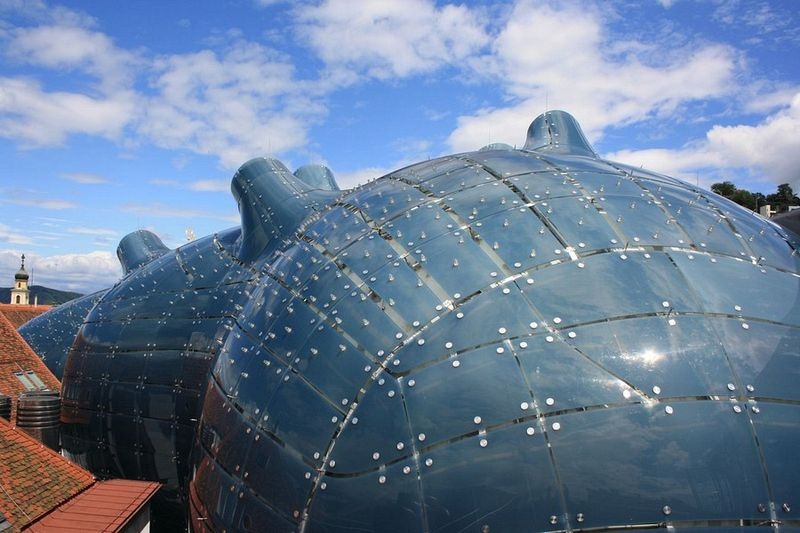
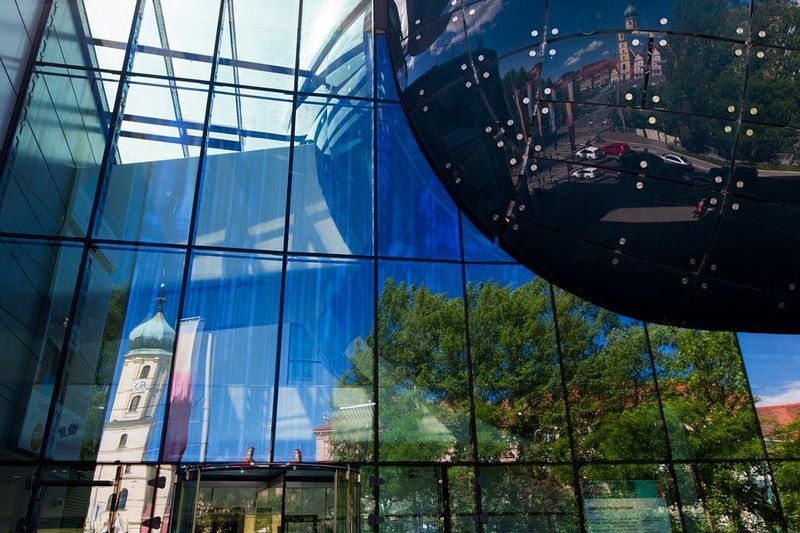
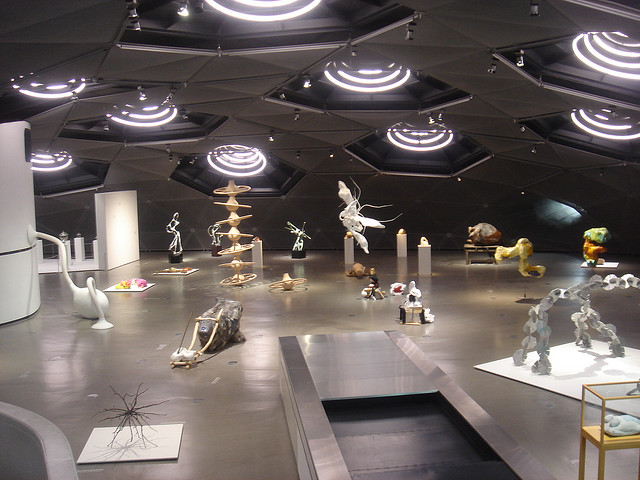
The Kunsthaus Graz Art Museum in Graz, Austria, is a gigantic blob-shaped building with a dozen or so tube like nozzles, acting as windows, that stick out from its curved roof, giving the structure an undeniable alien creature like look. Indeed, its designers, London architect Peter Cook and Colin Fournier, have themselves named the building the “Friendly Alien”. Inside the beast’s belly are two huge floors for modern art exhibitions.
Located on the west bank of the River Mur in the historic center, the Graz Art Museum was built as part of the European Capital of Culture celebrations in 2003, and has since become an architectural landmark in Graz.
The building’s roof is made from thousands of acrylic glass panels that generates energy with built-in photovoltaic panels. The outer skin is embedded with some nine-hundred fluorescent rings that can be individually programmed, creating a work of art on the structure itself.
Good God is this thing ugly!
It just doesn’t fit to the surrounding buildings and architecture.
The above photo appears to be of a European city, but no, it’s Pennsylvania, USA.
The Cathedral of Learning, a Pittsburgh landmark listed in the National Register of Historic Places, is the centerpiece of the University of Pittsburgh’s main campus in the Oakland neighborhood of Pittsburgh, Pennsylvania, United States. Standing at 535 feet (163 m), the 42-story Late Gothic Revival Cathedral is the tallest educational building in the Western hemisphere and the second tallest university building (fourth tallest educationally-purposed building) in the world. It is also the second tallest gothic-styled building in the world. The Cathedral of Learning was commissioned in 1921 and ground was broken in 1926. The first class was held in the building in 1931 and its exterior finished in October 1934, prior to its formal dedication in June 1937.
Colloquially referred to as “Cathy” by Pitt students, the Cathedral of Learning is a steel frame structure overlaid with Indiana limestone and contains more than 2,000 rooms and windows. It functions as a primary classroom and administrative center of the university, and is home to the Dietrich School of Arts and Sciences and many of its departments, as well as the University Honors College. It served as home of the university’s College of General Studies until its relocation to Posvar Hall in 2014. It houses many specialty spaces, including a studio theater, food court, study lounges, offices, computer and language labs, 30 Nationality Rooms, and a 1⁄2-acre (2,000 m2), 4-story-high, vaulted, gothic study and event hall. The building contains noted examples of stained glass, stone, wood, and iron work and is often used by the university in photographs, postcards, and other advertisements.
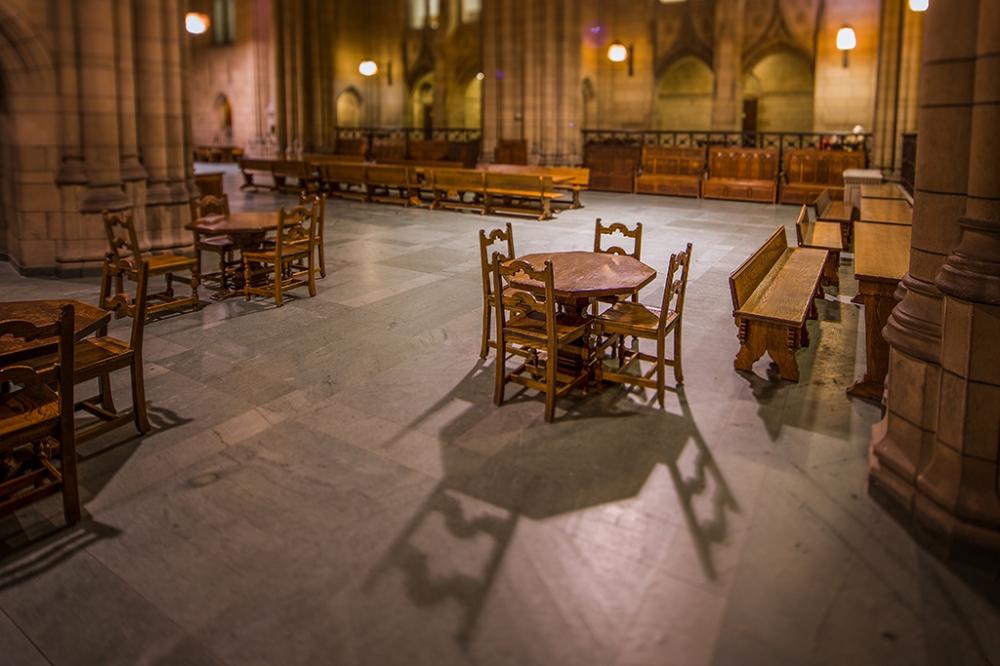
Commons room on the main floor
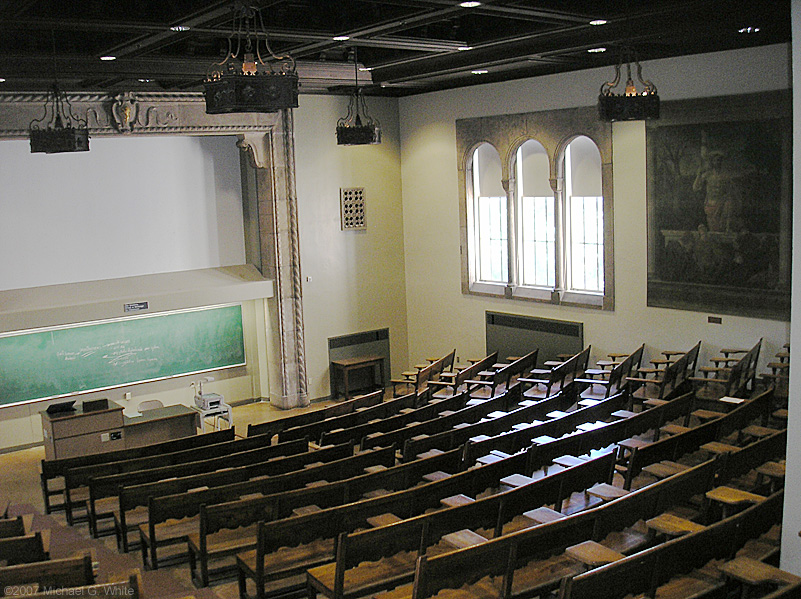
The basement and floors up to (and including) floor 40 are used for educational purposes, although most floors above 36 house the building’s mechanical equipment. These floors include theaters, computer laboratories, language laboratories, classrooms, and departmental offices. The basement contains a black box theater and the ground floor contains computer labs, language labs, classrooms, and the Cathedral Café food court. The “lobby”, comprising the first through third floors, contains a massive gothic “Commons Room” that is used as a general study area and for special events and is ringed by three floors of classrooms, including, on the first and third floors, the 30 Nationality Rooms designed by members of the Pittsburgh community in the styles of different nations and ethnic groups. Twenty-eight of these serve as functional classrooms while more conventional classrooms are located on the second floor and elsewhere throughout the building. The first floor also serves as the home to the offices of the Chancellor, Executive Vice Chancellor, and other administration offices, as well as the Nationality Rooms Gift Shop. The fourth floor, which used to be home to the main stacks of the university’s library, is now occupied by the McCarl Center for Nontraditional Student Success. The fifth floor originally housed the main borrowing, reference, and reading rooms of the university library, and now houses the Department of English. The Pitt Humanities Center is housed on the sixth floor. Additionally, the University Honors College is located on the 35th and 36th floors.
The Cathedral of Learning houses the Department of Philosophy, considered one of the top five in the United States, and the Department of History and Philosophy of Science, consistently ranked at the top of the field. Other departments in the Cathedral include English, Religious Studies, Statistics, Theatre Arts, and the School of Social Work which maintains the highest classrooms in the building located on the 23rd floor. Floors 37–40 are closed to the general public, as they contain electrical wiring for the building, as well as the Babcock Room, a large conference room on the 40th floor used for meetings, seminars, and special events and which provides a panoramic view of downtown Pittsburgh and the rest of the university. The 40th floor balcony also houses a nesting pair of Peregrine falcons. A view from the top is available via a webcam. Golden lights, dubbed “victory lights,” surround the outside of the highest floors and are lit following Pitt football wins and other notable victories, giving the upper part of the Cathedral an amber glow.



























 The MarkoZen Blog