
Trump 2024 flags being sewn in a Chinese factory… MERICA!!!

This happened in early 2019.
People are calling Trump’s McDonald’s and Wendy’s meal for the Clemson Tigers racist and classist.
When President Trump welcomed the Clemson Tigers, national college football champions, to the White House on January 14, he served them burgers, pizza, and fries from some of America’s most storied institutions: fast-food chains.
The resulting buffet, which included hamburgers, fries, salads, and fish sandwiches from McDonald’s, Burger King, and Wendy’s alongside Domino’s pizza, was a strange choice, particularly for an event held in the 140-seat State Dining Room, which traditionally hosts formal dinners for ambassadors and heads of state.

Though he told reporters that he had personally bought “300 hamburgers,” in a tweet the next morning that number had skyrocketed to “1000 hamberders [sic].” (Photos and videos of the scene show that the lower number is likely the more correct one.)
Great being with the National Champion Clemson Tigers last night at the White House. Because of the Shutdown I served them massive amounts of Fast Food (I paid), over 1000 hamberders etc. Within one hour, it was all gone. Great guys and big eaters!— Donald J. Trump (@realDonaldTrump) January 15, 2019
At least some of the guests, for their part, seem to have appreciated the dinner choice; Clemson quarterback Trevor Lawrence told TMZ that “It was awesome.” Trump himself has also long professed to be a fan of fast food, possibly out of a fear of being poisoned, so it’s likely that he enjoyed the meal just fine.
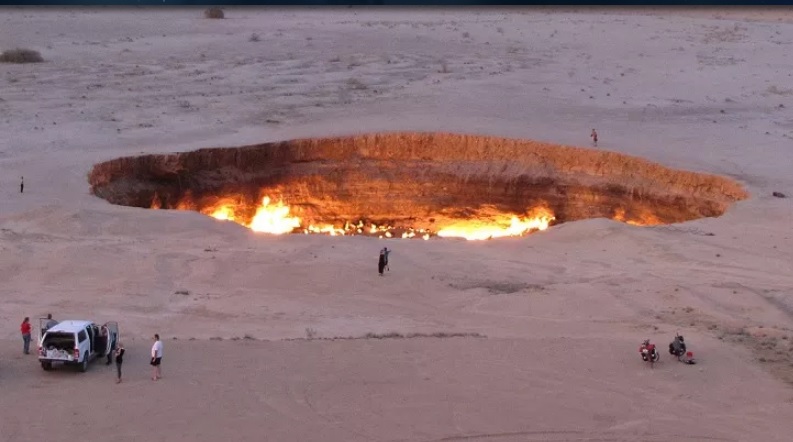
The president of Turkmenistan hopes to extinguish a massive fiery crater, dubbed the ‘Gates of Hell,’ which has been burning for decades and has become one of the country’s most popular tourist attractions. Gurbanguly Berdymukhamedov reportedly issued the decree this past Saturday, explaining that the inferno’s output “negatively affects both the environment and the health of the people living nearby.” He also argued that “we are losing valuable natural resources for which we could get significant profits and use them for improving the well being of our people.” As such, Berdymukhamedov told officials in the country to figure out a way to finally snuff out the fire.
The origins of the monstrous chasm and its iconic inferno are murky at best with legend stating that it was accidentally created in the 1970s by Russian miners hoping to extract natural gas from the area. That version of events is now doubted by researchers, who believe that the crater probably formed sometime in the 1960s. Although it has been burning continuously for several decades, how and when the fire started remains a mystery. Be that as it may, it has become a genuine landmark which draws visitors from all over the world to Turkmenistan.
Before one sheds a tear for the tourist attraction, the fate of the ‘Gates of Hell’ is far from certain as this is actually the second time that Berdymukhamedov has called for the fire to be extinguished. Back in 2010, he issued a similar order to experts in the country, but the effort clearly failed as the inferno continues to burn to this day. With that in mind, there is a strong possibility that the authoritarian leader’s wishes will once again be thwarted by the mysterious fiery chasm.
Previous post:
The “Gates of Hell”

The Darvaza gas crater, known locally as the “Door to Hell” or ”Gates of Hell”, is a natural gas field in Derweze, Turkmenistan, that collapsed into an underground cavern, becoming a natural gas crater. Geologists set it on fire to prevent the spread of methane gas, and it has been burning continuously since 1971. The diameter of the crater is 69 metres (226 ft), and its depth is 30 metres (98 ft).
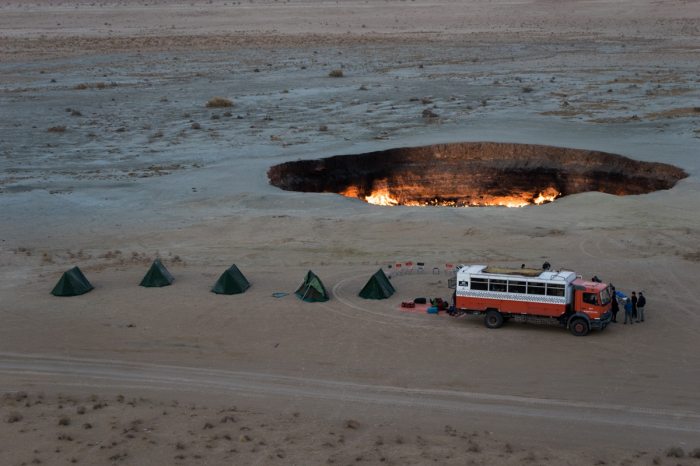
The crater is a popular tourist attraction. Since 2009, 50,000 tourists have visited the site. The gas crater has a total area of 5,350 m2. The surrounding area is also popular for wild desert camping.
The gas crater is located near the village of Derweze, also known as Darzava. It is in the middle of the Karakum Desert, about 260 kilometres (160 mi) north of Ashgabat, the capital of Turkmenistan. The gas reserve found here is one of the largest in the world. The name “Door to Hell” was given to the field by the locals, referring to the fire, boiling mud, and orange flames in the large crater, which has a diameter of 70 metres (230 ft). The hot spots range over an area with a width of 60 metres (200 ft) and to a depth of about 20 metres (66 ft).
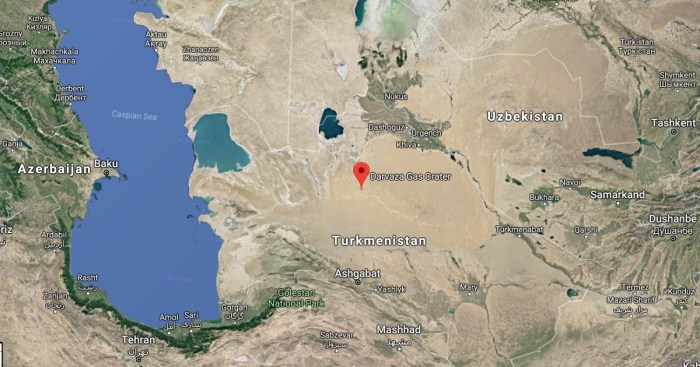
According to Turkmen geologist Anatoly Bushmakin, the site was identified by Soviet engineers in 1971. It was originally thought to be a substantial oil field site. The engineers set up a drilling rig and operations to assess the quantity of oil available at the site. Soon after the preliminary survey found a natural gas pocket, the ground beneath the drilling rig and camp collapsed into a wide crater and was buried.
Expecting dangerous releases of poisonous gases from the cavern into nearby towns, the engineers thought it best to burn the gas off. It was estimated that the gas would burn out within a few weeks, but it has instead continued to burn for more than four decades.

In April 2010, the president of Turkmenistan, Gurbanguly Berdimuhamedow, visited the site and ordered that the hole should be closed. In 2013, he declared the part of the Karakum Desert with the crater a nature reserve.
The crater was featured in a Die Trying episode titled “Crater of Fire”. Explorer George Kourounis became the first person to ever set foot at the bottom, gathering samples of extremophile microorganisms. The episode was broadcast on the National Geographic Channel on July 16, 2014.
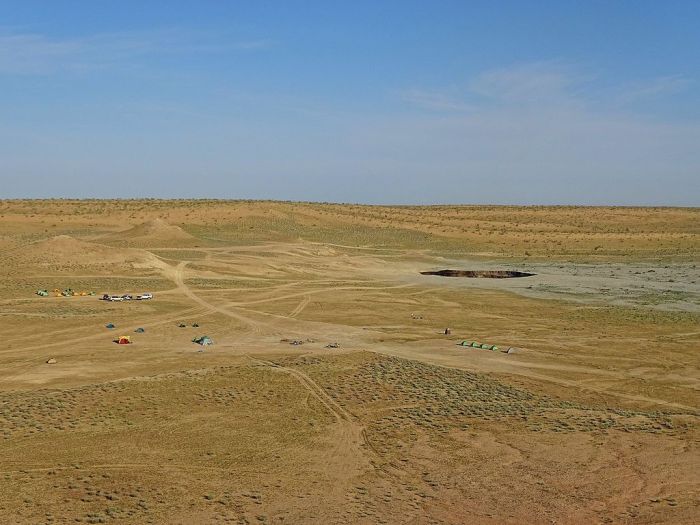
Camping on the edge of the “Gates of Hell”
Some animals can be trained to do the most absurd things. While other animals are totally submissive to their powerful instincts. The dog in this video is doing something that a dog just shouldn’t be doing.


Laurence Fishburne as “Cowboy Curtis.”
Talk about getting passed around.
Yang Kyoungjong (c. 1920 – April 7, 1992) was a Korean soldier who fought during World War II in the Imperial Japanese Army, the Soviet Red Army, and later the German Wehrmacht.
In 1938, at the age of 18, Yang was in Manchuria when he was conscripted into the Kwantung Army of the Imperial Japanese Army to fight against the Soviet Union. At the time Korea was ruled by Japan. During the Battles of Khalkhin Gol, he was captured by the Soviet Red Army and sent to a labour camp. Because of the manpower shortages faced by the Soviets in its fight against Nazi Germany, in 1942 he was pressed into fighting in the Red Army along with thousands of other prisoners, and was sent to the European eastern front.
In 1943, he was captured by Wehrmacht soldiers in Ukraine during the Third Battle of Kharkov, and was then pressed into fighting for Germany. Yang was sent to Occupied France to fight in a battalion of Soviet prisoners of war known as the “Eastern Battalion”, serving in a battalion located on the Cotentin peninsula in Normandy, located close to Utah Beach. After the D-Day landings in northern France by the Allied forces, Yang was captured by paratroopers of the United States Army in June 1944. The Americans initially believed him to be Japanese in German uniform, and he was placed in a prisoner-of-war camp in the United Kingdom. At the time, Lieutenant Robert Brewer of the 506th Parachute Infantry Regiment, 101st Airborne Division, reported that his regiment captured four Asians in German uniform after the Utah Beach landings, and that initially no one was able to communicate with them. Yang later emigrated from Russia to the United States, where he lived until he died in Illinois in 1992.

Yang Kyongjong (left) in Wehrmacht attire following capture by American paratroopers in June 1944 after D-Day__
| Died | April 7, 1992 Illinois, United States |
|---|---|
| Allegiance |  Empire of Japan Empire of Japan  Soviet Union Soviet Union  Nazi Germany Nazi Germany |
| Years of service | Imperial Japanese Army: 1938–1939 Soviet Red Army: 1942–1943 Wehrmacht: 1943–1944 |
| Battles/wars | Battles of Khalkhin Gol Battle of Kharkov D-Day |
Following a storm that swept over the region, a city in southern Egypt found itself under siege from a swarm of scorpions that scurried into the community and stung more than 500 people. The unsettling incident reportedly began on Friday evening when torrential rains pounded the area around the city of Aswan, resulting in widespread flooding. As residents struggled to deal with the fallout from the inclement weather, they were soon faced with a more troubling problem as the storm caused the region’s scorpion population to flee their underground burrows and take shelter inside people’s homes.
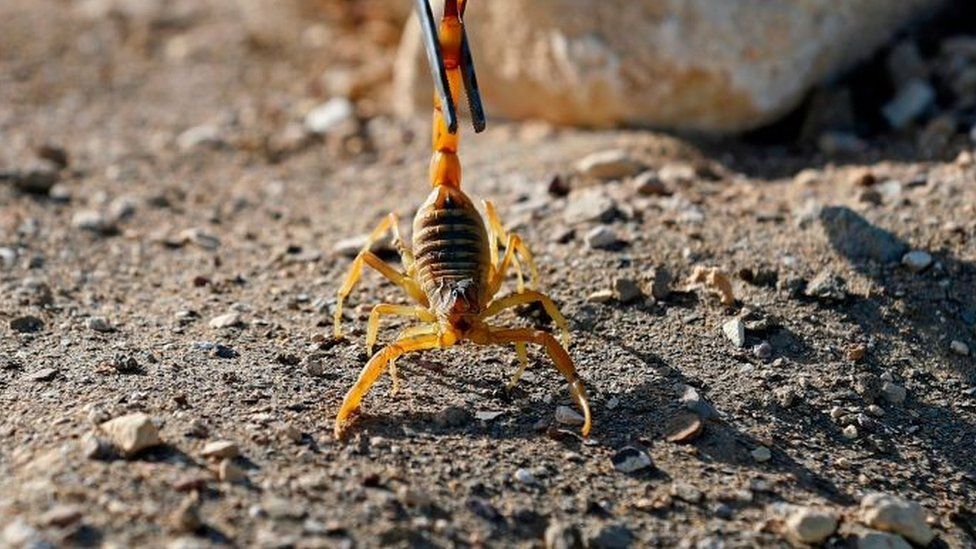 IMAGE SOURCE,AFP VIA GETTY IMAGES Image caption,Scorpions are regularly washed into Egypt’s streets by heavy rain and take refuge in houses (file photo)
On Friday night alone, a staggering 503 individuals were stung by the creepy creatures, causing the country’s Ministry of Health to issue a warning to residents about the situation. Dozens of different scorpion species reside in Egypt, including two particularly troubling types: the fat-tailed scorpion, which boasts venom that can kill a person within an hour, and the nightmarishly named ‘deathstalker,’ which possesses a less-lethal sting, but one that can also kill children and badly sicken adults.
Fortunately, the region is familiar with the dangers that come from the deadly creatures that have called the area home for hundreds of years and, as such, ample supplies of antivenom were rushed to hospitals in order to treat the massive wave of afflicted people. Meanwhile, some enterprising individuals have found a silver, albeit very dangerous, lining to the influx of scorpions as people have now begun wrangling the deadly animals, since their venom is highly valuable to scientists and medical professionals.
NY Times









 The MarkoZen Blog