Very Strange Looking Aircraft

Men and their flying machines.  Giant ones, tiny ones, some with forward-swept wings, all kinds of strange aircraft have been invented.  Here are some of the strangest looking ones I have found.


This opposite of beauty flew only once in 1947 and was designed to carry over  700 people. It was actually a wooden heavy transport aircraft designed and built  by the Hughes Aircraft company. It was built by the U.S. War Department because  of wartime raw material restrictions on the use of aluminum. Its official name  is Hughes H-4 Hercules but Spruce Goose somehow stuck. This heavy transport  flying boat is the largest flying boat ever built, and has the largest wingspan  of any aircraft in history with span exceeding the length of a football field.  It is currently housed in Evergreen Aviation Museum in McMinnville, Oregon, USA.


This overeating plane, officially, the Boeing 747 Large Cargo Freighter, is a  wide-body cargo aircraft and the world’s longest cargo loader constructed by  drastic modifications to an existing Boeing 747-400. Boeing uses this plane to  bring in aircraft parts from suppliers around the world. Only 4 of the type have been built.


Pregnant Guppy

As weird as its name, this plane was a large, wide-bodied cargo aircraft built  in the United States by Aero Spacelines and used for ferrying outsized cargo  items, most notably NASA’s components of the Apollo moon program. Infact, the  Dreamlifter was inspired from this beauty. Only 1 unit if this aircraft was ever  built and it served a good 15 years, starting in 1962.


Northrop Tacit Blue

Before you start laughing, do understand that this aircraft was a pioneer in  stealth technology. There was only one produced, by the U.S. Air Force, in 1982,  which was meant to demonstrate that a stealth low observable surveillance  aircraft with a low probability of intercept radar and other sensors could  operate close to the forward line of battle with a high degree of survivability.  The pioneer plane is currently housed at the National Museum of the US Air  Force.


Horten HO 229

Designed by Horten brothers of Germany this plane was a late-World War II  prototypefighter/bomber. Its odd shape can be attributed to the fact that it was  designed to be more difficult to detect with radar. Horten Ho 229 never made it  to actual war and was only flown as a prototype.


Officially, the Vought V-173 was designed by Charles H. Zimmerman. It was an American experimental test aircraft built as part of the Vought XF5U “Flying  Flapjack” World War II United States Navy fighter aircraft program and without doubt it is one of the most strangest planes ever built.
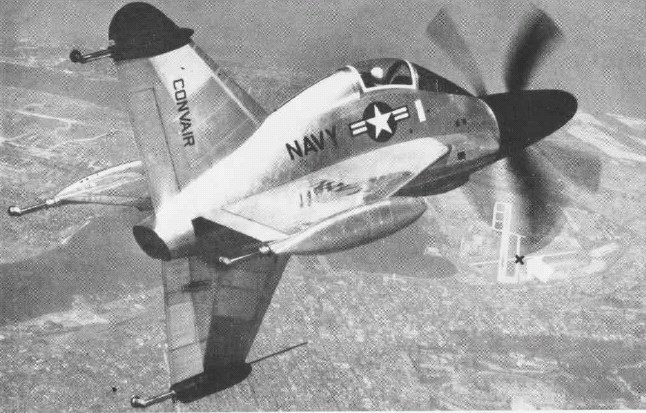


The Convair XFY Pogo tailsitter was an experiment in vertical takeoff and landing. The Pogo had delta wings and three-bladed contra-rotating propellers powered by a 5,500 hp (4,100 kW) Allison YT40-A-16 turboprop engine. It was intended to be a high-performance fighter aircraft capable of operating from small warships. Landing the XFY-1 was difficult as the pilot had to look over his shoulder while carefully working the throttle to land.


The Grumman X-29 was an experimental aircraft that tested a forward-swept wing, canard control surfaces, and other novel aircraft technologies. The aerodynamic instability of this arrangement increased agility but required the use of computerized fly-by-wire control. Composite materials were used to control the aeroelastic divergent twisting experienced by forward-swept wings, also reducing the weight. Developed by Grumman, the X-29 first flew in 1984 and two X-29s were flight tested over the next decade.


The Russians had their version as they always do.

The Sukhoi Su-47 Berkut (Russian: Су-47 Беркут – Golden Eagle) (NATO reporting name Firkin), also designated S-32 and S-37 (not to be confused with the single-engined delta canard design offered by Sukhoi in the early 1990s under the designation Su-37) during initial development, was an experimental supersonic jet fighter developed by Sukhoi Aviation Corporation. A distinguishing feature of the aircraft was its forward-swept wing, similar to that of the Tsybin’s LL-3., that gave the aircraft excellent agility and maneuverability. While serial production of the type never materialized, the sole aircraft produced served as a technology demonstrator prototype for a number of advanced techhnologies later used in the 4.5 generation fighter SU-35BM and current Indo-Russian 5th generation fighter prototype Sukhoi PAK FA.


The Hawker Siddeley Nimrod was a military aircraft developed and built in the United Kingdom. It is an extensive modification of the de Havilland Comet, the world’s first jet airliner. It was originally designed by de Havilland’s successor, Hawker Siddeley, now part of BAE Systems.

It was designed with an extended nose for radar, a new tail with electronic warfare (ESM) sensors mounted in a bulky fairing, and a MAD (Magnetic anomaly detector) boom. After the first flight in May 1967, the RAF ordered 46 Nimrod MR1s. The first example (XV230) entered service in October 1969.  Five squadrons were eventually equipped with the MR1.


Aircraft with huge rotating radar domes.

The Grumman E-2 Hawkeye is an American all-weather, aircraft carrier-capable tactical airborne early warning (AEW) aircraft. This twin-turboprop aircraft was designed and developed during the late 1950s and early 1960s by the Grumman Aircraft Company for the United States Navy as a replacement for the earlier E-1 Tracer, which was rapidly becoming obsolete. E-2 performance has been upgraded with the E-2B, and E-2C versions, where most of the changes were made to the radar and radio communications due to advances in electronic integrated circuits and other electronics. The fourth version of the Hawkeye is the E-2D, which first flew in 2007.


XF-107A Experimental Fighter Bomber

The air intake was in the unusual dorsal location as the USAF had required the carriage of an underbelly semi-conformal nuclear weapon. The original chin intake caused a shock wave that interfered in launching this weapon. The implications this had for the survivability of the pilot during ejection were troubling. The intake also severely limited rear visibility. Nonetheless this was not considered terribly important for a tactical fighter-bomber aircraft, and furthermore it was assumed at the time that air combat would be via guided missile exchanges outside visual range.

Duck-Billed Russian Fighter Aircraft

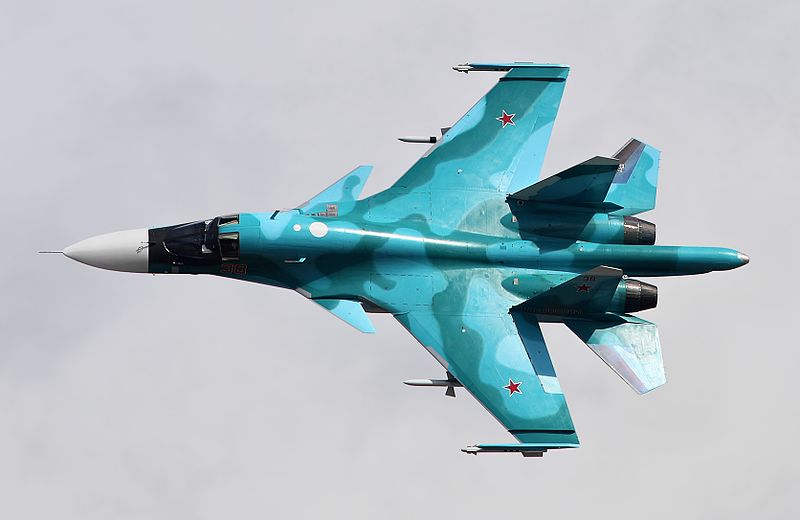
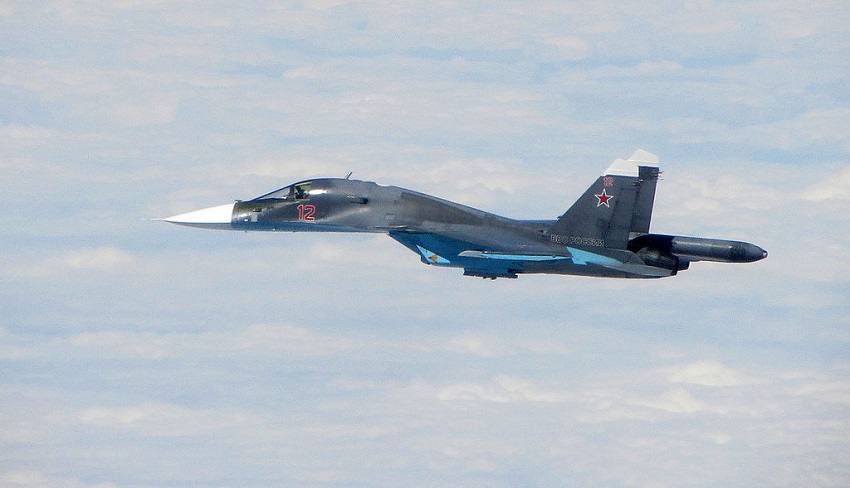
The Sukhoi Su-34 (Russian: Сухой Су-34) (export designation: Su-32, NATO reporting name: Fullback) is a Russian twin-seat fighter-bomber. It is intended to replace the Sukhoi Su-24. The jet has a different look to it as it has a duck-billed nose.


duck


Role Fighter-bomber
Manufacturer Sukhoi
First flight 13 April 1990
Introduction 2012 (plan)
Status In production
Primary user Russian Air Force
Produced 2006–present
Number built 136 of plus 7 prototypes
Unit cost US$36 million
Developed from Sukhoi Su-27


duck1


General characteristics

  • Crew: 2
  • Length: 23.34 m (72 ft 2 in)
  • Wingspan: 14.7 m (48 ft 3 in)
  • Height: 6.09 m (19 ft 5 in)
  • Loaded weight: 39,000 kg (85,980 lb)
  • Useful load: 8,000 kg (17,600 lb)
  • Max. takeoff weight: 45,100 kg (99,425 lb)
  • Powerplant: 2 × Lyulka AL-31F1 turbofans, 13,500 kgf (132 kN, 29,762 lbf) with afterburner each

Performance

  • Maximum speed:
    • High altitude: Mach 1.8 (2,200 km/h, 1,375 mph)
    • Low altitude: Mach 1.2 (1,400 km/h, 870 mph) at sea level
  • Range: 1,100 km (680 mi) at low level altitude
  • Ferry range: 4,000 km (2,490 mi)
  • Service ceiling: 15,000 m (49,200 ft)
  • Wing loading: 629 kg/m² (129 lb/ft²)
  • Thrust/weight: 0.68


This jet has really nice sleek lines.


The Colorful Jets of the Japan Air Self-Defense Force

The Japan Air Self-Defense Force (航空自衛隊, Kōkū Jieitai), or JASDF, is the aviation branch of the Japan Self-Defense Forces responsible for the defense of Japanese airspace and other aerospace operations.  The JASDF carries out combat air patrols around Japan, while also maintaining an extensive network of ground and air early warning radar systems. The branch also has an aerobatic team known as Blue Impulse and has recently been involved in providing air transport in several UN peacekeeping missions.

The JASDF had an estimated 45,000 personnel in 2005, and as of 2013 operates 791 aircraft.  Of those 791 aircraft in service approximately 350 are fighter aircraft.

Most of the aircraft below are Aggressor Jets.  Aggressors are used as training opposition aircraft and thus painted in the colour schemes of potential enemy air forces.  The Jets are painted in Russian, North Korean and mainland Chinese schemes. The bottom three images are JASDF paint schemes.


J-1, Japanese variant of the American F-16 Falcon


japs


F-15 Eagle Aggressors


japs01


japs2


japs6


japs7


japs8


japs10


Some engineers have too much time on their hands

The Goodyear Inflatoplane was an experimental aircraft made by the Goodyear Aircraft Company, a subsidiary of Goodyear Tire and Rubber Company, well known for the Goodyear blimp. Although it seemed an improbable project, the finished aircraft proved to be capable of meeting its design objectives although its sponsor, the United States Army, ultimately cancelled the project when it could not find a “valid military use for an aircraft that could be brought down by a well-aimed bow and arrow.”

The original concept of an all-fabric inflatable aircraft was based on Taylor McDaniel inflatable rubber glider experiments in 1931. Designed and built in only 12 weeks, the Goodyear Inflatoplane was built in 1956, with the idea that it could be used by the military as a rescue plane to be dropped in a hardened container behind enemy lines. The 44 cubic ft (1.25 cubic meter) container could also be transported by truck, jeep trailer or aircraft.  The inflatable surface of this aircraft was actually a sandwich of two rubber-type materials connected by a mesh of nylon threads, forming an I-beam. When the nylon was exposed to air, it absorbed and repelled water as it stiffened, giving the aircraft its shape and rigidity. Structural integrity was retained in flight with forced air being continually circulated by the aircraft’s motor.

Monster of the Caspian Sea – A Once Glorious Soviet Aircraft Rusting Away on a Beach

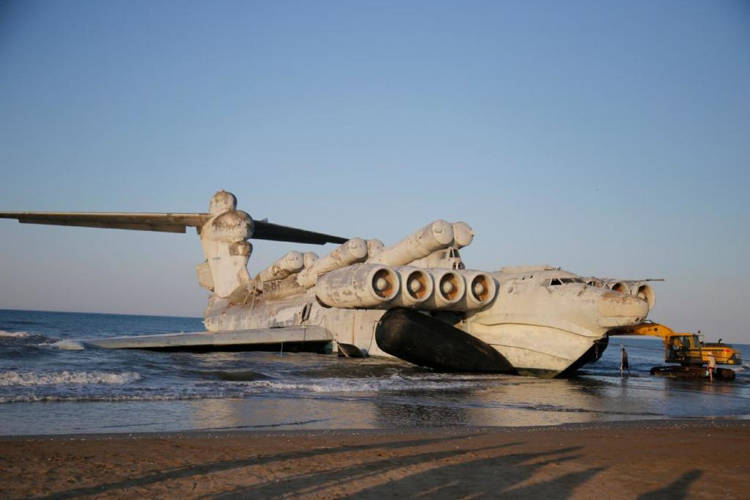
Developed during the 1980’s in Soviet Russia, the futuristic looking MD-160 Lun-class ekranoplan had been sitting unused at a Russian naval base since the late 1990’s, but has now been beached on the shores of the Caspian Sea, as part of a plan to turn it into an ocean-side tourist attraction.

Known as the Caspian Sea Monster, the giant ekranoplan was designed in 1975 by Rostislav Evgenievich Alexeyev, a prominent developer of of hydrofoil ships and ground effect vehicles. It used a cushion of air beneath its giant wings to hover at about 13 feet above water, making it hard to detect. It was built as part of the Soviet WIG program, which dated back to the 1960’s Cold War, and was the only Lun-class ekranoplan to ever be completed and equipped with supersonic missiles.


The experimental aircraft got its nickname from the CIA. When spy satellite photos revealed this giant airplane with “KM” stamped on the wings, they named it Kaspian Monster, not knowing that the letters actually stood for Korabl-Maket (Prototype Ship).

The MD-160 ekranoplan was retired in the late 1990’s and had been sitting abandoned in a Russian naval base ever since. On July 31, the vehicle was taken under tow for a move to Derbent, Dagestan, with plans to turn into a tourist attraction as part of a park. When it arrived, authorities realized that there was nowhere to put the giant aircraft, which dwarfs a 747 jet.

The one-of-a-kind ekranoplan has been beached on the shore of the Caspian Sea since August, despite several attempts by locals to pull it to dry land by hand.

It appears that the Caspian Sea Monster has once again been abandoned, at least for the moment, and there is the sad possibility that it will be pummeled to pieces by the waves. A tragic ending for one of the most visually-impressive aircrafts ever built.

General characteristics

  • Crew: 5
  • Capacity: 50 people
  • Length: 92.00 m (301 ft 10 in)
  • Wingspan: 37.60 m (123 ft 4 in) * Tail stabilizer span: 37 m (121 ft 5 in)
  • Height: 21.80 m (71 ft 6 in)
  • Wing area: 662.50 m2 (7,131.1 sq ft)
  • Empty weight: 240,000 kg (529,109 lb)
  • Max takeoff weight: 544,000 kg (1,199,315 lb)
  • Powerplant: 10 × Dobrynin VD-7 turbojet, 127.53 kN (28,670 lbf) thrust each

Performance

  • Maximum speed: 500 km/h (310 mph, 270 kn)
  • Cruise speed: 430 km/h (270 mph, 230 kn)
  • Range: 1,500 km (930 mi, 810 nmi)
  • Ground effect altitude: 4–14 m (13 ft 1 in–45 ft 11 in)
  • Maximum sea state: 1.2 m (3 ft 11 in)

Is someone really flying around LAX in a jet pack? Trying to solve an aviation mystery

David Mayman flies up the Goodwood Hill displaying his JB11 JetPack .
David Mayman, founder of Chatsworth-based JetPack Aviation, suits up in his company’s JB11 JetPack in 2018 in England. (Michael Cole / Corbis via Getty Images)

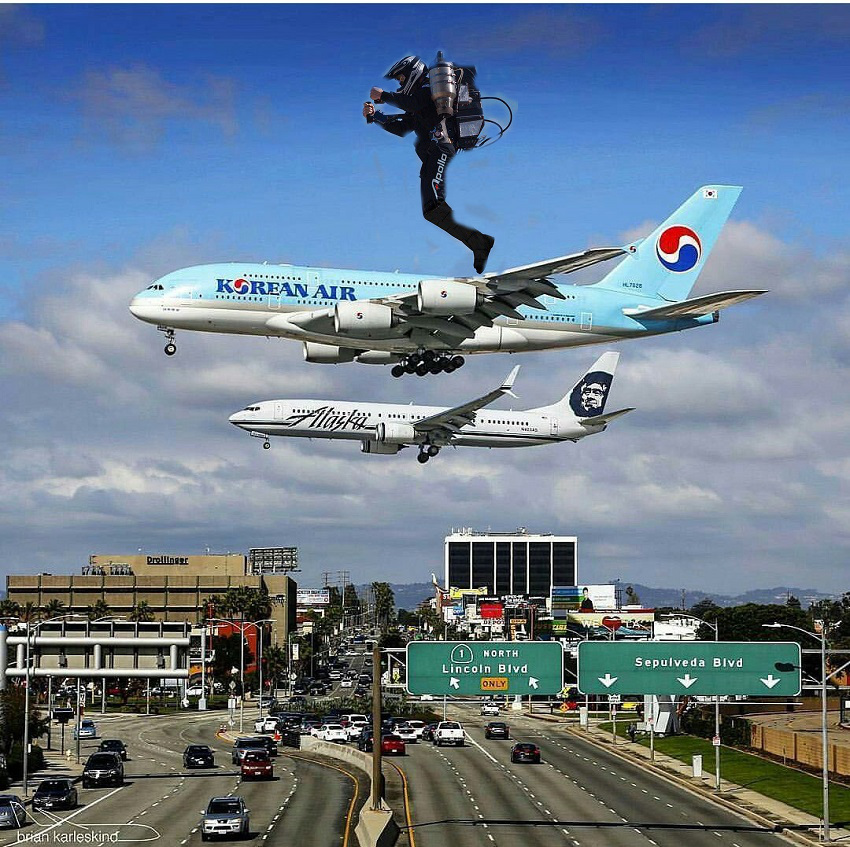
It was an otherwise quiet Sunday night at the Los Angeles International Airport control tower when an American Airlines pilot radioed in with an unbelievable report.

“Tower, American 1997. We just passed a guy in a jet pack,” the pilot said.

Minutes later came another report, this time from a pilot approaching LAX in a Jet Blue airliner: “We just saw the guy pass us by in the jet pack.”

So began one of the most intriguing aviation mysteries Los Angeles has confronted in years.

Those sightings occurred Aug. 30. The case took another twist Wednesday when a China Airlines pilot approaching LAX reported seeing a jet pack flying at an altitude of 6,000 feet. That’s more than a mile up.

The FBI is on the case, as is a good chunk of L.A.’s aviation community, which has been buzzing about the sightings.

Though jet packs make frequent appearances in popular culture and movies — think Sean Connery’s James Bond and Disney’s “The Rocketeer” — they are actually very rare.

There are only a handful of companies around the world that make jet packs, including a winged device created by former Swiss air force pilot Yves Rossy, which requires him to be hoisted in the air by a helicopter or balloon before he can take off. There is also a type of hoverboard made by French firm Zapata and flown only by its inventor, Franky Zapata.

Locally, Chatsworth-based JetPack Aviation has created five jet packs that are worn like backpacks. But they’re not for sale, and Chief Executive David Mayman said none of his competitors’ products are sold to consumers, either.

It’s possible that Wednesday’s sighting near LAX was indeed a person flying with a jet pack. But the reported altitude makes such a flight seem “highly unlikely,” said Mike Hirschberg, executive director of the Vertical Flight Society, a nonprofit professional organization.

Mayman said his company’s jet packs are technically capable of soaring to heights of 15,000 feet. But because of fuel constraints, they can actually reach only about 1,000 or 1,500 feet off the ground safely.

“To fly up to 6,000 feet from the ground, to fly around long enough to be seen by China Airlines and then to descend again, you’d be out of fuel,” he said.

Mayman said he knows it wasn’t any of his company’s jet packs because he knows exactly where they are — plus, they are disabled when not in use, so grabbing a pack out of storage wouldn’t be possible.

Instead, he suggests a more likely scenario, an electric drone — perhaps with a mannequin attached.

Thomas Anthony, director of the USC Aviation Safety and Security Program and a former Federal Aviation Administration criminal investigator, said the strongest evidence that the LAX sightings is a person with a jet pack — as opposed to a balloon or drone — came from the American Airlines pilot, who reported seeing the object at 3,000 feet over Cudahy.

The pilot stated he saw “a guy in a jet pack” 300 yards to his left and flying at about the plane’s altitude.

“That is quite close,” Anthony said.

He said federal investigators would immediately look at the limited number of jet packs that exist in the U.S. and overseas.

“People in that community will know who has bought these packs,” he said. “If someone is doing this, they are going to have to take off and land somewhere, and there is going to be noise.”

Anthony said he doubts the culprit is using an airport to take off and that investigators should look to out-of-the-way industrial spots for clues. The FBI suggested the jet pack was flying in a section of Southeast Los Angeles County near Cudahy and Vernon that is dotted with commercial and manufacturing businesses.

The flying range of jet packs is pretty limited, Anthony added, so it’s unlikely it traveled any great distance.

After the China Airlines pilot’s report Wednesday, the LAX control tower called in a law enforcement aircraft to investigate.

The aircraft was flying about seven miles from where the pilot said he’d seen the jetpack, according to radio communications.

But when the craft arrived, no signs of the jet pack remained.

A jet pack could be operated as an ultralight — meaning it would not be registered and its operator wouldn’t need a pilot’s license if it meets fuel capacity, weight and speed requirements, according to the FAA. Ultralight aircraft are permitted to fly only during the day and are barred from flying over densely populated areas or in controlled aerospace without FAA approval.

Anthony and others say it’s imperative that the FBI investigate the sightings for safety.

“This does represent a very significant compromise of the airspace,” he said.

If a rogue pilot were flying at 6,000 feet without a transponder or radio, Anthony said, that would put him or her in the path of commercial airlines maneuvering over Los Angeles.

Airliners are designed to withstand getting hit by small objects. But a big metal object is another matter, especially if it were sucked into an engine.

“The engines aren’t designed to consume something large and metal, or something with fuel that’s going to burn or explode,” Hirschberg said. “That could be potentially catastrophic for an airplane. You could potentially have an engine explode and bring down the airliner and potentially hundreds of people could die.”

So is what has been reported near LAX really a jet pack?

Some experts say it’s possible.

In February, a pilot in Dubai reached an altitude of 5,900 feet flying a Jetman jet pack powered by four mini jet engines with carbon-fiber wings. The pack’s builders say it can reach speeds of nearly 250 mph. After a number of dip and roll maneuvers, the Dubai pilot descended to the ground using a parachute.

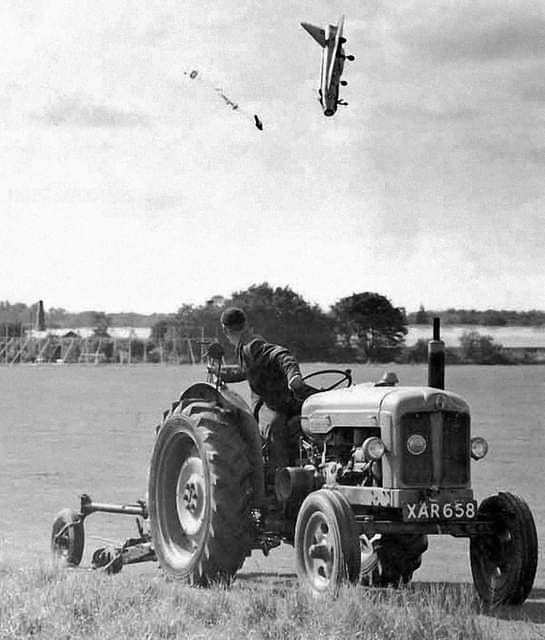
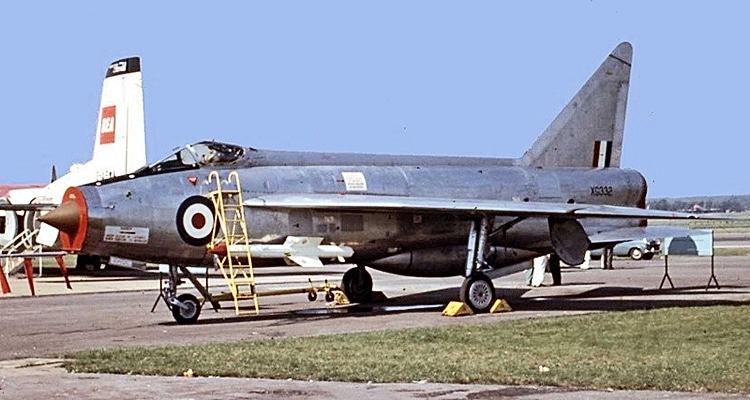
An English Electric Lightning jet crashing in an English field, September 1962. The pilot survived.

The aircraft in the photograph was XG332. It was built in 1959, one of 20 pre-production Lightnings. Alan Sinfield took a photograph of XG332 in 1960 at Farnborough:

However, the very last photograph taken of XG332, in 1962, is deservedly the most famous one. How does someone manage to take a photograph like this? Planning, quick wits and a healthy dose of luck.

Jim Meads is the man who took the picture. He was a professional photographer who lived near the airfield, next door to de Havilland test pilot Bob Sowray.

So, the story goes: Bob Sowray mentioned to Jim Meads that he was going to fly the Lightning that day. When Meads took his kids for a walk, he took his camera along, hoping to get a shot of the plane.

His plan was to take a photograph of the children with the airfield in the background as the Lightning came in to land. They found a good view of the final approach path and waited for the Lightning to return.

As it happened, Bob Sowray didn’t fly the Lightning that day. The pilot was George Aird, another test pilot working for De Havilland.

Whilst carrying out a demonstration flight, there was a fire in the aircraft’s reheat zone. Unburnt fuel in the rear fuselage had been ignited by a small crack in the jet pipe and had weakened the tailplane actuator anchorage. This weakened the tailplane control system which failed with the aircraft at 100 feet on final approach.

The aircraft pitched up violently just as Aird was coming up to land. Aird lost control of the aircraft and ejected.

Luckily, because the nose pitched up he had just enough time to eject.

The tractor in the photograph was a Fordson Super Major. If you look closely at the grill, you’ll see it reads D H Goblin, as in the de Havilland Goblin jet engine.

The tractor driver was 15-year-old Mick Sutterby, who spent that summer working on the airfield. He wasn’t posing for the camera. In fact, he was telling the photographer, Jim Mead, to move on, because he shouldn’t be there.

Mead saw the plane coming in and the nose pitch up. Then Aird ejected and Mead says he had just enough time to line up the shot as the Lightning came down nose first.

Meanwhile, George Aird landed on a greenhouse and fell through the roof, breaking both legs as he landed unconscious on the ground. The water from the sprinkler system for the tomatoes woke him. He’s reported to have said that his first thought was that he must be in heaven.


Magnificent Jet Airplanes

16249849822_a4c9b459fc_b

San Francisco International


airline

Five giants: three Airbus A380’s, a Boeing 747 and 777.


airline1

Qantas A380


airline2

747 coming in extremely low at St. Martens.

airline3

The infamous “Gimli Glider”. Air Canada 767 made an emergency landing at an abandoned airstrip in Gimli, Manitoba. The plane ran out of fuel when a technician made a mistake converting gallons into litres.

airline4 lax

Up and away  at LAX

airline5 berlin

Berlin Airshow. The American section with the giant C-5 Galaxy dwarfing everything else.

airline6 Antonov An-225 Mriya

The Russian Anotov AN-225 Mriya. Biggest plane in the world.


airline7

Crosswinds


More Crosswinds


airline9 crosswinds ecuador


airline8

747 into the sunset


airline10

Car-go


airline11

Thunderbirds over Nevada


airline12

F-100 Super Sabre alongside FedEx MD-111 Mojave, California.

A Canyon That Fighter Pilots Love To Scream Through

f-16c


In Death Valley National Park, north of Barstow, California, is Rainbow Canyon. It’s not especially remarkable, just one canyon in an area full of them, all but indistinguishable from its neighbors in an area populated mainly by snakes. But stand on one of the canyon tops for long enough and a fighter jet will suddenly roar into the valley below you, flying fast and very, very low. It will be visible for only a few seconds before it turns hard and disappears behind the next hill. But during those few moments, anyone with a camera has a brief chance to take a spectacular picture. Rainbow Canyon (or Star Wars Canyon, as some call it) is part of the R-2508 restricted airspace complex, host to a busy, low-level training route for combat aircraft.

Military pilots train to fly low and fast, hiding behind hills to fool radar and going fast enough that they can’t be shot at. Since flying is a perishable skill, every fighter or attack pilot periodically has to practice such low-level flights. Rainbow Canyon is in the desert of eastern California, where the population is sparse and the airspace wide open. It’s also surrounded by military bases, bombing ranges, maneuvering grounds and radars—an ideal spot for military pilots to hone their skills. Among the nearby facilities are Edwards AFB, Naval Air Station China Lake, and Plant 42 (where Lockheed and Northrop build advanced aircraft).


f-4
f-15
Photos are taken on a high ridge above the jets
f-16d
f-15a
f-16a
Thunderbird
Marine Harrier
f-8
f-18
f-16b
F-18 Hornet with brown camo.
fa-18f-vfa-122

Pilots Report Seeing ‘Guy in Jetpack’ Flying Near LAX

Only in Los Angeles.

In a bizarre story out of Los Angeles, the pilot of a jet coming in for a landing at LAX reported seeing a person in a jetpack flying alongside their aircraft. The very strange incident reportedly occurred on Sunday evening as an American Airlines flight was headed towards Los Angeles International Airport. The normally routine task of landing the plane took a weird turn when the pilot looked out his window and spotted a proverbial ‘rocketeer’ in the sky next to the airliner.

Understandably concerned about the ‘unidentified flying person,’ the pilot promptly contacted the control tower at LAX to report the curious sighting. “We just passed a guy in a jetpack,” he told them with a tone suggesting that he was more annoyed than bewildered by the odd aerial interloper. To their credit, officials at the airport also seemed to take the sighting in stride and simply asked “were they off to your left side or right side?”

In response to the inquiry, the pilot said “off to the left side, maybe 300 yards or so, at about our altitude,” which was around 3,000 feet at the time. The sighting was subsequently confirmed by two other pilots who told the tower that they had also seen the mysterious individual flying near the airport. Although the series of sightings sound somewhat hard to believe, aviation experts say that it is possible that someone with an advanced jetpack could actually pull off the foolish feat.

As one might imagine, authorities are taking the matter seriously since someone flying a jetpack in the congested airspace around LAX could have disastrous consequences. Attempts to locate and identify the individual at the center of the case have so far proven futile. One suspects that now that their misadventure has spawned international headlines and likely would result in some kind of legal trouble, ‘jetpack man’ will likely stay silent and, hopefully, stick to the ground.