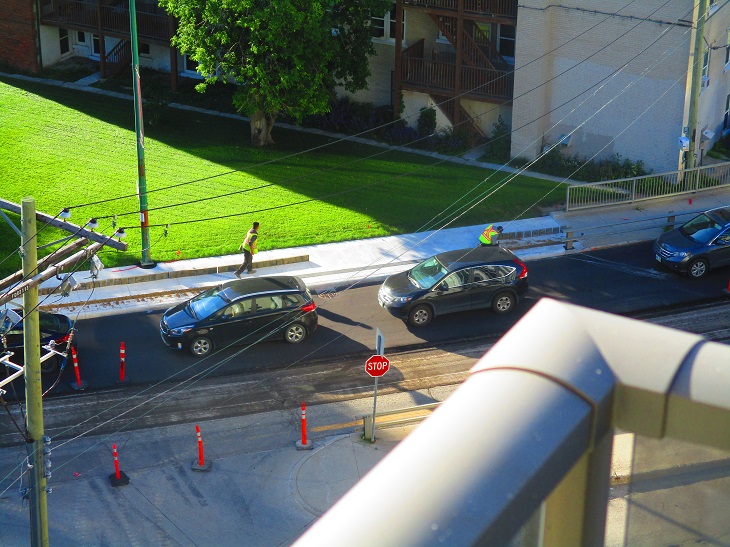
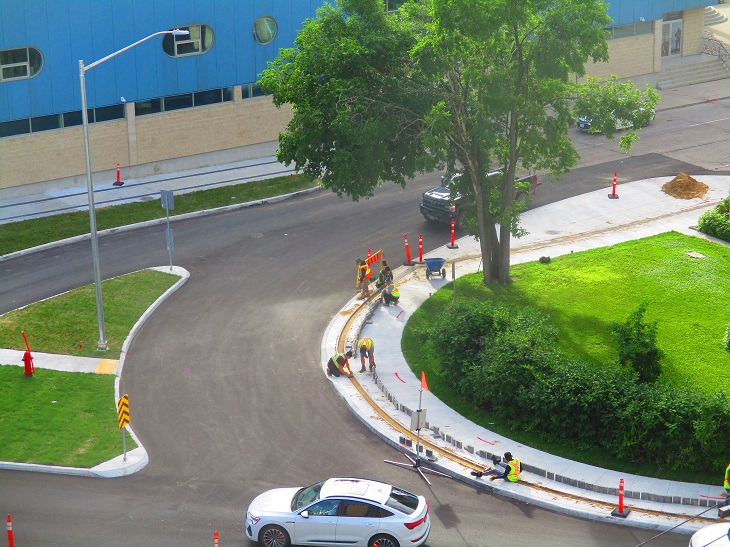
Sidewalk workers enjoying the fresh morning air in Winnipeg.
These guys fill a small trench in the sidewalk with sand, then with extreme finesse place thin brick plates onto the top of the trench. Great craftsmanship.
Thomas Barbèy grew up in Geneva, Switzerland, across the street from the “Caran D’ache” factory, the largest manufacturer of art supplies. He started drawing seriously at the age of 13, using black “encre de Chine” and gouaches for color. His influences were Philippe Druillet, Roger Dean and H.R. Giger.
After living in Geneva for 17 years and designing posters for musical bands, he decided to move to Italy. Thomas lived in Milan for 15 years making a living as a successful recording artist, lyricist and fashion photographer. Today, he resides in Las Vegas and travels the world, taking his camera wherever he goes.
Thomas has been a photographer for over twenty years now and prefers to use his old Canon AE1s when he shoots in 35mm or his RB67 when he shoots in medium format. More recently, he has been doing Black and White Photomontages for the sole purpose of doing Fine Art, without working for a specific client.
He’s combined several images taken over a period of twenty years to create surreal situations with the help of the enlarger in a dark room. His work has a specific style and is very characteristic. He only works with Black and White, including Sepia toning at times. Thomas exhibits in galleries throughout the world and is included in many private collections.
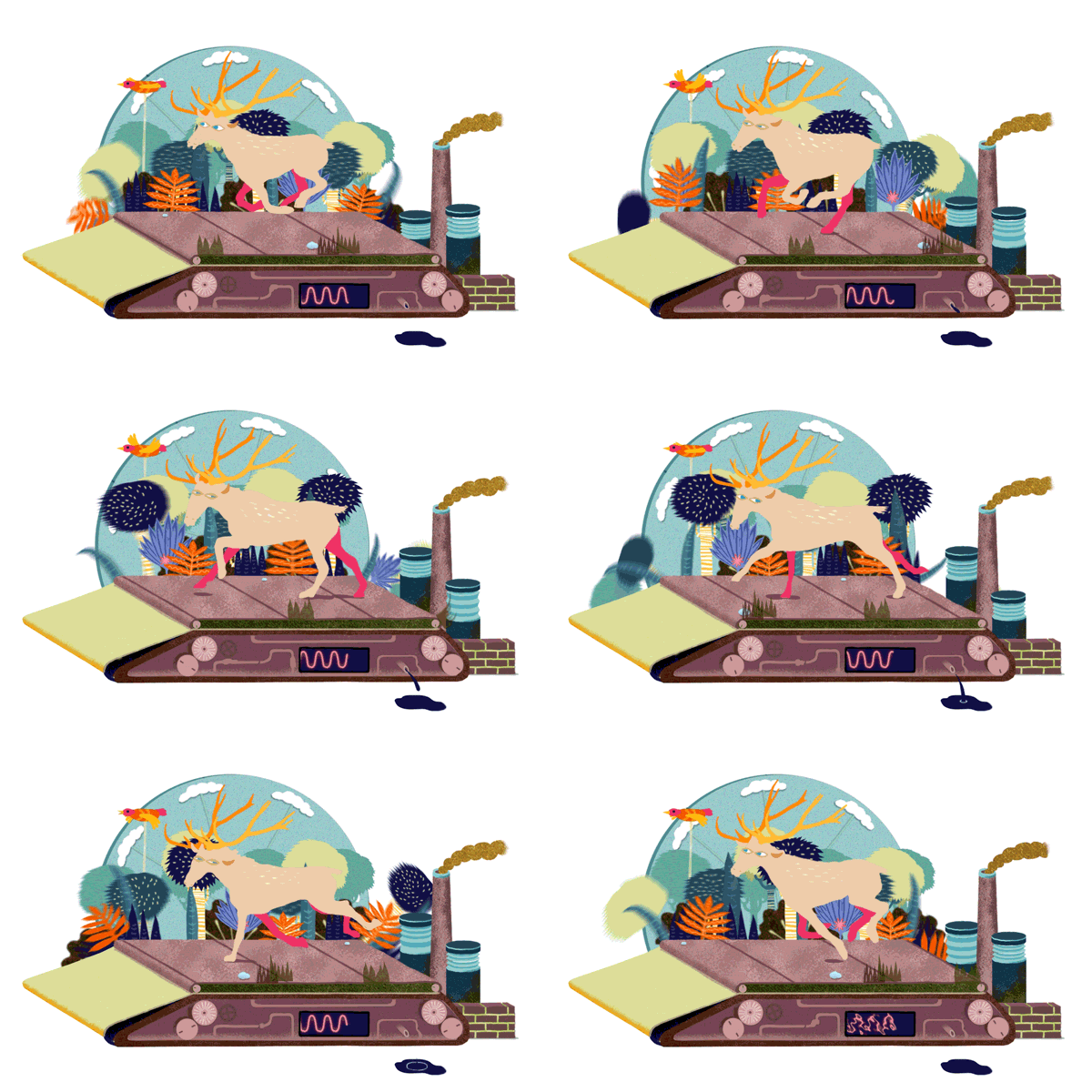
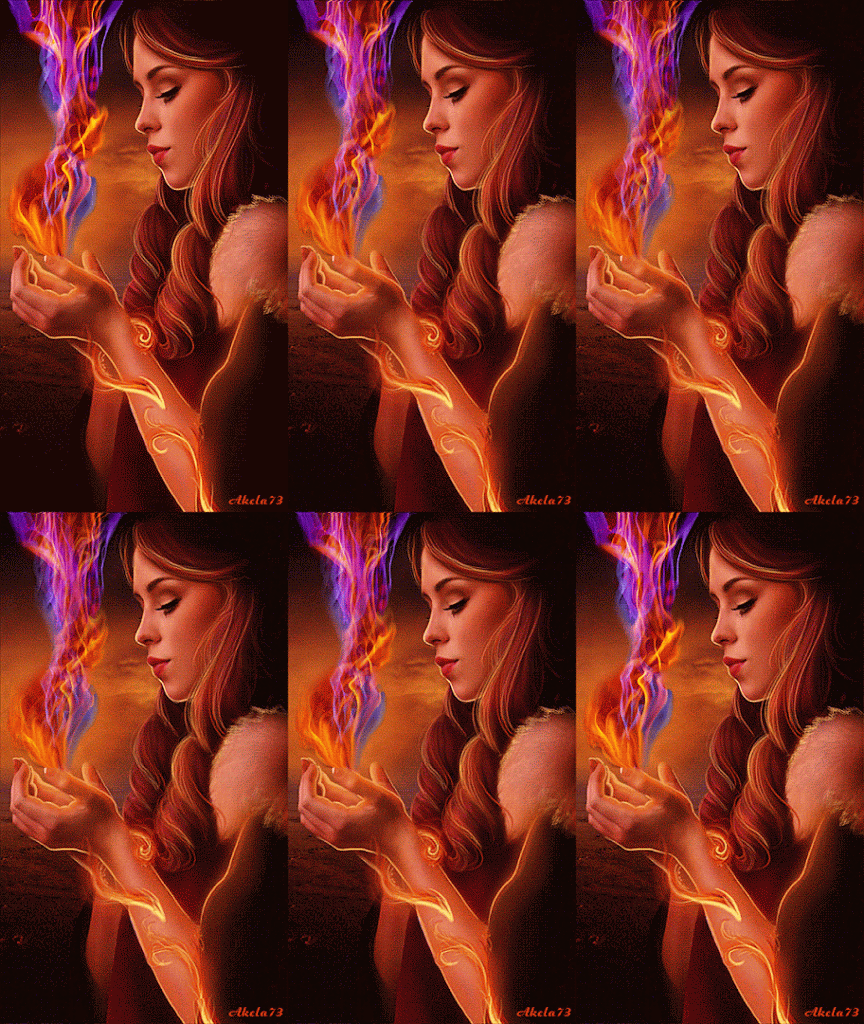
The Graphics Interchange Format (better known by its acronym GIF) is a bitmap image format that was introduced by CompuServe in 1987 and has since come into widespread usage on the World Wide Web due to its wide support and portability.
The format supports up to 8 bits per pixel for each image, allowing a single image to reference its own palette of up to 256 different colors chosen from the 24-bit RGB color space. It also supports animations and allows a separate palette of up to 256 colors for each frame. These palette limitations make the GIF format less suitable for reproducing color photographs and other images with continuous color, but it is well-suited for simpler images such as graphics or logos with solid areas of color.
Talented creatives from DesignCrowd’s global community have designed a series of scary mock-ups featuring former US president Donald Trump.
The DesignCrowd.com contest generated fantastic Photoshop artworks, which morphed Trump into scenes from horror movies such as Scream, An American Werewolf in London, Silence of the Lambs, and Alien.
Here’s Donald
The Shining Twins
Hannibal the Dealmaker
Freddy
This is just horrid!
Scream
The Beast of the East
Didn’t last long as an Exorcist, not enough money.
As the bodiless droid in Alien
More Alien
The mean-spirited reprobate won’t go away. But he is fading. God help us all that he fades away into oblivion before 2024.
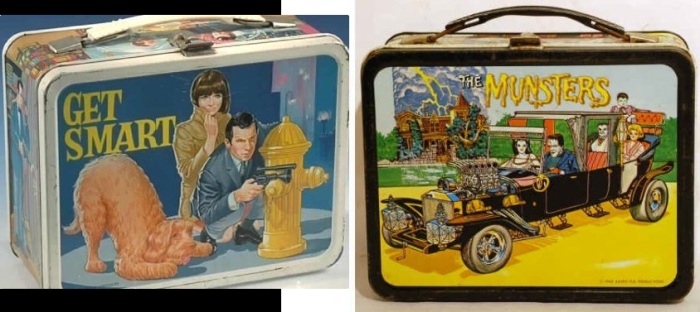
They don’t make lunch boxes, also known as lunch kits, like they did back in the sixties and seventies. The tin boxes which had a thermos inside were adorned with pop culture icons, TV shows, movies, sports heroes, historical events and many other topical subject matter.
The vintage lunch box as we think of it today was born in 1935. That’s when a Milwaukee, Wisconsin, company called Geuder, Paeschke, and Frey licensed the likeness of a new cartoon character named Mickey Mouse for the top of its oblong-shaped “Lunch Kit.” The metal container was sealed at the top with a loop of stiff wire that doubled as a handle.
From that moment on, placing a character of any sort on the side of a lunch box (or lunchbox, as it is often spelled) became the standard for the lunch boxes children toted to school. Before long, the signal a lunch box sent to your peers could mark you as a cool kid or a dork, depending on if your PB&J was packed inside a Mercury’s Space capsule Container (Universal, 1962) or a Evel Knievel lunch box (Aladdin, 1973).
Modern lunch boxes just don’t have the same eye-catching appeal of the old boxes. The lunch boxes today are more practical and cater to contemporary technology.
A three decker.
The majestic old lunch boxes:
The interior of a vintage box.
When buying a Roy Rogers and Dale Evans box on the right, included was a toy horse. It goes by the name Trigger.
























 The MarkoZen Blog