

March 20 (UPI) — A family’s pet pig is turning heads in his owners’ Illinois town after picking up an unusual hobby: skateboarding.
Norbert, a 150-pound black-and-white pig belonging to Vincent and Alicen Baran, has become a familiar sight to Buffalo Grove residents after learning to ride a skateboard.
“People just really enjoy seeing a pig do things that normally pigs don’t do,” Vincent Baran told WLS-TV. “I took one of my old skateboards and put it out and literally within seven days he was able to get his hooves on the board and push with his other hooves.”
The couple said Norbert is an expert at several tricks commonly associated with dogs, including shaking hands and spinning, but the skateboarding gets him the most attention.
“He’s not always graceful but it’s definitely a unique thing to see,” Alicen Baran said. “It’s just the craziest thing to see him kind of roll on by.”
Norbert has also become famous on social media after his owners started casting him in recreations of famous music videos from pop punk bands including Blink 182 and New Found Glory.
This movie looks like rollicking good fun.

Cocaine Bear is an upcoming American dark comedy action film directed and co-produced by Elizabeth Banks and written by Jimmy Warden. It is inspired by the true story of the “Cocaine Bear”, an American black bear that ingested a duffel bag full of cocaine in 1985. The film features an ensemble cast that includes Keri Russell, O’Shea Jackson Jr., Christian Convery, Alden Ehrenreich, Jesse Tyler Ferguson, Brooklynn Prince, Isiah Whitlock Jr., Kristofer Hivju, Hannah Hoekstra, Margo Martindale, and Ray Liotta in one of his final performances before his death.
Cocaine Bear is scheduled to be released in the United States on February 24, 2023, by Universal Pictures.
Premise
After ingesting a duffel bag full of cocaine, a 500 lb (230 kg) American black bear goes on a killing rampage in a small Georgia town where a group of locals and tourists must join forces to survive the attack.
The real Cocaine Bear:
The Cocaine Bear, also known as Pablo Eskobear (sometimes spelled Escobear), was a 175-pound (79-kilogram) American black bear that overdosed on cocaine in 1985. The cocaine had been dropped by drug smugglers in the wilderness in Tennessee, United States. The bear was found dead in northern Georgia and was stuffed and displayed at a mall in Kentucky. It inspired the 2023 action-comedy film, Cocaine Bear.
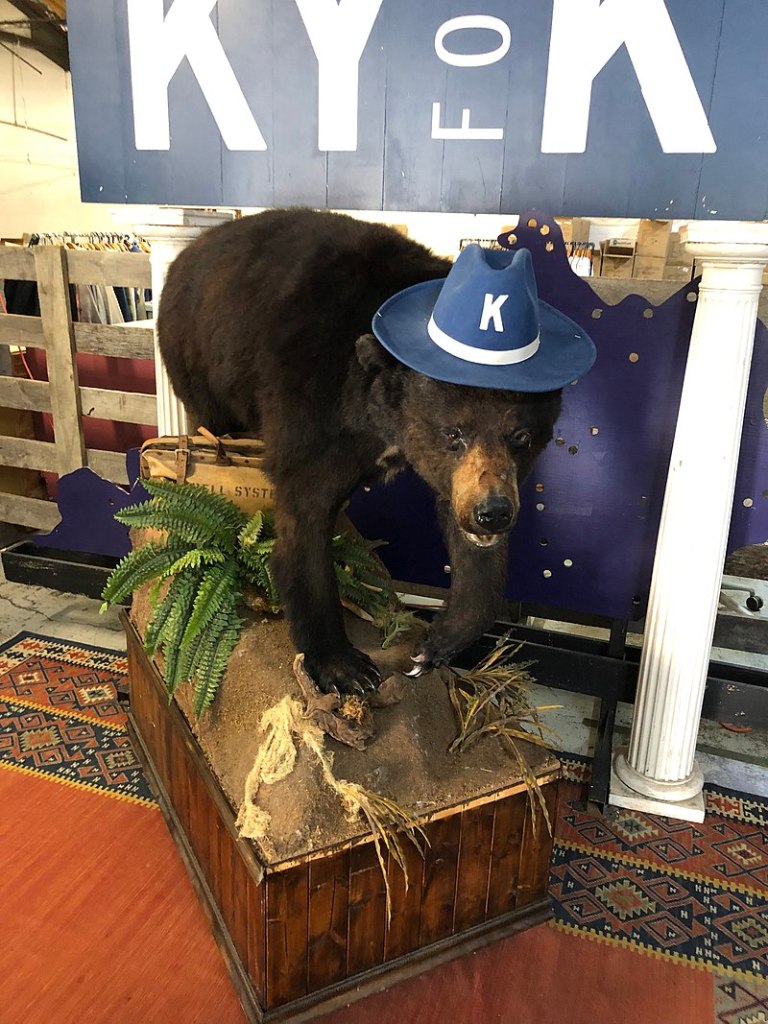
Cocaine Bear taxidermied in Lexington, Kentucky.
On September 11, 1985, former American narcotics officer and Kentucky-based drug smuggler Andrew C. Thornton II was trafficking cocaine from Colombia into the United States. After dropping off a shipment in Blairsville, Georgia, Thornton and an accomplice departed in an auto-piloted Cessna 404 Titan. En route, the duo dropped a load of 40 plastic containers of cocaine into the wilderness before abandoning the plane above Knoxville, Tennessee. Thornton was instantly killed in the evacuation when his parachute failed to open. According to the FBI, Thornton dumped their cargo due to the weight being too heavy in-flight.
On December 23, the Georgia Bureau of Investigation reported finding a dead black bear that had eaten the cocaine from the containers. The total amount of cocaine eaten was 75 pounds (34 kilograms), valued at 2 million dollars. The chief medical examiner from the Georgia State Crime Lab, Dr. Kenneth Alonso, stated that its stomach was “literally packed to the brim with cocaine”,though he estimated the bear had absorbed only 3 to 4 grams into its bloodstream at the time of its death.
Dr. Alonso did not want to waste the body of the bear, so he had it taxidermied and gave it to the Chattahoochee River National Recreation Area. However, the bear was lost until it emerged again in a pawn shop. Country singer Waylon Jennings bought it, and eventually it made its way to the “Kentucky for Kentucky Fun Mall” in Lexington, Kentucky where it remains to this day.

Well, come on, baby, I’ll show you how
Come on, baby, I’ll show you how
We’ll do it hot and we’ll do it fast
We’ll do it hot and we’ll do it fast
Come on, baby, do the chicken-chicken walk
Quiver yourself from head to toe
Do your stuff wherever you go
Do your stuff up on the floor
Do your stuff wherever you go
Come on, baby, do the chicken-chicken walk
Push in and a-push out
Push in and a-push out
Push in and a-push out
Push in and a-push out
Push in and a-push-push-push-push out
Yeah, let’s walk, walk, walk, baby
Quiver yourself from head to toe
Do your stuff up on the floor
Do your stuff wherever you go
Do your stuff wherever you go
Come on, baby, do the chicken-chicken walk
Push in and a-push out
Push in and a-push out
Push in and a-push out
Push in and a-push out
Push in and a-push-push-push-push out
Yeah, let’s walk, walk, walk, walk, walk, baby
Police in the Chinese city of Chongqing has begun using specially-trained squirrels in their war against drug traffickers.
The Police Dog Brigade of the Criminal Police Detachment in Hechuan District, Chongqing has successfully bred the first batch of drug-sniffing squirrels in China. The breakthrough was part of the country’s national key research and development project, which sought, among others, the creation of new training methods for anti-drug animals. Apparently, scientists have been aware of squirrels’ keen sense of smell for a long time, but rodent training methods were apparently not advanced enough until now.
Chinese news outlets recently reported that the Police Dog Brigade of Hechuan District had successfully trained six drug-detecting squirrels which will soon start working alongside police, helping them find hidden forbidden substances.
Yin Jin, the lead trainer of the Hechuan police dog brigade, told journalists that he and his team managed to train the six squirrels using internally-developed technology and training methods. The rodents were reportedly trained to scratch at the place where they detected drugs.
Tests showed that not only are the squirrels just as efficient as sniffer dogs at detecting drugs, but they also have the added advantage of being smaller, faster, and the ability to reach high places that dogs could never check.
Ming was a tiger that became notable when he was found living in an apartment in Harlem, New York City, United States, in October 2003. Ming, approximately three years old at the time of his capture, lived semi-openly with his owner, Antoine Yates, in a room of his five-bedroom apartment on the fifth floor of a large public housing complex in Harlem. Several other normal and exotic pets were found in Yates’ apartment, including an alligator named Al in another bedroom.
Ming spent the rest of his life at Noah’s Lost Ark Animal Sanctuary in Berlin Center, Ohio. Ming died from natural causes in February 2019 and was buried at the Hartsdale Pet Cemetery in Hartsdale, New York.

Ming’s resting place in Hartsdale Pet Cemetery, Hartsdale NY.
In April 2000, Antoine Yates, a 31-year-old part-time taxicab driver and resident of Harlem, New York City, purchased Ming, an 8-week-old male Siberian–Bengal tiger hybrid, from the BEARCAT Hollow Animal Park in Racine, Minnesota. Records indicated that BEARCAT Hollow had previously sold a lion cub to Yates, but he had found another home for the lion shortly after purchasing Ming. Yates lived with the animals in Apartment 5E of the Drew-Hamilton Houses, a public housing complex; for five years, Yates left the apartment only once a day for an hour to purchase food.
In an interview published in 2020, Yates clarified that he first had purchased Jabba, a lion cub which passed away at a young age, and then he purchased Ming and Nemo, another lion cub, as a pair. Nemo was included with the sale because he was ill and unlikely to live long. At the time he acquired Ming, Yates already owned an alligator named Al, which he had purchased legally in New Jersey.

Ming’s existence became known and reported in the media after Yates was taken to the Harlem Hospital Center emergency room on September 30, 2003 with bites on the arm and leg. At the time of treatment, Yates claimed that his pet pit bull had bitten him; however, the medical personnel were suspicious, because the width of the bite marks suggested an animal with a much larger jaw. Later, Yates said he had been bitten while trying to keep Ming away from Shadow, a cat he had recently adopted. That day was the first time Ming had met Shadow; according to Yates, after Ming began chasing Shadow, Yates jumped in front of Ming, who bit and clawed Yates multiple times as he wrestled with the tiger. After Ming finally closed his jaws on Yates’s knee, Yates recalled “That had me going through flashes of life. I was like, ‘Oh my god, guess this is where I die at.'” Yates declined to call it an attack, saying it was a natural reaction of Ming’s frustration: “I’m walking around. I’m still alive. I haven’t lost a limb. You couldn’t even tell I got bit by a tiger, unless I told you and showed you the mark.”
On Thursday, October 2, the police received an anonymous tip that “there was a large wild animal that was biting people”; the same anonymous person followed up the next day by providing the animal’s location, at Yates’s apartment.[9] Yates checked out of the hospital that same day, and following up on the tips, an officer of New York City Police Department was sent to his home address to investigate on October 3. Loud growling noises could be heard through the door of the apartment and the officer declined to enter. The NYPD Technical Assistance Response Unit drilled holes through a neighbor’s walls and used a camera on a pole to locate Ming. Martin Duffy, another police officer, was sent to the roof, from which he abseiled on a rope sling to view through the apartment’s windows. Ming roared at Duffy, who then anaesthetized Ming by firing a rifle with a tranquilizer dart prepared by Dr. Robert Cook, then the Chief Veterinarian of the Wildlife Conservation Society, which manages the city’s zoos.
After being darted, Ming charged at the window from which Duffy had fired, breaking it, then retreated further into the apartment. Authorities waited several minutes for the sedative to take effect before an animal control team was sent into Yates’ apartment. Dr. Cook used a catchpole and gave Ming another sedative injection to ensure he would remain asleep during transport. It took more than six men to carry Ming down via elevator to a waiting truck. The team also discovered Al, a five-and-a-half-foot alligator that Yates had been raising in one of the other bedrooms. Yates was later located at a hospital in Philadelphia and placed under guard.

After Ming was discovered in Yates’ apartment in October 2003, questioning of the neighbors determined that the existence of the tiger was widely known for at least three years, but as a sort of urban legend. Yates regularly bought large quantities of raw chicken at the local supermarket, and one standing joke in the building was that he could eat so much chicken every day. By 2003, Yates was feeding Ming 20 pounds (9 kg) of chicken, livers, and bones per day. The downstairs neighbor was aware that Yates owned many animals, in contradiction to Housing Authority rules, and her daughter had once seen Ming. The neighbor added it was not a problem until the summer of 2003, when she opened her windows for the first time that year and found her windowsills soaked with urine accompanied by a heavy animal odor. In addition, Yates had taken roommates, who were unaware at first of the animals in the home. According to the New York Daily News,
A woman who shared a Harlem apartment with a 425-pound tiger said yesterday she was terrified at first—but soon got used to living with the man-eater down the hall. Caroline Domingo told the Daily News she couldn’t believe her eyes when she spotted the big cat roaming free in the apartment where she and her husband rented a room from tiger-owner Antoine Yates. […] But eventually, she said, “We all became family.”
Authorities decided to move the seized animals to more appropriate housing: Ming was sent to Noah’s Lost Ark Animal Sanctuary in Berlin Center, Ohio, while Al was given a new home in Indiana. For approximately a decade, human visitors were barred from visiting Ming in Ohio, but the sanctuary later changed their policy in the interest of enrichment. Ming lived in Ohio until he died on February 4, 2019, of kidney and heart failure; his remains were cremated and interred at Hartsdale Pet Cemetery in Hartsdale, New York on April 20. The cemetery donated the site and mausoleum. According to the director of Noah’s Lost Ark, “[Ming] lived a really good life here. He was able to run and play on the grounds. He had tiger friends. He had a swimming pool. He was able to experience the elements.”
Animal trainer Mark Dumas plays with a polar
bear named Agee

Mark Dumas plays with a 16-year-old polar bear named Agee at his home in Abbotsford, British Columbia, Canada.

Mark has an intimate bond with Agee, and wrestles on the grass with her, kissing
her, and putting his head in her huge jaws.

The fearless 60-year-old bear handler even goes for dip in his swimming pool
where he and Agee enjoy a watery cuddle together.

Mark and his wife Dawn have owned Agee since she was six weeks old and the
colossal mammal even lived in their home as a cub where she played with the
family dogs and was bottle fed.

Mark and Dawn train the 800lb friendly beast – the world’s largest
land predator – to star in TV adverts. She has even performed in movies like
‘Alaska’ in 1995 when she was just a few weeks old.

Mark said: “If anyone else tried this they’d end up as Agee’s dinner. The only
people she likes are me and my wife Dawn.”

Mark has trained various animals for many films, including Best in Show, Alien
vs. Predator: Requiem and Fantastic Four: Rise of the Silver Surfer.


A couple in England could not believe their eyes when they spotted a bizarre two-legged fox frolicking in their backyard. According to a local media report, the curious creature appeared outside the home of Philip and Jane Carter in the community of Ilkeston last month as they were setting up their Christmas tree. “My wife shouted to me to come to the window quick because I wouldn’t believe” what was in their backyard, he recalled, musing that her assertion proved to be correct when he saw a two-legged fox that was remarkably adept at moving in a bipedal fashion.
The peculiar creature remained in their backyard for approximately 45 minutes before it fled the scene when the couple tried to feed it. “It blew my mind,” he said, “it was so strange to just see him go vertical with his tail, just put his head forward and walked off like that.” What was particularly astounding to the Philip was the speed with which the two-legged animal moved. “At one point he ran over to the gate, and I mean run, vertically, straight up,” he marveled, “you wouldn’t believe it unless you’d seen it. It’s absolutely phenomenal.”
Fortunately, the gobsmacked man managed to capture the jaw-dropping creature on film with his cell phone and the video (seen above) has subsequently gone viral. While it is uncertain exactly how the fox wound up with only two legs, a wildlife expert who viewed the footage surmised that whatever caused the condition likely occurred quite some time ago as the animal did not appear to be injured and seems to have adapted to being bipedal.

 The MarkoZen Blog