Lancour went home, got a leash and called his friend John Moss, for help.
When he realized that the leash was not going to work, Lencour stepped out onto the ice and approached the deer. When the animal didn’t seem to bolt or struggle, he came up with a different idea.
Wearing ice cleats, Lencour began sliding the helpless animal towards the shore as Moss got out his phone and began recording.
When they were near the edge of the ice, the deer struggled and finally righted itself. Laughing, Lencour quipped “you’re welcome,” as it ran into the distance.
In these trying times I am continually looking out for news that might bring some fun into the world and in so doing, brighten up your day. There is a farmer in Bathgate in Scotland who came up with a novel idea for brightening up the day for motorists who drive by his farm on the M8 motorway.
This story all started back in 2007 when a Scottish farmer named Andrew Jack decided to color his sheep blue to celebrate the Scottish national St Andrew’s Day holiday. Don’t worry the sheep didn’t get hurt as he used a special animal friendly spray paint. The effect was quite stunning don’t you think?
The reaction to his blue sheep was tremendous. When asked for his reaction, Bob Carruth of the National Farmers’ Union Of Scotland commented “It’s a very patriotic gesture and it also reminds people how important sheep are to our agriculture” This support encouraged Jack and he decided to also add a few red ones to his growing flock of funky sheep.
According to Jack he liked the idea of the funky sheep as it was his way to “Spice Things Up A Bit” so people could smile on their way to and from work while driving on the motorway. Once again the reaction was overwhelming and the drive past Jack’s farm became a bit of a tourist attraction.
Jack’s reaction to the publicity was to expand his color range even further and today if you pass the M8 you will most likely see a rainbow effect of colorful, funky , Scottish sheep all diligently brightening up the day for all the folks who drive by and It may look something like this.
Jack frequently re-sprays his sheep and they remain colorful until it is time for shearing. If you are still concerned about the effect of the paint on the animals, the editor of “Sheep” magazine, Nathan Griffith states that it is not harmful to dye sheep with the right products, and that many sheep farmers count and identify their flocks by color coding their fleeces.
The majesty of nature has been captured via drone footage once again thanks to an aerial photographer in New Zealand.
Tim Whittaker managed to film hundreds of sheep being herded in a field from a perspective that leaves the animals resembling a school of fish or a flock of birds.
The breathtaking film also shows the subtle ways in which their direction can shift due to outside forces such as herding dogs.
To an on-the-ground observer, the movement of the mass of sheep may seem chaotic, but the maneuvers of the animals are revealed to remarkably harmonious when seen from above.
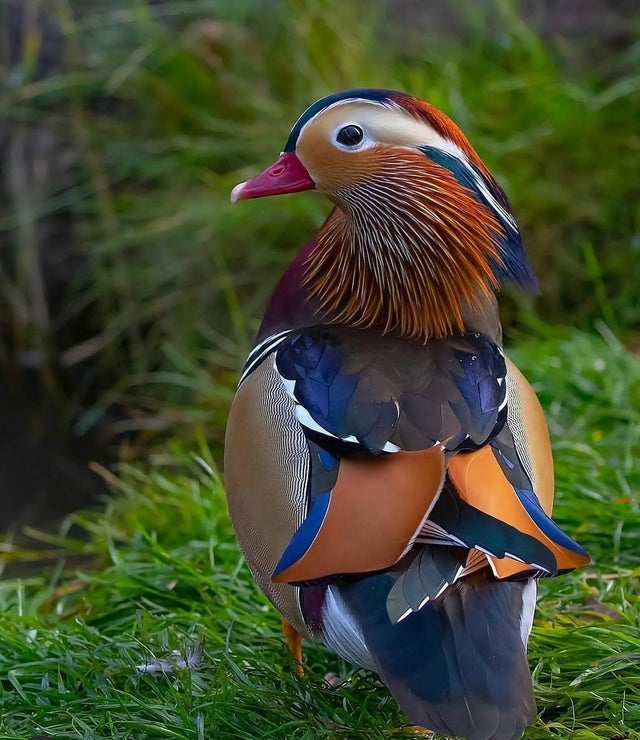
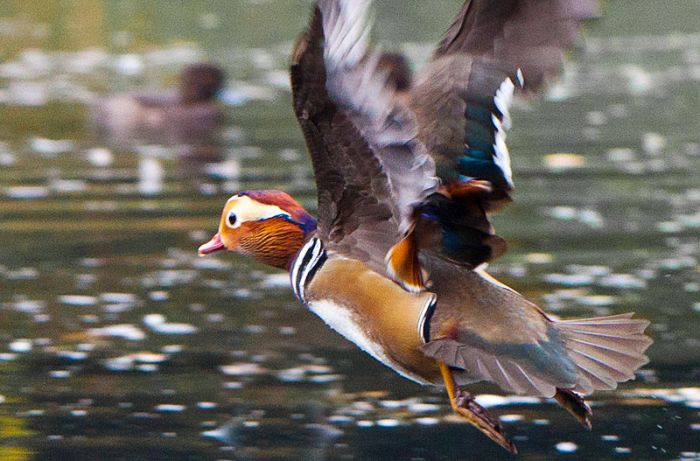
The mandarin duck (Aix galericulata) is a perching duck species native to the East Palearctic. It is medium-sized, at 41–49 cm (16–19 in) long with a 65–75 cm (26–30 in) wingspan. It is closely related to the North American wood duck, the only other member of the genus Aix. Aix is an Ancient Greek word which was used by Aristotle to refer to an unknown diving bird, and galericulata is the Latin for a wig, derived from galerum, a cap or bonnet.
The species was once widespread in East Asia, but large-scale exports and the destruction of its forest habitat have reduced populations in eastern Russia and in China to below 1,000 pairs in each country; Japan, however, is thought to still hold some 5,000 pairs. The Asian populations are migratory, overwintering in lowland eastern China and southern Japan.
Specimens frequently escape from collections, and in the 20th century, a large, feral population was established in Great Britain; more recently, small numbers have bred in Ireland, concentrated in the parks of Dublin. Now, about 7,000 are in Britain with other populations on the European continent, the largest of which is in the region of Berlin. Isolated populations exist in the United States. The town of Black Mountain, North Carolina, has a limited population, and a free-flying feral population of several hundred mandarins exist in Sonoma County, California. This population is the result of several ducks escaping from captivity, then reproducing in the wild. In 2018, a single bird, dubbed Mandarin Patinkin, was seen in New York City’s Central Park.
A deep sea diver has captured life in the Caribbean like never before – by attaching a camera to the body of a hammerhead shark by hand.
Andy Casagrande, an award-winning wildlife cinematographer, captured the extraordinary scenes just off the coast of Bimini, in the Bahamas.
The GoPro camera stayed on the shark’s fin for almost three hours and took in a tour of the sea bed to give Mr Casagrande, 37, a unique viewpoint of the creature’s adventures.
Hammerheads routinely make top ten lists of world’s most deadly sharks, but it didn’t stop Mr Casagrande diving in to attach the camera.
Mr Casagrande, who has worked with sharks for 15 years, said he hoped the footage would help give a greater understanding of hammerheads’ natural lifestyle.
He said: ‘Bimini is the worldwide hot spot for hammerheads so we knew we had a chance of getting some good shots. I’m fascinated by the secret life of sharks and I’ve wanted to film them on the GoPro for some time.
‘It was actually more of a struggle than I thought it might. I had to grab the shark’s head to stabilise it and then take a chance with attaching the GoPro.
‘Hammerheads are quite a timid shark usually but this one was hard to get close to.
‘We have to build up trust but it’s pretty awesome just getting up close and observing these guys. When it finally came close enough I put the camera’s clamps around the dorsal fin and off it went.
‘The clamps are harmless because they’re designed to dissolve in salt water after a few hours.’
Mr Casagrande then sat back and waited for the GoPro to release itself and tracked it hundreds of metres away using a high-frequency radio.
The device – a GoPro Hero 4 provided by his sponsors – had floated to the surface of the crystal-clear water and the footage was edited at his home in the U.S.
Mr Casagrande, who lives with wife Emma, 32, and their two children in Naples, Florida, dismissed some online critics who claimed that the project was harmful to sharks.
Mr Casagrande, an Emmy award winner with more than 100 wildlife filming credits to his name, said: ‘I’m trying to engage people to care about sharks and conservation. The whole reason I got into this was because I care about sharks.
‘This was 100 per cent non-invasive. It seemed pretty chilled out once the GoPro was on. It just turned on its side and took off.
‘I deployed it on a few of them and this one just stuck. It cruised all around the area.
‘Bimini is a pretty small island but it went out to some deeper water and through some pretty different habitats. I’m really happy with the footage and I’d love to do more of this.’
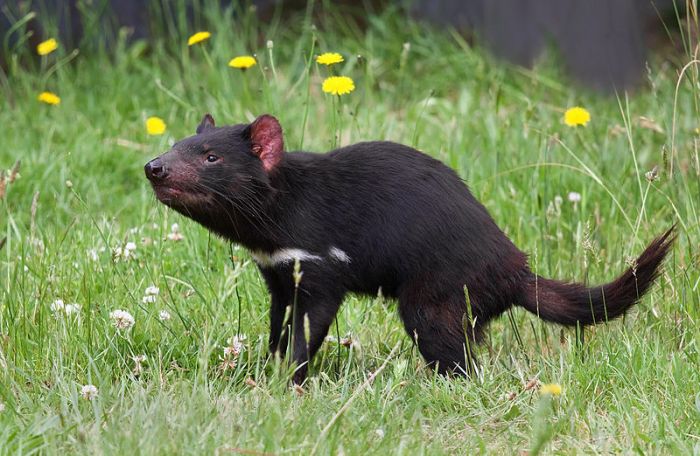
The Tasmanian devil (Sarcophilus harrisii) is a carnivorous marsupial of the family Dasyuridae. It was once native to mainland Australia and was found in the wild only on the island state of Tasmania. It has now been reintroduced to New South Wales with a small breeding population. The size of a small dog, the Tasmanian devil became the largest carnivorous marsupial in the world, following the extinction of the thylacine in 1936. It is related to quolls, and distantly related to the thylacine. It is characterised by its stocky and muscular build, black fur, pungent odour, extremely loud and disturbing screech, keen sense of smell, and ferocity when feeding. The Tasmanian devil’s large head and neck allow it to generate among the strongest bites per unit body mass of any extant predatory land mammal. It hunts prey and scavenges carrion, as well as eating household products if humans are living nearby.
I always thought the Tasmanian devil looked like this:
Swine across China are jumping or being shoved off platforms and splashing into pools and ponds, where they bob around before paddling to shore.
Images on the Internet and reports in newspapers suggest that creating a leaping, amphibious pig is another realm where China, which raises more than half the world’s pigs, can claim global pre-eminence. Online photos show piglets prodded to dive off a bridge into a lake. Others show a spotted-pig triathlon of diving, swimming and hurdling.
Aquatic swine are not exclusive to China. Australia has a family with diving pigs, and in the Bahamas you can frolic in the surf with them. But China’s rural entrepreneurs have turned the pursuit into a tourist draw and a selling point for pork. Proponents say that diving pigs are healthier, leaner and tastier.
“We wanted to make the pigs grow healthier, because usually they’re too lazy,” said Zou Wei, a manager in the planning department of Tuhe Black Pork, a company in Shandong Province that puts some of its hogs through a routine of diving and swimming. “To start with, the pigs don’t like it, but you force one onto the diving platform and it slides down, the others see that and follow.”
The Piggy Kingdom Family Amusement Park in Zhejiang Province has taken the amusement factor to new heights. Pictures and video from the park show pigs being heaved off a platform and thrashing in the air until smacking into water 39 feet below. That’s about six feet more than the tallest Olympic diving platform.
“The Piggy Amusement Park is a bit smelly,” one visitor said, according to a report on the local government’s website. “But the piglets were cute diving into the water and the kids loved it.”
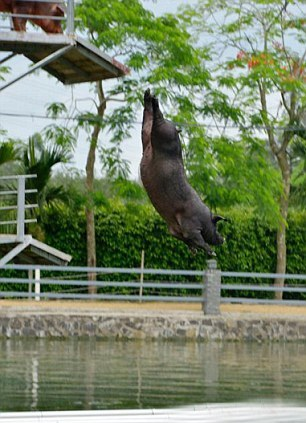
This dark-haired porker has the technique down pat.
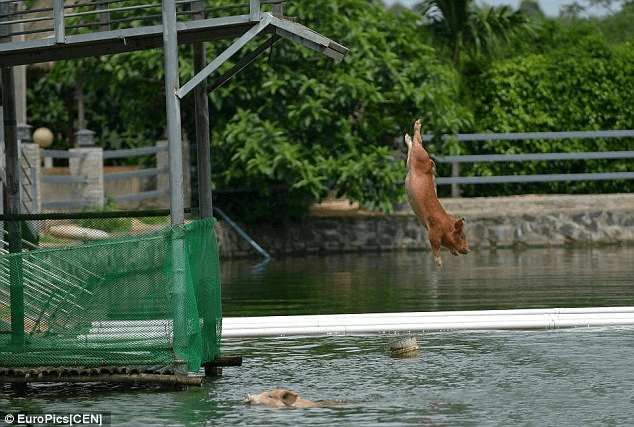
Judges give this red-haired piglet tens all-around!
As with human athletes, it’s a matter of mind-set, said Yang Shiliu, a former researcher in the Hunan Animal Husbandry and Veterinary Institute, who is considered one of the foremost experts on pig diving.
“The occasional divers will be hesitant,” Mr. Yang said in a telephone interview from Changsha, the capital of Hunan Province in southern China. “Once they’re used to it, they don’t mind.”
Besides, he said, pigs are more adept at swimming than other athletic activities. The Salon pig-breeding company in Hunan considered making pigs jog for exercise, he said, but found that their trotters were too dainty for their bulky bodies. Moreover, he said, “aquatic exercise is a bit more intense.”
Some people have been appalled by the spectacle of pigs being pushed into ponds. “Making pigs dive into water is abusing them,” one person said. “Our citizens have no heart.”
Animal rights advocates, however, have been restrained in their criticism. Jeff Zhou, a China representative for Compassion in World Farming, which campaigns against animal abuse, said pigs in China’s factory farms suffer worse fates than diving, including castration without anesthesia and immobilization in sow stalls and farrowing crates.
But platform diving was not necessarily a pig’s idea of fun, he added.
“It can bring a certain kind of stress to them at the very beginning,” he said. He said farmers should base exercise regimes “on the needs of animals, not the amusement of humans.”
Pig-diving proponents insist that they are doing both.














 The MarkoZen Blog