‘Crocodile Hunter’ Steve Irwin – rest his soul – pushed it to the limit many times

In this classic episode of ‘Crocodile Hunter’ Steve handles the deadliest snake in the world, the Inland Taipan or Fierce Snake. He is taking a major chance in the video below, one bite and he is a dead man. But that is how Steve operated.

The inland taipan (Oxyuranus microlepidotus), also commonly known as the western taipan, the small-scaled snake or the fierce snake, is a species of extremely venomous snake in the family Elapidae. The species is endemic to semi-arid regions of central east Australia. Aboriginal Australians living in those regions named the snake Dandarabilla. It was first described by Frederick McCoy in 1879 and then by William John Macleay in 1882, but for the next 90 years, it was a mystery to the scientific community; no further specimens were found, and virtually nothing was added to the knowledge of this species until its rediscovery in 1972.

Based on the median lethal dose value in mice, the venom of the inland taipan is by far the most toxic of any snake – much more so than even that of sea snakes – and it has the most toxic venom of any reptile when tested on human heart cell culture. The inland taipan is a specialist hunter of mammals, so its venom is specially adapted to kill warm-blooded species. It is estimated that one bite possesses enough lethality to kill at least 100 fully grown humans, It is an extremely fast and agile snake that can strike instantly with extreme accuracy, often striking multiple times in the same attack, and it envenomates in almost every case.
Moose Running on Water?

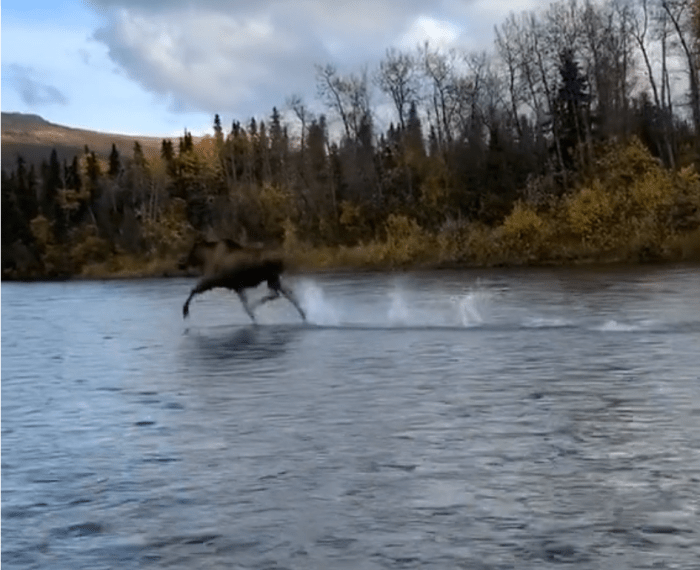
It’s not every day that you get to witness something bizarre. But if you spend enough time outdoors in nature, sometimes you will see something that makes you do a double take. Of course, nothing prepares you for seeing something truly insane, like a moose running on water. That is definitely not something that would ever cross our minds as being remotely possible. We all know that a moose is a very, very large and heavy animal. That is why we’d never imagine them being capable of running on water.

But there is one very funny video clip from a Tik Tok user, kristy_234, which shows a large moose running on water. The clip, which was taken in Alaska, is more of an optical illusion.

He’s not really running on the water’s surface like it might appear at first. The reality was that the moose was running along in shallow water, but because it’s so large and tall, it looks like he’s traversing the water’s surface.

The moose is in roughly 6 inches of water. The boat is a flat bottom that can traverse very shallow water.

Dozens of Spiders Found in Australian Home

Dozens of what have been tentatively identified as baby Huntsman spiders scurried around the walls as Demrose shot video of the terrifying sight. Since this was in Australia, where some of the most disturbing wildlife encounters have occurred, the woman seemed unimpressed by the startling sight and quips “they’re so cute!” as the arachnids scuttle around the room.

The Australian Broadcasting Corporation says that a heatwave followed by heavy rains likely brought the spiders inside, as other Sydney residents have also reported similar experiences. Dr. Robert Raven of the Queensland Museum said that the creatures pose little threat to humans and will “happily eat each other” as they grow.

As a further testament to the Australian spirit of living in harmony with crawly neighbors, Demrose said that her daughter actually went to sleep in the room that night, with the spiders still lurking about.

Aussies seem to just live with this kind of craziness. I saw a reality show about people that catch snakes in Adelaide, Australia. A woman discovered a brown snake in her pantry (extremely venomous snake that is 6-7 feet long) and just called the snake catchers while sitting on the island in the kitchen. No panic whatsoever. Unbelievable.


Iguana escapes fire by jumping on Corby fireman’s helmet

An iguana escaped from a house fire by jumping on to a firefighter’s helmet.

The athletic reptile’s survival instinct kicked in when fire broke out at its owner’s home in Whitworth Avenue, Corby, on Wednesday night.

As crews battled the flames, the iguana leapt to the safety of a firefighter’s head, Northamptonshire Fire and Rescue Service said.

A spokeswoman said the crew member did not realise it was there, and the pet was carried away unscathed.

It was “a very unique incident – one that we have never dealt with before”, she said.

“The fireman… didn’t realise the iguana had climbed on top of him at first as he initially thought it was a colleague touching his helmet.

“What a surprise he then had to find this iguana chilling on his head, eager to escape the burning building.”

Iguana fact file

  • Iguanas are native to Central and South America and are tropical, arboreal lizards
  • They can grow up to six feet (1.8m) in length and are herbivorous, feeding on jungle leaves, fruits and flowers in the wild
  • Young iguanas need daily feeding whilst large adult iguanas may only feed two to three times a week on a diet consisting of, among other things, dark green leafy vegetables, carrots, tomatoes, melon and bananas
  • A mature iguana can weigh as much as 15lbs (6.8kg) and the reptiles can be difficult to handle as they have razor-sharp teeth, claws and a lashing tail

Gorillas pose for selfie with DR Congo anti-poaching unit

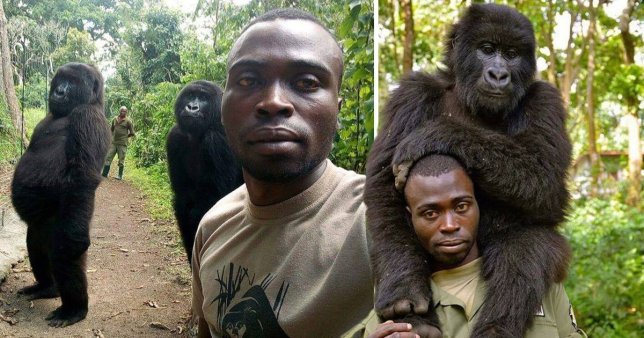
Two gorillas have been photographed posing for a relaxed selfie with the rangers who rescued them as babies.

The image was taken at a gorilla orphanage in Virunga National Park, DR Congo, where the animals were raised after poachers killed their parents.

The park’s deputy director told BBC Newsday that they had learned to imitate their carers, who have looked after them since they were found.

The gorillas, he added, think of the rangers as their parents.

Innocent Mburanumwe, deputy director of Virunga, told the BBC the gorillas’ mothers were both killed in July 2007.

The gorillas were just two and four months old at the time.

Shortly afterwards, they were found and taken to Senkwekwe Sanctuary in Virunga, where they have lived ever since.

Because they’ve grown up with the rangers who rescued them, Mr Mburanumwe added, “they are imitating the humans” – and standing on two legs is their way of “learning to be human beings”.

But it “doesn’t happen normally”, he said.

“I was very surprised to see it… so it’s very funny. It’s very curious to see how a gorilla can imitate a human and stand up.”

Five rangers were killed in Virunga National Park last year in an ambush by suspected rebels, and more than 130 park rangers have been killed in Virunga since 1996.

Eastern DR Congo is mired in conflict between the government and various armed groups.

Some of these armed groups are based in the park, where they often poach animals.

BBC

Bears Contemplating Life


bears1


bears2


bears3


bears4


bears5


bears6


bears7


bears8


bears9


bears10


bears11


bears12


bears13


bears14


bears15


bears16


These two specimens don’t care about contemplation, they’re in a beer drinking contest!

MOS02-20010903-MARIINSK, RUSSIAN FEDERATION: Businessman Nikolai Kirpichnikov gives medovukha (self made alcohole drink based on honey) to his bears (bears like this drink very much and they receive it time to time) in the yard of his house in the town of Mariinsk in Kemerovo region (eastern Siberia), Saturday, 01 September 2001. Nikolay Kirpichnikov found three bear cubs four years ago in the forest when their mother was killed by a poachers. Untill now all three bears live in his house ian iron cage.

Businessman Nikolai Kirpichnikov gives medovukha (self made alcohole drink based on honey) to his bears (bears like this drink very much and they receive it time to time) in the yard of his house in the town of Mariinsk in Kemerovo region (eastern Siberia), Saturday, 01 September 2001. Nikolay Kirpichnikov found three bear cubs four years ago in the forest when their mother was killed by a poachers. Until now all three bears live in his house in iron cage.