
.
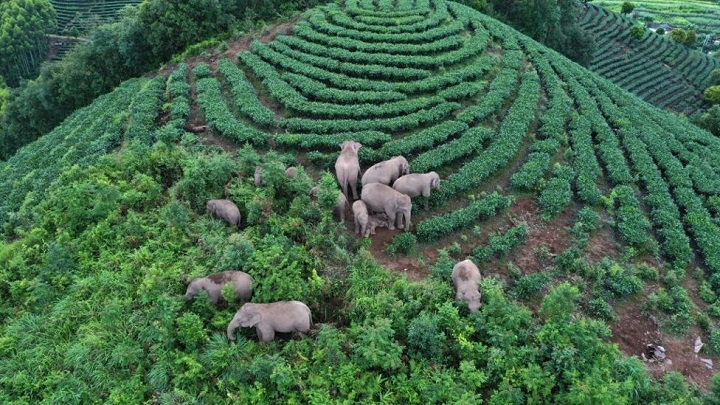
For the past 17 months, a wandering herd of elephants in China has embarked on an adventure of mammoth proportions.
Now, after straying hundreds of kilometres from their nature reserve, the animals are on the final leg of their journey home, Chinese officials announced last week.
From breaking into villagers’ homes to giving birth while on the road, it’s been an epic journey that could have been straight out of The Lord of the Rings.
This is the story of how the fellowship of elephants journeyed there and back again.
Leaving the shire
Tucked in the bottom end of the southern Yunnan province, the sprawling Xishuangbanna National Nature Reserve lies right by the border of Myanmar and Laos.
A lush tropical forest that stretches for about 241,000 hectares – about one and a half times the size of London – it is home to most of Yunnan’s endangered Asian elephants.
Some time in March 2020, a herd of about 14 elephants decided to leave this jungle paradise, heading north.
Nobody batted an eyelid at first. Wild elephants are known to roam freely and regularly in the region, such that one city, Pu’er, even runs “elephant canteens” to feed their large visitors.
Most don’t stray very far, and usually head home after a while. But months after the herd left, officials started to realise that this was no ordinary trip.
This realisation literally hit home earlier this year when reports emerged of the elephants crashing into people’s houses, munching on their crops, and guzzling their water.
CCTV footage of the elephants wandering around the streets of various cities also went viral.


The person with the camera better get running.


AMERICAN BROWN or GRIZZLY BEAR Ursus arctos horribilis snarling, July USA


This is just so cruel. However there is a happy ending.
The man who abandoned the dog could face up to a year in jail and a $4,000 fine for animal cruelty.
A city in Thailand saw traffic come to a sudden halt when the streets were overrun by an epic battle that unfolded between rival gangs of monkeys. The wild scene, which was caught on film by amazed residents, reportedly erupted in the community of Lopburi last week. Much to the chagrin of commuters, hundreds of monkeys amassed in huge groups and faced off at an intersection in the city. After a few minutes of bluster and screeching, the creatures engaged in combat while drivers took cover inside their vehicles and watched the fight unfold.
It is believed that the proverbial monkey war was sparked by a scarcity of food as Lopburi is a popular tourist destination that has been hard by the pandemic, which has led to fewer visitors feeding the creatures that call the city home. Perhaps owing to this ongoing predicament, one local source indicated that the specific showdown between the simians was something of a turf war between three separate groups of monkeys likely looking to increase their territory in the snack-deprived city.
An emotional support animal (ESA) is a companion animal that a medical professional has determined provides benefit for an individual with a disability. This may include improving at least one symptom of the disability. Emotional support animals, typically dogs, but sometimes cats or other animals, may be used by people with a range of physical, psychiatric, or intellectual disabilities. In order to be prescribed an emotional support animal the person seeking such an animal must have a verifiable disability. To be afforded protection under United States federal law, a person must meet the federal definition of disability and must have a note from a physician or other medical professional stating that the person has that disability and that the emotional support animal provides a benefit for the individual with the disability. An animal does not need specific training to become an emotional support animal.

The Air Carrier Access Act establishes a procedure for modifying pet policies on aircraft to permit a person with a disability to travel with a prescribed emotional support animal, so long as they have appropriate documentation and the animal is not a danger to others and does not interfere with others (through unwanted attention, barking, inappropriate toileting, etc.

CNBC
Want to travel with an emotional support dog, duck or miniature horse? Starting next month, United Airlines will want passengers to show they can behave.
The airline is setting more stringent requirements for emotional support animals, joining Delta Air Lines in cracking down on a sharp increase in such animals in the cabin. Delta complained that some of the animals soiled cabins or bit travelers.
United said the number of customers bringing emotional support animals on board has risen 75 percent over the past year.
“The Department of Transportation’s rules regarding emotional support animals are not working as they were intended to, prompting us to change our approach in order to ensure a safe and pleasant travel experience for all of our customers,” United said.
Late last month, a Brooklyn artist tried to bring a peacock on board a cross-country United flight, but was turned away by the airline because of the bird’s weight and size.

“As a reminder, animals currently prohibited from traveling in the cabin include hedgehogs, ferrets, insects, rodents, snakes, spiders, reptiles, sugar gliders, non-household birds, exotic animals and animals not properly cleaned or carry a foul odor,” said United.
The animals below are not on the prohibited list.
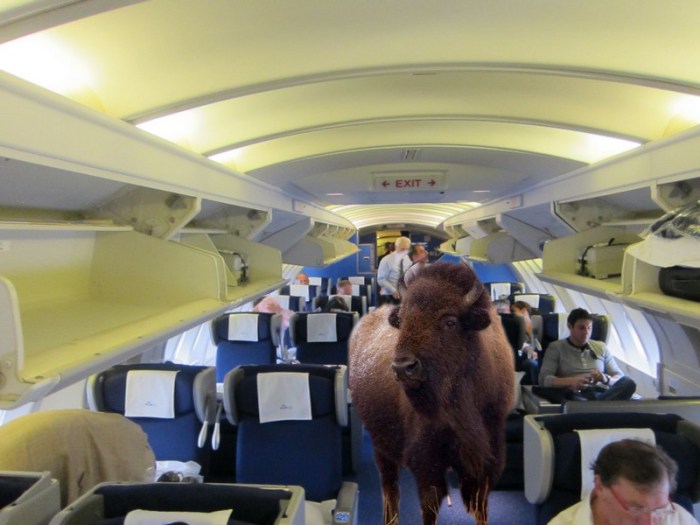

Last 2 images above courtesy of Markozen photoshop.
A dwarf cow in Bangladesh has become a sensation in the country as thousands of people have flocked to the farm where it lives in order to see the shockingly small creature. The diminutive animal, dubbed ‘Rani,’ was reportedly born approximately two years ago in the community of Charigram and, since that time, has only grown to a mere 20 inches in height and 26 inches in length. The wondrous creature had largely lived a quiet life until a few weeks ago when pictures of the tiny animal were posted to social media in Bangladesh, capturing the imagination of observers and sparking something of a nationwide frenzy.
Soon visitors and media outlets began descending upon the animal’s farm to marvel at the miniature cow that has become a veritable celebrity in the country. “More than 15,000 people have come to see Rani in the past three days alone,” site manager M.A. Hasan Howlader said, “they have come here in droves.” In response to the overwhelming and wholly unexpected reaction to the dwarf cow, the farm has reportedly been forced to hire security for the creature and, according to the Washington Post, now only allows a handful of people access to the animal per day and by appointment only. “Honestly speaking, we are tired,” Howlander revealed while reflecting on the proverbial Rani-mania that has swept over the farm.
The influx of visitors is particularly surprising since Bangladesh is under a lockdown due to the coronavirus and government-operated transportation in the country has been temporarily suspended. Be that as it may, those wishing to see the creature have disregarded the regulations and managed to find their way to the farm. As one might imagine, government officials aren’t exactly thrilled with the craze and have asked the site to dissuade crowds from gathering near the cow. The animal’s owners believe that she may be the world’s smallest bovine, since she is currently four inches shorter than the current record holder, and are awaiting an assessment from Guinness World Records as to whether or not Rani will take the tiny crown.


 The MarkoZen Blog