
Little buggers can climb upside down.
Little buggers can climb upside down.
The dogs love this little dog park in downtown Winnipeg.
A three legged good looking hound is there quite often. It seems to be having a great time.
The light colored dog on the left.


Sept. 22 (UPI) — A Central Florida family captured video when they had an unusual visitor — a large monitor lizard climbing on a window.
Jocelyn Penson, who posted the video to Facebook, said the footage was filmed at the home of her son, Frank Crowder, in Apopka, Fla.
The video shows the lizard climbing on the window in an apparent attempt to find its way into the house. The reptile ends up flopping off the window and down to the ground.
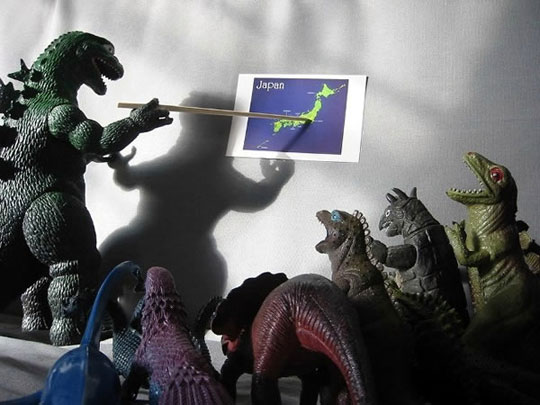
“Looks like Godzilla to me!” Penson wrote.
Penson’s family initially said the animal appeared to be a tegu lizard, but Ron Magill, a wildlife expert with Zoo Miami, said the reptile is a water monitor lizard from Sub-Saharan Africa.
“It’s a lizard that could be anywhere between 3 and 5 feet, generally speaking,” he told WSVN-TV.
Magill said the lizard was likely a former pet that either escaped or was abandoned into the wild by its owner.


Sept. 12 (UPI) — A bear crashed a 2-year-old’s birthday party in Connecticut and was filmed feasting on cupcakes while the party-goers fled inside.
Rauf and Laura Majidian said they were hosting a birthday party for their son, Cyrus, outside their West Hartford home when a bear emerged from the woods.
The parents and the other adults at the party rushed to get the kids inside, but the bruin was more interested in the contents of the picnic table, the Majidians said.
The bear was filmed feasting on cupcakes from the picnic table while the party attendees watched through a window.
Across northern South America, there are hundreds of colossal tunnels large enough for humans to walk through, but they weren’t dug by men. Nor they were formed by any known geological process. But their creators have left evidence all around the walls and ceilings—giant claw marks.
Geologists call these tunnels “paleoburrow,” and they are believed to have been dug by an extinct species of giant ground sloth.
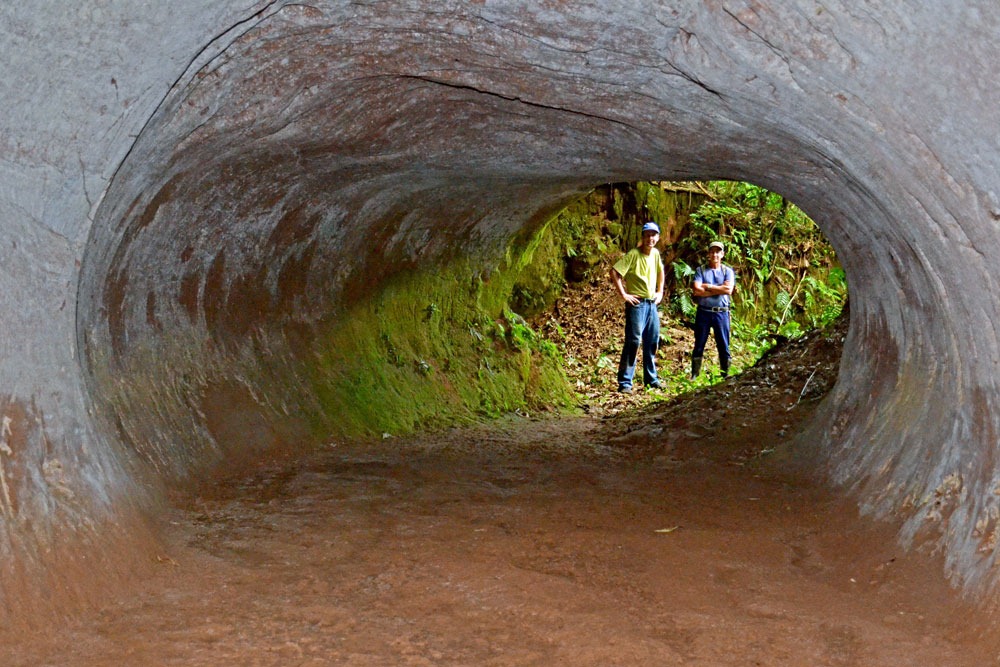
A large paleoburrow in Brazil. Photo credit: Heinrich Frank
The term was coined by Heinrich Frank, a professor at the Federal University of Rio Grande do Sul, in Brazil, who chanced upon one at a construction site in the town of Novo Hamburgo, in the early 2000s. Up until then, little was known or written about these tunnels in scientific literature. But since he came upon his first, Heinrich Frank and other researchers have discovered more than 1,500 tunnels, in the state of Rio Grande do Sul alone. Some of these burrows measure hundreds of feet long and branched off into several direction.
The largest one measured 2,000 feet long, six feet tall and three to five feet wide. An estimated 4,000 metric tons of dirt and rock were dug out of the hillside to create the burrow. It was evidently the work of not one or two individuals but several generations.
Frank believes the burrows were dug by a genus of giant ground sloths, as large as modern elephants, that once lived in South America until about 10,000 years ago. They were some of the biggest land mammals on earth exceeded in size only by the mammoth. Others believe that extinct armadillos, which were smaller than the giant sloths, were responsible for the burrows.
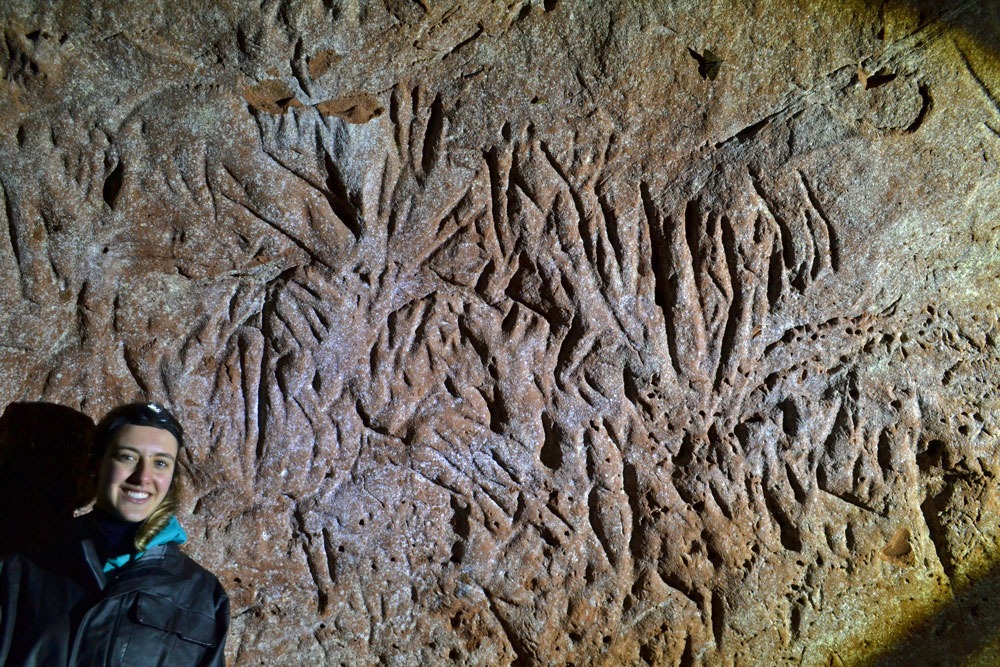
Claw marks on the sides of the burrow. Photo credit: Heinrich Frank
Regardless of who dug them, the sheer size of the burrows is something that Frank and his colleagues are still trying to explain.
The paleoburrows also have a strange geographic distribution. They have been found only in the southern Brazilian states of Rio Grande do Sul and Santa Catarina. Very few have been found in northern Brazil, or in other South American countries. Even in North America, where the giant ground sloths and giant armadillos once lived, no paleoburrows have been found.
Greg McDonald, a paleontologist from the Bureau of Land Management, however, believes that it’s just a matter of time before we find them.
“The fact that we don’t have them here could simply be that we’ve overlooked them,” he says.
There are still a lot of unanswered questions surrounding the paleoburrows and its creators. Who built them? Why they were built? How they were built, and when?
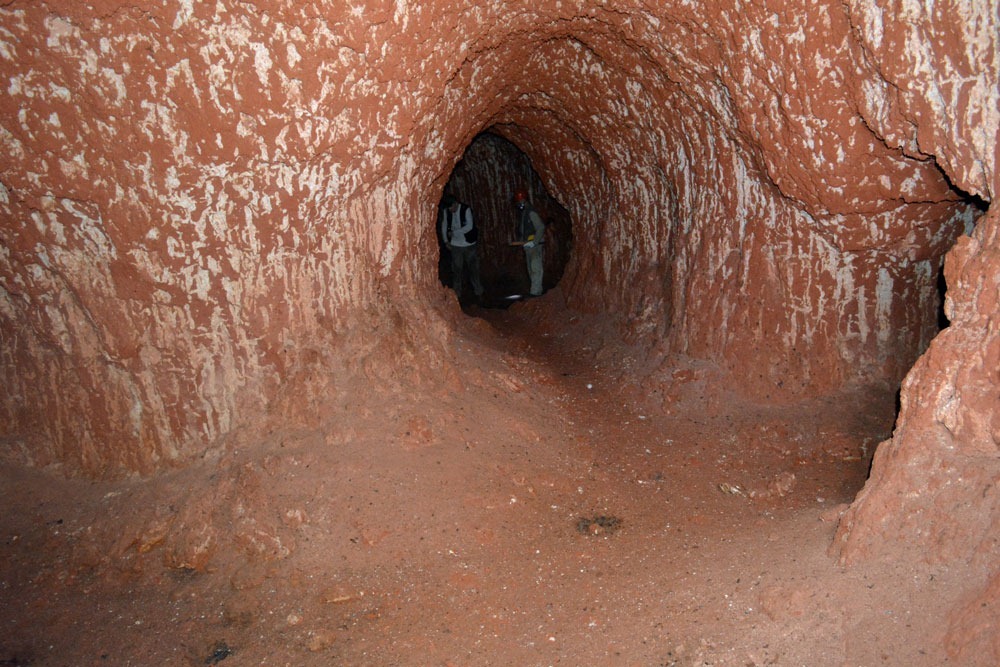
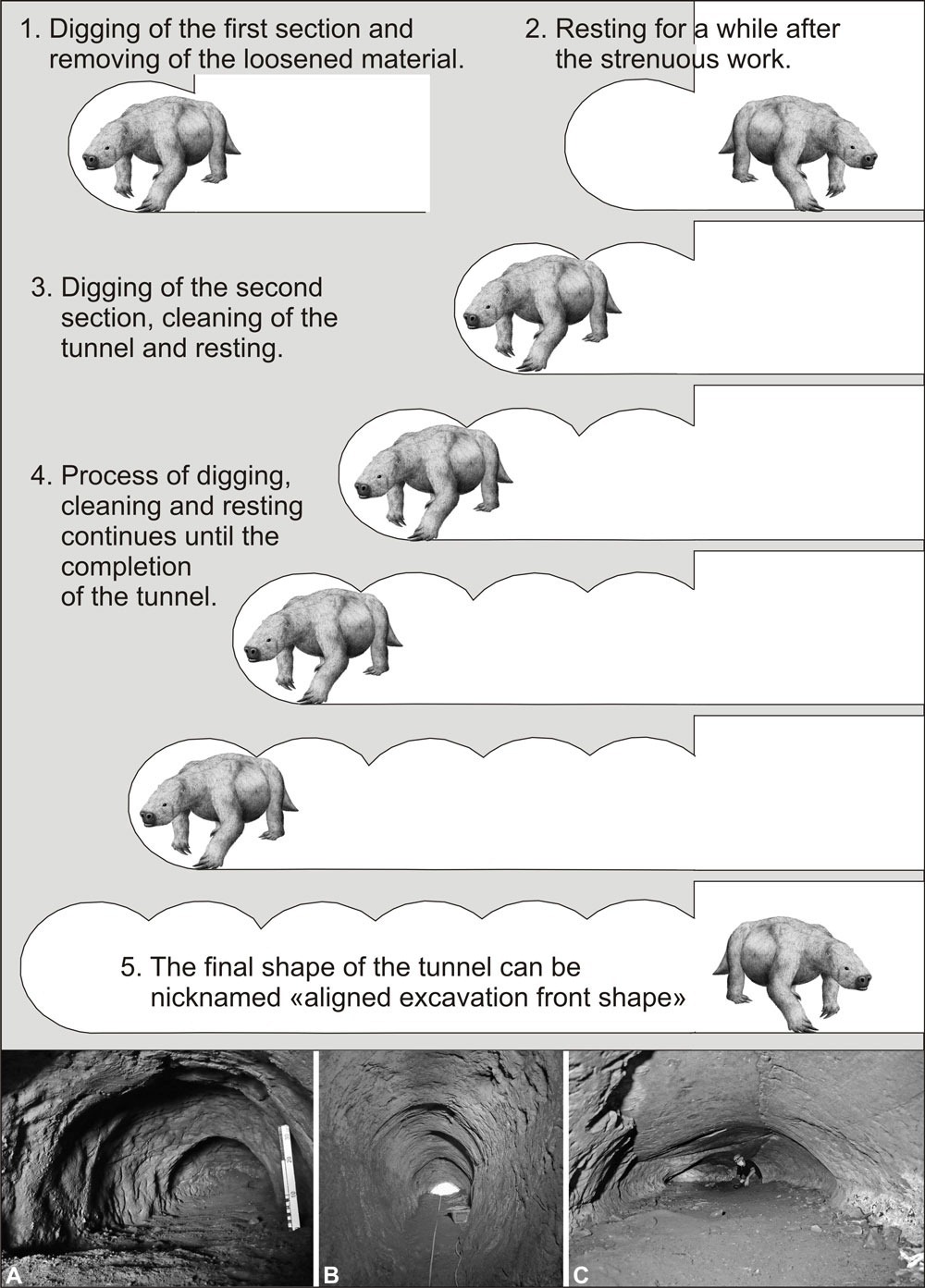
Inside the first paleoburrow discovered in the Amazon. It’s nearly twice as large as the second-largest known burrow, located elsewhere in Brazil. Photo Credit: Amilcar Adamy/CPRM
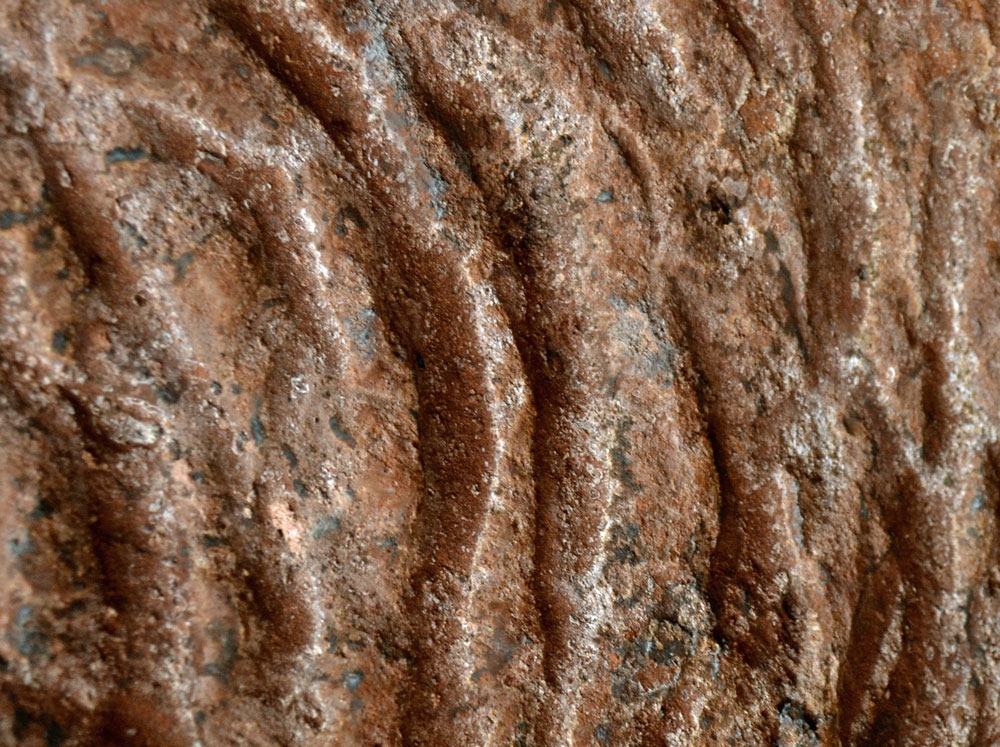
A closer look at those claw marks. Photo credit: Heinrich Frank
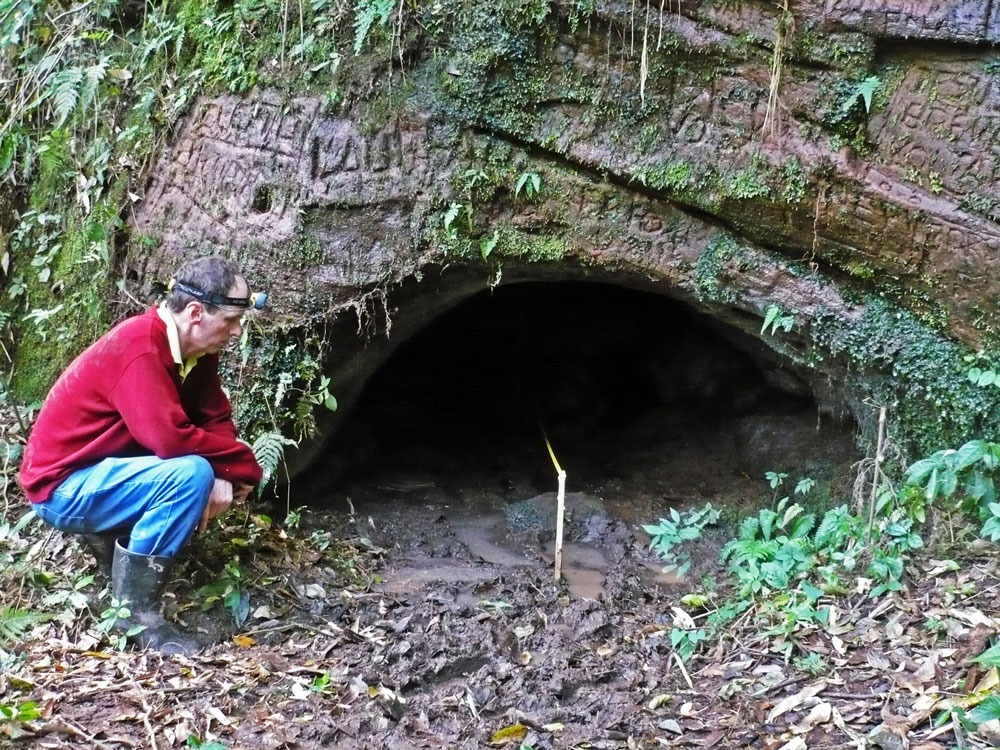
Outside the entrance to a paleoburrow. Photo credit: Heinrich Frank
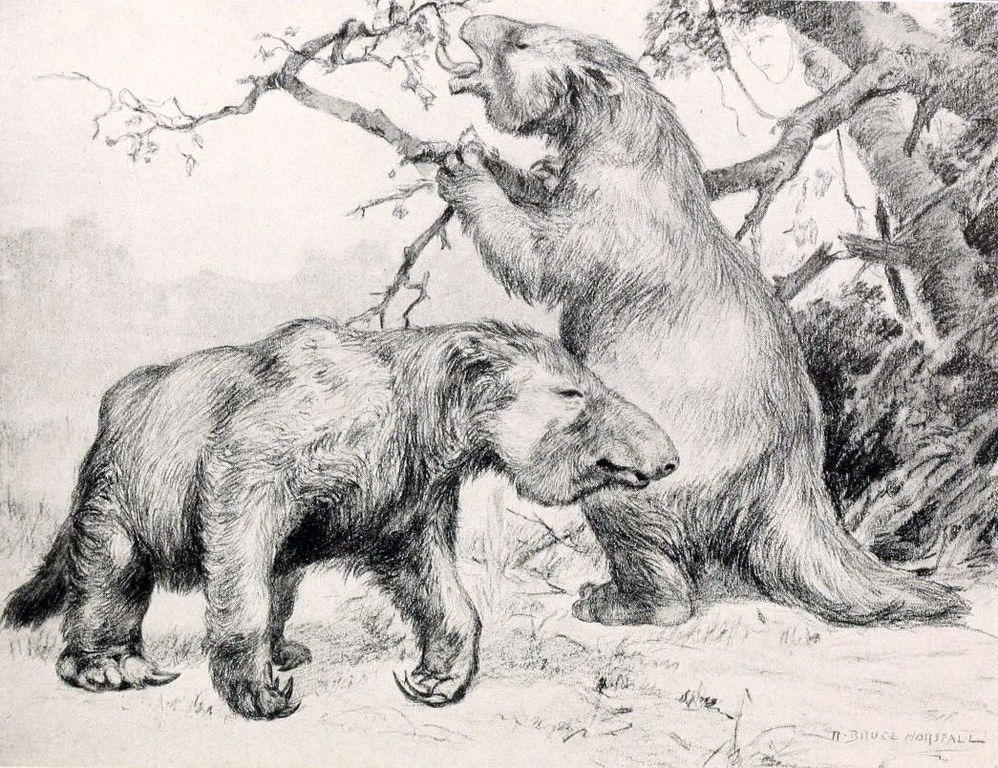
Megatherium americanum, the giant sloth.
Megatherium americanum (Giant Ground Sloth) is one of the largest land mammals known to have existed, weighing up to 4 t (4,000 kg; 4.4 short tons; 8,800 lb; 630 st) and measuring up to 6 m (20 ft) in length from head to tail. It is the largest-known ground sloth, almost as big as modern african elephants, and would have only been exceeded in its time by a few species of mammoth. Megatherium species were members of the abundant Pleistocene megafauna, large mammals that lived during the Pleistocene epoch.

“Dead Skunk” is a 1972 novelty song by Loudon Wainwright III. Released as a single in November 1972, it eventually peaked at number 16 on the Billboard charts on March 31, 1973. The song appears on Wainright’s 1972 album Album III.

The song is musically a simple folk song based on banjo, but accompanied by guitar, drums and fiddle. The lyrics describe a dead skunk in the middle of a busy road and the smell it produces for people as they drive by. Wainwright has said that the song came out of an actual accident involving a skunk, and that he wrote it afterward in 15 minutes. (“Someone had already killed it, but I ran over it.”)
Crossing the highway late last night
He shoulda looked left and he shoulda looked right
He didn’t see the station wagon car
The skunk got squashed and there you are
You got your dead skunk in the middle of the road
Dead skunk in the middle of the road
Dead skunk in the middle of the road
Stinking to high heaven
Take a whiff on me, that ain’t no rose
Roll up your window and hold your nose
You don’t have to look and you don’t have to see
‘Cause you can feel it in your olfactory
You got your dead skunk in the middle of the road
Dead skunk in the middle of the road
Dead skunk in the middle of the road
And it’s stinking to high heaven
Yeah, you got your dead cat and you got your dead dog
On a moonlight night, you got your dead toad frog
Got your dead rabbit and your dead raccoon
The blood and the guts, they’re gonna make you swoon
You got your dead skunk in the middle
Dead skunk in the middle of the road
Dead skunk in the middle of the road
Stinking to high heaven
C’mon, stink
You got it, it’s dead, it’s in the middle
Dead skunk in the middle
Dead skunk in the middle of the road
Stinking to high heaven
All over the road
Technicolor
Oh, you got pollution
It’s dead, it’s in the middle
And it’s stinking to high, high heaven

| State | Sightings | State Population | Sightings per 100k |
|---|---|---|---|
| Washington | 676 | 7,614,893 | 8.9 |
| California | 445 | 39,512,223 | 1.1 |
| Florida | 328 | 21,477,737 | 1.5 |
| Ohio | 302 | 11,689,100 | 2.6 |
| Illinois | 296 | 12,671,821 | 2.3 |
| Oregon | 254 | 4,217,737 | 6 |
| Texas | 246 | 28,995,881 | 0.8 |
| Michigan | 220 | 9,986,857 | 2.2 |
| Missouri | 154 | 6,137,428 | 2.5 |
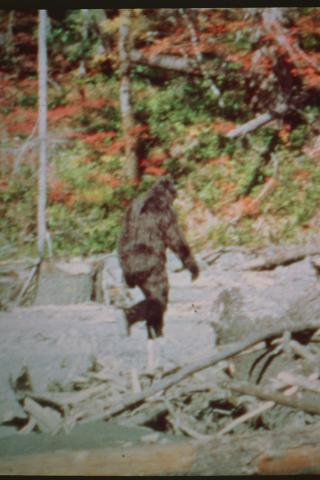
Approximately 5,000 reported sightings in the United States. Some people interested in the subject argue that there are many more sightings: the unreported ones. They put forward the idea that only a small percentage of people that think they saw a Bigfoot make a report. Most people that see something like that want to avoid being ridiculed, so they keep it to themselves. Some estimates put the actual reported sightings at between 10-40 percent of all sightings. Lets go to middle and say 25 percent are reported. Then you can times the 5,000 by 4. This is all conjecture, but then you have 20,000 sightings!
With today’s technology, cameras, drones etc., there should be more good sightings. But this technology is a two edged sword. The technology also creates better fakes, hoaxes and CGI images. There are very intereting videos and photos out there. But are they real or elaborate hoaxes.
Video below is very intriguing. The end of this video shows the actual footage.
Master, what the hell is taking you so long? I’m hungry.
This one is honking and howling at the same time.
The extinct superpredator megalodon was big enough to eat orcas, scientists say
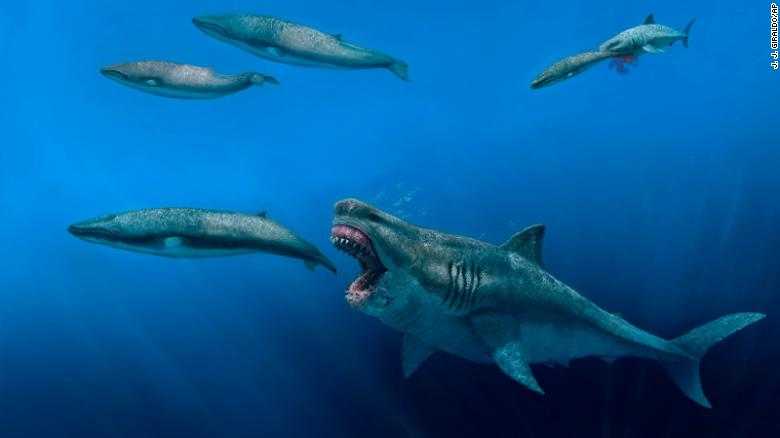
This illustration depicts a 52-foot Otodus megalodon shark predating on a 26-foot Balaenoptera whale in the Pliocene epoch, between 5.4 to 2.4 million years ago.
(CNN)Faster than any shark alive today and big enough to eat an orca in just five bites: A new study suggests the extinct shark known as a megalodon was an even more impressive superpredator than scientists realized before.
The Otodus megalodon, the inspiration behind the 2018 film “The Meg,” lived more than 23 million years ago. Fossils of the extinct giant are hard to come by: While there are plenty of fossilized shark teeth, their bodies mainly consist of cartilage rather than bones, and are rarely preserved.
A research team led by Jack Cooper, a paleobiologist at Swansea University, set out to use 3D modeling from a rare and exceptionally well-preserved megalodon spinal column to extrapolate information about the shark’s movement and behavior. Their research was published in Science Advances Wednesday.
“We estimate that an adult O. megalodon could cruise at faster absolute speeds than any shark species today and fully consume prey the size of modern apex predators,” wrote the researchers.
Most of what we know about megalodons come from scientific inferences: Scientists have estimated the extinct sharks could be as long as 65 feet through a comparison with great white sharks, thought of as their “best available ecological analog,” since they both occupy the top rung in the food chain, according to the article.
The researchers used a megalodon vertebral column from Belgium, a tooth from the United States, and the chondrocranium — the cartilaginous equivalent of a skull — from a great white shark to build their 3D skeleton. Then they used a full-body scan of a great white shark to estimate how flesh would sit on the megalodon’s skeleton.
With a complete 3D rendering, they came up with estimates for the volume and body mass of the shark’s whole body. By comparing the figures to the size of modern sharks, they estimated the shark’s swimming speed, stomach value, calorie needs, and prey encounter rates.
The megalodon they modeled would have been almost 16 meters, or 52 feet, long. It weighed around 61,560 kilograms, or 135,717 pounds, according to their estimates.
They estimated the megalodon would have been able to devour prey the size of orca whales — which can be up to 26 feet long and weigh over 8,000 pounds — in just five bites.
Prey the size of a modern humpback whale would have been too big for a megalodon to eat in full, according to the researchers. Eating large prey may have given the megalodon a competitive edge over other predators. Eating large amounts at a time would have also allowed them to travel great distances without eating again, much like modern great white sharks.
An adult megalodon would have needed to eat a whopping 98,175 calories per day, 20 times higher than an adult great white shark. They could have met their energetic needs by eating around 31.9 kilograms of shark muscle, according to the researchers’ estimates.
The megalodon was also faster than any shark alive, with a theoretical average cruising speed of around 3.1 mph. This speed would have allowed it to encounter more prey, helping it meet its massive caloric demands.
Overall, the data extrapolated from the 3D model paints the portrait of a “transoceanic superpredator,” say the researchers.
Luckily, today’s orcas don’t have to worry about running into the massive shark. The megalodon went extinct around 3.6 million years ago, according to the United Kingdom’s Natural History Museum, for reasons scientists are still trying to understand.
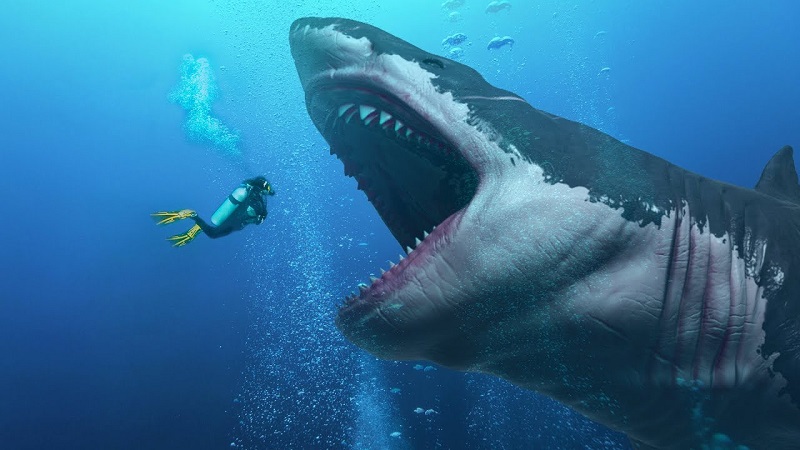
“The Meg” 2018 movie.

 The MarkoZen Blog