
Wiring an IBM computer 1958


Now this is camping.


An odd castle house in Versailles, Kentucky.


Wiring an IBM computer 1958
Now this is camping.
An odd castle house in Versailles, Kentucky.

Neuschwanstein Castle is a 19th-century Romanesque Revival palace on a rugged hill above the village of Hohenschwangau near Füssen in southwest Bavaria, Germany. The palace was commissioned by King Ludwig II of Bavaria as a retreat and in honour of Richard Wagner. Ludwig paid for the palace out of his personal fortune and by means of extensive borrowing, rather than Bavarian public funds.
The castle was intended as a home for the King, until he died in 1886. It was open to the public shortly after his death. Since then more than 61 million people have visited Neuschwanstein Castle. More than 1.3 million people visit annually, with as many as 6,000 per day in the summer.

The effect of the Neuschwanstein ensemble is highly stylistic, both externally and internally. The king’s influence is apparent throughout, and he took a keen personal interest in the design and decoration. An example can…
View original post 257 more words

A severe cold wave has gripped many parts of northern India, with temperatures plummeting to -6C (21F) in Indian-administered Kashmir. The famous Dal Lake, as seen in the picture above, has partially frozen, making it hard for boatmen to ferry passengers and tourists.

Water pipelines have frozen in some parts of Kashmir, road transport has been severely affected and supply chains have been disrupted, making it hard for local communities to meet their daily needs.

India’s capital Delhi has also been reeling under a severe cold wave. Some areas of Delhi have recorded temperatures as low as 2.2C. The cold snap has been particularly hard for Delhi’s homeless people who mostly sleep on pavements.

Dropping temperatures and dense fog have also disrupted train schedules. India Railways carries some 23 million passengers daily and it’s considered the backbone of the country’s transport system. Several trains have been running late – sometimes by six to 10 hours – in northern India, throwing people’s travel plans into chaos.

The cold wave has also been causing serious health issues, especially in Delhi which also sees severe pollution levels during winter months.

The north-western state of Rajasthan has also been witnessing a severe drop in temperatures. Farmers there say it has affected their work and harvests.

The holy city of Amritsar has also been engulfed in dese fog in the past few days. Transport services, including trains and buses, have been badly hit.
BBC

Antelope Canyon is a slot canyon (vary narrow canyon) in the American Southwest. It is located on Navajo land east of Page, Arizona. Antelope Canyon includes two separate, photogenic slot canyon sections, referred to individually as Upper Antelope Canyon or The Crack; and Antelope Canyon or The Corkscrew.
The Navajo name for Upper Antelope Canyon is Tsé bighánílíní, which means “the place where water runs through rocks.” Lower Antelope Canyon is Hazdistazí (advertised as “Hasdestwazi” by the Navajo Parks and Recreation Department), or “spiral rock arches.” Both are located within the LeChee Chapter of the Navajo Nation.

Antelope Canyon was formed by erosion of Navajo Sandstone, primarily due to flash flooding and secondarily due to other sub-aerial processes. Rainwater, especially during monsoon season, runs into the extensive basin above the slot canyon sections, picking up speed and sand as it rushes into the narrow passageways. Over time the…
View original post 322 more words

Anomaly Six (A6) is an American media intelligence company. It sells global-location-data products to the United States government and the private sector. The company has embedded its software in over 500 mobile applications, giving it the ability to track hundreds of millions of mobile phones. In one presentation, the company claimed it could track 3 billion phones in real time.
The company was founded in 2018 by two former military intelligence officers. It is based in Alexandria, Virginia.
The company purchases cell phone location data from advertisers who in turn get the information from embedded software development kits (SDK) in commonly used phone applications. The publishers of apps frequently allow third parties to insert SDKs into their apps for a fee. Some of the apps have Anomaly Six’s own SDK embedded in them. This system often relies on disclosures in the complex terms of service that must be agreed to in order to use an application. Most apps’ privacy policies do not disclose whether or not SDKs are embedded in their product.

In September 2020, U.S. Special Operations Command Africa, an operational unit of the United States Special Operations Command, paid Anomaly 6 $589,500 for a “Commercial Telemetry Feed”. This is the first reported contract between the United States government and Anomaly 6.
In April 2022, it was revealed that the company had demonstrated its surveillance ability by tracking the mobile phones of members of the CIA and NSA. The company revealed the tracking during a meeting between A6 and Zignal Labs. The two companies were in talks to discuss a potential partnership, which they decided not to proceed on.
They are watching you. This goes against privacy rights and norms. However, they have to keep tabs on radical suicidal terrorists.
Animal trainer Mark Dumas plays with a polar
bear named Agee

Mark Dumas plays with a 16-year-old polar bear named Agee at his home in Abbotsford, British Columbia, Canada.

Mark has an intimate bond with Agee, and wrestles on the grass with her, kissing
her, and putting his head in her huge jaws.

The fearless 60-year-old bear handler even goes for dip in his swimming pool
where he and Agee enjoy a watery cuddle together.

Mark and his wife Dawn have owned Agee since she was six weeks old and the
colossal mammal even lived in their home as a cub where she played with the
family dogs and was bottle fed.

Mark and Dawn train the 800lb friendly beast – the world’s largest
land predator – to star in TV adverts. She has even performed in movies like
‘Alaska’ in 1995 when she was just a few weeks old.

Mark said: “If anyone else tried this they’d end up as Agee’s dinner. The only
people she likes are me and my wife Dawn.”

Mark has trained various animals for many films, including Best in Show, Alien
vs. Predator: Requiem and Fantastic Four: Rise of the Silver Surfer.


A 500-foot asteroid passing just twice the distance from Earth to the moon was recently the target of radio signals emitted by a powerful transmitter deep within the heart of Alaska, as part of an effort to enhance our ability to detect potentially deadly space objects.
The experiment, which bounced long-wavelength radio signals off the surface of the passing object to reveal information about its interior and composition, was conducted last week at Alaska’s High-frequency Active Auroral Research Program (HAARP) research facility near Gakona.

The test, which targeted an asteroid called 2010 XC15, was part of a joint research effort with NASA to prepare for the arrival of the 1,100-foot-wide asteroid Apophis in 2029. Discovered in 2004 and originally believed to pose a potential threat to Earth in the decades ahead, it is now believed that the object’s close approach will not pose any direct threat to Earth.
Mark Haynes, a radar systems engineer at NASA’s Jet Propulsion Laboratory (JPL) and the project’s lead investigator said that last week’s experiment marked the first time an asteroid was monitored in such a way, and at such low frequencies.
The data that was collected will be analyzed in the weeks ahead, with findings from the research effort published later this year.

Haynes added that the experiment “shows the value of HAARP as a potential future research tool for the study of near-Earth objects.”
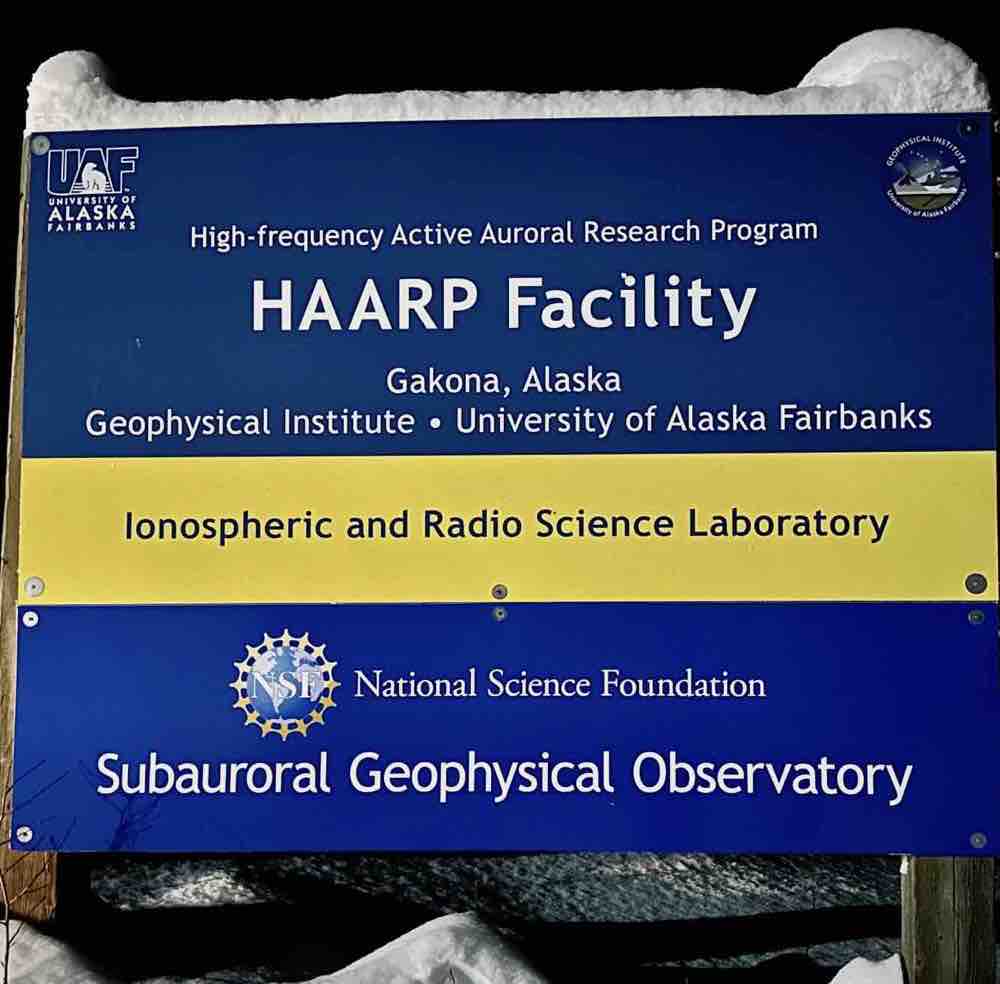
(Credit: UOA/HAARP)
Although several similar efforts involving planetary defense against asteroid impacts are currently underway, the long wavelength radio signals that HAARP employs can also provide information about the interior of such objects, not just their exterior shape and size.
Understanding the composition of asteroids and other details about their makeup and interior could potentially provide crucial data in future efforts toward defending against such an object, should one ever pose a direct threat to our planet.
According to NASA, each year at least one car-sized asteroid will collide with Earth’s atmosphere, burning up before ever striking the surface and producing a vivid fireball as it streaks through the sky during reentry.
However, larger asteroids approaching the size of a modern football field also strike the Earth every couple of thousand years. Fortunately, objects large enough to cause widespread cataclysmic damage to our planet only cross paths with us every few million years.
Still, preparing for such eventualities had been the driving force behind the successful first test of NASA’s Double Asteroid Redirection Test mission, or DART, on September 26, 2022.
Also earlier this year, tests similar to those conducted at the HAARP facility last week succeeded in bouncing long-wavelength radio signals off the surface of the Moon, whose size, distance, and predictable orbital path around the Earth makes it a much easier target than distant asteroids passing near our planet.
Following Tuesday’s experiment, more than 300 reception reports from citizen scientists tracking the effort were logged, according to HAARP program manager Jessica Matthews, who said in a press release that data has been provided “from the amateur radio and radio astronomy communities from six continents who confirmed the HAARP transmission.”
A joint program of the University of Alaska Fairbanks and military partners that include the U.S. Air Force, Navy, and the Defense Advanced Research Projects Agency (DARPA), HAARP was originally conceived as a program to study the thin layer of Earth’s atmosphere between 50 and 600 miles from Earth known as its ionosphere for its potential use in surveillance and radio communications.
Long a target of unfounded conspiracy theories, the HAARP facility has been operated by the University of Alaska at Fairbanks since 2015.
A couple in England could not believe their eyes when they spotted a bizarre two-legged fox frolicking in their backyard. According to a local media report, the curious creature appeared outside the home of Philip and Jane Carter in the community of Ilkeston last month as they were setting up their Christmas tree. “My wife shouted to me to come to the window quick because I wouldn’t believe” what was in their backyard, he recalled, musing that her assertion proved to be correct when he saw a two-legged fox that was remarkably adept at moving in a bipedal fashion.
The peculiar creature remained in their backyard for approximately 45 minutes before it fled the scene when the couple tried to feed it. “It blew my mind,” he said, “it was so strange to just see him go vertical with his tail, just put his head forward and walked off like that.” What was particularly astounding to the Philip was the speed with which the two-legged animal moved. “At one point he ran over to the gate, and I mean run, vertically, straight up,” he marveled, “you wouldn’t believe it unless you’d seen it. It’s absolutely phenomenal.”
Fortunately, the gobsmacked man managed to capture the jaw-dropping creature on film with his cell phone and the video (seen above) has subsequently gone viral. While it is uncertain exactly how the fox wound up with only two legs, a wildlife expert who viewed the footage surmised that whatever caused the condition likely occurred quite some time ago as the animal did not appear to be injured and seems to have adapted to being bipedal.

.

.

.

.

.

.

.

.

.

.

.

.

.

 The MarkoZen Blog