There are radio and TV commercials going around where pizza restaurants have satisfied customers moaning and groaning when they taste the delicious pizza pies. Oomm, ahh this is so good. Obviously the commercials are bias and the actor customers are over doing it. But when it comes to enjoying a tasty morsel, nothing beats Snuffle the Floating Dog.
Snuffles is an anthropomorphic cartoon dog appearing in animated television shorts produced by Hanna-Barbera beginning in 1959 on The Quick Draw McGraw Show.
Snuffles is a bloodhound used by Quick Draw McGraw to ferret out bad guys in the old West but needed to be bribed with a dog biscuit before performing his task. Upon chomping on one, he would hug himself in ecstasy, jump into the air and float back down, sighing. Occasionally, Snuffles would demand more than one biscuit, and was willing to accept them from bad guys as well. In several cases when Quick Draw did not have a dog biscuit to offer due to being out of them or if he tried to give Snuffles the reward cash for capturing an outlaw, Snuffles would either shake his head and say “Uh-uh” or grunt to himself and mumble “Darn cheapskate!” as well as sometimes throwing the reward money back in Quick Draw’s face.
For some reason the dialogue in the video above was in something that sounds like Russian.
Hansel and Gretel have over reactive taste buds as well.
To the outside world, Genghis Khan, the fearsome Mongolian warrior who conquered half the known world in the 13th century, is remembered for his brutalities and destruction that he brought upon the conquered regions resulting in the death of forty million people. But to Mongolians, he is a national hero, a larger-than-life figure and the symbol of Mongolian culture, and for good reasons. Genghis Khan founded the Mongol Empire, which became the largest contiguous empire in history, revived the Silk Road, uniting warring tribes and was responsible for cementing the position of Mongols in the world’s map.
After Mongolia overthrew communist rule more than 20 years ago, there appeared a slew of monuments and products celebrating the famous personage known locally as Chinggis Khaan. Mongolia’s main international airport in Ulaanbaatar is named Chinggis Khaan International Airport, students attend Chinggis Khaan University and tourists can stay at the Chinggis Khaan Hotel. His face can be found on everyday commodities, from liquor bottles to candy products, and on bank notes.
In 2008, a gigantic statue of Genghis Khan riding on horseback was erected on the bank of the Tuul River at Tsonjin Boldog, 54 km east of the Mongolian capital Ulaanbaatar, where according to legend, he found a golden whip. The statue is 40 meters tall and wrapped in 250 tons of gleaming stainless steel. It stands on top of the Genghis Khan Statue Complex, a visitor center that itself is 10 meters tall, with 36 columns representing the 36 khans from Genghis to Ligdan Khan. The statue is symbolically pointed east towards his birthplace.
Inside the two-story base of the statue, visitors can see a replica of Genghis Khan’s legendary golden whip, sample traditional cuisine of horse meat and potatoes, or play billiards. Visitors can ascend to the exhibition hall using an elevator at the back of the horse and then walk to the horse’s head passing through its chest and the back of its neck from where they can have an excellent panoramic view over the complex area and the scenery beyond.
The Chinggis Khan Statue is currently the biggest equestrian statue in the world.
An angler from England made a monstrous catch in the form of an enormous goldfish that weighed a whopping 67 pounds and, until now, had managed to avoid being captured for a staggering 20 years. Andy Hackett reportedly snagged the remarkable creature while fishing at a lake in Champagne, France earlier this month. “I knew it was a big fish when it took my bait and went off side to side and up and down with it,” he recalled, “then it came to the surface 30 or 40 yards out and I saw that it was orange.” It was at that point that Hackett realized he was tangling with a legendary denizen of the lake that had come to be known as ‘The Carrot.’
According to the manager of the fishery where it resides, the creature had been deposited into the location around two decades ago “as something different” for visitors to try and catch. However, the hybrid species of leather and koi carp turned out to be rather tough to snag and, in the ensuing 20 years, the goldfish grew to its now epic-size. The presence of the wondrous fish was well-known among anglers at the lake as, like the Loch Ness Monster, the elusive creature had occasionally been seen by awestruck observers, which led to it being given its unique name.
To that end, Hackett marveled that “I always knew The Carrot was in there, but never thought I would catch it.” However, those doubts were dispelled when he felt the tremendous strength of the creature on the end of his line and spotted its distinct orange coloring. After an arduous 25-minute long battle, he hauled in the fishery’s famous resident, which was determined to weigh a little over 67 pounds. Crediting the catch to “sheer luck,” Hackett posed for a few photos with The Carrot before, commendably, releasing the giant goldfish back into the lake.
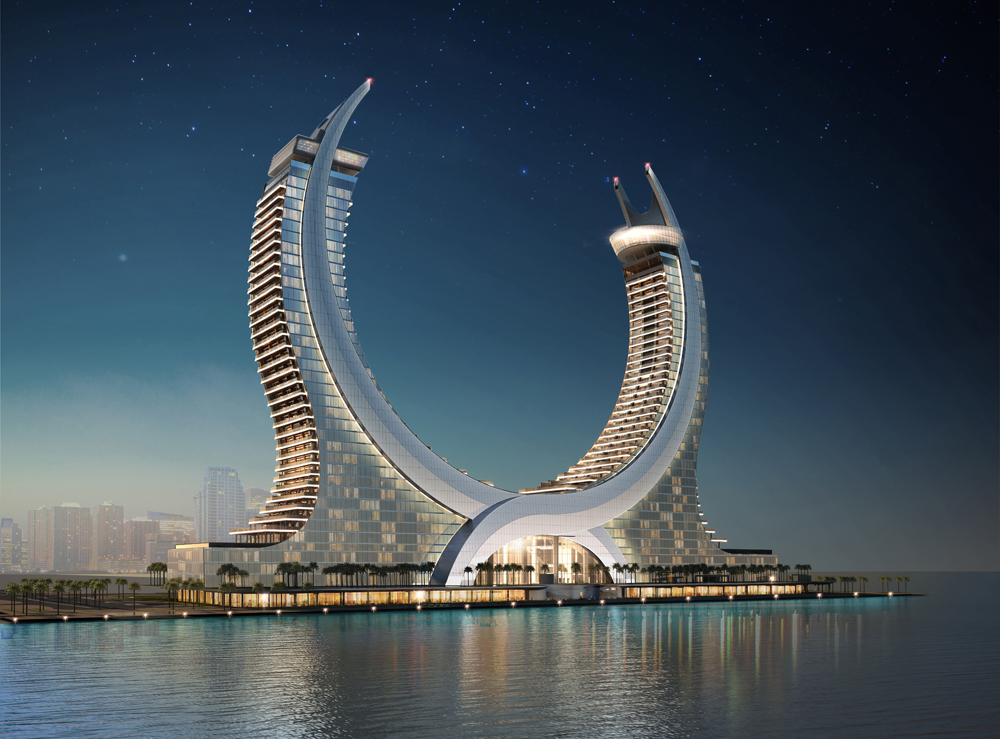
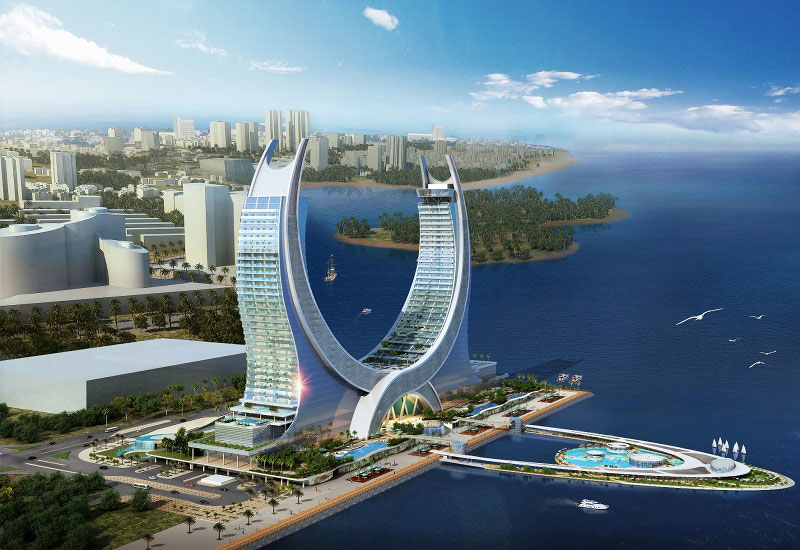
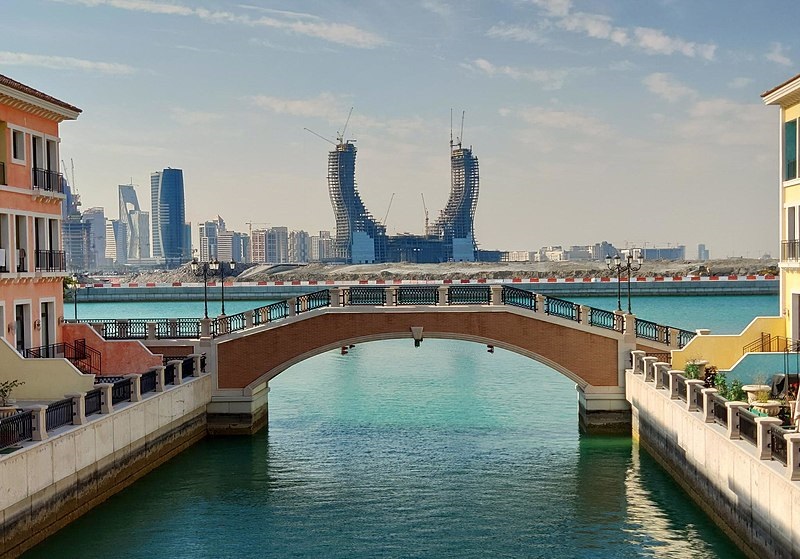
Katara Towers is a skyscraper in Lusail, Qatar. It is 211 meters (692 feet) tall and has 40 floors. It was completed in 2022, will boast two luxury hotels, plus apartments, office space, shops and restaurants.
Lusail is the second-largest city in Qatar, located on the coast, in the southern part of the municipality of Al Daayen. Lusail is located about 23 kilometres (14 mi) north of the city centre of Doha, just north of the West Bay Lagoon, on over 38 square kilometres (15 sq mi) and will eventually have the infrastructure to accommodate 450,000 people. Of these 450,000 people, it is estimated that 250,000 or fewer will be residents, 190,000 will be office workers and 60,000 will be retail workers.
Katara Towers.
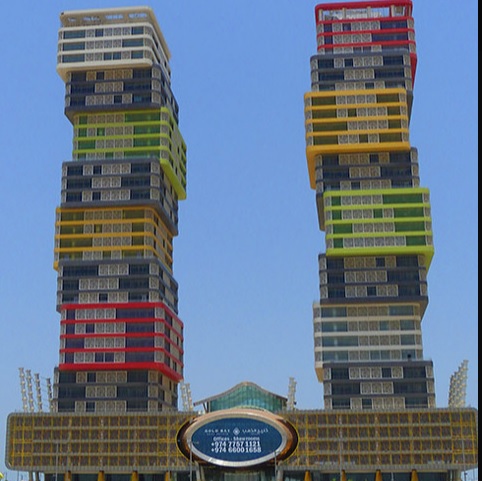
Al Marina Twin Towers is an office complex in Lusail. It was completed in 2015, is 33 stories tall and peaks out at 459 feet.
The buildings almost look like they are constructed out of Lego.
Interesting cloud formation over the South Dakota Badlands.
Young Orangutan uses a leaf for shelter during a rain storm. Bali, Indonesia.
Cheetah’s scanning for prey on a mound in Kenya. Shift change, when the second one arrived, the first one left the perch.
Wild fox at Chernobyl. Looks like it may be suffering from radiation poisoning.
Coloured mountains in China. Various minerals in the soil create the striking colours.
Massive tornado in Colorado. It narrowly missed the farm yard.
Godafoss Falls, Iceland.
Sunset in Greece.
Beautiful ice cave in Iceland.
Iranian girls on the Iran-Iraq border. A destroyed tank left over from the Iran-Iraq War of the 1980’s. The girl on top of the tank opened her arms in the direction of Iraq in a gesture of defiance.
Mother Cheetah protecting her five cubs, a sixth had been killed by a lion.
Combines in formation, Minnesota.
Beautiful fjord in Norway.
Great scenery on the Polish-Slovakian border.
Salt terraces in Peru.
Terraces in Vietnam.
Striking scenery, Albania.
Whitmore Hot Springs, California.
Wildebeests crossing a river on the Serengeti.
Residential zoning in Tibet. Except for a few holy Monk buildings, nothing gets built to the right of the line.
The Toronto Zoo released a new cute animal video Friday – this one featured its four rare white lion cubs playing with dad, Fintan.
“Our white lion cubs continue to grow and have slowly been introduced to dad Fintan,” zoo officials said. “Every weekday, keepers are working on integrating the pride with Fintan and the cubs. All cubs are over 30lbs and as you can see, they are still very active, playful and rambunctious!”
‘Blown away:’ Ingersoll, Ont., photographer captures more than just a storm in ‘perfect’ shot
Waves were a result of gales that are common during seasonal transitions, meteorologist says
Photographer Cody Evans of Ingersoll, Ont., captured wave action that resembled a famous Greek god. (Cody Evans)
Most people avoid the beach on a stormy day. Not Cody Evans.
The howling wind and churning waters are what draw the Ingersoll, Ont., photographer to Lake Erie regularly, with the mission of capturing the perfect shot — and on Nov. 18 was his lucky day.
Of the more than 10,000 photos he shot, one appeared to look like a face.
Evans said he believes it resembles the face of Poseidon, the ancient Greek god of the sea and storms.
“I was kind of blown away,” he said. “You see a lot of stuff like that in waves and in clouds, but to have it clear like that was just unreal. That photo sure stood out of all the rest.”
Since 2020, Evans has used his Nikon Z9 camera to catch the wave action at the lake, but this was an image he was not expecting to see, he said.
“It was just crazy. It was like the perfect day. I’ve been going there for three years, trying to get good shots and that was by far the best day I had there,” Evans said.
So, what was in the air that caused this phenomenon to happen?
Evans is from Ingersoll, south of London. (Submitted by Cody Evans)
Strong winds and enhanced waves
According to Environment Canada meteorologist Daniel Liota, the short answer is “November gales,” strong winds over marine areas that go faster than 64 km/h.
“The lakes this time of the year are relatively warm compared to the air above them, especially with the cold air mass that came into the Great Lakes this past weekend,” Liota said. “So that resulted in the very gusty winds over the water.”
One of the many photos Evans took of Lake Erie’s waves. (Cody Evans)
Gales are especially common during the times between the fall and winter seasons, Liota said. In this case, southwesterly winds travelled a long distance over the lake and built up those waves over the water, he added.
Evans admits windy days can be difficult on the beach especially with cold weather and sand blasts, but he made sure to wait out the snowfall to see the waves crash.
“The waves were crashing pretty good because the pier pushes the water back out into the lake so when the water is pushed back out, the waves collide and they cause those peaks,” he said.
This was due to the cold air that was prominent in the Great Lakes region that came through behind a cold front, making for unstable conditions causing some lake-effect snow.
“We usually have an active storm track that runs through the lake this time of year especially in the wake of these stronger systems that bring in cold air masses,” Liota said.
High winds causing for strong winds and enhanced waves at Lake Erie in Port Stanley, Ont. (Cody Evans)
“So we get the strong instability over the waters which results in a long of strong winds and gustiness over the great lakes hence the gales.”
Liota said there’s not much peculiarity behind these kinds of waves and they happen every year.
But Evans is determined to continue his streak of catching more of these stills at Port Stanley. “I’ll have a camera in my hands till I can’t hold one anymore honestly, I love it,” he said.



















 The MarkoZen Blog