Interesting cloud formation over the South Dakota Badlands.
Young Orangutan uses a leaf for shelter during a rain storm. Bali, Indonesia.
Cheetah’s scanning for prey on a mound in Kenya. Shift change, when the second one arrived, the first one left the perch.
Wild fox at Chernobyl. Looks like it may be suffering from radiation poisoning.
Coloured mountains in China. Various minerals in the soil create the striking colours.
Massive tornado in Colorado. It narrowly missed the farm yard.
Godafoss Falls, Iceland.
Sunset in Greece.
Beautiful ice cave in Iceland.
Iranian girls on the Iran-Iraq border. A destroyed tank left over from the Iran-Iraq War of the 1980’s. The girl on top of the tank opened her arms in the direction of Iraq in a gesture of defiance.
Mother Cheetah protecting her five cubs, a sixth had been killed by a lion.
Combines in formation, Minnesota.
Beautiful fjord in Norway.
Great scenery on the Polish-Slovakian border.
Salt terraces in Peru.
Terraces in Vietnam.
Striking scenery, Albania.
Whitmore Hot Springs, California.
Wildebeests crossing a river on the Serengeti.
Residential zoning in Tibet. Except for a few holy Monk buildings, nothing gets built to the right of the line.
The Toronto Zoo released a new cute animal video Friday – this one featured its four rare white lion cubs playing with dad, Fintan.
“Our white lion cubs continue to grow and have slowly been introduced to dad Fintan,” zoo officials said. “Every weekday, keepers are working on integrating the pride with Fintan and the cubs. All cubs are over 30lbs and as you can see, they are still very active, playful and rambunctious!”
‘Blown away:’ Ingersoll, Ont., photographer captures more than just a storm in ‘perfect’ shot
Waves were a result of gales that are common during seasonal transitions, meteorologist says
Photographer Cody Evans of Ingersoll, Ont., captured wave action that resembled a famous Greek god. (Cody Evans)
Most people avoid the beach on a stormy day. Not Cody Evans.
The howling wind and churning waters are what draw the Ingersoll, Ont., photographer to Lake Erie regularly, with the mission of capturing the perfect shot — and on Nov. 18 was his lucky day.
Of the more than 10,000 photos he shot, one appeared to look like a face.
Evans said he believes it resembles the face of Poseidon, the ancient Greek god of the sea and storms.
“I was kind of blown away,” he said. “You see a lot of stuff like that in waves and in clouds, but to have it clear like that was just unreal. That photo sure stood out of all the rest.”
Since 2020, Evans has used his Nikon Z9 camera to catch the wave action at the lake, but this was an image he was not expecting to see, he said.
“It was just crazy. It was like the perfect day. I’ve been going there for three years, trying to get good shots and that was by far the best day I had there,” Evans said.
So, what was in the air that caused this phenomenon to happen?
Evans is from Ingersoll, south of London. (Submitted by Cody Evans)
Strong winds and enhanced waves
According to Environment Canada meteorologist Daniel Liota, the short answer is “November gales,” strong winds over marine areas that go faster than 64 km/h.
“The lakes this time of the year are relatively warm compared to the air above them, especially with the cold air mass that came into the Great Lakes this past weekend,” Liota said. “So that resulted in the very gusty winds over the water.”
One of the many photos Evans took of Lake Erie’s waves. (Cody Evans)
Gales are especially common during the times between the fall and winter seasons, Liota said. In this case, southwesterly winds travelled a long distance over the lake and built up those waves over the water, he added.
Evans admits windy days can be difficult on the beach especially with cold weather and sand blasts, but he made sure to wait out the snowfall to see the waves crash.
“The waves were crashing pretty good because the pier pushes the water back out into the lake so when the water is pushed back out, the waves collide and they cause those peaks,” he said.
This was due to the cold air that was prominent in the Great Lakes region that came through behind a cold front, making for unstable conditions causing some lake-effect snow.
“We usually have an active storm track that runs through the lake this time of year especially in the wake of these stronger systems that bring in cold air masses,” Liota said.
High winds causing for strong winds and enhanced waves at Lake Erie in Port Stanley, Ont. (Cody Evans)
“So we get the strong instability over the waters which results in a long of strong winds and gustiness over the great lakes hence the gales.”
Liota said there’s not much peculiarity behind these kinds of waves and they happen every year.
But Evans is determined to continue his streak of catching more of these stills at Port Stanley. “I’ll have a camera in my hands till I can’t hold one anymore honestly, I love it,” he said.
While calculating the number of guns in private hands around the world is difficult, figures from the Small Arms Survey – a Swiss-based leading research project – estimate that there were 390 million guns in circulation in 2018.
The US ratio of 120.5 firearms per 100 residents, up from 88 per 100 in 2011, far surpasses that of other countries around the world.
More recent data also suggests that gun ownership grew significantly over the last several years. One study, published by the Annals of Internal Medicine in February, found that 7.5 million US adults – just under 3% of the population – became first new gun owners between January 2019 and April 2021.
This, in turn, exposed 11 million people to firearms in their homes, including 5 million children. About half of new gun owners in that time period were women, while 40% were either black or Hispanic.
A separate study, published by the American Academy of Pediatrics in 2021, linked a rise in gun ownership during the pandemic to higher rates of gun injuries among – and inflicted by – children.
How do US gun deaths break down?
According to the US Centers for Disease Control and Prevention (CDC), a total of 45,222 people died from gun-related injuries of all causes during 2020, the last year for which complete data is available.
And while mass shooting and gun murders generally garner more media attention, of the total, 54% – about 24,300 deaths – were suicides.
A 2016 study published in the American Journal of Public Health found there was a strong relationship between higher levels of gun ownership in a state and higher firearm suicide rates for both men and women.
Advocates for stricter gun laws in the United States often cite this statistic when pushing lawmakers to devote more resources to mental health and fewer to easing gun restrictions.
How do US gun killings compare with other countries?
Are mass shootings becoming deadlier? Deaths from the “mass shootings” that attract international attention, however, are harder to track.
While the country does not have a single definition for “mass shootings”, the FBI has for over a decade tracked “active shooter incidents” in which “an individual actively engaged in killing or attempting to kill people in a populated area”.
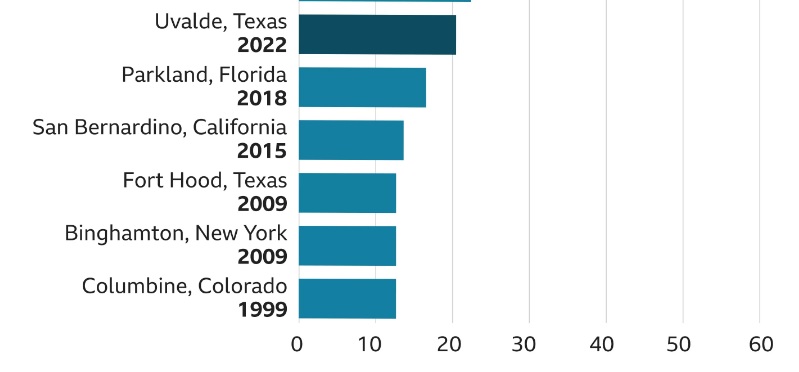
According to the FBI, there were 345 “active shooter incidents” in the United States between 2000-2020, resulting in more than 1,024 deaths and 1,828 injuries.
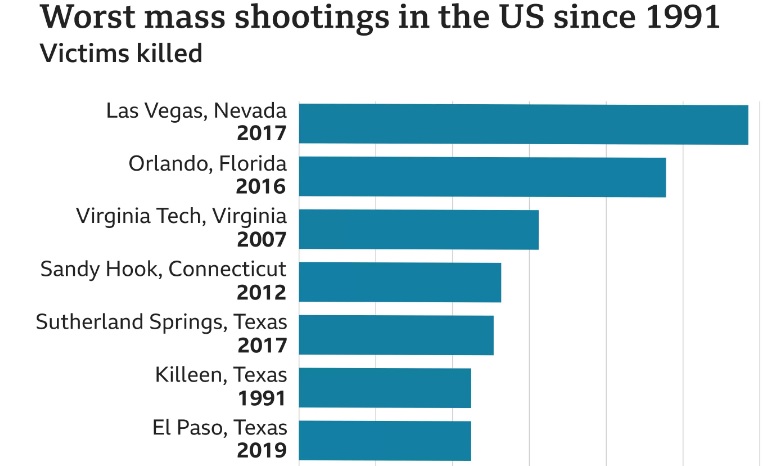
The deadliest such attack, in Las Vegas in 2017, killed more than 50 people and left 500 wounded. The vast majority of mass shootings, however, leave fewer than 30 people dead.
Many people who do not have English as their first language struggle to speak the language. But most newfangled speakers of English seem to master the language over a few years. Except for one group.
The French seem to have a hard time with certain pronunciation nuances of English. A university professor from Montreal who rarely speaks English can sound like a back bush billy when trying to speak the language. Third turns into turd, over there turns into hover dare, hockey becomes auckey and cows can become cowses. I’m not quite sure why this is.
Actually, I think it is because hard-core French people never think in anything but French. Even though they understand and can speak English, they never think in English. Even when they do speak English they are thinking in French and interpreting their thoughts into English words. It gets very complicated.
Gilles Duceppe provides a brief yet concise illustration of this phenomenon.
Stop fighting heach odder.
And this joke also clarifies this occurrence.
In Quebec , the French do not pronounce the letter ‘H’. For example Hot Dog is pronounced Ot Dog and Hudson Hardware is pronounced Udson Ardware. They also insert an ‘H’ where there is none, by saying Hany (instead Of Any) and Hall (instead of All). This explanation is for non-Canadians.
One day in a French Immersion Class for 1st graders, the teacher was asking her class to describe the use of Ozonol. Little Mary got up and explained that she had fallen while roller skating and scratched her knee. She went home and her Mother cleaned the cut and put a bandage with Ozonol on her knee and it was all better. The teacher was so proud and then asked other children if they had any explanation of the word. Little Pierre raised his hand and started to explain. ‘Well Teacher, da udder nite, me an my fodder are watching da Montreal and Tampa Ockey Game. An den my mudder start to do da vaccum. Den, my fodder, yell at my mudder, ai, ai, ai, ai, Tabarnack Louise, put dat dam ting haway now or I’ll stick it up your hass …..Ose an all’.
It is a hybrid game that combines pool and soccer together, by replacing pool balls with soccer balls and the pool cue with a pair of shoes.
Originated from France
Played on a giant blow-up version of the pool table that is 3.6 by 6.6 meters!
Has 2 variations – the game of 8 and the game of 9.
The soccer balls used are 2 types of size 3 balls: weighted white ball and non-weighted colored balls.
Set Up
As in pool games, 15 numbered balls are arranged using a triangle. The 1 ball is placed at the top of the triangle, and the 8 ball is placed in the middle of the third row, leaving all rest randomly placed around the 8 ball.
How it’s played
The player that pockets the first ball get to choose which target ball group, solid or striped. The first player to pocket all the balls of his/her group, then the #8 ball, wins the game. During the game, a player continues playing as long as each strike pockets his/her own balls and doesn’t commit any faults.
The wacky sport is the brainchild of a couple of French entrepreneurs – Aurélien and Samuel – who are well known for their weird ideas.





















 The MarkoZen Blog