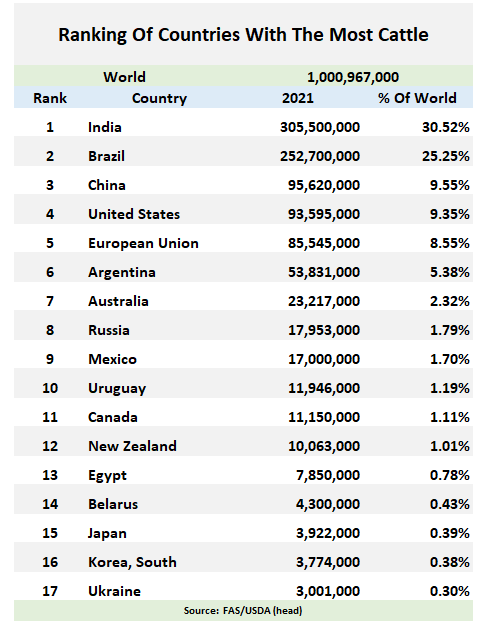
Ever wonder where all the cattle are in the world? The chart below will quench that curiosity. Most countries raise cattle for food, but in some countries they are treated with more dignity. Hindus regard the animals as sacred and will not kill or eat them.
In India a large population of cows wanders freely through both rural areas and city streets, undisturbed by the millions of hungry and malnourished people. They are used as draft animals however.
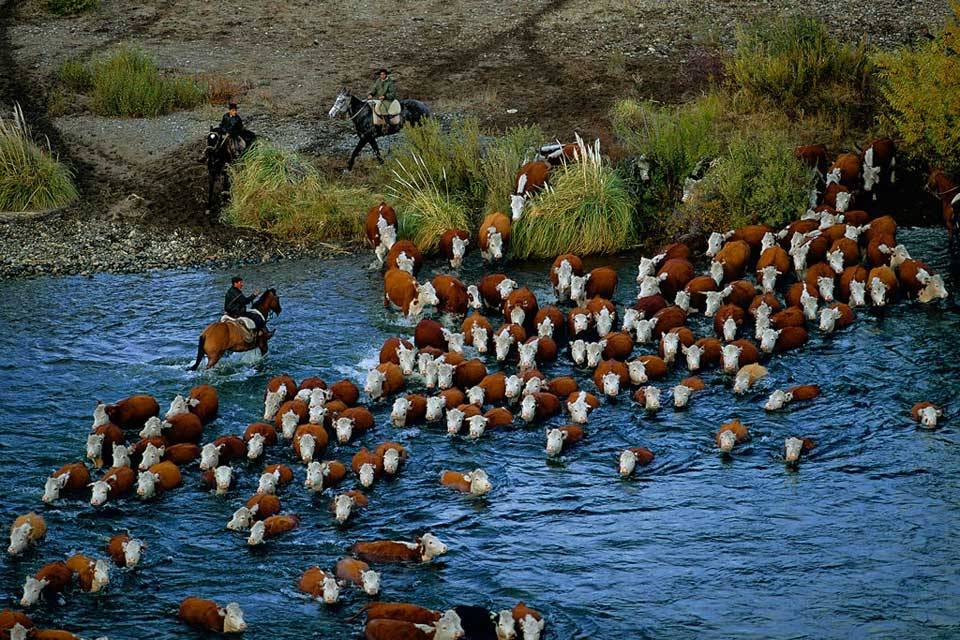
Herd of cattle in South America.
World cattle populations
African cattle.
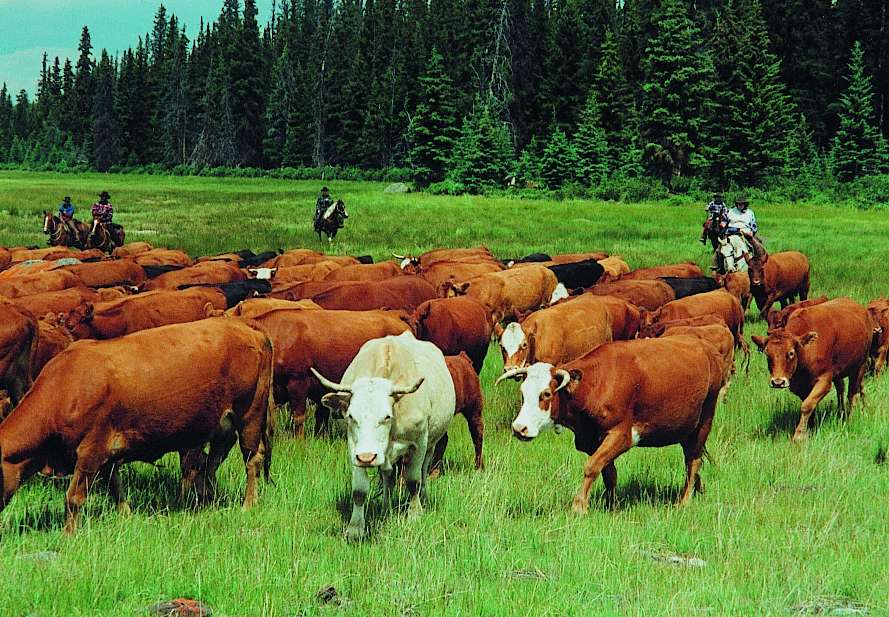
Herd of cattle in North America.
Cattle herd and American soldiers cross paths in Afghanistan.
There have been unsubstantiated reports that the odd cow went missing near U.S. military outposts in Afghanistan. Just after the cow was reported missing the Americans always had a large barbeque.
Aurochs: How Hitler and Goering resurrected extinct species to make ‘Nazi super cows’
Heck cattle was bred by Nazis as propaganda tools.
A breed of cow that went extinct in the 1600s but was brought back to life by Hitler has made the headlines across the UK.
Devonshire farmer Derek Gow had to slaughter most of his herd of Heck because of their “incredibly aggressive” behaviour. Some of the animals would try to kill anyone that approached and, as a result, have been turned into sausage meat.
Gow killed all but two bulls and four cows of the herd. “The ones we had to get rid of would just attack you any chance they could. They would try to kill anyone. I have worked with a range of different animals and they are far and away the most aggressive I have ever dealt with.”
Origins
Aurochs, or Bos primigenius, died out in 1627 in Poland. They were a large breed of cattle, standing up to 1.8m in height, and was ancestor to modern domestic breeds. Aurochs had huge curved horns that characterised the breed – in some the horns could reach 80cm in length – and their legs were longer than modern cattle.
Historical accounts suggests the beasts were fast and very aggressive. They were not afraid of humans, and if they were hunted would attack back in response.
Evidence suggests the wild species began to be domesticated around 8,000 years ago.
By the 13th century, populations of wild aurochs had fallen dramatically with their range restricted from human expansion. They had disappeared from Britain by 2,000 BC, but remained in eastern Europe until the 17th century.
Rise of Nazi super cows
In the 1930s, Nazi second in command Hermann Goering asked geneticists Heinz and Lutz Heck to re-create the extinct species. A keen hunter, Goering instructed them to develop a genetically engineered species by back-breeding from auroch descendants.
The Heck brothers – working independently – crossed Spanish fighting bulls with Highland cattle, along with primitive breeds from Corsica and Hungary. The result – Nazi super cows. They were used for propaganda material during WWII – their bodies were huge and muscular, with massive horns – an illustration of the strength of the party.
Hermann Goering commissioned the Heck brothers to create the species.
Gow said: “There was a thinking that you could selectively breed animals – and indeed people – for ‘Aryan’ characteristics, which were rooted in runes, folklore and legend. What the Germans did with their breeding programme was create something truly primeval.
“The reason the Nazis were so supportive of the project is they wanted them to be fierce and aggressive. When the Germans were selecting them to create this animal they used Spanish fighting cattle to give them the shape and ferocity they wanted.”
Problems and downfall
While resembling aurochs, Heck cattle never matched the size and stature of the extinct species. The brothers only ever managed to breed the cattle to the size of domestic cows. However, the physical resemblance was strong – as was the aggressive temperament.
German jackbooters with a milking cow
Neither of the Heck brothers is believed to have survived WWII, with Lutz Heck’s breed of cattle also dying out before 1945. As a result, all modern Heck breeds are descendants of Heinz Heck’s experiments, with breeds including Hungarian Grey, Highland, Corsican and Murnau-Werdenfels.
Modern Hecks
Heck bulls today measure about 1.4m in height and weight up to 600kg. Their horns, while present, are not as uniform as aurochs, curving up or out more than the original species. However, the breed is very well suited to life in the wild, able to withstand cold temperatures and nutrient-poor food.
Currently there are about 2,000 Heck cattle in Europe, with the species found roaming free in nature reserves in Barvaria and the Netherlands.
Gow said that since he slaughtered the aggressive animals, the rest of the herd is no longer murderous.
“Since they have gone it is all peaceful again. Peace reigns supreme on the farm. Despite these problems, I have no regrets at all. It has been a good thing to do and the history of them is fascinating,” he said, adding that the sausages tasted a bit like venison.
Khao Phing Kan or Ko Khao Phing Kan is an island in Thailand, in Phang Nga Bay northeast of Phuket. The islands are limestone karst towers and are a part of Ao Phang Nga National Park.
About 40 metres (130 ft) from the shores of Khao Phing Kan lies a 20-metre (66 ft) tall islet called Ko Ta Po or Ko Tapu. Since 1974, when they were featured in the James Bond movie The Man with the Golden Gun, Khao Phing Kan and Ko Ta Pu have been popularly called James Bond Island.
The Man with the Golden Gun is a 1974 spy film and the ninth in the James Bond series produced by Eon Productions, and the second to star Roger Moore as the fictional MI6 agent James Bond. A loose adaptation of Ian Fleming’s novel of the same name, the film has Bond sent after the Solex Agitator…
The Chilean Army comes by its German influences and traditions honestly, from a decent-sized influx of German immigrants during the second half of the 19th century, most of whom settled in the southern part of the country, centered around Puerto Montt, where the weather is cooler and wetter, and where dairy farms and breweries now abound. But it didn’t end with Chile. Bolivia, Columbia and Argentina all used German advisors, techniques and uniforms. Right up to the present day.
(Bolivian soldiers with stahlhelm M35 helmets and M16 assault rifles.)
(Argentine soldiers with Casco M38 helmets in the mid-1940s.)
Former US Joint Chiefs of Staff Chairman general Mike Mullen with Chilean honour guard 2012.
Chilean army 2014
German Waffen SS troops 1944
Chile
Chile
(Colombian troops on the streets of Bogota in the 1948-1949 time frame.)
Traditions are hard to break, especially military tradition.
Not to be left out of the equation, the U.S. changed their military helmets in the early 1980’s. The Advanced Combat Helmet (ACH) is the United States Army’s current combat helmet. Although very different from the German helmets, the U.S. helmet does have a similar look.
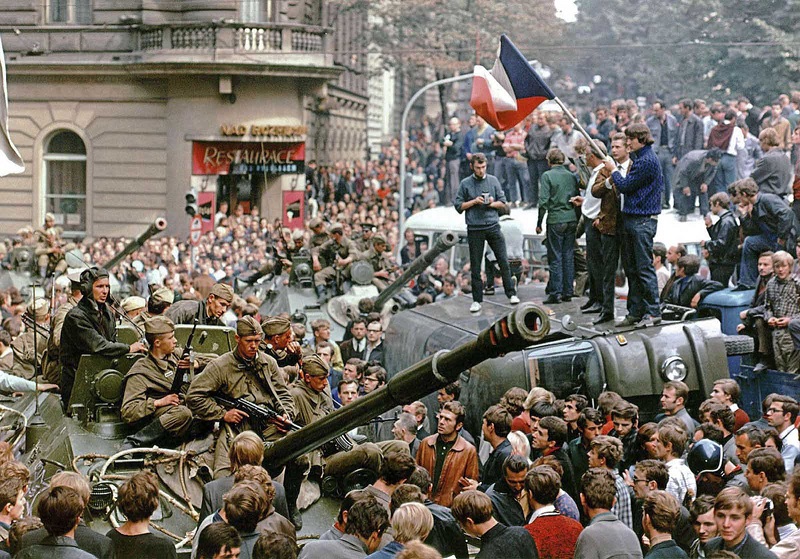
Prague residents surround Soviet tanks in front of the Czechoslovak Radio station building in central Prague during the first day of Soviet-led invasion to then Czechoslovakia August 21, 1968. Vera Machutova woke one August night in 1968 to the thunder of Soviet tanks surging through this Czech city on the East German frontier. Forty years later, with the Czech Republic now a democracy within NATO and the European Union, Machutova is troubled by the conflict in Georgia, whose army was routed last week by Russian forces that pushed deep inside its territory. The banner reads, “Entry forbidden to unauthorized personnel”. Picture taken August 21, 1968. To match feature CZECH-RUSSIA/INVASION REUTERS/Libor Hajsky (CZECH REPUBLIC) – GM1E48I1OC701
On 20–21 August 1968, Czechoslovakia was jointly invaded by four Warsaw Pact countries: the Soviet Union, Poland, Bulgaria and Hungary. About 250,000 Warsaw Pact troops (afterwards rising to about 500,000), supported by thousands of tanks and hundreds of aircraft, participated in the overnight operation, which was code-named Operation Danube. Romania and Albania refused to participate, while East German forces, except for a small number of specialists, were ordered by Moscow not to cross the Czechoslovak border just hours before the invasion. 137 Czechoslovak civilians were killed and 500 seriously wounded during the occupation.
The invasion stopped Alexander Dubček’s Prague Spring liberalisation reforms and strengthened the authoritarian wing of the Communist Party of Czechoslovakia (KSČ). The foreign policy of the Soviet Union during this era was known as the Brezhnev Doctrine.
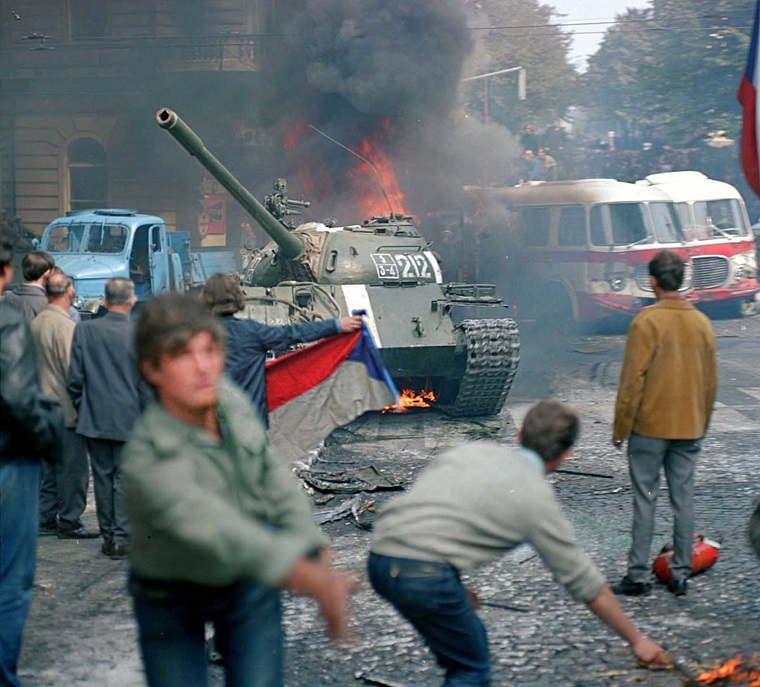
People throw Molotov cocktails and stones at Soviet Army tanks in front of Czechoslovak Radio station building in central Prague during the first day of Soviet-led invasion to then Czechoslovakia August 21, 1968. AP – In this Aug. 21,1968 file picture, Prague residents carrying a Czechoslovakian flag and throwing burning torches, attempt to stop a Soviet tank in downtown Prague, Czechoslovakia as the Soviet-led invasion by the Warsaw Pact armies crushed the so-called Prague Spring reforms. In August 2008, the ex-communist country will mark the 40th anniversary of the Prague Spring challenge to Soviet domination – bold pro-democracy reforms that the Kremlin swiftly and brutally crushed. Experts say Russia’s threat of a military response if the U.S. and Czech Republic ratify a missile defense system is mostly bluster. But for Czechs, the timing couldn’t be more jarring. – AP REUTERS/Libor Hajsky (CZECH REPUBLIC) – GF2E45J1BUZ01
Public reaction to the invasion was widespread and divided. Although the majority of the Warsaw Pact supported the invasion along with several other communist parties worldwide, Western nations, along with Albania, Romania, and particularly China condemned the attack. Many other communist parties lost influence, denounced the USSR, or split up or dissolved due to conflicting opinions. The invasion started a series of events that would ultimately see Brezhnev establish peace with U.S. Richard Nixon in 1972 after the latter’s historic visit to China.
The legacy of the invasion of Czechoslovakia remains widely discussed among historians and has been seen as an important moment in the Cold War. Analysts believe that the invasion caused the worldwide communist movement to fracture, ultimately leading to the Revolutions of 1989, and the dissolution of the Soviet Union in 1991.
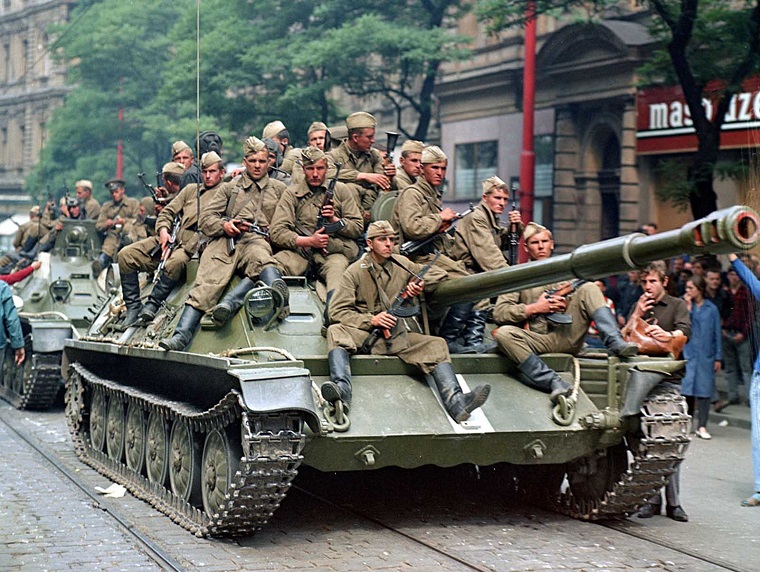
Soviet Army soldiers sit on their tanks in front of the Czechoslovak Radio station building in central Prague during the first day of Soviet-led invasion to then Czechoslovakia on August 21, 1968. REUTERS/Libor Hajsky(CZECH REPUBLIC) . – PM1E45J17KL01Lone car passing dozens of Russian tanks during Russian invasion of Czechoslovakia during Prague Spring. (Photo by Bill Ray/The LIFE Picture Collection/Getty Images)
CN’s Rail Inspection Portals near Winnipeg, Manitoba
In May 2018, CN awarded a contract to Duos Technologies to provide four Rail Inspection Portals (rip®) around Winnipeg, Manitoba to perform automated inspection of passing trains. These portals incorporate high speed cameras and thermal imaging to inspect rail cars at speeds up to 70 MPH (110 km/hr).
These portals are now in operation, and CN is clearly happy enough with them that it placed an order for three additional portals in November 2018. Two of these portals will be built in the US and one in Canada, I believe near Toronto.
How They Work
LED lights
The portal has high speed cameras mounted on the sides, top and bottom of a frame that encloses a track. These cameras basically take a series of thin, very tall “slice” photos that are stitched together by the system’s software into a complete picture of a rail car.
The portals are equipped with banks of LEDs to light up the train as it passes through, so they can be used at any time of day.
Rail portal under construction in Winnipeg
The rail car inspection portal at Vivian, Manitoba
CN 5655 at Vivian, Manitoba
The portal did not light up as the train went through, so I don’t think it was quite in service yet. Before the train arrived, I did hear some fans or something like that, so I think it had heaters running. Still, it was pretty neat to see a train go through it.
Containers going through the rail inspection portal at Vivian
CN 2314 entering the rail inspection portal
Scanning… scanning…
Here’s a closeup of the train rolling through. The train is lit and photographed on both sides, top and underside.
























 The MarkoZen Blog