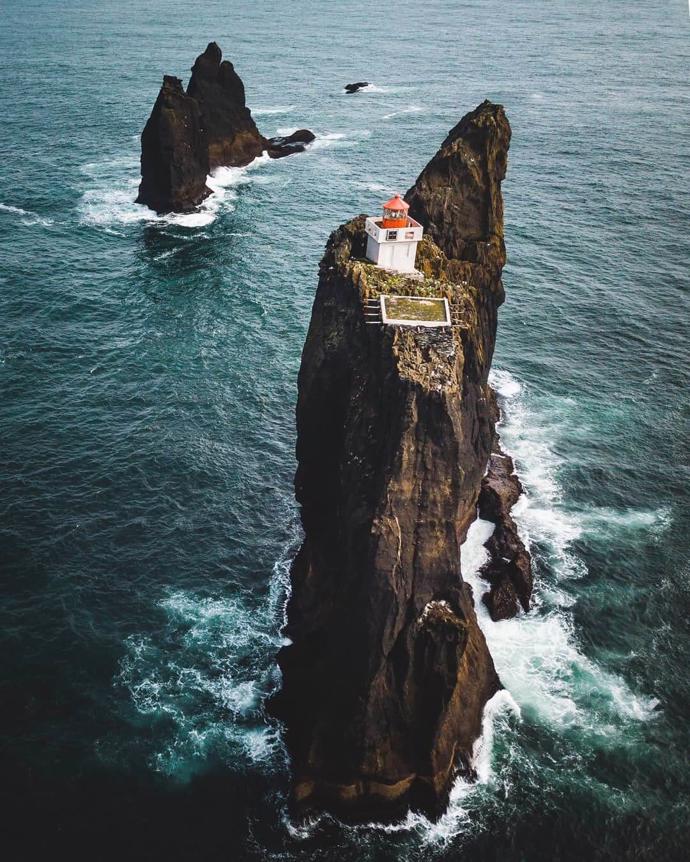
Incredible location for a lighthouse perched on a rock in Iceland’s wild surf

The lighthouse is surrounded by open water and is precariously …

The lighthouse is surrounded by open water and is precariously perched on a cliff. Morgunblaðið/Árni Sæberg

A photograph taken by Morgunblaðið photographer Árni Sæberg of the Þrídrangaviti lighthouse in 2009 has now become viral thanks to Justin Bieber of all people.

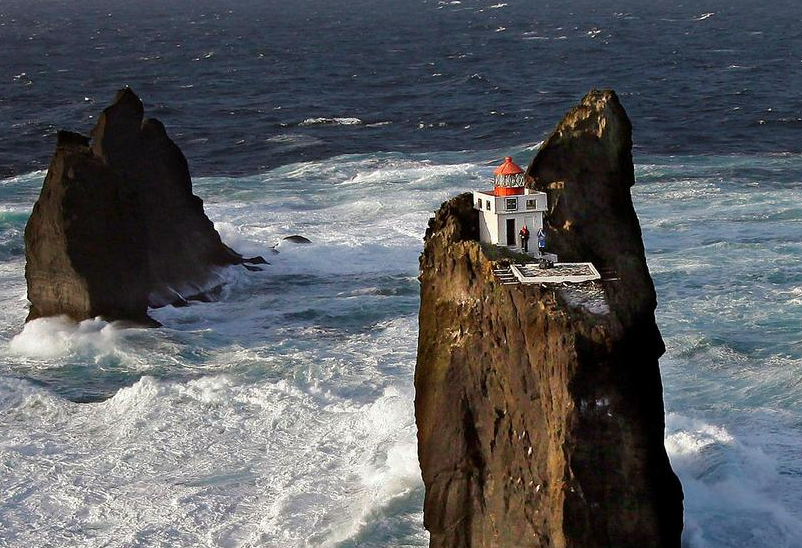
Árni Sæberg is photographer for our sister publication Morgunblaðið (and also takes photos for us at Iceland Monitor). The lighthouse, Þrídrangaviti, is located in the Westman Islands and is located around six miles from the shore.  It’s quite possibly the most isolated lighthouse in the world and is precariously perched on top of a rock pillar with the wild waves of the cold North Atlantic ocean raging below.

Þrídrangar means “three rock pillars” and the lighthouse was built there in 1939. The lighthouse has also been an inspiration to literature, with best-selling thriller novelist Yrsa Sigurðardóttir using it in her novel “Why did you lie?” This is not the first time that Sigurðardóttir draws inspiration from Sæberg’s photos. His photos of the deserted farmhouse in Hesteyri in the remote West Fjords became the setting of her spine chilling ghost story, I remember you, which recently was made into an Icelandic film of the same name.
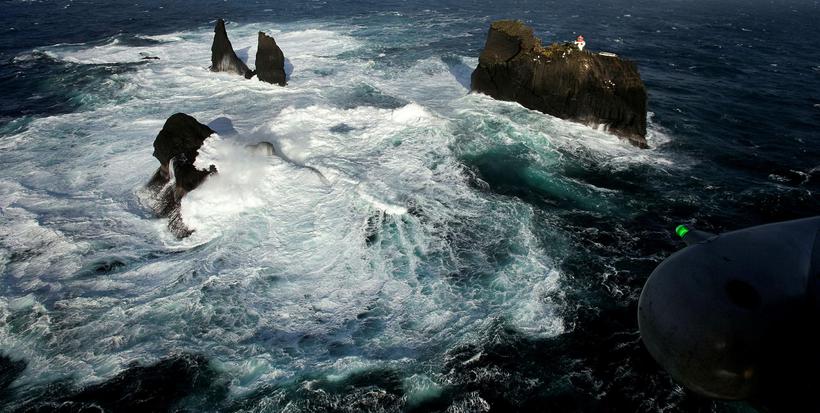
The strong surf below the lighthouse.

The strong surf below the lighthouse. Photograph/ Árni Sæberg

Sæberg  didn’t realise until recently that his photo of the lighthouse had been published all around the world for years until his barber showed him the photo on a German website. The barber’s daughter also told him that Justin Bieber had been posting the photo on social media.Sæberg flew with the national coastguard helicopter, TF LÍF to the take the photo of the lighthouse. It’s quite incredible how people actually managed to build this lighthouse, just at WW2 began. In 1939 there were no helicopters so people would have had to sail to the cliff and scale it. In an old article in Morgunblaðið, project director Árni G. Þórarinsson says in an interview, “The first thing we had to to was create a road up to the cliff. We got together of experienced mountaineers, all from the Westman Islands. Then we brought drills, hammers, chains and clamps to secure the chains. Once they got near the top there was no way to get any grip on the rock so one of them got down on his knees, the second stood on his back, and then the third climbed on top of the other two and was able to reach the nib of the cliff above. I cannot even tell you how I was feeling whilst witnessing this incredibly dangerous procedure.”Þrídrangar, the three pillars of rock are in fact four pillars named Stóridrangur, Þúfudrangur, Klofadrangur and the fourth one is nameless. In 1938 a road was constructed to Stóridrangur and the following year the lighthouse was raised. Many years later a helipad was set up on Stóridrangur where helicopters can land.
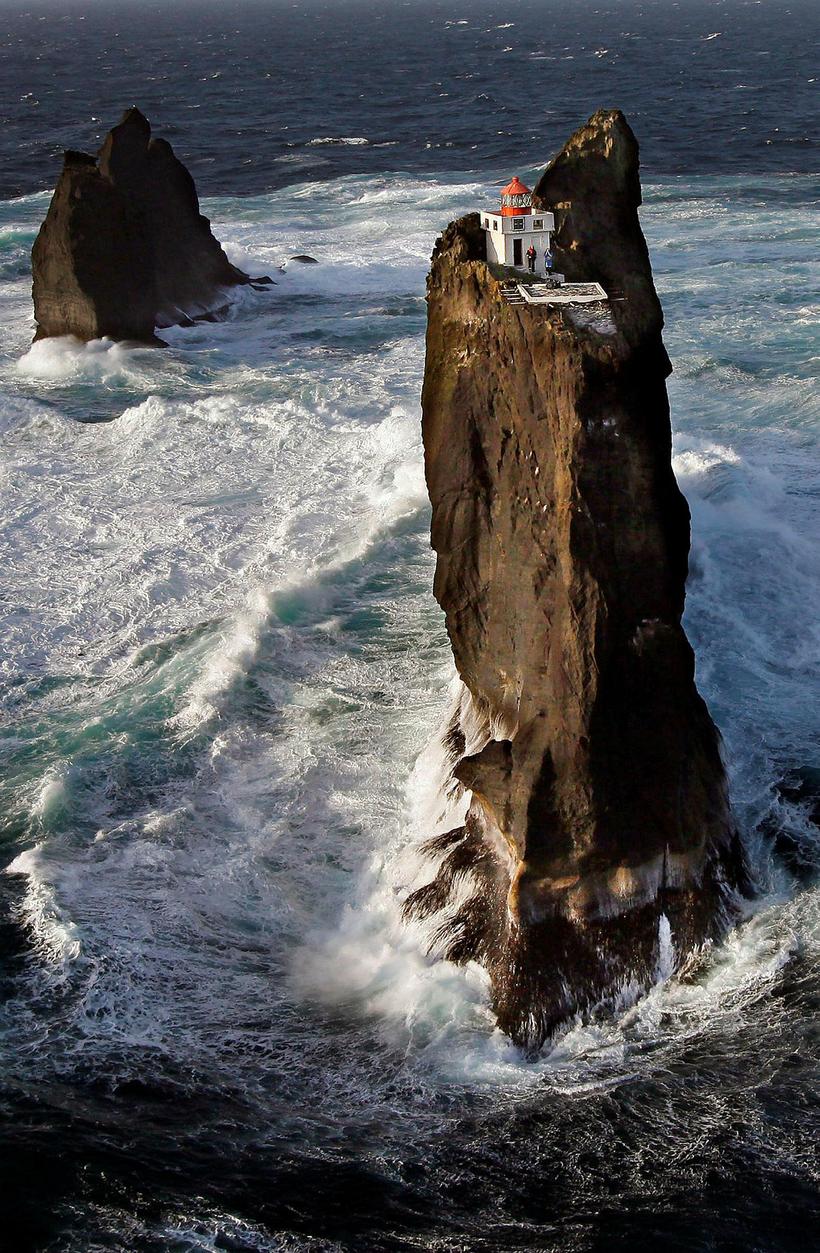
Morgunblaðið/Árni Sæberg

The national coastguard helicopter flying towards the lighthouse.

The national coastguard helicopter flying towards the lighthouse. Photograph/ Árni Sæberg
Cherished horse, pregnant cow airlifted to safety from flooded Nicola River farms in British Columbia

November 22

Horse credited with saving owner’s life takes a helicopter ride after being cut off by rising water.

Winter the horse was saved using an Anderson Sling owned by a Fraser Valley veterinarian. The animal was airlifted by helicopter last Friday out of a flooded area near Spences Bridge in B.C.’s southern Interior. (Kelly Kennedy)

A small menagerie of marooned animals — including a horse and a pregnant cow — were rescued in recent days from flooded farms on the Nicola River west of Kamloops, B.C., using a helicopter, a specialized livestock harness and a whole lot of ingenuity.

Kim Cardinal says it was a desperate situation when her two horses and mule became trapped on a stretch of pavement near the community of Spences Bridge following torrential rains that ultimately swept her home into the raging Nicola River last Monday.

Cardinal says she can still hear the sounds of smashing boulders and glass as her house was destroyed by the power of the waters.

She and her partner Lorne Cardinal were airlifted to safety after a B.C. Hydro crew spotted smoke from a campfire they had lit after their house was destroyed. But their animals remained trapped by flooded roads.

Winter being harnessed into the Anderson Sling for transport after his owners’ home and much of their property was lost. (Kelly Kennedy)

“The horse — Winter — saved my life. I just couldn’t bear the thought of him there, dying after that,” said Cardinal.

She said the horse began acting spooked and almost “dancing” as the waters rose. It alerted her and Lorne to the danger and they got out just in time, she said.

But the rushing water made it impossible to get Winter, along with a mini-horse named Spicey and mule named Moxy, to safety.

The view of the area where 2 horses, a mule and a cow and other animals were rescued less than 10 kilometres south of Spence’s Bridge in B.C., west of Kamloops. A washed out portion of Highway 8 is visible in the centre of the photo. (Kelly Kennedy)

Kelly Kennedy says she got a call last Thursday from RCMP livestock officer Cpl. Cory Lepine about the dire situation.

“I was thinking about it and I was like, why can’t we just airlift them out?” said Kennedy, a director with the Horse Council of B.C. who also runs Sageview Rescue Centre in Kamloops.

Over the next three days she orchestrated the rescue.

She hired Summit Helicopters with funds from the B.C. Horse Council and had a special sling shipped from the Fraser Valley to Kamloops.

Aldergrove veterinarian Dr. David Paton owns the device, known as an Anderson Sling, that protects large animals when they are lifted off the ground — which is both difficult and dangerous.

The contraption allows this to be done — usually for urgent transport — with little risk to the animal. Paton recommended using the sling in this rescue, which he called a “perfect” example of its usefulness, given there was no other way to get the animals out of their spot.

Paton said despite the fact that horses do not generally fly, they handle being moved in a sling quite well.

“Horses are amazingly calm and quiet, they may need a mild sedation — kind of a little bit of an exciting ride for sure. Once they are airborne they’re not struggling or thrashing,” he said.

Paton says there is only one Anderson Sling in the province and this type of rescue was a first in B.C.

At the beginning of the operation, Kennedy met the pilot Aaron Toombs near Spences Bridge and they flew over the muddy, angry river to the rescue site. The harness took so long to fasten on Winter that the tranquilizer used to keep the horse calm wore off.

Spicey and Winter munch hay after their rescue. (Kelly Kennedy)

“That horse was wide awake. He stayed quiet through the air but when it came to landing it took the helicopter half an hour before we could drop him and try and get a long line on him to control him,” said Kennedy.

By then, Kennedy said “the whole town” of Spences Bridge had come to watch as the pilot tried to delicately land the big horse without breaking the large animal’s legs.

“It wasn’t pretty but we got it done.” Kennedy said.

Some of the other animals needing rescuing were too small for the sling, so Kennedy devised a backup plan. A massive grain tote made out of netting that can handle loads of up to 680 kilograms of feed was used to cradle the smaller animals in and fly them to safety.

Then they heard the neighbours nearby were also in need — with a pregnant Jersey cow named Tina and three goats, cut off by the floods.

But by Friday night they’d run out of daylight and money for the $3,000-per-hour helicopter so they had to refuse. However, the pilot knew a government official looking at the highways who had a helicopter booked but only half a day of work on Monday, so they used that aircraft for the goats and the pregnant cow.

Rescuers with Spicey a mini horse that had to be sedated and cradled in a feed tote for airlift. (Kelly Kennedy)

They laid the cargo net on the ground, “and the cow walked into the middle of it and we just scooped her up,” said Kennedy.

It took three days and used up the animal rescue contingency fund of the Horse Council of B.C., but in the end they rescued two horses, a mule, a pregnant cow, nine puppies, two large dogs, three goats and several cats.

Cardinal says she can’t stop sobbing thinking about the ordeal, and is so thankful that she survived and that her animals got out thanks to fast-thinking volunteers — especially Kennedy.

“She is my hero,” Cardinal said.

Tina the pregnant Jersey cow enjoys a drink after a harrowing rescue. (Kelly Kennedy)
Moxy the mule is loaded into a jury-rigged feed transport net to lift the animal via helicopter out of a flood zone. (Kelly Kennedy)

The Marijuana Nuns of Merced, California 

Cannabis-growing ‘nuns’ grapple with California law: ‘We are illegal’

The Sisters of the Valley’s “abbey” is a modest three-bedroom house on the outskirts of Merced, in a cul-de-sac next to the railroad tracks. (Sister Kate calls the frequent noise from passing trains “part of our penance”.) When visitors come to the door, Sister Kate asks them to wait outside until she can “sage” them with the smoke from a piece of wood from a Russian tree given to her by a shaman.

Sister Kate lives here with her “second sister”, Sister Darcy, and her youngest son.

But these aren’t your average nuns. The women grow marijuana in the garage, produce cannabidiol tinctures and salves in crockpots in the kitchen, and sell the merchandise through an Etsy store. (Cannabidiol, or CBD, is one of the active ingredients in marijuana that is prized for medicinal qualities and is not psychoactive.) The women perform their tasks wearing long denim skirts, white collared shirts and nun’s habits. And while their “order” is small – last week they ordained their third member, a marijuana grower in Mendocino County known as Sister Rose.

00nuns

00nuns1

But their ambitions have been thwarted by legislation that was passed last year – 19 years after medical marijuana was first legalized in the state – to regulate the billion-dollar industry through the Medical Marijuana Safety and Regulation Act.  An error in the final text of the law has resulted in scores of cities across the state passing local bans on the cultivation, distribution, and sale of the drug, including Merced, a small city in California’s Central Valley where the Sisters live.

The legislation accidentally established a 1 March 2016 deadline for cities to impose their own bans or regulations on medical marijuana or be subject to state rules, a deadline that assembly member Jim Wood, who authored that section of the bill, said was included by complete accident.

Wood has drafted fix-it legislation, which he’s optimistic will pass in the legislature by the end of next week and be signed by the governor immediately after. But next week is too late for the Sisters of the Valley.

“If it was a typo, that’s great. If it wasn’t, who knows,” said John M Bramble, the city manager of Merced, the morning after Merced’s city council passed its medical marijuana ban. Either way, “it’s too late,” he said. “We’re banning it for now because if we don’t, we’ll have no local control.”

That leaves the Sisters of the Valley in a precarious position. “We are completely illegal, banned through commerce and banned through growing,” said Sister Kate. “They made criminals out of us overnight.”

00nuns2

Despite Sister Kate’s Catholic upbringing, the Sisters “are not affiliated with any traditional earthly religion”. The order’s principles are a potent blend of new age spirituality (they time their harvests and medicine making to the cycles of the moon, and pray while they cook to “infuse healing and intent to our medicine”), environmentalism (“We think the plant is divine the way Mother Earth gave it to us”), progressive politics (asked whether she’s offended if someone drops her title and calls her “Kate”, Sister Kate responds: “It’s offensive that no banksters went to jail”), feminism (“Women can change this industry and make it a healing industry instead of a stoner industry”), and savvy business practices.

Sister Kate was looking for a “second sister” when a mutual friend arranged a phone call with Darcy Johnson. After just a thirty minute conversation, the 24-year-old from Washington state was ready to move to Merced and join the order. Sister Darcy had spent time in New Zealand working on an organic farm, and now, back in the States, was looking for a better way of life.

“This is my better,” Sister Darcy said.

The day after Merced’s ban on medical marijuana was passed, the sisters were preparing for battle. Sister Kate is planning to start a call-in campaigns across the Central Valley, urging growers and customers to flood city council members with phone calls every Friday until they come up with reasonable regulations.

Whatever happens, though, the Sisters of the Valley are answering to a higher authority. “We’re not accepting their ban,” said Sister Kate. “It’s against the will of the people, and that makes it unnatural and immoral.”

00nuns3

00nuns4

00nuns5

00nuns6

00nuns7

00nuns8

Woman Tries to Hire Assassin on RentAHitman.com, Ends Up in Prison

A Michigan woman who turned to a bogus rent-a-hitman website to have an assassin kill her ex-husband was recently convicted for solicitation of murder.

The internet is amazing. You can find just about any kind of information or service if you put in the work and do some research, but when it comes to hiring someone to be your hitman, you may want to skip the obvious options. Wendy Wein, a 52-year-old woman from Michigan who wanted her ex-husband dead, failed to do just that. She found the website RentAHitman.com and assumed that it was a legitimate business where vengeful people like her could find professionals to do their dirty work for them. It won’t surprise anyone that this wasn’t the case and that she is now facing at least nine years behind bars.

RentAHitman.com promises confidentiality, boasts about complying with HIPPA, which apparently stands for the non-existent “Hitman Information Privacy & Protection Act of 1964,” features testimonies from satisfied customers, including women who caught their husbands cheating, and offers access to a network of over 17,000 “field operatives”. And that’s apparently more than enough for people to put in an order for a hitman…

The bogus assassin-hiring website is the brainchild of Bob Innes, a 54-year-old Northern California man, who created it not as a joke or a honey-pot for people with criminal tendencies, but as part of an Internet security business that never took off. He registered RentAHitman.com on Feb. 5, 2005 and considered opening a network security business. Eventually, he put it up for sale, hoping to make a profit, but that didn’t really work out either, so he simply forgot about it.

Then, three years later, he happened to check an email address connected to the domain name and was shocked to see about 200 to 300 emails, many of them one-liners asking questions like: ‘How much for services?’ ‘Do you operate in this or that country?’ etc.

Innes was surprised by all these emails, but he still didn’t do anything with the domain name until 2010 when he got an email from an English woman who claimed she had been tricked out of an inheritance by some people and wanted to have them all killed. She said her situation was urgent and had no issue providing the names of her victims. Bob could tell she was serious, and the names she mentioned in her messages turned out to be her relatives.

But before turning in the woman to the authorities, Bob Innes gave her a chance to change her mind, just like he does everyone else who appears serious about their intention to hire a hitman via his website. He asked her if she still required the service and if she wanted to be placed in contact with a field operator. She said yes and ended up spending four months behind bars before being sent back to Britain.

“It’s a crazy world,” Innes told the Washington Post. “The Internet is obviously a dangerous place. And this website is a magnet for low-hanging fruit that are out there trying to harm other people.”

A decade after RentAHitman.com fooled its first real customer, dozens of other people have fallen prey to it, the latest of whom was Wendy Wein. She too got the chance to walk back on her plan to have her ex-killed, but she didn’t take it. She did mention that finding the website so easily was a bit weird but in the end went ahead with her plan.

“This is kind of weird that your company is not on the deep or dark web,” Wein wrote to Innes. “I prefer not going to jail. Thank you for your time.”

Unfortunately, that’s exactly where she went after the owner of RentAHitman.com reported her to the police. Now, the 52-year old is looking at a minimum of nine years behind bars after pleading guilty earlier this month to solicitation of murder and using a computer to commit a crime. Her sentence is due in January.

“I don’t get it, people are just stupid,” Bob Innes eloquently summed up the whole story of RentAHitman.com.

Odditycentral.com

Los Angeles: the freeway capital of the universe 

los angeles7

Postcard from the 1960’s.

The Southern California freeways are a network of interconnected freeways in the megaregion of Southern California, serving a population of 22 million people. A comprehensive freeway plan was produced in 1947 and with construction beginning in the 1950s. The plan hit opposition and funding limitations in the 1970s and by 2004 some 61% of the original planned network had been completed.

los angeles8

The Judge Harry Pregerson Interchange is a stack interchange near the Athens and Watts communities of Los Angeles, California.

Los_Angeles_-_Echangeur_autoroute_110_105
los angeles

los angeles9

The Inland Empire (I.E.) is a region in Southern California. The term may be used to refer to the cities of western Riverside County and southwestern San Bernardino County. A generally broader definition will include eastern Los Angeles County cities in the Pomona Valley, and/or the desert community of Palm Springs as well as its surrounding area; a much larger definition will include all of San Bernardino and Riverside counties.

The term “Inland Empire” is documented to have been used by the Riverside Enterprise newspaper (now The Press-Enterprise) as early as April 1914. Developers in the area likely introduced the term to promote the region and to highlight the area’s unique features. The “Inland” part of the name is derived from the region’s location, about 60 miles (97 km) inland from Los Angeles and the Pacific Ocean. The area has a population of approximately 4.2 million people.

los angeles1

los angeles2

los angeles3

los angeles5

los angeles4

Cat Hilariously Jumps On News Desk Interrupting LIVE Political Talk Show

VIDEO: Cat Hilariously Jumps On News Desk Interrupting Political Talk Show
[YouTube Screenshots/Fair Use/Credit: SFM]

Kakutsa, the curious cat, caused quite the stir when he jumped onto a news desk interrupting a political interview in progress, drawing hilarious memes and viral videos.

An anchor and a studio guest were discussing the regional political issues and economic situation.

Out of the blue, a cat jumped on the table and sat right in the middle.

The guest was surprised and burst into laughter.

Georgia’s TV Kavkasia said they don’t know where it came from, and it was not part of the show.

The feline felt comfortable and started to the pet itself.

A Twitter user wrote, “Who knows why the creature jumped onto the desk — maybe to check their mics or make-up?”

However, after the encounter, the cat was taken away by a studio member, and the show went on.

Seal spotted surfing humpback whale in Australia 

bbc

An Australian photographer has captured a rare moment of animal communion with a shot of a fur seal surfing a humpback whale off the New South Wales coast.

Robyn Malcolm had been photographing a pod of whales on a feeding frenzy 500km (310 miles) south of Sydney.  But she only realised she had taken the unusual picture when she went through the photos later, she told the Sydney Morning Herald.

Animal experts say that witnessing such a partnership is rare.

New South Wales National Parks and Wildlife whale expert Geoff Ross told the paper the coupling was very rare but he had heard of it happening once before.“The only other time was a seal trying to get away from a killer whale… the seal hopped on the back of the pectoral fins of a humpback whale,” he said.

Ms Malcolm insisted that the photo was not doctored.

“I’m positive, because I don’t know how to use Photoshop. And I do still have it on the camera so I can prove it,” she told the newspaper.

bbc1

The meeting of seal and whale is the latest in a series of serendipitous animal piggyback rides which have been captured this year.

In March, amateur photographer Martin Le-May shot this picture of a weasel clinging on to the back of a woodpecker at Hornchurch Country Park in east London.

bbc2

Bosom buddies? Sadly the picture actually shows a baby weasel attacking the woodpecker

In June, a family walking in a forest in central Florida spotted this raccoon hitching a ride on the back of an alligator.

Mr Richard Jones told local television station WFTF that he “snapped a lucky picture right when the gator slipped into the water and before the raccoon jumped off and scurried away”.

bbc3

Here we have a mother polar bear giving the cub a helping hand/swim.

bearz2