Interesting Ring House in Japan

Japanese architecture is always pushing the limits for what is considered unique. It is quite often fascinating rather than architecturally brilliant and I think thats what appeals to the people who enjoy it – it’s different. This particular house is somewhat dated now, built in 2006, but it is still a stunning example of thought provoking and original Japanese architecture.


ring10


As an upscale weekend enclave, Karuizawa may be Tokyo’s equivalent of New York City’s Hamptons (minus the beach), but the developer had nonetheless failed repeatedly to sell the raw land on which Ring House now stands. In an attempt to turn his luck he marketed the land together with a house, commissioned by the youthful Tokyo based firm TNA. The developer, a youngster himself, had seen TNA’s work published in a magazine and was keen to give the newly minted design team a chance to build.


ring


ring3


The team created a mini-tower at the maximum height, skinned in alternating bands of wood and glass — an irregularly striped sheath that evenly balances transparency and opacity. As sunlight floods into the interior by day (or electric illumination glows from within the volume by night), the wrapper allows views straight through the house.


ring2


ring1


ring4


ring5


ring6


ring8


ring9


ring7

The First Cellular Phone, and It was Big!

DynaTAC is a series of cellular telephones manufactured by Motorola, Inc. from 1983 to 1994. The Motorola DynaTAC 8000X commercial portable cellular phone received approval from the U.S. FCC on September 21, 1983. A full charge took roughly 10 hours, and it offered 30 minutes of talk time. It also offered an LED display for dialing or recall of one of 30 phone numbers. It was priced at $3,995 in 1984, its commercial release year, equivalent to $9,831 in 2019. DynaTAC was an abbreviation of “Dynamic Adaptive Total Area Coverage.”  It weighed 1.75 lb., stood 13 in. high.

Several models followed, starting in 1985 with the 8000s, and continuing with periodic updates of increasing frequency until 1993’s Classic II. The DynaTAC was replaced in most roles by the much smaller Motorola MicroTAC when it was first introduced in 1989, and by the time of the Motorola StarTAC’s release in 1996, it was obsolete.

Martin Cooper of Motorola made the first publicized handheld mobile phone call on a prototype DynaTAC model on April 3, 1973. This is a reenactment in 2007.

The first cellular phone was the culmination of efforts begun at Bell Labs, which first proposed the idea of a cellular system in 1947, and continued to petition the Federal Communications Commission (FCC) for channels through the 1950s and 1960s, and research conducted at Motorola. In 1960, electrical engineer John F. Mitchell became Motorola’s chief engineer for its mobile communication products. Mitchell oversaw the development and marketing of the first pager to use transistors.

Motorola had long produced mobile telephones for cars that were large and heavy and consumed too much power to allow their use without the automobile’s engine running. Mitchell’s team, which included Martin Cooper, developed portable cellular telephony, and Mitchell was among the Motorola employees granted a patent for this work in 1973; the first call on the prototype was completed, reportedly, to a wrong number.

While Motorola was developing the cellular phone itself, during 1968–1983, Bell Labs worked on the system called AMPS, while others designed cell phones for that and other cellular systems. Martin Cooper, a former general manager for the systems division at Motorola, led a team that produced the DynaTAC 8000x, the first commercially available cellular phone small enough to be easily carried, and made the first phone call from it. Martin Cooper was the first person to make an analog cellular mobile phone call on a prototype in 1973.


First ‘space helicopter’ set to take to Martian skies

NBC News

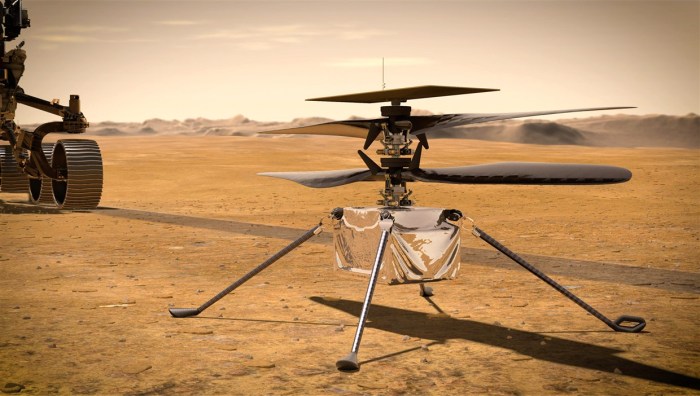
When NASA’s Perseverance rover touches down next week, it will carry one of the strangest devices ever seen on Mars — a drone destined to make the first controlled flights on an extraterrestrial planet.

Dubbed “Ingenuity,” the drone weighs just 4 pounds, and it will stay stored beneath the rover’s belly while Perseverance runs through its initial surface checks and experiments.

But about the middle of April, the rover will scout out a flat area without large rocks to deploy the drone, and soon after that Perseverance will release Ingenuity to make the first flights on Mars.

“It’s pretty unique in that it’s a helicopter that can fly around,” said Tim Canham, the operations lead for the Ingenuity project at NASA’s Jet Propulsion Laboratory in California.

“There was a balloon mission on Venus years ago, so we can’t claim to be the first aircraft,” he said, referring to the two Soviet Vega space probes that deployed balloons attached to scientific instruments in the clouds on Venus in 1985. “But we can claim we’re the first powered aircraft outside Earth.”

Canham will coordinate the five test flights scheduled for the Ingenuity drone over 30 days, with each at least three days apart.

“The first flight will be very basic – it will just go straight up, hover and go straight down,” he said. “After that, we’ll do a couple of flights where we go horizontally, to test how it works.”

The car-size Perseverance rover has seven complex scientific instruments, so it can take panoramic video, monitor the weather, perform ultraviolet and X-ray spectroscopy on anything it finds, and look for signs of ancient microbial life.

But, Ingenuity will carry out no science on its test flights. It will only take photographs of the Martian terrain with its two cameras, one facing forward and one down.

Instead, the Ingenuity project is designed to show drones can be an important addition to the ongoing explorations of distant planets, Canham said.

“Our job is really to prove that the aerodynamics, as we’ve tested them here, work also on Mars,” he said.

Mars is a hard place to fly, which is why Ingenuity weighs so little and needs two counter-rotating 4-foot-long helicopter rotors to stay aloft.

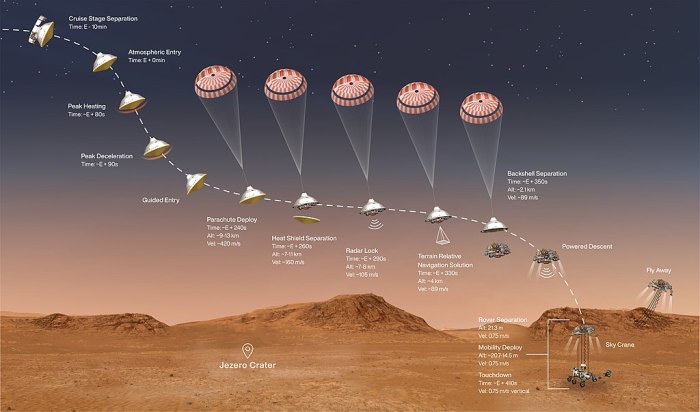
Perseverance, nicknamed Percy, is a car-sized Mars rover designed to explore the Jezero crater on Mars as part of NASA’s Mars 2020 mission. It was manufactured by the Jet Propulsion Laboratory and was launched on 30 July 2020, at 7:50 a.m. EDT (11:50 UTC), and is scheduled to land on Mars on 18 February 2021, 3 p.m EST/8 p.m UTC.

Perseverance carries seven scientific instruments to study the Martian surface at Jezero crater. It carries several cameras and two microphones.

Technical details
Length 2 m (6 ft 7 in)
Diameter 2.7 m (8 ft 10 in)
Height 2.2 m (7 ft 3 in)
Launch mass 1,025 kg (2,260 lb)
Power 110 W (0.15 hp)

Dutch take to the ice as canals and lakes freeze over

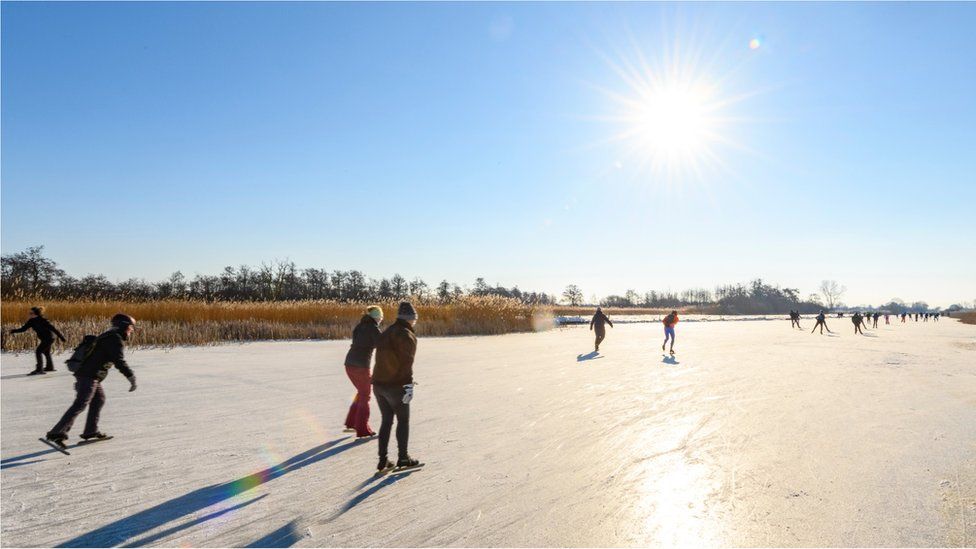
People ice skating on a frozen canal in the Weerribben-Wieden nature reserve in Overijssel during a cold winter day in The Netherlands on February 12, 2021 in Belt-Schutsloot, Netherlands.IMAGE COPYRIGHTGETTY IMAGES

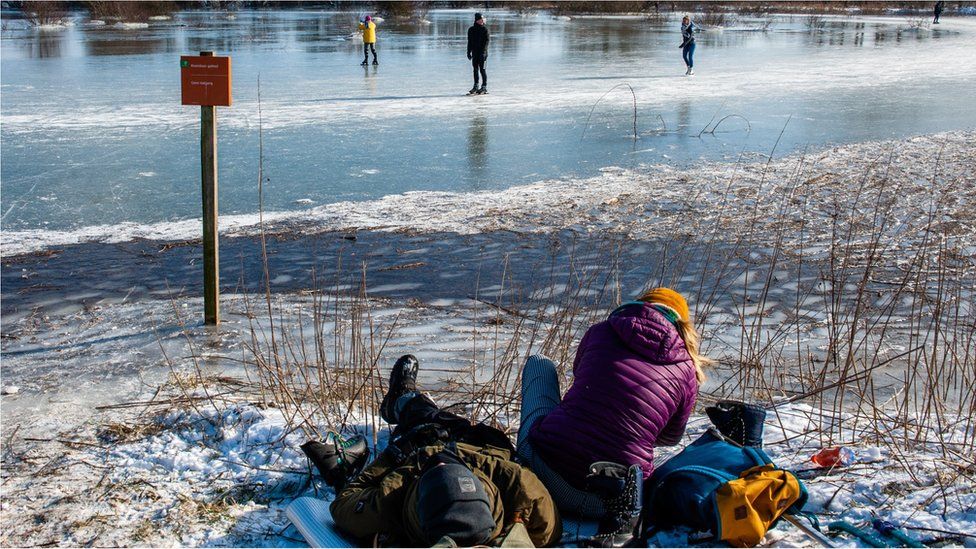
Ice skating fever is gripping the Netherlands after days of sub-zero temperatures froze lakes, ponds and canals across the country.

Many welcomed the opportunity to don their skates amid coronavirus restrictions.

“This is the perfect reason to go out and have a little fun with the museums and everything being closed,” one woman told Reuters news agency as she strapped on her skates in Amsterdam on Friday.

But officials have urged people to stay close to home and avoid crowds to prevent the spread of Covid-19.

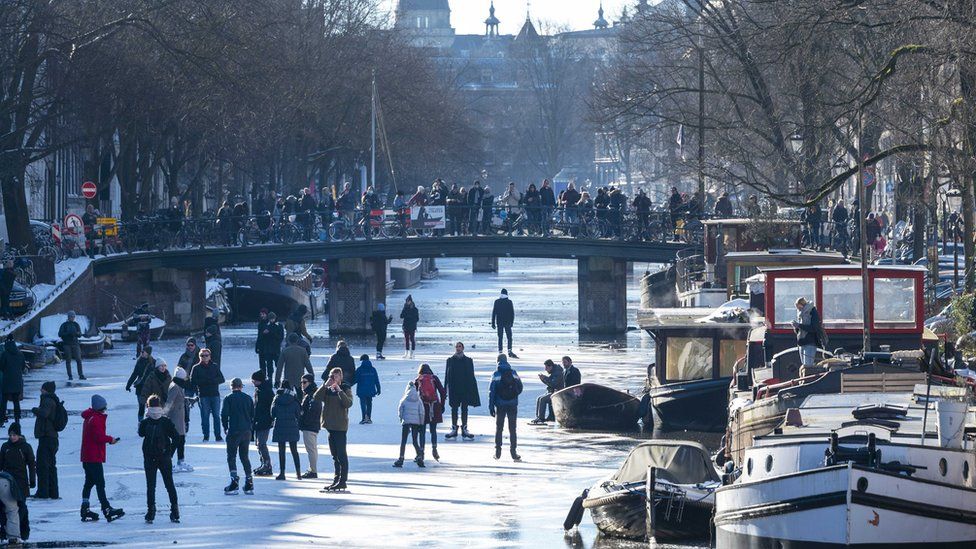
Dozens of skaters briefly glided along the surface of Amsterdam’s historic Prinsengracht canal on Saturday.

People walk and skate on ice on the Prinsengracht canal in Amsterdam, The Netherlands, 13 February 2021.IMAGE COPYRIGHTEPA

It was the first time since 2018 that skating there had been possible, reports said.

“It’s a once-every-so-many-years experience, so when you get the chance, do it,” one man told the Associated Press news agency.

People walk and skate on ice on the Prinsengracht canal in Amsterdam, The Netherlands, 13 February 2021.IMAGE COPYRIGHTEPA

Elsewhere in the country, people made the most of frozen lakes, ponds and canals before a thaw expected to begin in coming days.

As the wintry weather continues, skaters are taking the chance to skate in one of the frozen lakes close to the Dutch city of Nijmegen, on February 12th, 2021.IMAGE COPYRIGHTNURPHOTO VIA GETTY IMAGES
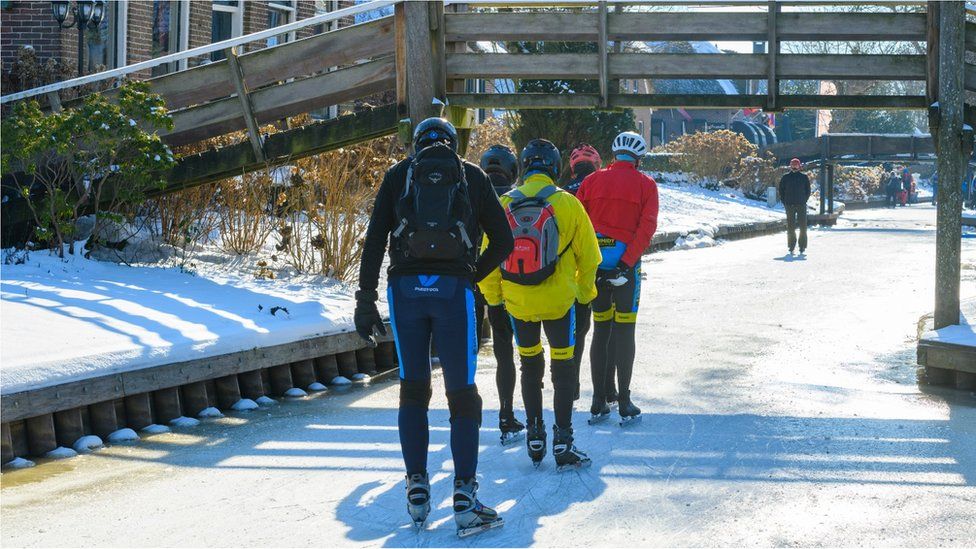
People ice skating on a frozen canal in the water village of Giethoorn in the Weerribben-Wieden nature reserve in Overijssel during a cold winter day in The Netherlands on February 12, 2021 in Giethoorn, Netherlands.IMAGE COPYRIGHTGETTY IMAGES
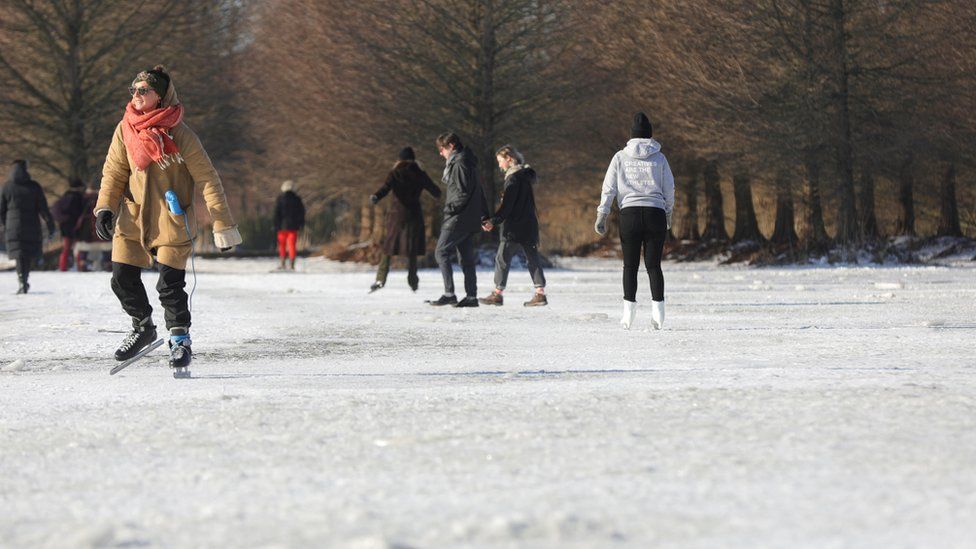
People ice skate during a cold wave across the country, in Amsterdam, Netherlands February 12, 2021.IMAGE COPYRIGHTREUTERS

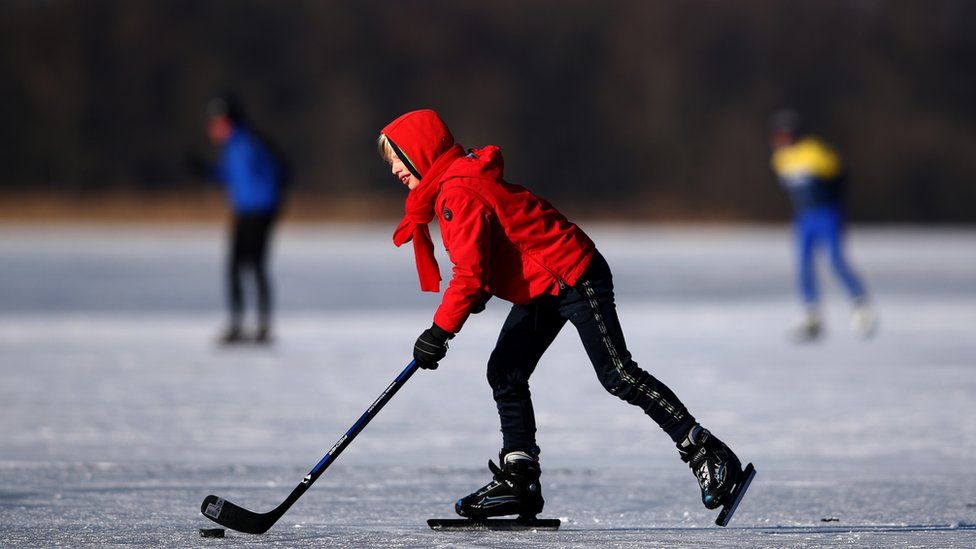
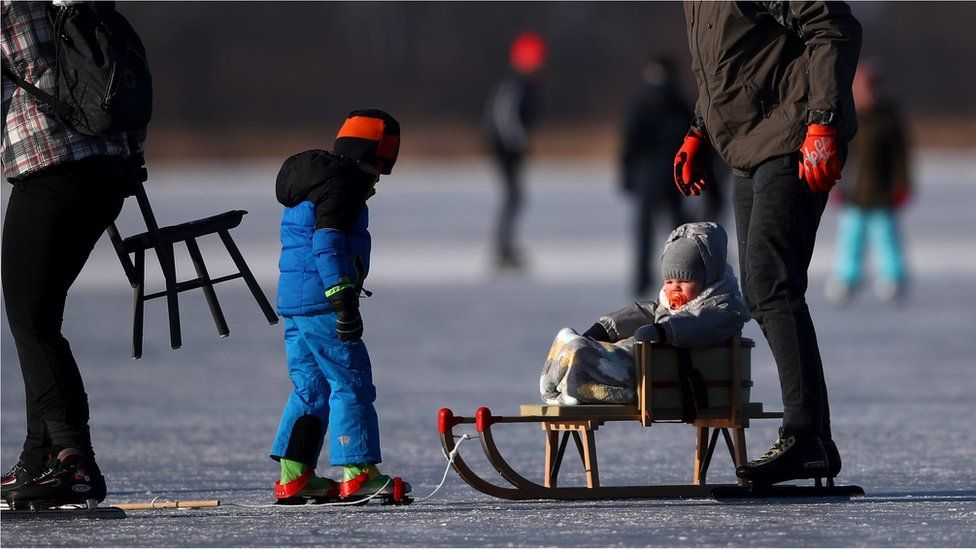
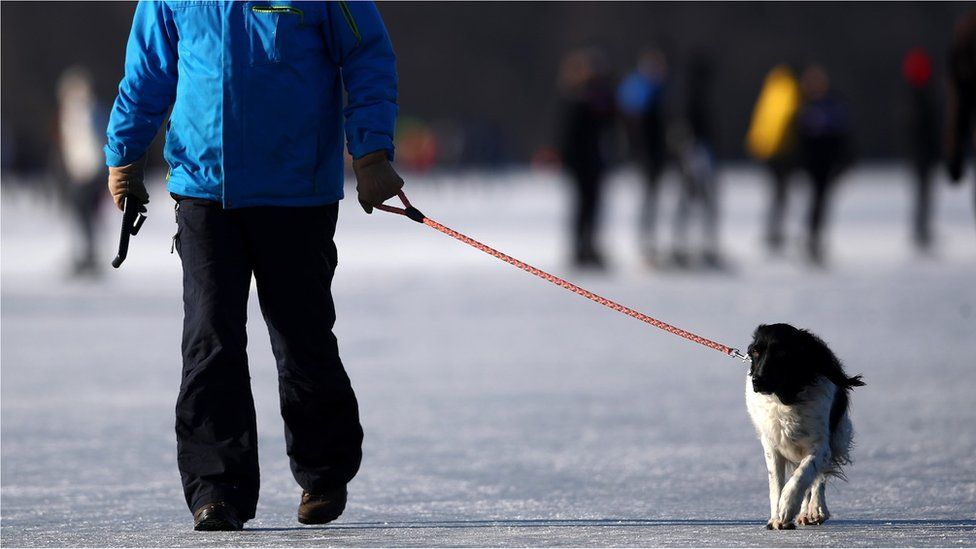
At the frozen Nannewiid lake in the north of the country, groups played hockey, parents pulled their children along on sledges, and dogs took to the ice.

A boy plays ice hockey on the Nannewiid, a lake frozen over as temperatures stay below zero and locals enjoy activities like speed skating, ice hockey, using sleds and walking dogs on February 12, 2021 in Oudehaske, Netherlands.IMAGE COPYRIGHTGETTY IMAGES
People skate on the Nannewiid, a lake frozen over as temperatures stay below zero and locals enjoy activities like speed skating, ice hockey, using sleds and walking dogs on February 12, 2021 in Oudehaske, Netherlands.IMAGE COPYRIGHTGETTY IMAGES
A man walks his dog on the Nannewiid, a lake frozen over as temperatures stay below zero and locals enjoy activities like speed skating, ice hockey, using sleds and walking dogs on February 12, 2021 in Oudehaske, Netherlands.IMAGE COPYRIGHTGETTY IMAGES

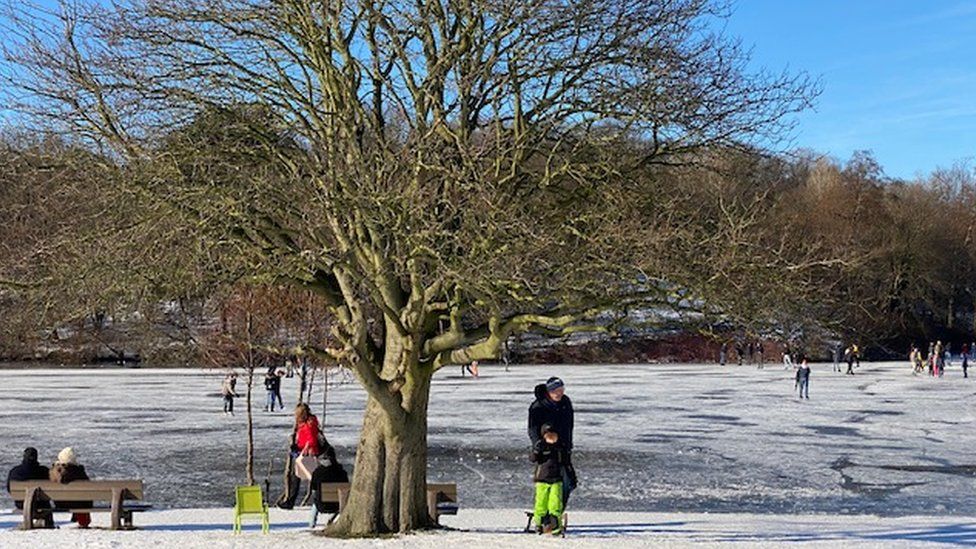
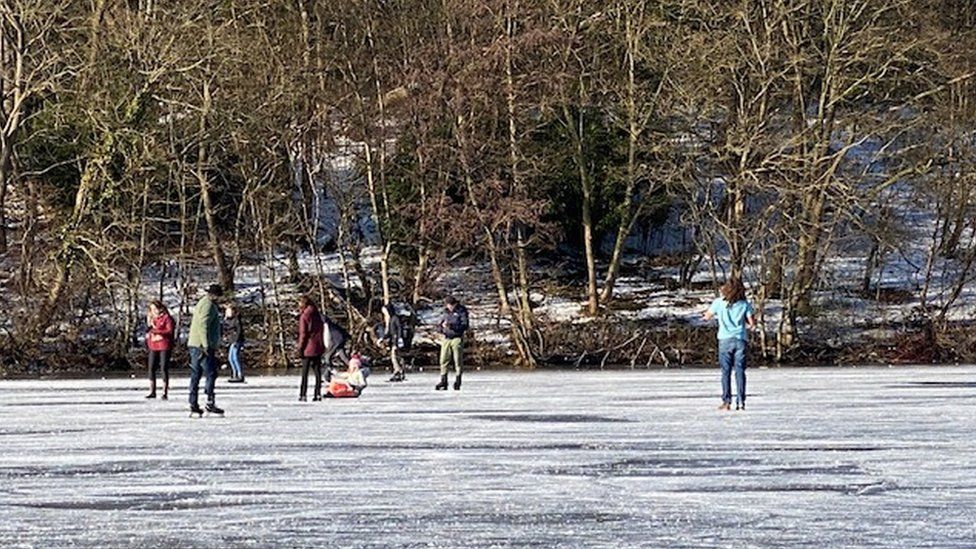
Our correspondent Anna Holligan shared photos of people enjoying the ice in The Hague.

People skating in The HagueIMAGE COPYRIGHTANNA HOLLIGAN/BBC

“Take advantage of the good weather and the ice, but do it under Covid-19 measures,” Prime Minister Mark Rutte told a news conference on Monday. “You can skate with another person, but what you can’t do is organise big competitions. Unfortunately that doesn’t work.”

BBC

Abandoned Places and Things

Railroad Tracks In Forest

Railroad Tracks In Forest

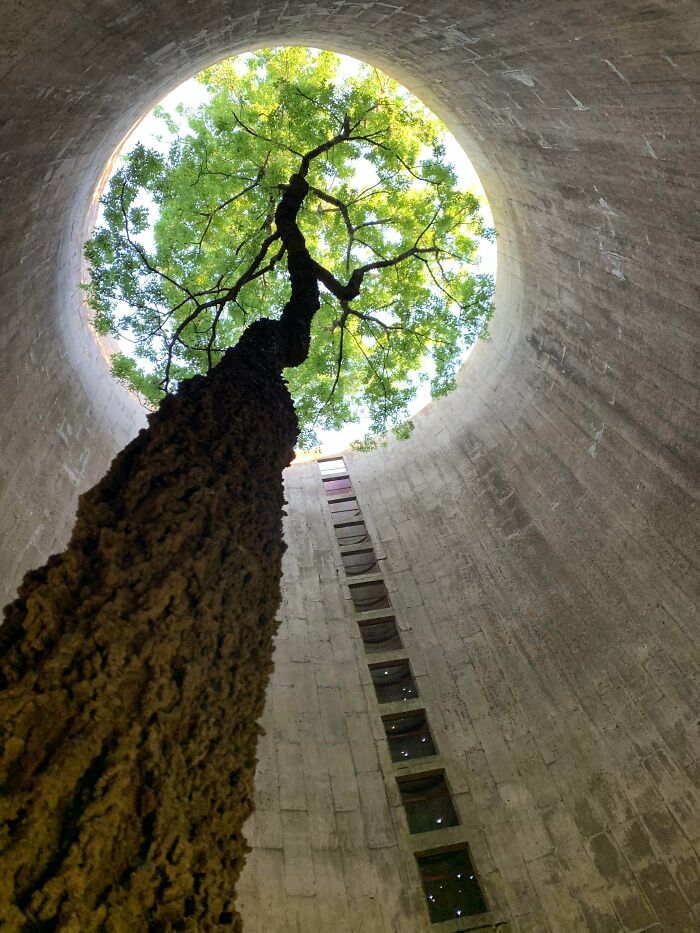
Beautiful Tree Growing Inside An Abandoned Silo

Found This Beautiful Tree Growing Inside An Abandoned Silo While I Was Exploring

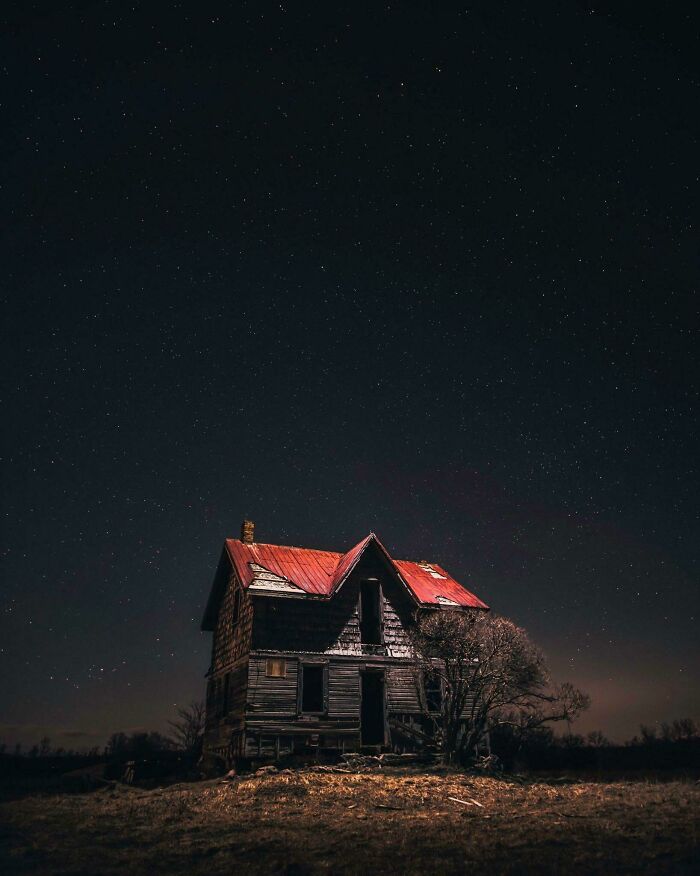
Spooky Abandoned House

I Lit Up This Spooky Abandoned House With My Drone And A Lume Cube Attached To It

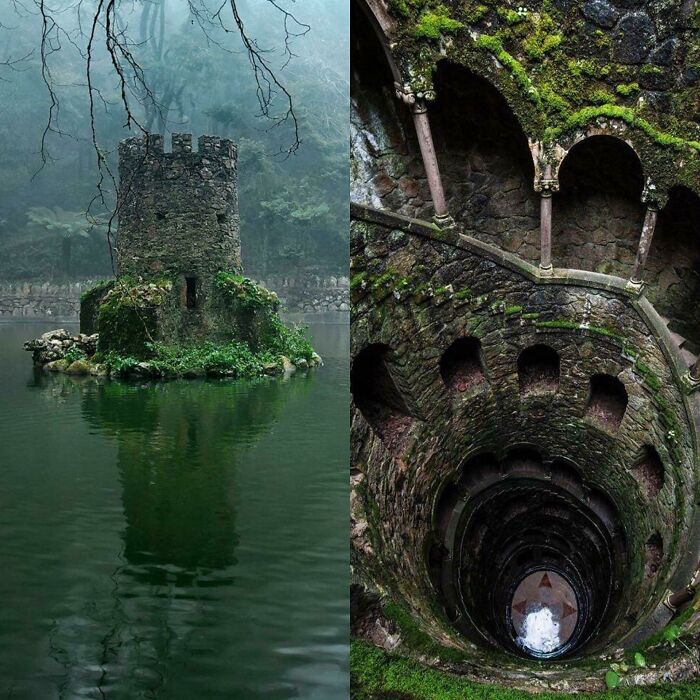
Sintra, Portugal

Sintra, Portugal

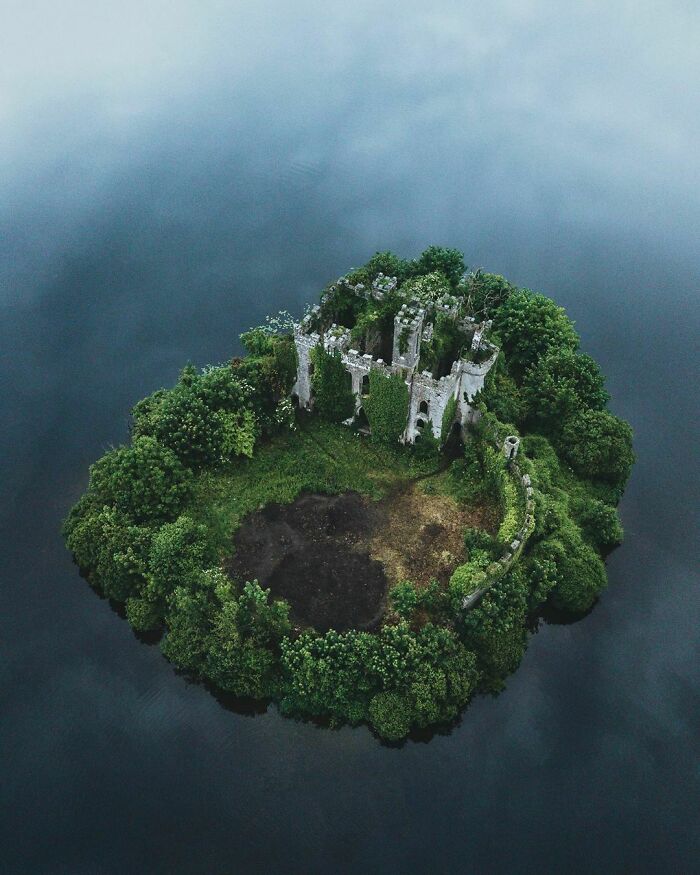
Abandoned Castle In Ireland

Abandoned Castle In Ireland Country

Abandoned French Chapel

Abandoned French Chapel

Abandoned Stairway In The Woods: Madame Sherri Forest, Chesterfield, NH

Abandoned Stairway In The Woods: Madame Sherri Forest, Chesterfield, Nh

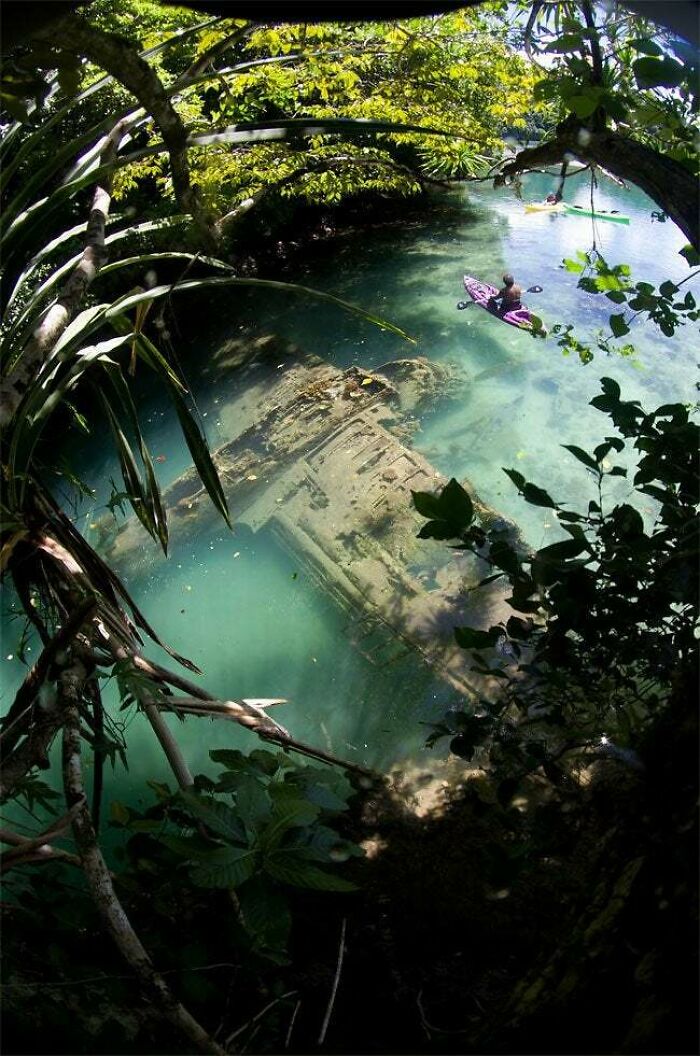
Japanese WWII Warplane Lies Wrecked In Shallow Water Off Guam

Japanese WWII Warplane Lies Wrecked In Shallow Water Off Guam

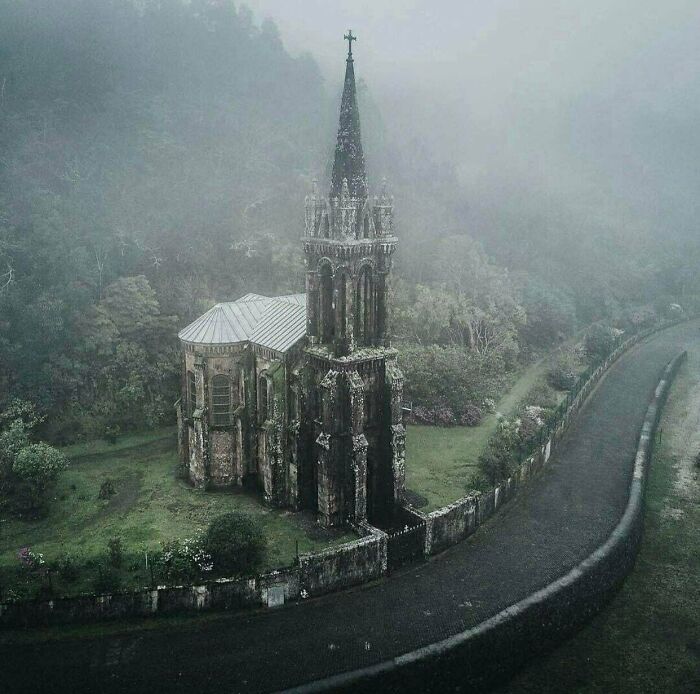
Abandoned Gothic Church In Portugal

Abandoned Gothic Church In Portugal

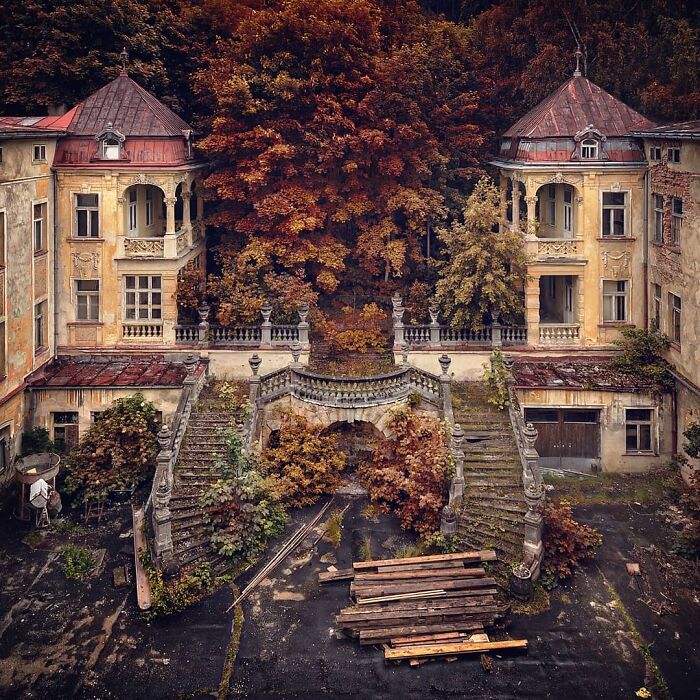
Hotel In Europe

This Hotel In Europe

Abandoned Party Mansion Deep In The Maryland Forest

Abandoned Party Mansion Deep In The Maryland Forest

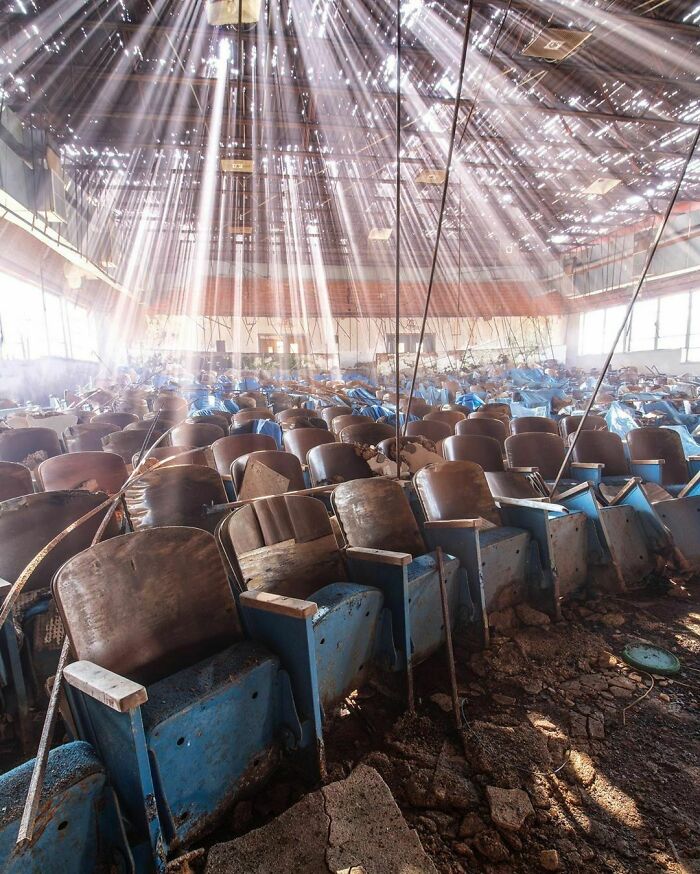
Light Rays Making Their Way Into An Abandoned Theater

Light Rays Making Their Way Into An Abandoned Theater

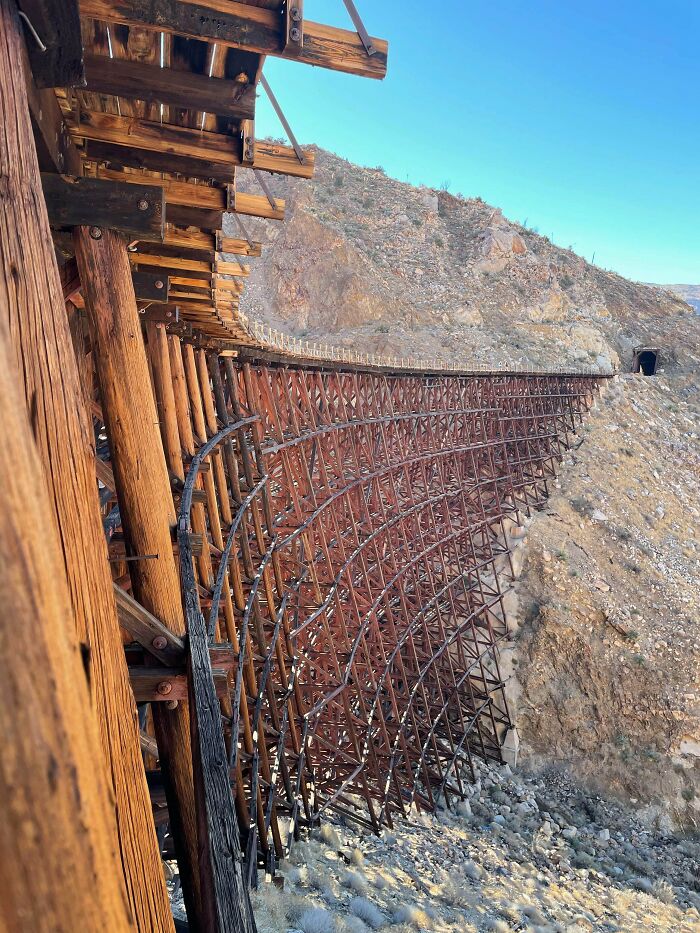
16 Mile Hike To An Abandoned Train Track Bridge In California

16 Mile Hike To An Abandoned Train Track Bridge In California

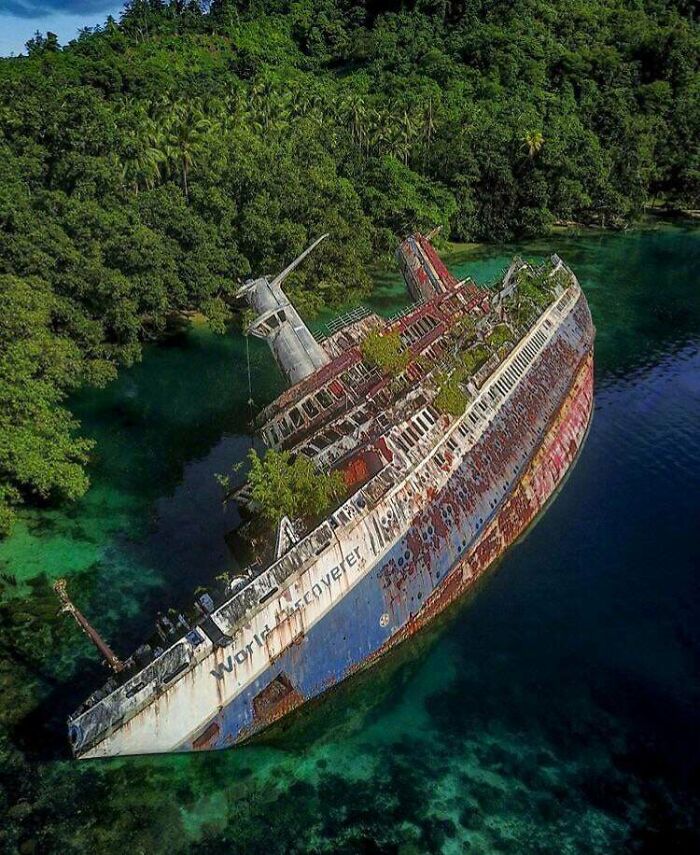
Ms World Discoverer Was A German Expedition Cruise Ship. It Hit A Uncharted Reef In The Sandfly Passage, Solomon Islands 29. April 2000

Ms World Discoverer Was A German Expedition Cruise Ship. It Hit A Uncharted Reef In The Sandfly Passage, Solomon Islands 29. April 2000

Moose Running on Water?

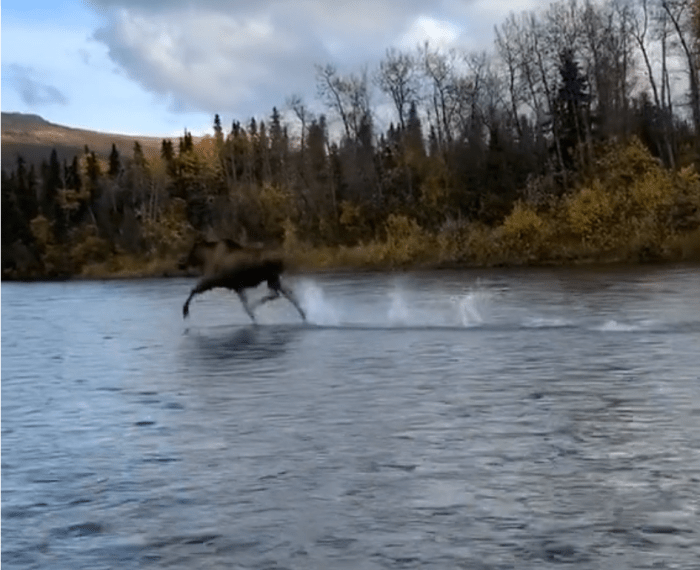
It’s not every day that you get to witness something bizarre. But if you spend enough time outdoors in nature, sometimes you will see something that makes you do a double take. Of course, nothing prepares you for seeing something truly insane, like a moose running on water. That is definitely not something that would ever cross our minds as being remotely possible. We all know that a moose is a very, very large and heavy animal. That is why we’d never imagine them being capable of running on water.

But there is one very funny video clip from a Tik Tok user, kristy_234, which shows a large moose running on water. The clip, which was taken in Alaska, is more of an optical illusion.

He’s not really running on the water’s surface like it might appear at first. The reality was that the moose was running along in shallow water, but because it’s so large and tall, it looks like he’s traversing the water’s surface.

The moose is in roughly 6 inches of water. The boat is a flat bottom that can traverse very shallow water.

Stunning National Geographic Photos


geo

Kirill Vselensky perches on a cornice in Moscow as Dima Balashov gets the shot. The 24-year-olds, risktakers known as rooftoppers, celebrate their feats on Instagram.


geo1

As an evening storm lights up the sky near Wood River, Nebraska, about 413,000 sandhill cranes arrive to roost in the shallows of the Platte River.


geo2

Ye Ye, a 16-year-old giant panda, lounges in a wild enclosure at a conservation center in China’s Wolong Nature Reserve.


geo3

Tempted by the fruit of a strangler fig, a Bornean orangutan climbs 100 feet into the canopy. With males weighing as much as 200 pounds, orangutans are the world’s largest tree-dwelling animals.


geo4

In Flint, Michigan, siblings Julie, Antonio, and India Abram collect their daily allowance of bottled water from Fire Station #3, their local water resource site.

 

geo5

Russia’s Bovanenkovo natural gas field, on the Yamal Peninsula, was deemed too expensive to develop until President Vladimir Putin made it a priority.

 

geo6

The colors of Grand Prismatic Spring in Yellowstone come from thermophiles: microbes that thrive in scalding water.


geo7

Steven Donovan, flipping into a pool, took a seasonal job at Glacier National Park to sharpen his photography skills.


geo8

Kirk Odom was convicted of rape after an expert testified that a hair on the victim’s nightgown matched his. He spent years in prison before DNA tests proved his innocence.


geo9

In Alaska, a mother grizzly and her cubs cause a “bear jam” on Denali’s 92-mile-long Park Road, open to private vehicles only five days each summer.


geo10

On a mountainside in Yosemite National Park, photographer Stephen Wilkes took 1,036 images over 26 hours to create this day-to-night composite.


geo11

Dressed for Mars, space engineer Pablo de León tests a prototype space suit at NASA’s Kennedy Space Center, where fine soil and fans simulate conditions on the red planet.


geo12

Villagers in Bagaran, Armenia, sing of cultural endurance and survival while picnicking at night beneath apricot trees—and a giant cross that shines defiantly into Turkey.
 

geo13

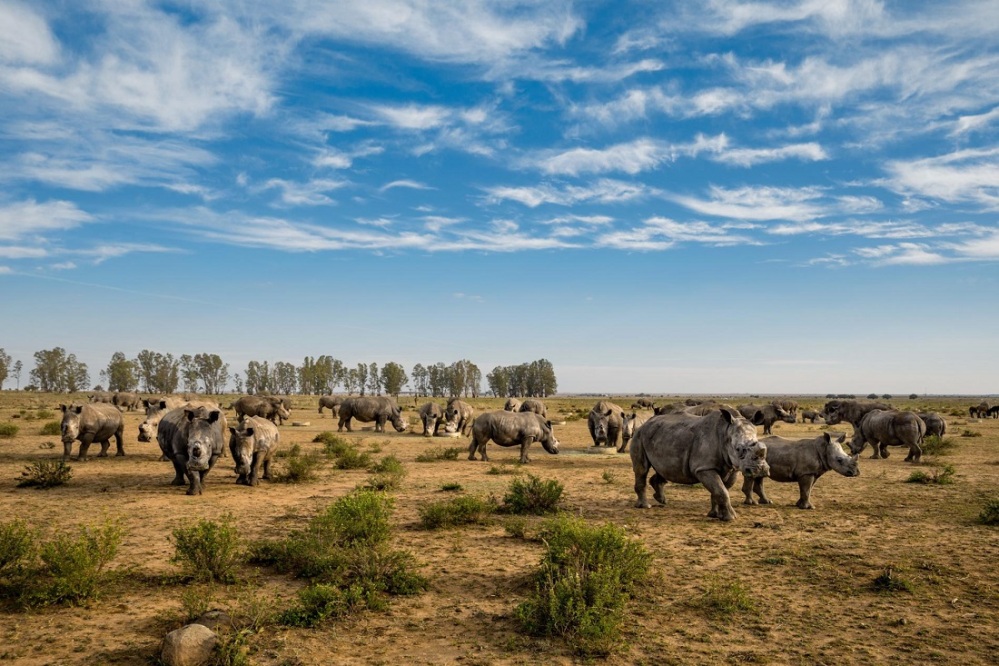
These rhinos on a South African ranch have recently had their horns trimmed. Unlike elephant ivory, rhino horn grows back when cut properly. The rancher is stockpiling the horn in hopes that selling it will soon be legal.


geo14

On their first migration to their summer range in southeastern Yellowstone, three-week-old calves of the Cody elk herd follow their mothers up a 4,600-foot slope.


geo15

Summer attracts sunbathers—clothed and otherwise—to the grassy banks of Munich’s Schwabinger Bach. The meadows here have been popular with nudists since the 1970s.


geo16

A panda keeper in China uses a stuffed leopard to train young pandas to fear their biggest wild foe. A cub’s reactions help determine if the bear is ready to survive on its own.


geo17

Lounging in inches of warm water, blacktip reef sharks wait for the tide to refill the lagoon at Seychelles’ Aldabra Atoll.