Dirty Harry can now upgrade to a bigger handgun. The .44 Magnum that Harry used was very powerful. It could take down a punk rapist at 150 meters and if it hit the punk in the head, it would take it clean off. Even if it winged a slimy street robber it would take out such a big chunk, that the robber punk would be neutralized.
But now there is a bigger cannon on the block. The Model 500 from Smith & Wesson is the biggest, heaviest, most powerful factory-production double-action revolver in the world. It’s built on an entirely new and massive S&W frame size. It fires the new .500 S&W Magnum cartridge, which is the most powerful factory load ever developed specifically for handgun use. The gun and the cartridge are both impressive product accomplishments, beyond the industry norm, and both moved together from concept to reality in less than a year.
This gun is 34 percent more powerful than the .44 Magnum. If Dirty Harry used this weapon he could take down a rogue elephant at 200 meters. Or splatter bad boy punk street slime all over the side of a building at 250 meters. This bazooka fires a 50 caliber cartridge. The .500 Magnum would very definitely make Dirty Harry’s day.
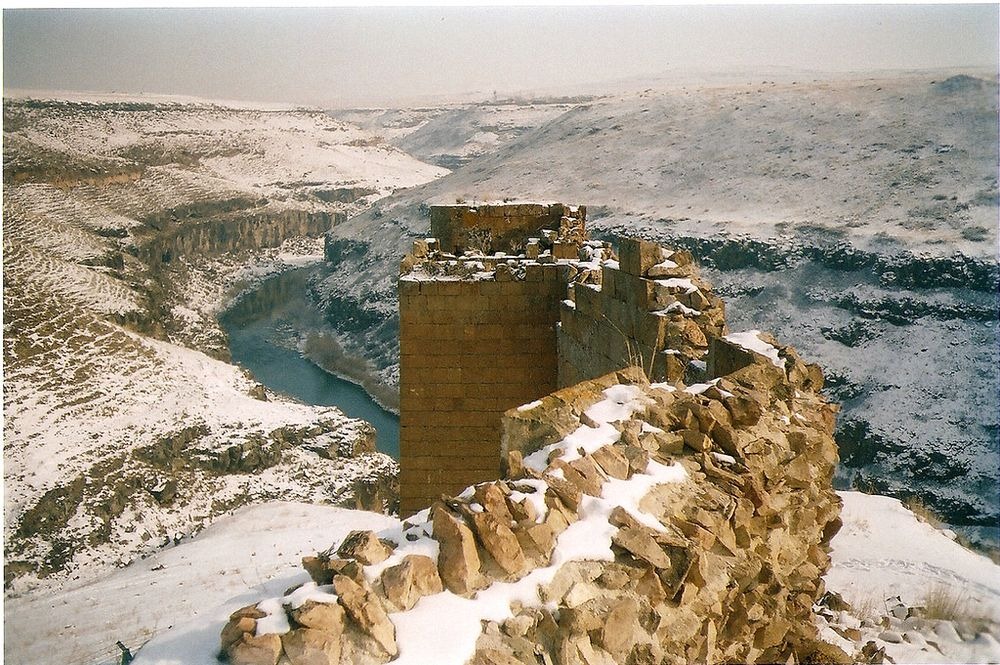
Up on a plateau in the remote highlands of northeast Turkey, 45 km away from the Turkish border city of Kars, lies the crumbling ruins of some forty-odd churches, chapels and mausoleums. This area was once a glorious walled city called Ani belonging to the Armenian Kamsarakan Dynasty, who established base here in the 5th century. As the city grew in size, power and wealth, it became an important trading hub, and by the 11th century, the city boasted more than 100,000 citizens. During its heydays, it was known as “the City of Forty Gates” and sometimes “the City of a Thousand And One Churches.”
Ani’s golden age of wealth, peace and prosperity came to an end with the death of the Armenia ruler King Gagik I, after which the city gave way to a string of invaders starting with the Byzantines, followed by a ruthless massacre by the Turks, the Kurds, the Georgians, and then the Mongols who left the city devastated in 1236. Although Ani continued to exist for another six centuries it was little more than a small town. By the time the Europeans discovered Ani, it lay abandoned for nearly a century with great heaps of stones for former buildings. Ani’s most visible monuments today are the dozens of half standing churches.
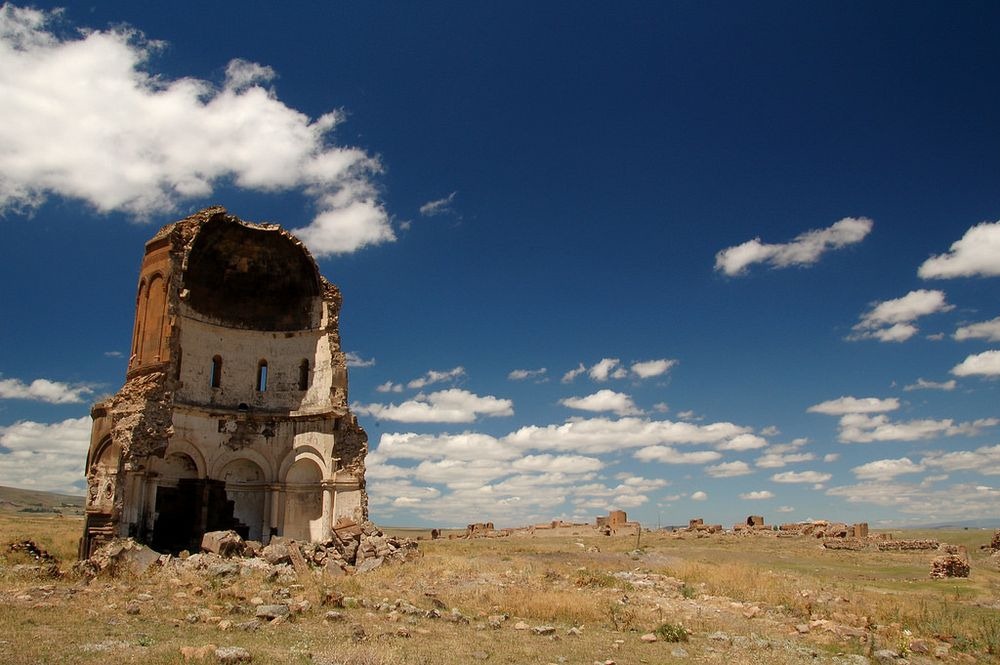
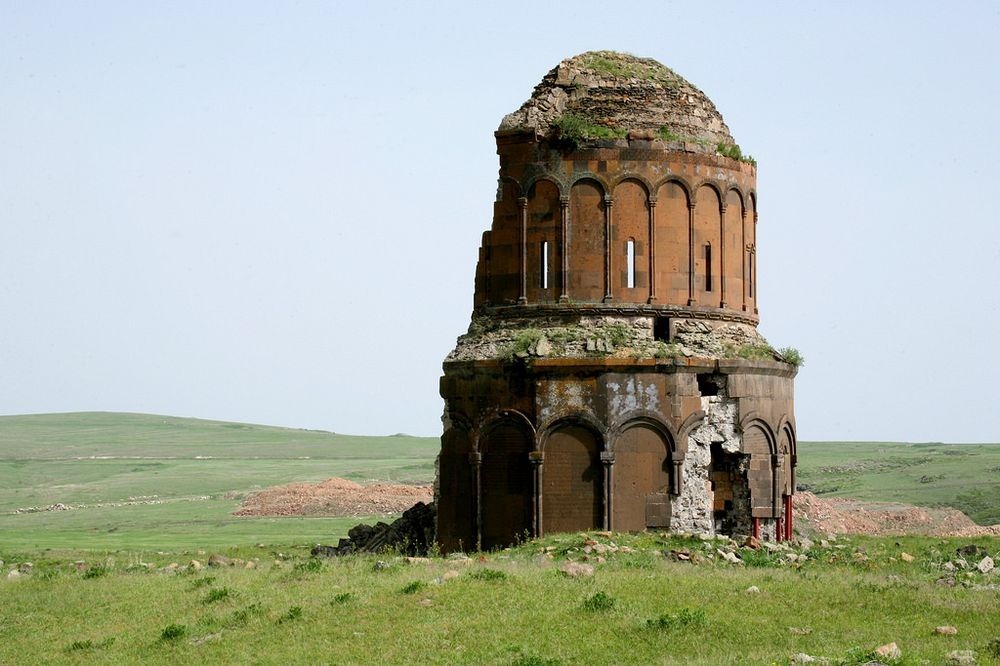
The Church of the Redeemer, completed shortly after the year 1035. It had a unique design: 19-sided externally, 8-apsed internally, with a huge central dome set upon a tall drum. The church was largely intact until 1955, when the entire eastern half collapsed during a storm.
The Cathedral of Ani, built in 989.
The Church of the Redeemer.
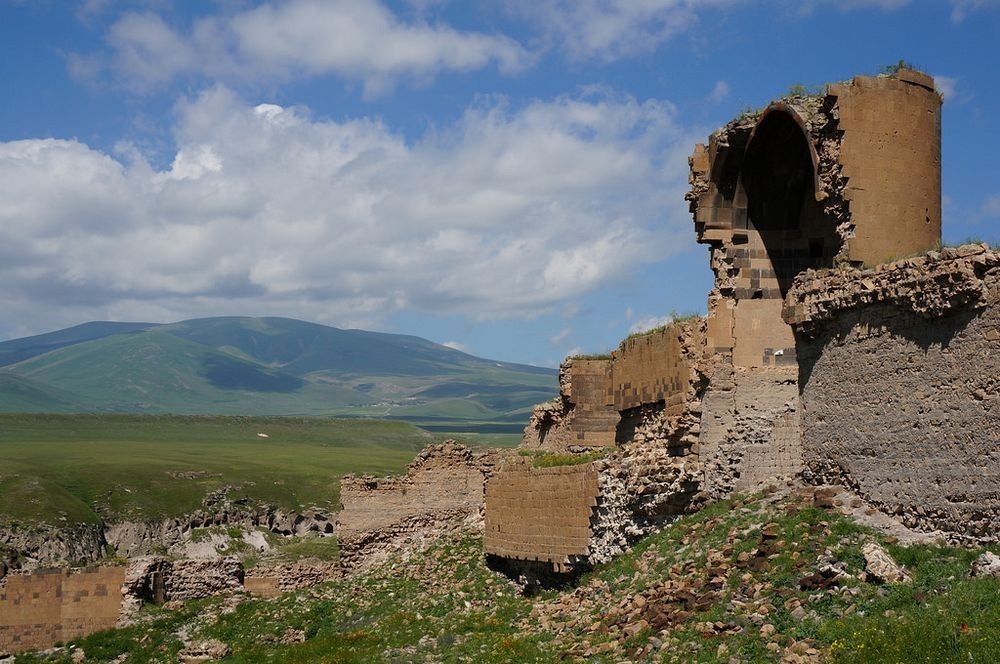
The walls of Ani.
The walls of Ani.
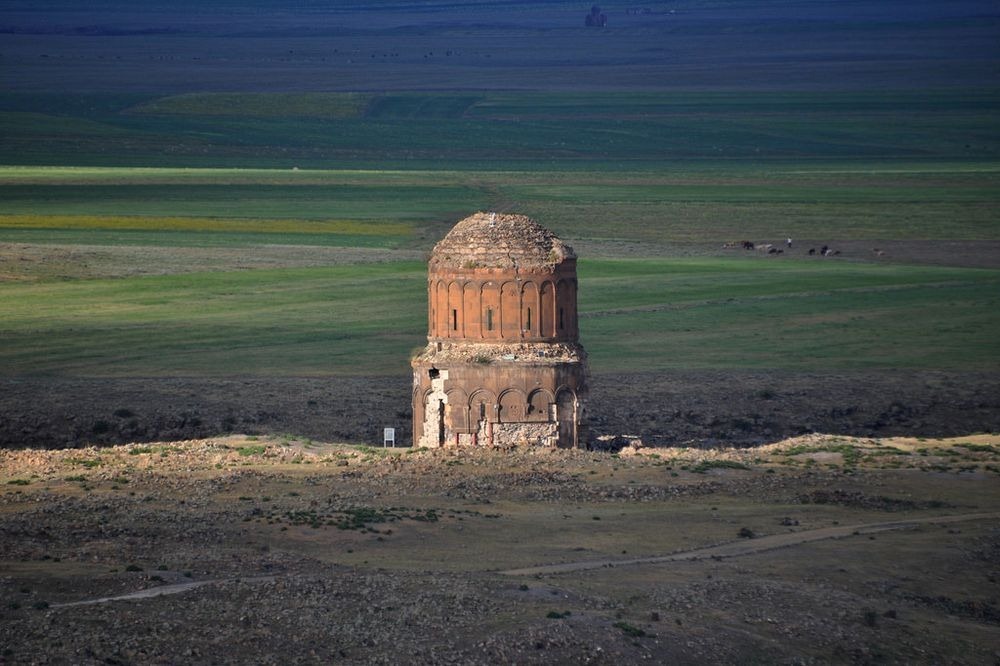
The Monastery of the Hripsimian Virgins, by the Akhurian River.
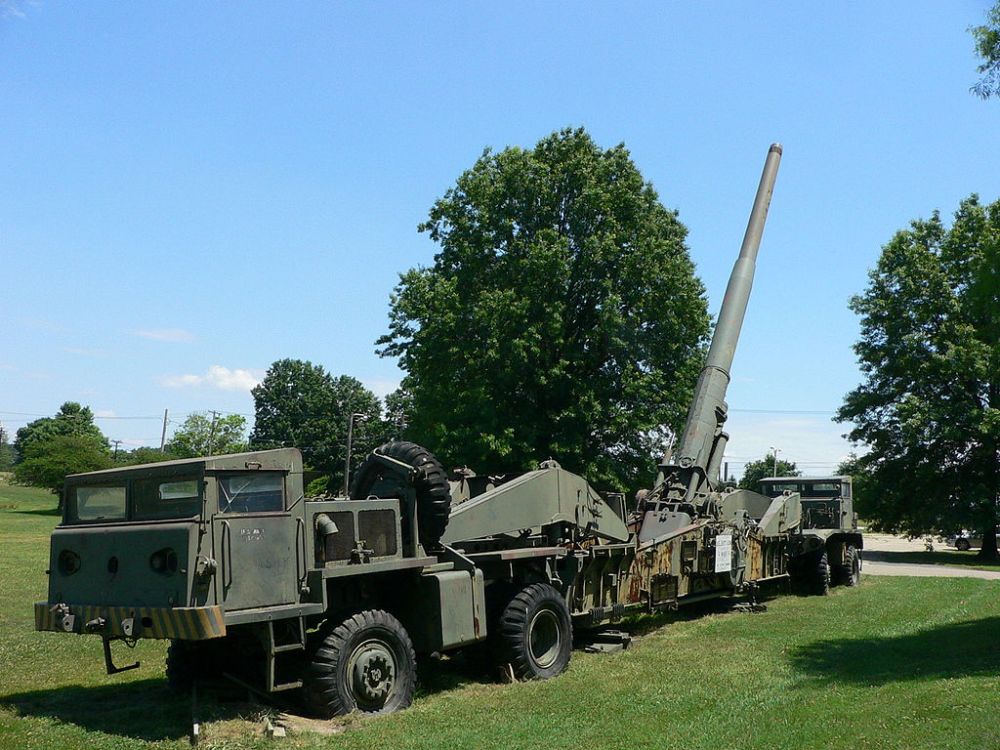
The M65 atomic cannon, often called “Atomic Annie“, was a towed artillery piece built by the United States and capable of firing a nuclear device. It was developed in the early 1950s, at the beginning of the Cold War, and fielded, by 1953, in Europe and Korea.
Picatinny Arsenal was tasked to create a nuclear capable artillery piece in 1949. Robert Schwartz, the engineer who created the preliminary designs, essentially scaled up the 240mm shell (then the maximum in the arsenal) and used the German K5 railroad gun as a point of departure for the carriage. (The name “Atomic Annie” likely derives from the nickname “Anzio Annie” given to a German K5 gun which was employed against the American landings in Italy.) The design was approved by the Pentagon, largely through the intervention of Samuel Feltman, chief of the ballistics section of the ordnance department’s research and development division. A three-year developmental effort followed. The project proceeded quickly enough to produce a demonstration model to participate in Dwight Eisenhower’s inaugural parade in January 1953.
The cannon was transported by two specially designed tractors, both capable of independent steering in the manner of some extra-long fire engines. Each of the tractors was rated at 375 hp, and the somewhat awkward combination could achieve speeds of 35 miles an hour and negotiate right angle turns on 28 ft wide, paved or packed roads. The artillery piece could be unlimbered in 15 minutes, then returned to traveling configuration in another 15 minutes.
On May 25, 1953 at 8:30am, the atomic cannon was tested at the Nevada Test Site (specifically Frenchman Flat) as part of the Upshot-Knothole series of nuclear tests. The test — codenamed “Grable” — was attended by the Chairman of the Joint Chiefs of Staff, Admiral Arthur W. Radford and Secretary of Defense Charles Erwin Wilson; it resulted in the successful detonation of a 15 kt shell (W9 warhead) at a range of seven miles. This was the first and only nuclear shell to be fired from a cannon (the Little Feller 1 test shot of an M388 used a Davy Crockett weapon system which was a recoilless smooth bore gun firing the warhead mounted on the end of a spigot inserted in the barrel of the weapon.)
After the successful test, there were at least 20 of the cannons manufactured at Watervliet and Watertown Arsenals, at a cost of $800,000 each. They were deployed overseas to Europe and Korea, often continuously shifted around to avoid being detected and targeted by opposing forces. Due to the size of the apparatus, their limited range, the development of nuclear shells compatible with existing artillery pieces (the W48 for the 155mm and the W33 for the 203mm), and the development of rocket and missile based nuclear artillery, the M65 was effectively obsolete soon after it was deployed. However, it remained a prestige weapon and was not retired until 1963.
The kind of monstrous weapons the Cold War spurned is mind boggling.
Moose crashes through window of Sylvia Fedoruk School in Saskatoon
Officials say 1 student sustained minor injuries, classes continuing as normal.
Jayme Melnyk took this picture of a moose after it smashed through a window at Sylvia Fedoruk School in Saskatoon. (Jayme Melnyk)
Jayme Melnyk says she couldn’t believe her eyes as a moose smashed into a school room located directly across the hallway from her son’s daycare.
Melnyk was dropping her two-year-old son off at an early-learning centre attached to Sylvia Fedoruk School in Saskatoon Thursday morning.
Her son spotted the moose running outside and was excited to see the huge animal at his school.
Suddenly, the moose ran through a large glass window in a community room and eventually slumped to the ground, in shock.
Despite the chaos, Melnyk kept a level head.
“I was very calm about it,” she said. “It didn’t really faze me as much as it probably should have.”
No serious injuries
The moose broke into the room just before 9 a.m. CST as a before-school program was wrapping up for the morning.
Immediately, Melnyk said the room’s supervisor gathered up the children in the room and got them to safety.
She snapped a picture of the young moose as it lay down near the classroom’s door, dazed from the experience.
A moose stands in a room of the school after bursting through the window. (Chanss Lagaden/CBC)
Not surprisingly, her two-year-old has been talking about the experience all day long.
“We know the lady who works at the child care centre who was able to get all the kids out,” she said.
“So, he’s been talking about her a lot and how she was scared of the moose because, obviously, the moose burst through the window.”
According to Saskatoon Public Schools, the school division that oversees the elementary school, no one was seriously injured. One student sustained minor injuries but did not need medical help.
Conservation officers load the unconscious moose into the back of a truck. The animal was released outside the city. (Chanss Lagaden/CBC)
Moose tranquilized and released outside city
Ben Denis saw the moose trotting down his alley while working in his home office. He noticed a conservation officer tracking the animal, so he decided to follow behind.
When he arrived at the school, officers told him the moose had smashed inside.
Within about 45 minutes, conservation officers had tranquilized the moose and brought the unconscious animal outside.
Curious, Denis followed the conservation officers outside the city and talked to them as they stopped at a gas station.
He said he was told that the moose was in good condition and would be released outside the city.
“It’s a feel-good story, even if there was a little bit of property damage,” said Denis.
“I think it’s the type of story we need after everything that’s gone on.”
Saskatoon Public Schools said classes at the school are continuing as normal.
The moose was successfully released into the wild. (Saskatchewan Environment/Facebook)
Nov. 3 (UPI) — Workers with a Brazilian highway management company received a surprise when a curious Amazon parrot flew up to investigate a traffic camera.
Footage posted to Twitter by highway management company Arteris Planalto Sul shows the parrot’s head blocking the view of the highway near Curitiba as it investigates the traffic camera.
“We received a special visit,” the post said.
Environmental authorities confirmed the bird was an Amazon parrot, a species listed as endangered in Brazil and Bolivia.
A New Zealand couple cleaning out their vegetable garden were astounded when they unearthed an enormous potato that weighs a staggering 17 pounds. Colin and Donna Craig-Brown reportedly made the incredible discovery back in August as they were in the process of preparing for the forthcoming spring season Down Under. As Colin was attempting to turn some soil over with a hoe, the tool struck a sizeable solid object that made him stop in his tracks.
Carefully and slowly digging around the oddity, he eventually pulled a massive and wildly misshapen potato out of the ground. The jaw-dropping spud was so peculiar that Colin and Donna actually debated whether or not it was a potato until he poked it with a fork and confirmed that to be the case. The couple believes that the tremendous tuber, which they dubbed ‘Doug,’ had been growing unnoticed in their garden for the past two years as that was the last time that they planted potatoes.
Their amazement was compounded when they eventually put the vegetable on a scale and saw that it weighs an extraordinary 17 pounds. A subsequent check online found that the spud easily surpasses the current record holder for the title of the world’s largest potato, which is a ‘mere’ 11 pounds. However, the couple and Doug now find themselves in something of a race against time as it could take up to 12 weeks for Guinness to confirm the tuber’s championship status.
As such, the Craig-Browns have wrapped the potato in two plastic bags and are keeping it in their freezer in order to prevent it from losing too much water weight before the final judgment from Guinness can be handed down. Should the spud be awarded the title, Donna declared that “there will be a celebration.” However, Doug’s fate beyond that point remains uncertain as self-described “hobbyist homebrewer’ Craig has considered using the tuber to create a special vodka or, failing that, he jokingly mused “we’ll fence it off and I reckon I could charge at least five bucks admission.”
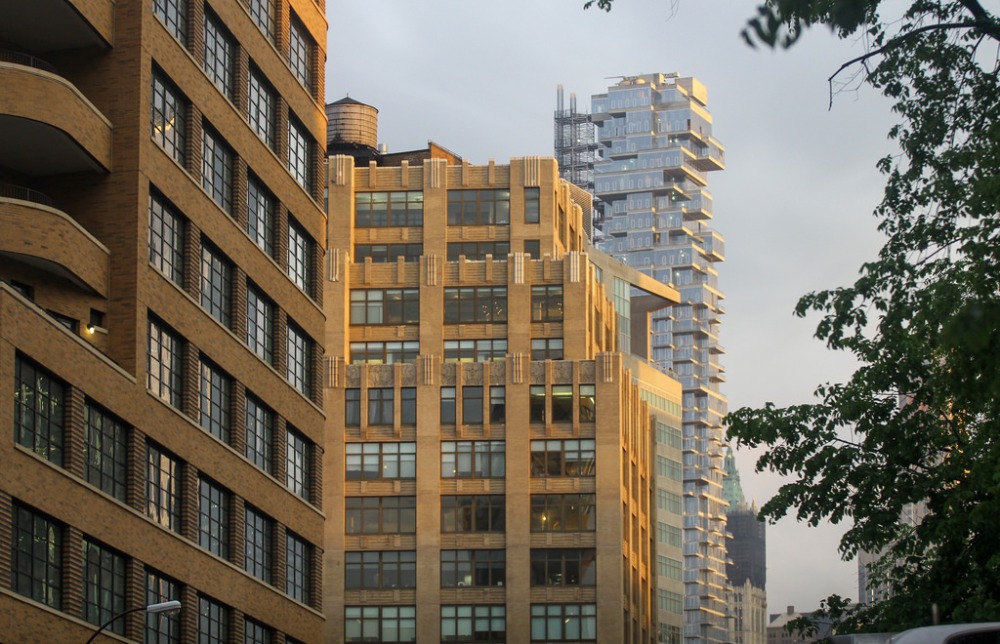
56 Leonard Street is an 821 feet (250 m) tall, 57-story skyscraper currently under construction on Leonard Street in, New York City, United States. The Pritzker Prize-winning Swiss architecture firm Herzog & de Meuron describes the building as “houses stacked in the sky.”
The building has 145 condominium residences priced between US$3.5 million and US$50 million. Residences will range in size from 1,418 to 6,400 square feet (131.7 to 594.6 m2) and will include 2 to 5 bedrooms all with private outdoor space.
As of May 2013, 70% of the building had sold. According to building developer Izak Senbahar, the building was 92% sold in seven months. In June 2013, a penthouse at 56 Leonard went into contract for US$47 million, making it the most expensive residential property ever sold below Midtown Manhattan.
The building was completed in 2016. Due to its cantilevered balconies it has been nicknamed as the Jenga building by the media.

















 The MarkoZen Blog