Just outside Portland, Oregon.

Just outside Portland, Oregon.

Imagine driving along the street and running into this… Image Credit: YouTube / Guardian News
Organizers of a festival in China’s Henan province were recently forced to chase after a giant runaway moon.The enormous inflatable satellite was seemingly caught by a particularly strong gust of wind during this year’s lunar festival celebrations in Henan province and broke free of its moorings.
In a video clip that has been circulating online, festival organizers can be seen chasing the errant lunar sphere as it careens down the street while motorists stop nearby to observe the spectacle.
It isn’t clear how (or even if) they managed to get a handle on the thing.
This wasn’t the only mishap to beset the lunar celebrations this year either – another inflatable moon reportedly escaped its handlers in Hong Kong and ended up blowing into a river.
The same thing has happened before, too, in the city of Fuzhou in 2016 during Typhoon Meranti.
Suffice to say, festival organizers might want to come up with a better way to secure their balloons.
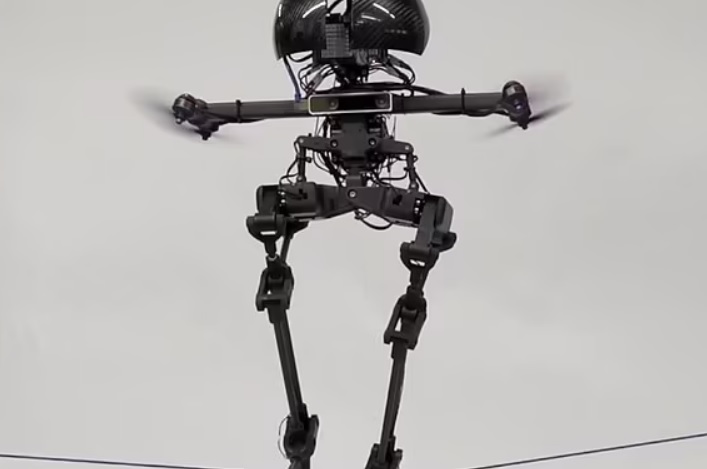
The idea of a robot that can navigate a slackline, skateboard and fly might sound like a concept of science fiction.
But such a bot is very much real, in the form of LEONARDO, or Legs Onboard Drone – a bipedal robot that has drone like thrusters for stability.
Known as LEO for short, it was built from parts of robots and drones found around the lab by engineers from the California Institute of Technology in Pasadena.

As well as improving stability when walking a tightrope, the propeller-based thrusters also allow the 2.5 foot tall bot to take to the air and fly.
The team says that LEO could someday apply its conquest of land and air to robotic missions currently difficult for ground- or aerial-based robots and drones.
As well as slacklining and skateboarding, the team says the robot could one day be used to perform tasks currently very difficult for drones, robots or humans – including operating in hazardous and hard to reach environments.
The team hasn’t said when LEO would be available for commercial use, or how much it would cost, as it is still at the research and development stage, but hope to work with a manufacturing partner in the future.




This street sign has been stolen a countless number of times. It keeps getting higher, literally.

Quetzalcoatlus Northropi An Ancient Bird Next To A Human
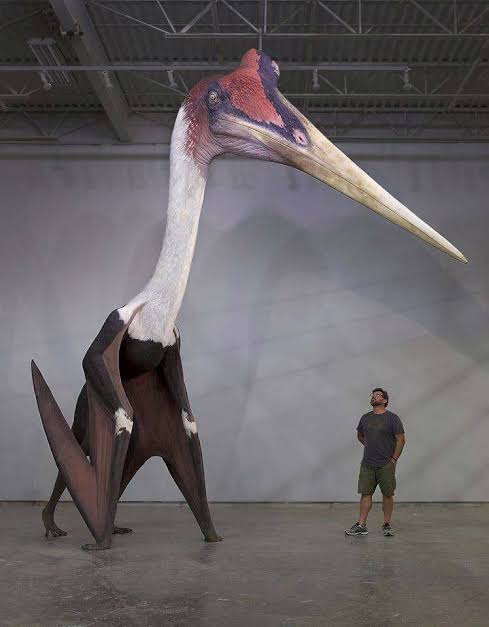
Image running into this thing. Luckily no humans around when this beast was on the planet.
Quetzalcoatlus is a pterosaur known from the Late Cretaceous period of North America, it was one of the largest known flying animals of all time. Quetzalcoatlus is a member of the family Azhdarchidae, a family of advanced toothless pterosaurs with unusually long, stiffened necks. Its name comes from the Aztec feathered serpent god, Quetzalcoatl, in Nahuatl. The type and only species is Q. northropi.
The first Quetzalcoatlus fossils were discovered in Texas, United States, from the Maastrichtian Javelina Formation at Big Bend National Park (dated to around 68 million years ago in 1971 by Douglas A. Lawson, a geology graduate student from the Jackson School of Geosciences at the University of Texas at Austin. The specimen consisted of a partial wing (in pterosaurs composed of the forearms and elongated fourth finger), from an individual later estimated at over 10 m (33 ft) in wingspan.
When it was first named as a new species in 1975, scientists estimated that the largest Quetzalcoatlus fossils came from an individual with a wingspan as large as 15.9 m (52 ft). Choosing the middle of three extrapolations from the proportions of other pterosaurs gave an estimate of 11 m, 15.5 m, and 21 m, respectively (36 ft, 50.85 ft, 68.9 ft). In 1981, further advanced studies lowered these estimates to 11–12 m (36–39 ft).

Odd green light spotted at Indonesian volcano was a meteorite
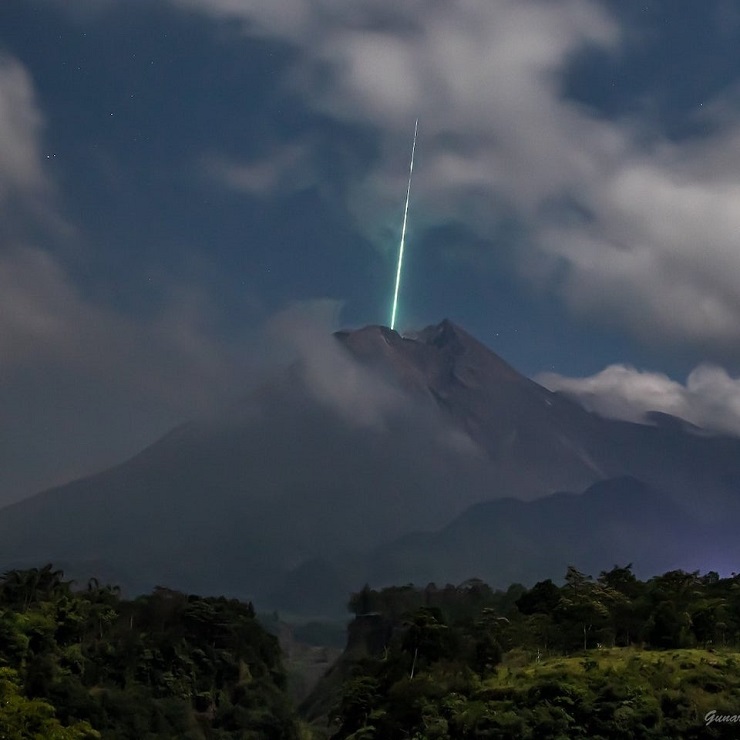
A series of photos of Indonesian volcano Mount Merapi have gone viral after a photographer captured images that look like a laser is erupting from the massive peak, but it’s most likely a meteorite, according to experts.
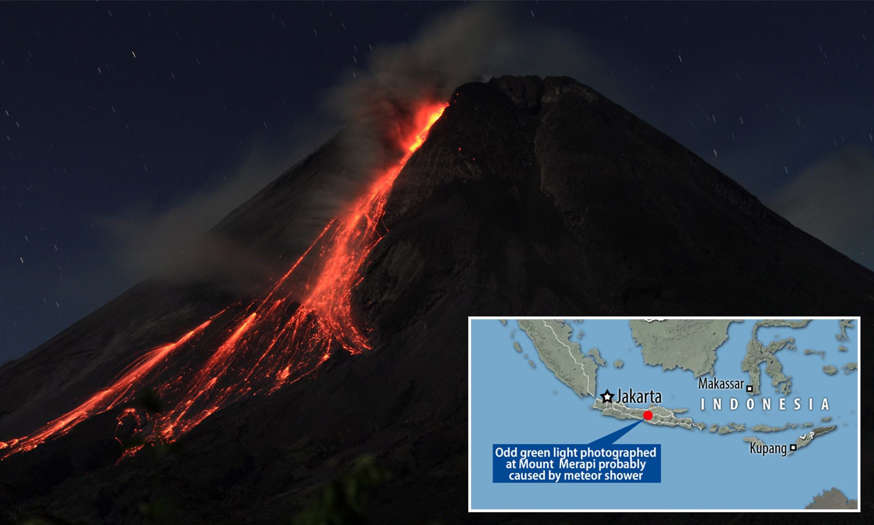
Indonesian photographer Gunarto Song took the photos on May 28 that have now garnered more than 28,000 likes. The caption on the photos reads: ‘a meteor fell into the peak of Mount Merapi?’
However, it’s likely that the strange green light stems from two meteor showers, the Eta Aqarid meteor shower and the Arietid meteor shower, that happened during the time, according to National Institute of Aeronautics and Space (LAPAN).
The beam was captured in a still photograph and confirmed by CCTV monitoring of the volcano by the Kalitengah Kidul Post for a few seconds.
‘So, from these two data, it can be assumed that the flash of greenish light that appears near Mount Merapi may be related to meteor shower activity,’ LAPAN wrote in a translated version of its website.
The Eta Aquarids meteor shower happened between April 19 to May 28, while the Arietids shower started on May 14 and will last through June 24.
As for the bright greenish hue, that can likely be explained by the level of magnesium in the space rock.
‘Given that the light emitted is green, it is likely that the meteor that feel around Merapi was dominated by the element magnesium,’ LAPAN added.
A piece of an asteroid or comet is also known as a meteoroid. Upon entering Earth’s atmosphere, it turns into a meteor, fireball or shooting star.
The pieces that reach the ground are known as meteorites.
Speaking with CNN Indonesia, Gunarto said he set the shutter speed of his camera at four seconds and hoped for the best.
‘Because I use a speed of 4 seconds. Like it or not, the photo [of light] will be long. But the light is round light, hurry up, the round light keeps falling,’ Gunarto told the news outlet.
Mount Merapi on the border of Central Java and the Special Region of Yogyakarta,, is one of the world’s most active volcanoes. It last erupted on March 27, 2021, with prior eruptions happening twice in March 2020.
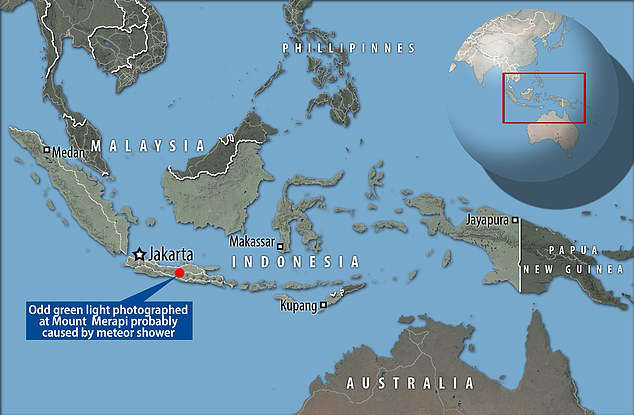
Indonesia sits on the ‘Ring of Fire,’ a tectonic plate in the Pacific Ocean that results in frequent seismic and volcanic activity.
The Albuquerque International Balloon Fiesta is a yearly hot air balloon festival that takes place in Albuquerque, New Mexico, during early October. The Balloon Fiesta is a nine-day event occurring in the first full week of October, and has over 500 hot air balloons each year far from its humble beginnings of merely 13 balloons in 1972. The event is the largest balloon festival in the world, followed by the Grand Est Mondial Air in France.













 The MarkoZen Blog