The Dhole

The Dhole is a species of canid native to South and Southeast Asia. The dhole is a highly social animal, living in large clans which occasionally split up into small packs to hunt. It primarily preys on medium-sized ungulates, which it hunts by tiring them out in long chases, and kills by disemboweling them. Though fearful of humans, dhole packs are bold enough to attack large and dangerous animals such as wild boar, water buffalo, and even tigers.
The Babirusa

Babirusa, meaning “Hog-deer”, are members of the pig family found in Wallacea, or specifically the Indonesian islands of Sulawesi, Togian, Sula and Buru. If a babirusa does not grind its tusks (achievable through regular activity), they will eventually keep growing so as to penetrate the animal’s own skull.
The Fossa
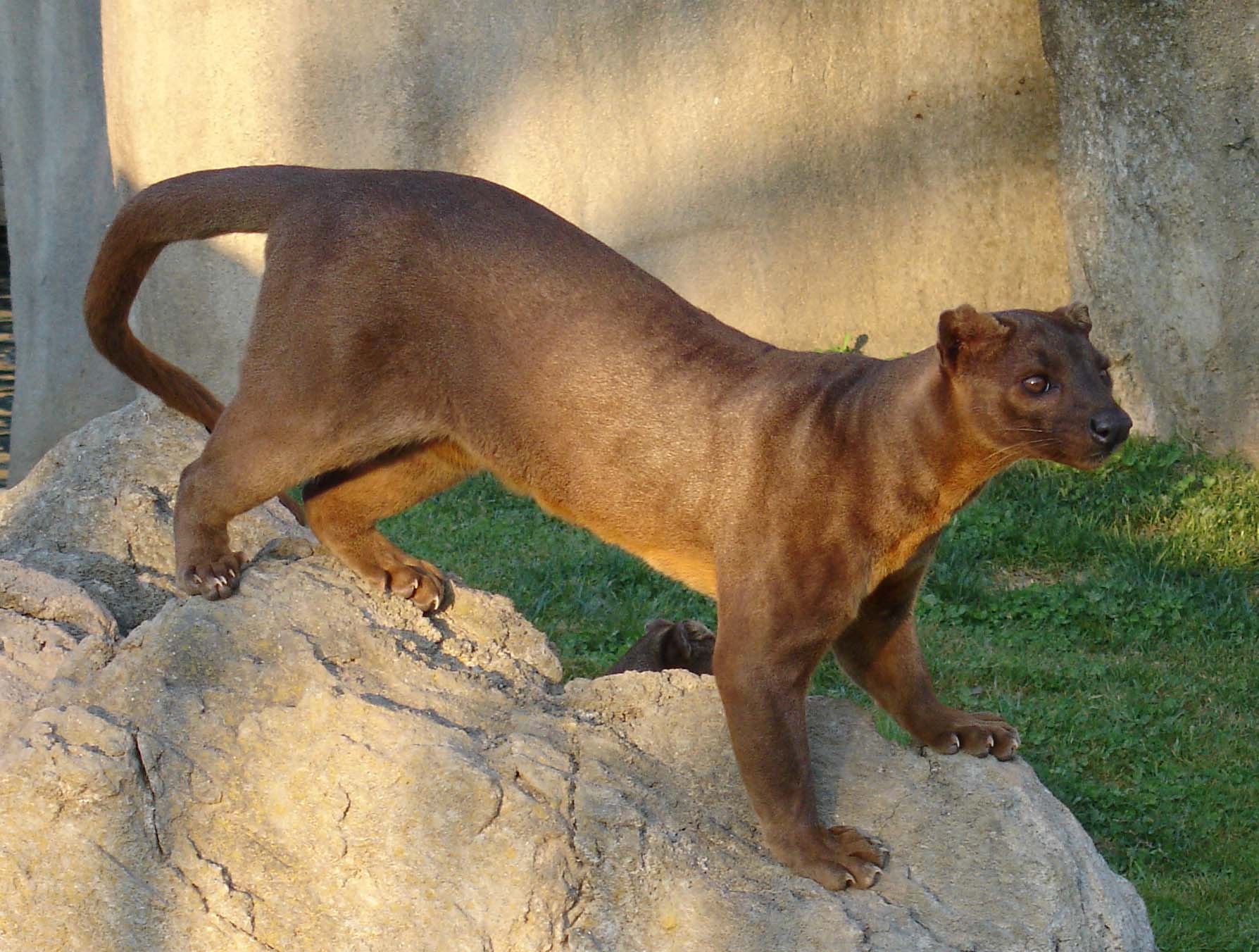

The fossa is a cat-like, carnivorous mammal that is endemic to Madagascar. The fossa is the largest mammalian carnivore on the island of Madagascar and has been compared to a small cougar. It has semi-retractable claws and flexible ankles that allow it to climb up and down trees head-first, and also support jumping from tree to tree.
The Gerenuk

The gerenuk, also known as the Waller’s gazelle, is a long-necked species of antelope found in dry thorn bush scrub and desert in Eastern Africa. The word gerenuk comes from the Somali language, meaning “giraffe-necked”. Gerenuks have a relatively small head for their body, but their eyes and ears are proportionately large. Gerenuks seldom graze but browse on prickly bushes and trees, such as acacias. They can reach higher branches and twigs than other gazelles and antelope by standing erect on their rear legs and stretching their elongated necks.
Irrawaddy Dolphin


The Irrawaddy dolphin is a species of oceanic dolphin found near sea coasts and in estuaries and rivers in parts of the Bay of Bengal and Southeast Asia. Genetically, the Irrawaddy dolphin is closely related to the killer whale.
Markhor

The markhor is a large species of wild goat that is found in northeastern Afghanistan and Pakistan. The species is classed by the IUCN as Endangered, as there are fewer than 2,500 mature individuals. The markhor is the national animal of Pakistan. While chewing the cud, a foam-like substance comes out of its mouth which drops on the ground and dries. This foam-like substance is sought after by the local people, who believe it is useful in extracting snake poison from snake bitten wounds.
Southern Right Whale Dolphin

The southern right whale dolphin is a small and slender species of mammal found in cool waters of the southern hemisphere. They are fast active swimmers and have no visible teeth and no dorsal fin. They are very graceful and often move by leaping out of the water continuously.
Sunda Colugo

Also known as The Sunda flying lemur, it is not actually a lemur and does not fly. Instead, it glides as it leaps among trees. It is strictly arboreal, is active at night, and feeds on soft plant parts such as young leaves, shoots, flowers, and fruits. The Sunda Coluga can be found throughout Southeast Asia in Indonesia, Thailand, Malaysia, and Singapore.
Lamprey

Lampreys are a type of jawless fish that live mostly in coastal and fresh waters whose adults are characterized by a toothed, funnel-like sucking mouth. They attach themselves to fish and suck their blood. Lampreys have been around for nearly 300 millions years and their body structure has remained relatively unchanged.
Raccoon Dog

The Raccoon Dog, or Tanuki, is a canid indigenous to East Asia. The raccoon dog is named for its resemblance to the raccoon, to which it is not closely related. They are very good climbers and regularly climb trees.
Zebra Duiker

The zebra duiker is a small antelope found in Ivory Coast and other parts of Africa. They have gold or red-brown coats with distinctive zebra-like stripes (hence the name) Their prong-like horns are about 4.5 cm long in males, and half that in females. They live in lowland rainforests and mostly eat leaves and fruit.
Star-Nosed Mole

The star-nosed mole is a small mole found in wet low areas of eastern Canada and the northeastern United States. It is easily identified by the 11 pairs of pink fleshy appendages ringing its snout, which is used as a touch organ with more than 25,000 minute sensory receptors, known as Eimer’s organs, with which this hamster-sized mole feels its way around.
Some more common animals.










 The MarkoZen Blog