World’s Largest Telescopes

Wiki

This list of the largest optical reflecting telescopes with objective diameters of 3.0 metres (120 in) or greater is sorted by aperture, which is one limit on the light-gathering power and resolution of a reflecting telescope’s optical assembly.

1. 

The Gran Telescopio Canarias (GranTeCan or GTC), also known as the Great Canary Telescope is a 10.4 m (410 in) reflecting telescope located at the Roque de los Muchachos Observatory on the island of La Palma, in the Canaries, Spain.

Construction of the telescope, sited on a volcanic peak 2,267 metres (7,438 ft) above sea level, took seven years and cost €130 million (£112 million). Its installation had been hampered by weather conditions and the logistical difficulties of transporting equipment to such a remote location. First light was achieved in 2007 and scientific observations began in 2009.

The GTC Project is a partnership formed by several institutions from Spain and Mexico, the University of Florida, the Universidad Nacional Autónoma de México and the Instituto de Astrofísica de Canarias (IAC). Planning for the construction of the telescope, which started in 1987, involved more than 1,000 people from 100 companies.

As of 2015, it is the world’s largest single-aperture optical telescope. The distribution of the availability of time to use the telescope meets its financial structure: 90% Spain, 5% Mexico and 5% the University of Florida.

telescope


2. 

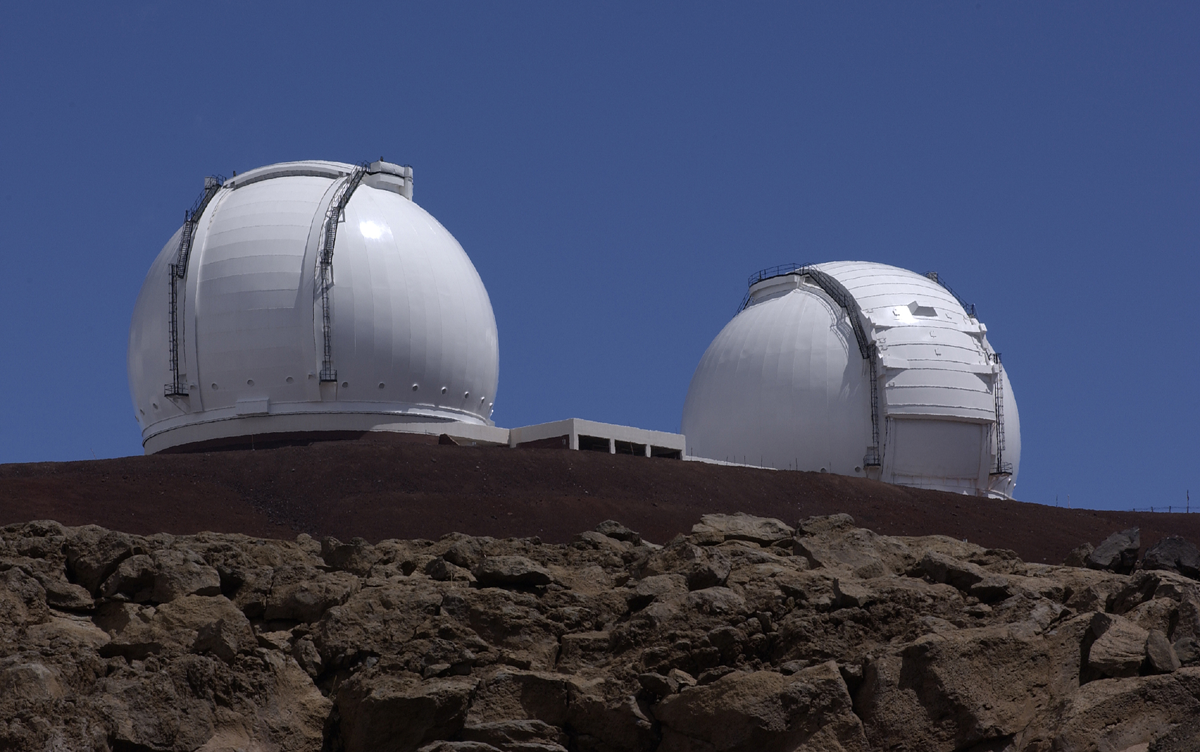
The W. M. Keck Observatory is a two-telescope astronomical observatory at an elevation of 4,145 meters (13,600 ft) near the summit of Mauna Kea in the U.S. state of Hawaii. Both telescopes feature 10 m (33 ft) primary mirrors, currently among the largest astronomical telescopes in use. The combination of an excellent site, large optics and innovative instruments has created the two most scientifically productive telescopes on Earth.
 

telescope1


3.

The Southern African Large Telescope (SALT) is a 10-metre class optical telescope designed mainly for spectroscopy. It consists of 91 hexagonal mirror segments each with a 1 metre inscribed diameter, resulting in a total hexagonal mirror of 11.1 m by 9.8 m. It is located close to the town of Sutherland in the semi-desert region of the Karoo, South Africa. It is a facility of the South African Astronomical Observatory, the national optical observatory of South Africa.


telescope2


4.

The Hobby–Eberly Telescope (HET) is a 9.2-meter (30-foot) aperture telescope located at the McDonald Observatory in Texas. It is one of the largest optical telescopes in the world and combines a number of features that differentiate it from most telescope designs, resulting in greatly lowered construction costs. For instance, the primary mirror is constructed from 91 hexagonal segments, which is less expensive than manufacturing a single large primary. Furthermore, the telescope’s main mirror is fixed at a 55° angle and can rotate around its base. A target is tracked by moving the instruments at the focus of the telescope; this provides access to about 70–81% of the sky at its location and allows a single target to be tracked for up to two hours.

The Hobby–Eberly Telescope is operated by The University of Texas McDonald Observatory for a consortium of institutions which includes The University of Texas at Austin, Pennsylvania State University, Stanford University, Ludwig Maximilians University of Munich, and Georg August University of Gottingen.


telescope3


5.

The Large Binocular Telescope (LBT) is an optical telescope for astronomy located on Mount Graham (10,700-foot (3,300 m) in the Pinaleno Mountains of southeastern Arizona, and is a part of the Mount Graham International Observatory. The LBT is currently one of the world’s most advanced optical telescopes; using two 8.4 m (27 ft) wide mirrors, with a 14.4 m center-center separation, it has the same light gathering ability as an 11.8 m (39 ft) wide single circular telescope and detail of a 22.8 m (75 ft) wide one. Either of its mirrors would be the second-largest optical telescope in continental North America, behind the Hobby–Eberly Telescope in West Texas; as of summer 2014, it would still be the largest monolithic, or non-segmented mirror, in an optical telescope. Optical performance of the telescope is excellent, and Strehl ratios of 60–90% in the infrared H band and 95% in the infrared M band have been achieved by the LBT.

The LBT was originally named the “Columbus Project”. It is a joint project of these members: the Italian astronomical community represented by the Istituto Nazionale di Astrofisica, the University of Arizona; University of Minnesota, University of Notre Dame, University of Virginia, the LBT Beteiligungsgesellschaft in Germany (Max Planck Institute for Astronomy in Heidelberg, Landessternwarte in Heidelberg, Leibniz Institute for Astrophysics Potsdam (AIP), Max Planck Institute for Extraterrestrial Physics in Munich and Max Planck Institute for Radio Astronomy in Bonn); The Ohio State University; Research Corporation in Tucson.


telescope4


6.

Subaru Telescope is the 8.2 metre flagship telescope of the National Astronomical Observatory of Japan, located at the Mauna Kea Observatory on Hawaii. It is named after the open star cluster known in English as the Pleiades. It had the largest monolithic primary mirror in the world from its commission until 2005.

In 1984, the University of Tokyo formed an engineering working group to study the concept of a 7.5-metre telescope. In 1985, the astronomy committee of Japan’s science council gave top priority to the development of a “Japan National Large Telescope” (JNLT), and in 1986, the University of Tokyo signed an agreement with the University of Hawaii to build the telescope in Hawaii. In 1988, the National Astronomical Observatory of Japan was formed through a reorganization of the University’s Tokyo Astronomical Observatory, to oversee the JNLT and other large national astronomy projects.


telescope5


7.

The Very Large Telescope (VLT) is a telescope operated by the European Southern Observatory on Cerro Paranal in the Atacama Desert of northern Chile. The VLT consists of four individual telescopes, each with a primary mirror 8.2 m across, which are generally used separately but can be used together to achieve very high angular resolution. The four separate optical telescopes are known as AntuKueyenMelipal and Yepun, which are all words for astronomical objects in the Mapuche language. The telescopes form an array which is complemented by four movable Auxiliary Telescopes (ATs) of 1.8 m aperture.

The VLT operates at visible and infrared wavelengths. Each individual telescope can detect objects roughly four billion times fainter than can be detected with the naked eye, and when all the telescopes are combined, the facility can achieve an angular resolution of about 0.001 arc-second (This is equivalent to roughly 2 meters resolution at the distance of the Moon). In single telescope mode of operation angular resolution is about 0.05 arc-second.

The VLT is the most productive ground-based facility for astronomy, with only the Hubble Space Telescope generating more scientific papers among facilities operating at visible wavelengths. Among the pioneering observations carried out using the VLT are the first direct image of an exoplanet, the tracking of individual stars moving around the supermassive black hole at the centre of the Milky Way, and observations of the afterglow of the furthest known gamma-ray burst.


telescope6


8.

The Gemini Observatory is an astronomical observatory consisting of two 8.19-metre (26.9 ft) telescopes, the Gemini North and Gemini South at different sites in Hawaii and Chile, respectively. Together, the twin Gemini telescopes provide almost complete coverage of both the northern and southern skies. They are currently among the largest and most advanced optical/infrared telescopes available to astronomers.

The Gemini telescopes were built and are operated by a consortium consisting of the United States, Canada, Chile, Brazil, Argentina, and Australia. This partnership is managed by the Association of Universities for Research in Astronomy (AURA). The United Kingdom dropped out of the partnership at the end of 2012 and the Gemini Observatory has responded to this by significantly reducing its operating costs, so that no new partners are required beginning in 2013.


telescope7


9.

The Magellan Telescopes are a pair of 6.5 m (21.3 ft) diameter optical telescopes located at Las Campanas Observatory in Chile. The two telescopes are named after the astronomer Walter Baade and the philanthropist Landon T. Clay.

First light for the telescopes was on September 15, 2000 for the Baade, and September 7, 2002 for the Clay.

A collaboration between Carnegie Institution for Science, University of Arizona, Harvard University, The University of Michigan and the Massachusetts Institute of Technology built and operate the twin telescopes.

It was named after the sixteenth-century Portuguese explorer Ferdinand Magellan.


telescope8


10.

The BTA-6 is a 6-metre (20 ft) aperture optical telescope at the Special Astrophysical Observatory located in the Zelenchuksky District on the north side of the Caucasus Mountains in southern Russia.

The BTA-6 achieved first light in late 1975, making it the largest telescope in the world until 1990, when it was surpassed by the partially constructed Keck 1. It pioneered the technique, now standard in large astronomical telescopes, of using an altazimuth mount with a computer-controlled derotator.

For a variety of reasons, BTA-6 was never able to operate near its theoretical limits. Early problems with poorly fabricated mirror glass were addressed in 1978, fixing the most serious issue. But due to its location down-wind of numerous large mountain peaks, astronomical seeing is rarely good. The telescope also suffers from serious thermal expansion problems due to the large thermal mass of the mirror, and the dome as a whole which is much larger than necessary. Upgrades have taken place throughout the system’s history and are ongoing to this day.


telescope9


Hinterland Who’s Who: the Manitoba Riverine Amphibious Humanoid Beastie

Hinterland Who’s Who is a federally funded educational wildlife agency.

Today’s featured creature on Hinterland Who’s Who is the Manitoba Riverine Amphibious Humanoid Beastie otherwise known as the (Green Gill-man).  The creature is seen by many witnesses and has been observed by paranormal nature biologists working for Hinterland Who’s Who.  The biologists estimate the creature to stand at least 8 feet tall and weigh somewhere in the neighborhood of 350- 500 pounds. The beasts’ diet seems to consist of tree leaves and other riverine plants, small mammals such as squirrels and cats, the odd dog and periodically a cow.  Farmers along the Red and Assiniboine Rivers have reported lost cows, only to find the skeleton of the cow a few days later.  The cows have been eaten completely, no flesh is found. Some think it could be space aliens, but Hinterland Who’s Who is sure the culprits are the Green Gill-man.

Mainstream science doesn’t touch the subject of the Green Gill-man, they want a body, as the mainstreamers profess they need actual physical evidence.  The sightings, photos, video and webbed footprints just aren’t enough for these obstinate skeptics. Maybe a body will surface one of these days, but let’s not hold our breath.

The sightings and reports go back hundreds of years to pre European contact in Manitoba.  The Cree Indian tribes had a name for the Gill-man, “Shushtanuckawucktoodeepwa,” which literally translates into “big green varmint that swims like fish but walks on the land and will attack our women.”  The Shushtanuckawucktoodeepwa is deeply ingrained in Native legend and stories.  One story is about the Gill-man having a major tussle with a Sasquatch.  The battle was observed near Pukatawagan in the 1920’s.  The beasts were laying heavy punches on each other until they all of a sudden stopped, shook hands and walked off in different directions.

Recent photos of the creature in the Assiniboine River in Winnipeg

riva

It appears obvious that this thing doesn’t hibernate. How it survives Manitoba’s winter is anybody’s guess.

Another brute enjoying a dip near the Midtown Bridge..

riva2

Damn that must be cold!

The creature’s habitat seems to go beyond the river systems. Sightings have been reported on the big lakes north of Winnipeg.  Gill-man has also been sighted deep inland, miles from any water.  They are usually sighted near cow pastures.  And immediately after the pasture sightings, a farmer reports a missing cow.  Dinner time for the green water goblin?

Here is a sighting at Patricia Beach on the south end of Lake Winnipeg.

creaturex

The photo was taken very close to the section of the beach that is reserved for nude beachgoers. The Green gill-man seems to have an interest in female humans.  Not sure why.

The famous Grand Beach Photo.  Taken 2 years ago by ghost hunter Mel Ryan. Mel was quoted as saying: “No ghosts this time, but sovanabitch this big green thing was even better than a ghost.  I wonder, when the gill-man dies, does it manifest into a gill-man ghost? Now that would be 2 birds with one stone my man.”

creature9

It appears to be stalking something.  Female human?

If anybody out there has reports, photos or video of the Manitoba Riverine Amphibious Humanoid Beastie please forward them to Hinterland Who’s Who, PO Box 2300, Ottawa, Ontario, Q4J 1X9. Email: HWW@JustinTrudeau.com.

For the record: Prime Minister Justin Trudeau just announced that he will be increasing the HWW budget ten-fold over the next few months. Yaha!

Man Slides Deer To Safety Across Frozen Lake

Lancour went home, got a leash and called his friend John Moss, for help.

When he realized that the leash was not going to work, Lencour stepped out onto the ice and approached the deer. When the animal didn’t seem to bolt or struggle, he came up with a different idea.

Wearing ice cleats, Lencour began sliding the helpless animal towards the shore as Moss got out his phone and began recording.

When they were near the edge of the ice, the deer struggled and finally righted itself. Laughing, Lencour quipped “you’re welcome,” as it ran into the distance.

Ded Moroz “Russian Santa”

Ded Moroz is a legendary figure similar to Saint Nicholas, Father Christmas and Santa Claus who has his roots in Slavic paganism mythology. The tradition of Ded Moroz is mostly spread in East Slavic countries and is an important part of Russian culture. Although at the beginning of the Soviet era communists banned Ded Moroz he soon became an important part of the Soviet culture. The literal translation is “Grandfather Frost”.

Ded Moroz is depicted as bringing presents to well-mannered children, often delivering them in person in December days and secretly under the Christmas tree on night at 31 December on New Year’s Eve.

In East Slavic cultures, Ded Moroz is accompanied by Snegurochka his granddaughter and helper, who wears long silver-blue robes and a furry cap or a snowflake-like crown. She is a unique attribute of Ded Moroz, since similar characters in other cultures do not have a female companion. Often Snegurochka is called Nastenka (Nastya), the diminutive of Anastasia.

Boeing 747-8 Private Jet takes Luxury to a Whole New Level

For most people, private jets such as the $65 million Gulfstream G650 or the Bombardier Global Series are the epitome of luxury air travel, but there are a select few who can afford more than that. They’re converting airliners into private flying palaces. To meet this demand, Airbus and Boeing have begun selling “VIP” versions of their airliners under the Airbus Corporate Jet and Boeing Business Jet brands. While most of these planes are based on smaller Airbus A320 series or Boeing 737 models, one recent VIP conversion took luxury to a new level.

One very lucky, very wealthy, and very confidential client took delivery of a personalized Boeing 747-8, completed by Greenpoint Technologies of Kirkland, Washington. Its incredible 4,786 sq. ft. of space features a stateroom, lounges, an office, and a massive dining room.


boeing2


Master Bedroom

boeing-747-8-master-suite-greenpoint


boeing5


boeing-747-8-interior-l-611f6e5cd1ffa74a


boeing greenpoint-technologies_747-8_img-3


boeing12


Upper Deck Lounge

boeing9 hump


Time to relax at 40,000 feet

boeing1


boeing3


boeing4


boeing7


boeing8


boeing11


boeing10


Big Majestic Beast

boeing13


Painted Sheep Look Really Cool

In these trying times I am continually looking out for news that might bring some fun into the world and in so doing, brighten up your day. There is a farmer in Bathgate in Scotland who came up with a novel idea for brightening up the day for motorists who drive by his farm on the M8 motorway.

This story all started back in 2007 when a Scottish farmer  named Andrew Jack decided to color his sheep blue to celebrate the Scottish national St Andrew’s Day holiday. Don’t worry the sheep didn’t get hurt as he used a special animal friendly spray paint. The effect was quite stunning don’t you think?

sheep

The reaction to his blue sheep was tremendous. When asked for his reaction, Bob Carruth of the National Farmers’ Union Of Scotland  commented “It’s a very patriotic gesture and it also reminds people how important sheep are to our agriculture”  This support encouraged Jack and he decided  to also add a few red ones to his growing flock of funky sheep. 

sheep1

According to Jack he liked the idea of the funky sheep as it was his way to “Spice Things Up A Bit”  so people could smile on their way to and from work while driving on the motorway. Once again the reaction was overwhelming and the drive past Jack’s farm became a bit of a tourist attraction.

Jack’s reaction to the publicity was to expand his color range even further and today if you pass the M8 you will most likely see a rainbow effect of colorful, funky , Scottish sheep all diligently brightening up the day for all the folks who drive by and It may look something like this.

cool-sheep-colors-dyed-farmer

Jack frequently re-sprays his sheep and they remain colorful until it is time for shearing. If you are still concerned about the effect of the paint on the animals, the editor of “Sheep” magazine, Nathan Griffith states that it is not harmful to dye sheep with the right products, and that many sheep farmers count and identify their flocks by color coding their fleeces.

.

sheep2

sheep3

SOLENT: IN THE PINK! Ewe must be kidding! Visitors at a nature park thought they were going baarmy when they spotted these sheep - with pink wool. The extraordinary flock is causing a sensation at SheepWorld, near Auckland, New Zealand. Park bosses originally dyed the animals with harmless food colouring as part of breast cancer awareness week. Photographer Samuel Zoll took these photos of the bizarre scene when he visted Sheepworld. Pic: Samuel Zoll/solent © Samuel Zoll/solent UK +44 (0) 2380 458800

sheep5

sheep6

sheep7

Nature Creates Magical Art in the North Arizona Desert


antelop7


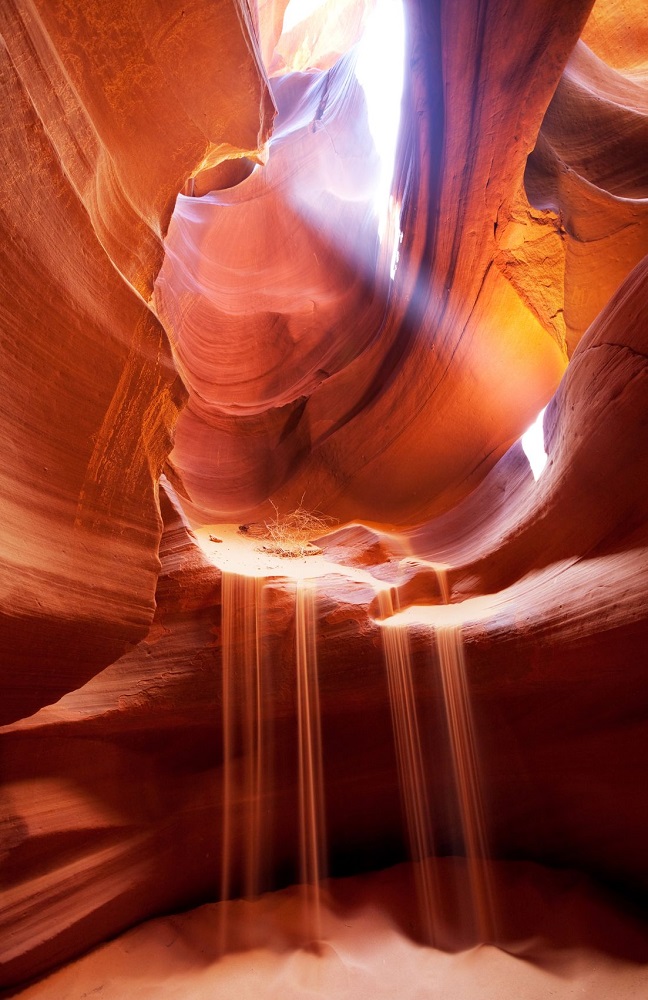
Antelope Canyon is a slot canyon (vary narrow canyon) in the American Southwest. It is located on Navajo land east of Page, Arizona. Antelope Canyon includes two separate, photogenic slot canyon sections, referred to individually as Upper Antelope Canyon or The Crack; and Antelope Canyon or The Corkscrew.

The Navajo name for Upper Antelope Canyon is Tsé bighánílíní, which means “the place where water runs through rocks.” Lower Antelope Canyon is Hazdistazí (advertised as “Hasdestwazi” by the Navajo Parks and Recreation Department), or “spiral rock arches.” Both are located within the LeChee Chapter of the Navajo Nation.


antelope


Antelope Canyon was formed by erosion of Navajo Sandstone, primarily due to flash flooding and secondarily due to other sub-aerial processes. Rainwater, especially during monsoon season, runs into the extensive basin above the slot canyon sections, picking up speed and sand as it rushes into the narrow passageways. Over time the passageways eroded away, making the corridors deeper and smoothing hard edges in such a way as to form characteristic ‘flowing’ shapes in the rock.

Flooding in the canyon still occurs. A flood occurred on October 30, 2006, that lasted 36 hours, and caused the Tribal Park Authorities to close Lower Antelope Canyon for five months.


antelope9


antelope1


Antelope Canyon is visited exclusively through guided tours, in part because rains during monsoon season can quickly flood the canyon. Rain does not have to fall on or near the Antelope Canyon slots for flash floods to whip through, as rain falling dozens of miles away ‘upstream’ of the canyons can funnel into them with little prior notice. On August 12, 1997, eleven tourists, including seven from France, one from the United Kingdom, one from Sweden and two from the United States, were killed in Lower Antelope Canyon by a flash flood. Very little rain fell at the site that day, but an earlier thunderstorm had dumped a large amount of water into the canyon basin, 7 miles (11 km) upstream. The lone survivor of the flood was tour guide Francisco “Poncho” Quintana, who had prior swift-water training. At the time, the ladder system consisted of amateur-built wood ladders that were swept away by the flash flood. Today, ladder systems have been bolted in place, and deployable cargo nets are installed at the top of the canyon. At the fee booth, a NOAA Weather Radio from the National Weather Service and an alarm horn are stationed.

Despite improved warning and safety systems, the risks of injuries from flash floods still exist. On July 30, 2010, several tourists were stranded on a ledge when two flash floods occurred at the Upper Antelope Canyon. Some of them were rescued and some had to wait for the flood waters to recede. There were reports that a woman and her 9-year-old son were injured as they were washed away downstream, but no fatalities were reported.


antelope2


antelope3


antelope4


antelope5


antelope6


antelope7


antelope8


Sensational Drone Footage of Sheep being Herded in New Zealand

The majesty of nature has been captured via drone footage once again thanks to an aerial photographer in New Zealand.

Tim Whittaker managed to film hundreds of sheep being herded in a field from a perspective that leaves the animals resembling a school of fish or a flock of birds.

The breathtaking film also shows the subtle ways in which their direction can shift due to outside forces such as herding dogs.

To an on-the-ground observer, the movement of the mass of sheep may seem chaotic, but the maneuvers of the animals are revealed to remarkably harmonious when seen from above.


sheep1

Eerie looking night flock.

The Chinese government has issued a new directive banning “bizarre architecture”

The Chinese government has issued a new directive banning “bizarre architecture”, and criticising some of the “oversized, xenocentric, weird” buildings in the country.

China has seen a number of architectural gems springing up in recent years, including one building shaped like a teapot and another that has been likened to a pair of trousers.

Under the new directive, buildings are to be “economical, functional, aesthetically pleasing” and “environmentally friendly”.

Here is a selection of the more adventurous buildings that have been developed.


china

The Guangzhou Circle was designed by Italian architect Joseph di Pasquale and opened in 2013. It is the world’s tallest circle-shaped building at 138m and stands on the banks of the Pearl River.


achina

This teapot-shaped building in Wuxi, Jiangsu province, has perhaps the most outlandish design. It was originally designed as a sales office and now includes an exhibition centre.


aachina

copyright Prisma Bildagentur AG / Alamy Image caption The headquarters of China Central Television (CCTV) was named the Best Tall Building Worldwide from the Council on Tall Buildings and Urban Habitat in 2013, yet some have called it “big pants” due to its resemblance to a pair of trousers.


aachina1

The Phoenix Towers in Wuhan are to be one kilometre tall and are scheduled to be completed in the next couple of years. Their exteriors will be covered in solar panels.


aachina2

The Gate of the Orient was completed in 2014 in Suzhou, Jiangsu province. Like the CCTV building, it too has been compared to a pair of trousers.


aachina3

The Sunrise East Kempinski Hotel is set near the Yanqi Lake in the Huairou District of Beijing.


aachina4

Another dramatic looking hotel is the Sheraton Hot Spring Resort on Taihu Lake, Huzhou, which comes complete with rubber ducks.


aachina5

This Inner Mongolian city of Ordos is known as a ghost town due to the low population level, yet it boasts two architectural gems, the City Library (left) and the Ordos Museum.