The Only Man to Be Buried on the Moon

Image for post
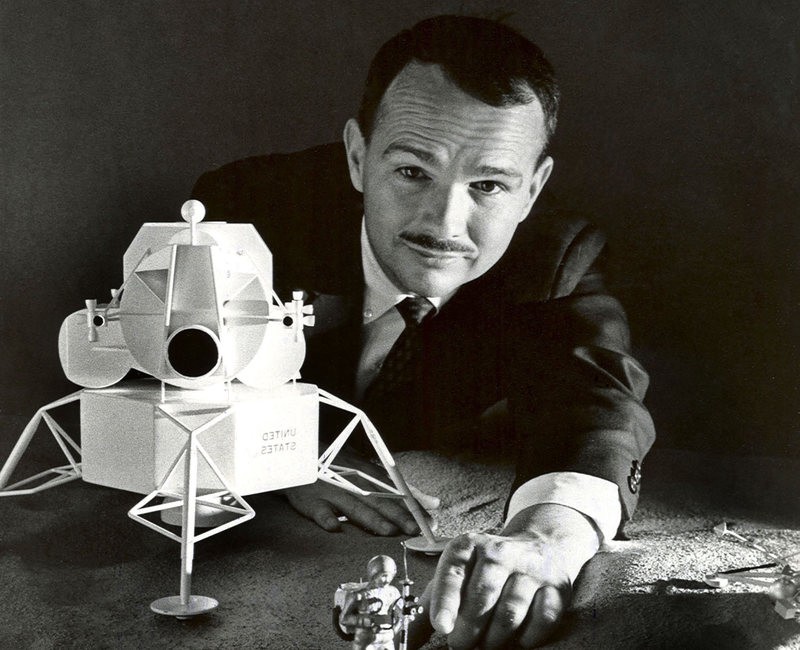
Eugene Shoemaker (Source: Atlas Obscura)

Humanity has seen only a handful of people that actually had the honor to step on earth’s natural satellite, but at present, there is only one person who is “buried” on an astronomical body orbiting Earth. The name of the soul that now rests on the Moon is Eugene Shoemaker, an astrogeologist who had worked with NASA since the 1960s and became famous when a comet that crashed on Jupiter in 1994 received his name (Shoemaker-Levy Comet).

The reason this comet became so famous is that this was the first time in human history that we had the chance to witness a planetary collision. This event was mainly reported by Eugene Shoemaker and David Levy, hence the two monikers within the comet’s name.

A long-lived passion

As an astrogeologist, he had always been fascinated by space and the idea of humans colonizing the earth’s natural satellite. Eugene was also schooled in the world of geology and this is where he used both of high interests to research the Moon and prepare astronauts for the type of soil/rock they would land on. As much as he loved the idea of traveling to the Moon he always knew that he may not be able to make it as he was the brain and not the muscle of NASA.

He was also very famous in the United States not only due to his intensive studies of craters around the state but also for founding the Program for archeological studies within the US in the 1960s. All of his knowledge was a very valuable element in the success of the Apollo missions and other NASA projects. In fact, the origins of what’s now known as Meteor Crater in Arizona had been uncertain before his Ph.D. dissertation settled the matter. This was the same crater that most astronauts that took part in the Apollo missions were trained in as it was quite similar to the terrain on the Moon.

The better the astronauts understood the terrain they were about to face the better they could get prepared for what was ahead. Getting to the Moon was only half of the mission. As mentioned before, Eugene’s long dream since he first approached astronomy was to go to the Moon to see our beautiful world from a different perspective. However, his focus was on his own work, he knew he was more valuable as an astronomist and geologist than as an astronaut.

Reaching his final destination

Sadly, his life was cut short due to a car accident that took place on the 18th of July 1997. However, this wasn’t going to be Eugene’s final journey. A close work colleague had the idea to actually send his corpse to the Moon as she knew this was his life-long dream. NASA thought that this was a very good idea to show their appreciation for his work over the years. His body was cremated as transporting his ashes would have been much easier than transporting his corpse.

Image for post

Eugene Shoemaker and his team also led geology field trips for astronauts-in-training in 1967. (Source: Science Source)

His ashes were loaded on the Lunar Prospector, a rocket which launched on the 6th of January 1998 with the goal of reaching the South pole of the Moon. Eugene Shoemaker’s ashes were inside a special polycarbonate capsule produced by a company called Celestis that was actually specializing in sending dead people to space but never onto the Moon. The outside of the capsule was marked with his name, his date of birth, and date of death as well as a picture of him training astronauts in a geology field trip (the same picture you can see above).

The Luna prospector reached the moon on the 31st of July 1999. On the same day, they launched the capsule containing Shoemaker’s ashes which crashed onto the moon, thus “burying” Eugene Shoemaker in the place he had always wanted to reach.

From: medium.com

Cowboys and Dinosaurs on the Loose!

The Valley of Gwangi is a 1969 American western-fantasy film directed by Jim O’Connolly and written by William Bast. The film is also known as GwangiThe Lost ValleyThe Valley Time Forgot, and The Valley Where Time Stood Still. It was filmed in Technicolor and is known for its creature effects provided by Ray Harryhausen, being the last prehistoric-themed film animated by him.


World’s funniest jokes according to Laughlab


Two hunters are out in the woods when one of them collapses. He doesn’t seem to be breathing and his eyes are glazed. The other guy whips out his phone and calls the emergency services. He gasps, “My friend is dead! What can I do?”. The operator says “Calm down. I can help. First, let’s make sure he’s dead.” There is a silence, then a gun shot is heard. Back on the phone, the guy says “OK, now what?”

The second place finisher and early leader was this joke, submitted by Geoff Anandappa of Blackpool: Sherlock Holmes and Dr Watson were going camping. They pitched their tent under the stars and went to sleep. Sometime in the middle of the night Holmes woke Watson up and said: “Watson, look up at the stars, and tell me what you see.” Watson replied: “I see millions and millions of stars.” Holmes said: “And what do you deduce from that?” Watson replied: “Well, if there are millions of stars, and if even a few of those have planets, it’s quite likely there are some planets like Earth out there. And if there are a few planets like Earth out there, there might also be life.” And Holmes said: “Watson, you idiot, it means that somebody stole our tent.”
While this was the top joke in the UK:

A woman gets on a bus with her baby. The bus driver says: “That’s the ugliest baby that I’ve ever seen. Ugh!” The woman goes to the rear of the bus and sits down, fuming. She says to a man next to her: “The driver just insulted me!” The man says: “You go right up there and tell him off – go ahead, I’ll hold your monkey for you.”
New Barbie Dolls available in ‘curvy, tall and petite’ sizes

barbi


Barbie, the iconic plastic toy doll model, is getting three new body types this year.

The US company behind the famous toy, Mattel, is adding “tall, curvy and petite” body shapes to its line-up of the fashion dolls.

Several skin tones, eye colours and hair styles will also be added to the collection, the company said.

Barbie’s figure has come under fire for years, with critics arguing it set an unrealistic body image for girls.  With the new body shapes, the toy makers say they are “offering girls choices that are more reflective of the world they see today”.

Last year, the company introduced 23 new dolls to its so-called Fashionistas line with varied skin and hair colours, and a much touted flat foot – replacing Barbie’s signature heels.

With this year’s update, the Barbie Fashionistas line will feature:

  • 33 new dolls
  • 30 hair colours
  • 24 hairstyles
  • 22 eye colours
  • 14 face shapes
  • 7 skin tones
  • 4 body shapes – original, plus tall, curvy and petite

barb

Barbie is finally sort of all-inclusive: almost all shapes, heights and races. Way to go Mattel.

bar

However, some people think Mattel hasn’t gone far enough. Since Mattel is trying to include young females from all possible life scenarios, here are some life situations that Barbie experiences that are real and unabashed.


barbie3

Hot sensuous Barbie


barbie

Couch-potato dope smoking plump Barbie.


barbie2

Sedentary and lethargic Barbie.


barbie1


Barbie-Doll-Mugshot--41694

Addicted to crack street Ho Barbie.


barbie7

Barbie and Ken EXPLOSION!

Street Fashions in Tokyo

If you are not in Japan, more precisely in Tokyo, how can you know what’s going on? I have a simple answer to that question – fashion photos from the streets of Tokyo.  Each season those styles change, subcultures come and go and brands are born and gone. In a fast moving fashion town like Tokyo, trends may be gone by the time you read about them. Check these pictures to see the latest trends and trend-busters in Harajuku, Shibuya, and beyond.


The Most Visually Impressive Impact Craters on Earth

It is estimated that the earth’s surface is struck by about 500 meteorites a year, but only about 5 or 6 are large enough to be detected by weather radar instruments or their fragments recovered. Large collisions that leave discernable impact craters are thankfully, extremely rare events, that occur in intervals of thousands of years on average. For instance, stony asteroids of size 100 meter in diameter strike earth every 5,200 years on average. Such a collision would create a crater 1.2 km across and release energy equivalent to 3.8 mega-ton of TNT, or about a thousand times more powerful than the combined energy of both the Hiroshima and Nagasaki explosions. Larger collisions involving asteroids 1km in diameter are even rarer (every 500,000 years), and collisions with 5km objects are rarer still (once every twenty million years). The last known impact of an object of 10 km in size was the dinosaur killer that happened 66 million years ago.


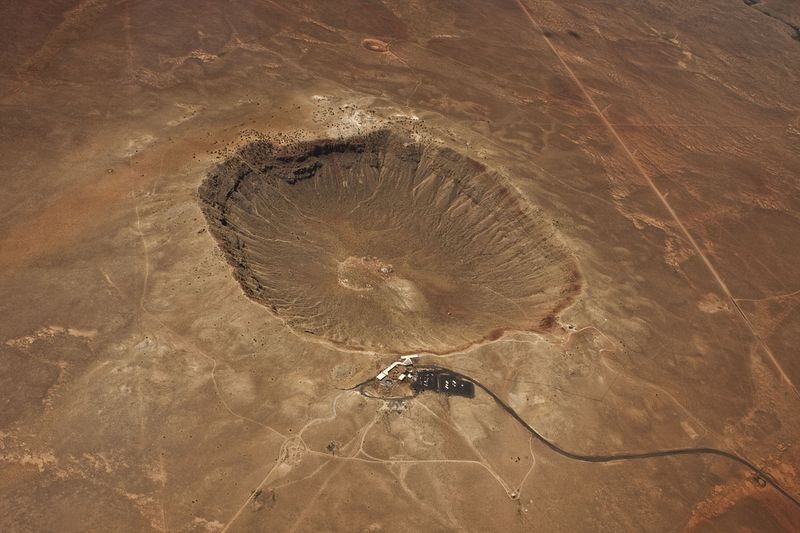
barringer-crater-1

Barringer Crater in Arizona, the US, is the most famous impact crater.

To date there are 188 confirmed impact craters on earth, but most of them are barely recognizable. Only a handful of them have escaped erosion and weathering or show the classic features that result from a large meteorite striking the earth. Here are 16 impact craters that provide the most stunning visuals.

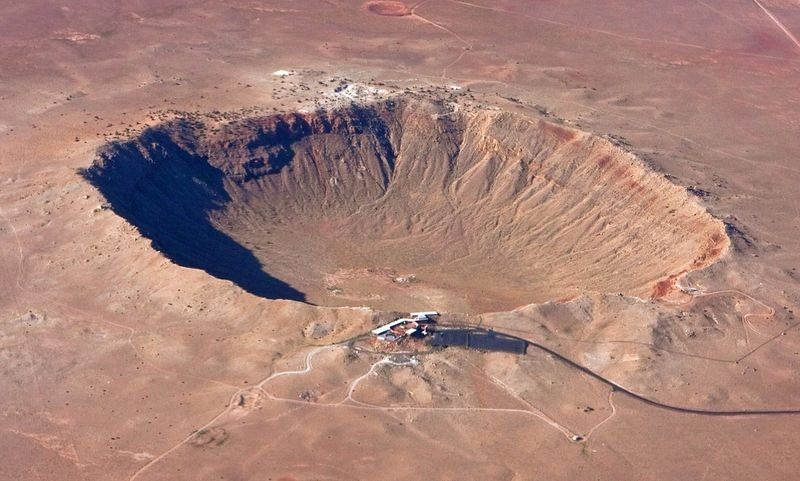
Barringer Crater

The Barringer Crater near Winslow in the northern Arizona desert of the United States, is not only the most beautiful and one of the best preserved impact craters on Earth, its discovery was a turning point in geological science. Before Daniel Barringer conclusively proved that the crater was created by a meteor impact and not by volcanism, geologists didn’t believe meteorites played any role in terrestrial geology. Even craters on the moon were attributed to volcanoes. Since Barringer’s discovery, numerous impact craters have been identified around the world. It is now widely accepted that meteor impacts have significantly shaped the earth’s geological and biological history — from the origin of water, extinction of dinosaurs to origin of life itself.

The Barringer crater is about 1,200 meters in diameter, 170 meters deep and is surrounded by a rim that rises 45 meter above the surrounding plains. It was formed 50,000 years ago.

barringer-crater-2


Pingualuit Crater

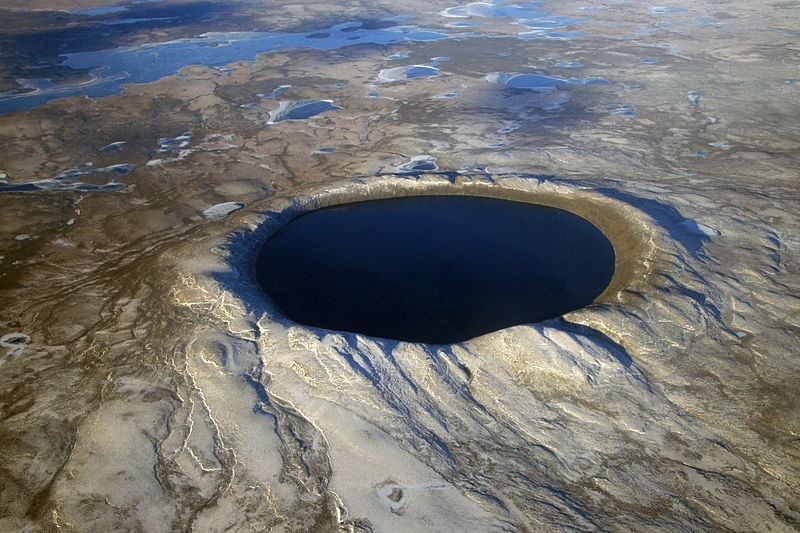
The Pingualuit Crater is located in Quebec, in Canada. It has a diameter of 3.44 km and was probably formed by an impact roughly 1.4 million years ago. The crater rises 160 meters above the surrounding tundra and is 400 meters deep. A 267 meters deep body of water fills the depression, forming one of the deepest lakes in North America. The lake also holds some of the purest fresh water in the world, and has great visibility at 35 meters.

Pingualuit-crater

Photo credit: NASA

Wolfe Creek Crater

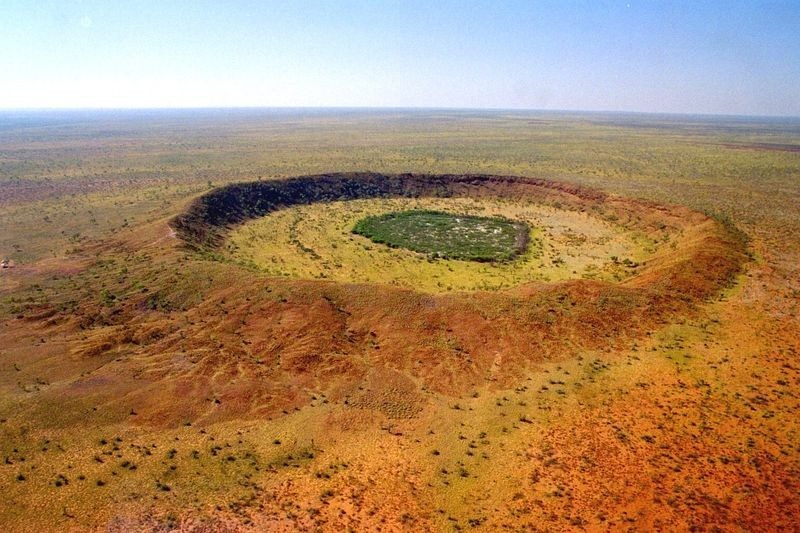
This well-preserved meteorite impact crater is located in the flat plains of the northeastern edge of the Great Sandy Desert in Western Australia, some 150 km south of the town of Halls Creek. It measures roughly 880 meters in diameter, and the mostly flat crater floor sits some 55 meters below the crater rim and some 25 meters below the sand plain outside of the crater. At the crater’s center, the ground rises slightly. Here grows some surprisingly large trees that draw moisture from the crater’s water reserves that remain after summer rains.

The crater was formed 300,000 years ago.

wolfe-creek-crater

Photo credit: unknown


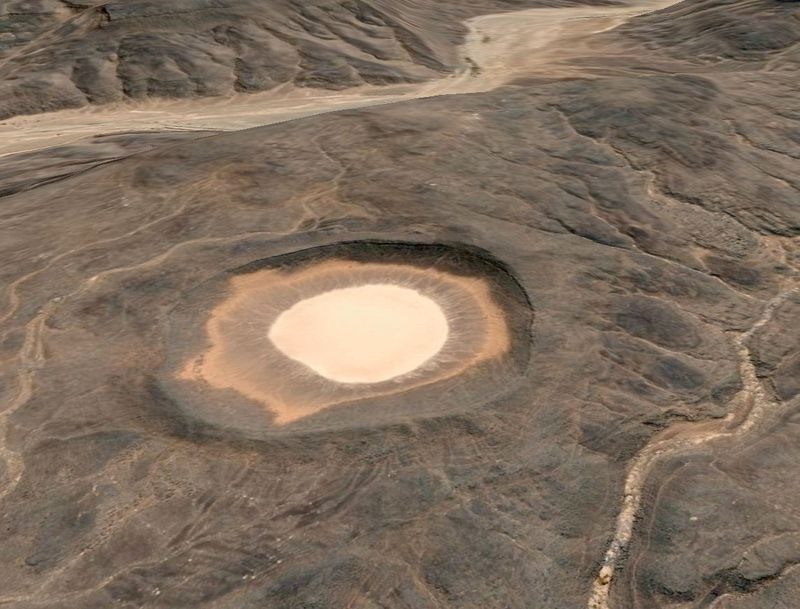
Amguid Crater

Amguid crater is located in a remote and inaccessible region of southwestern Algeria. The crater is about 500 meters across and 65 meters deep, but the actual depth has not been measured as the crater is partly filled with a wind blown sand. The central part of Amguid crater is flat and covered with aeolian silts. These silts refract the light due to which the crater appears white when viewed from space.

The crater is thought to have been formed less than 100,000 years ago but older than 10,000 years.

amguid-crater

Photo credit: NASA


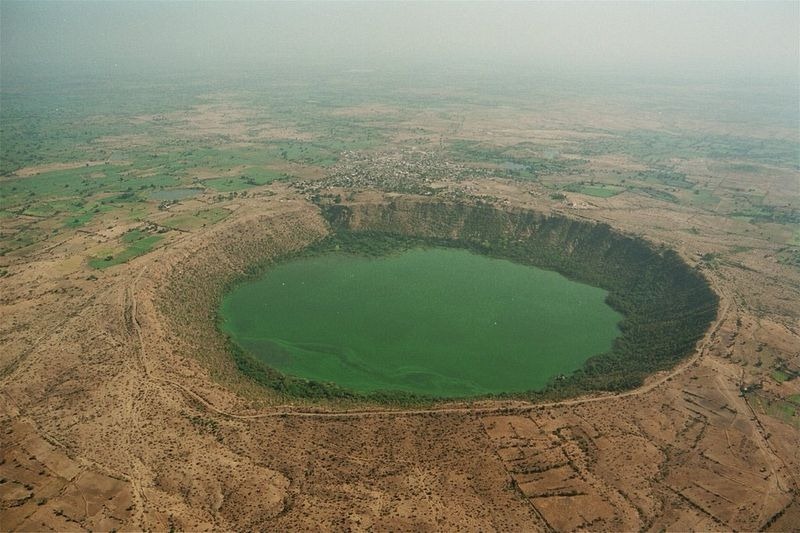
Lonar Crater

Lonar crater is located in a small Indian village of Lonar in Maharashtra. The crater was formed about 52,000 years ago when a gigantic chunk of rock crashed into this place creating a hole 1.8km wide and 150m deep. Over time perennial streams transformed the crater into a lake.

lonar-crater


Gosse’s Bluff

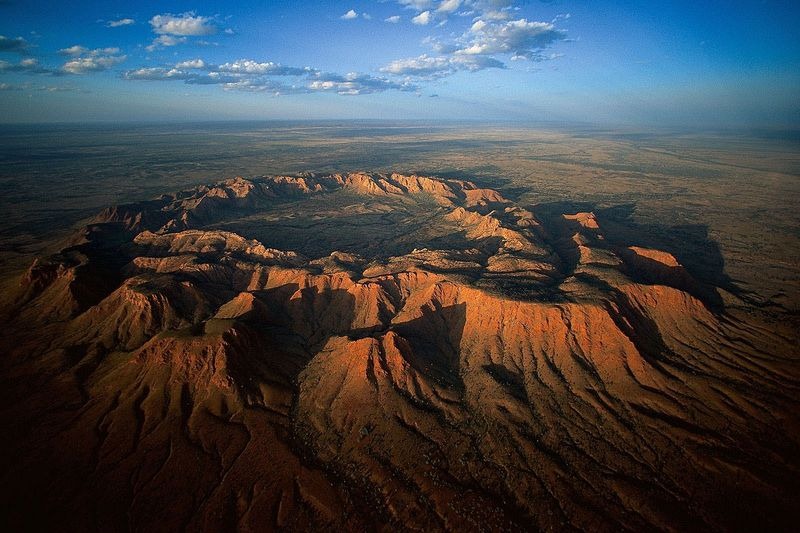
Gosse’s Bluff is located in the southern Northern Territory, near the center of Australia, about 175 km west of Alice Springs. The crater is thought to have formed by the impact of an asteroid or comet approximately 142 million years ago. The original crater rim was 22 km across but has been eroded away. The 180 meters high, 5 km diameter structure that is visible now is the eroded remains of the crater’s central uplift.

gosses-bluff

Photo credit: Yann Arthus-Bertrand


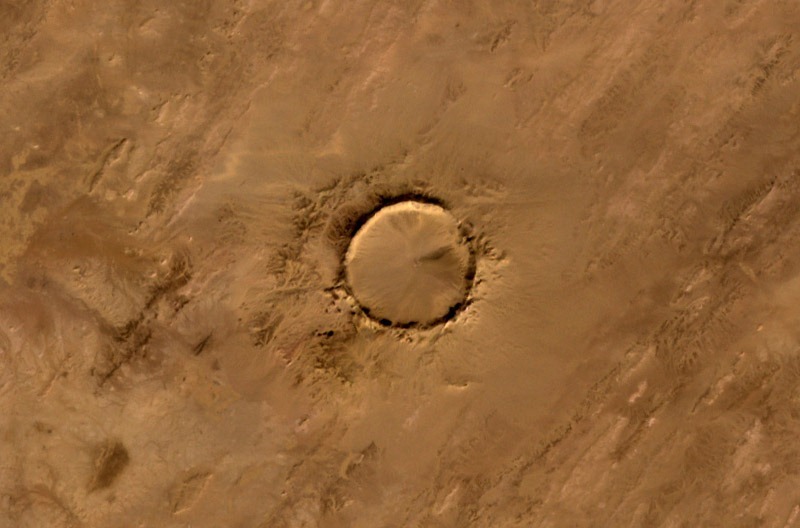
Tenoumer Crater

This crater is located Mauritania, in the western Sahara Desert. It’s a near perfect circle of diameter 1.9 km with a rim 100 meters high. The age of the crater is estimated to be between 10,000 and 30,000 years.

aouelloul-crater


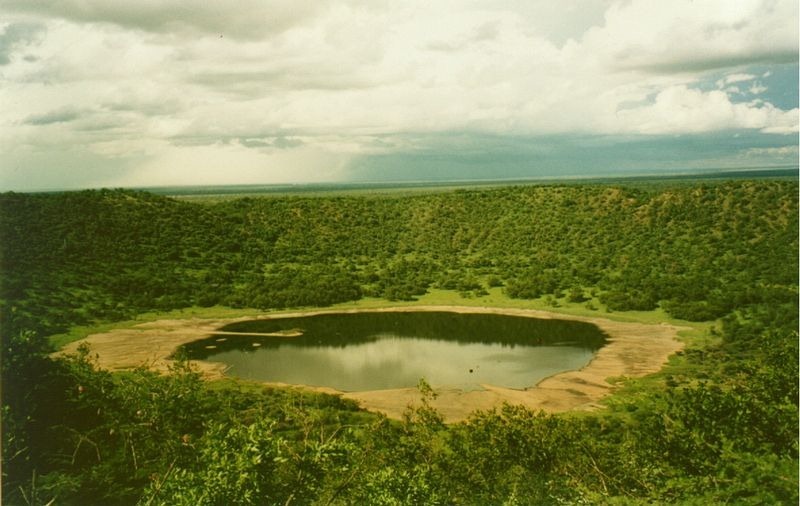
Tswaing Crater

Tswaing crater is in South Africa, 40 km to the north-west of Pretoria. The crater is 1.13 km in diameter and 100 meters deep with an estimated age of 220,000 ± 52,000 years. Surface springs, ground water and rain water have filled the crater and turned it into a lake rich with dissolved carbonates and sodium chlorides which was harvested until 1956.

tswaing-crater

Photo credit: M J Gaylard


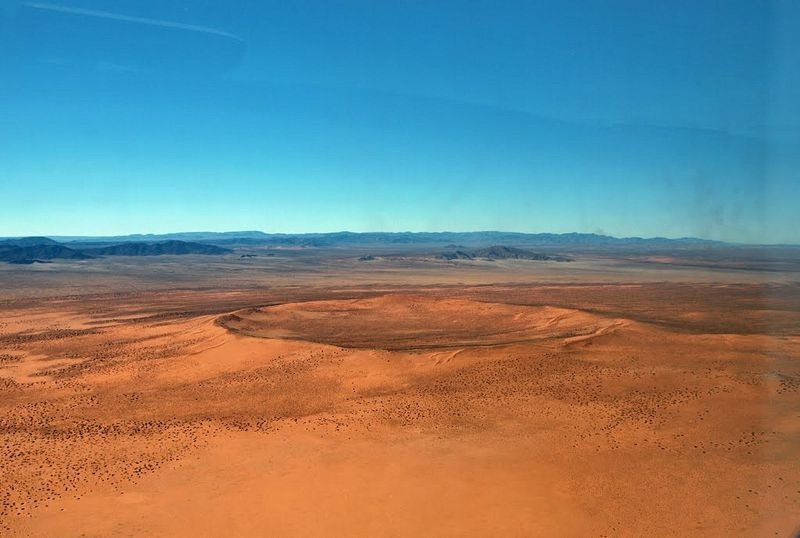
Roter Kamm

Roter Kamm in Namib Desert is 2.5 km in diameter and is 130 meters deep, but appears like a very shallow depression because the floor is covered with 100 meters of sand. It was formed between 4 and 5 million years ago.

roter-kamm-crater


Manicouagan crater

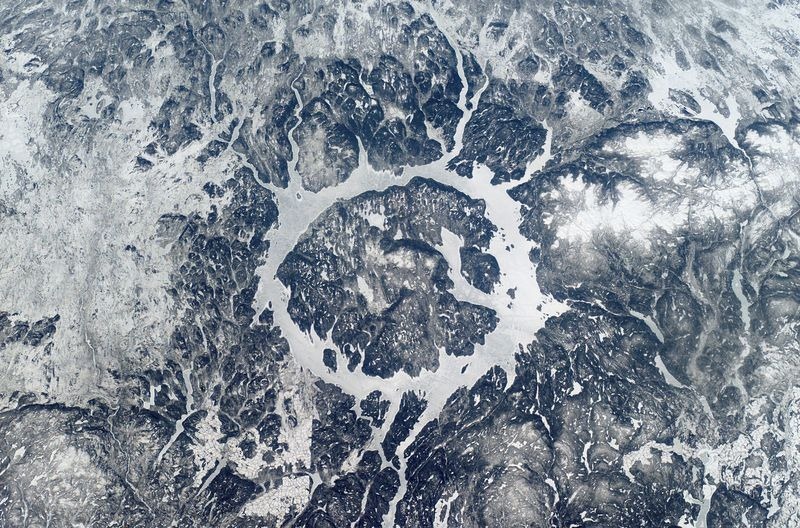
The Manicouagan Crater in Québec, Canada, is one of the oldest known impact craters and is the largest ‘visible’ impact crater on Earth. It is thought to have been caused by the impact of a 5 km diameter meteorite about 215.5 million years ago. The crater is a multiple-ring structure about 100 km across, with a 70 km diameter inner ring, which is now the Manicouagan Reservoir.

manicouagan-crater

Photo credit: NASA


Shoemaker Crater

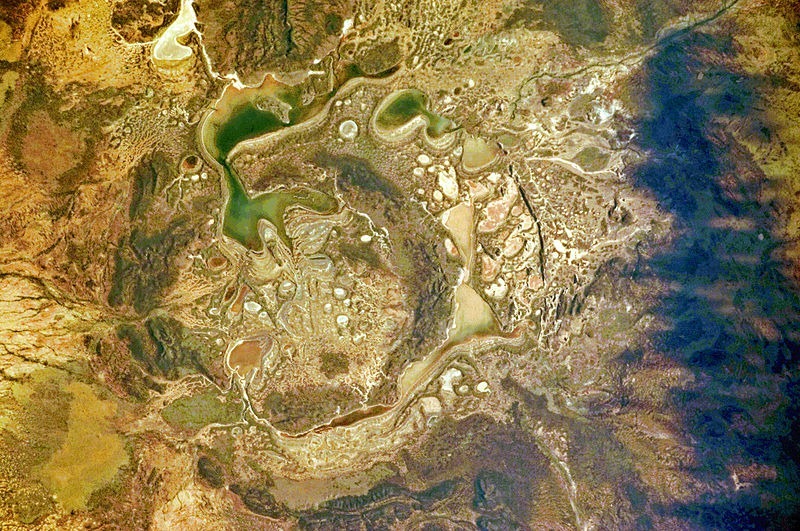
The Shoemaker crater is situated in arid central Western Australia, about 100 km north-northeast of Wiluna. The crater has a central circular region of uplifted Archaean Granite (Teague Granite) about 12 km in diameter, surrounded by a downwarped ring of sedimentary rocks with traces of a rim about 30 km in diameter. The age of the crater is uncertain.

Shoemaker_Impact_Structure

Photo credit: NASA