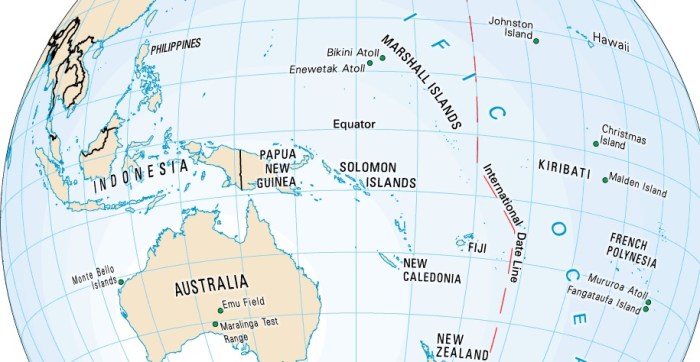
The Most Visually Impressive Impact Craters on Earth

It is estimated that the earth’s surface is struck by about 500 meteorites a year, but only about 5 or 6 are large enough to be detected by weather radar instruments or their fragments recovered. Large collisions that leave discernable impact craters are thankfully, extremely rare events, that occur in intervals of thousands of years on average. For instance, stony asteroids of size 100 meter in diameter strike earth every 5,200 years on average. Such a collision would create a crater 1.2 km across and release energy equivalent to 3.8 mega-ton of TNT, or about a thousand times more powerful than the combined energy of both the Hiroshima and Nagasaki explosions. Larger collisions involving asteroids 1km in diameter are even rarer (every 500,000 years), and collisions with 5km objects are rarer still (once every twenty million years). The last known impact of an object of 10 km in size was the dinosaur killer that happened 66 million years ago.
 

barringer-crater-1

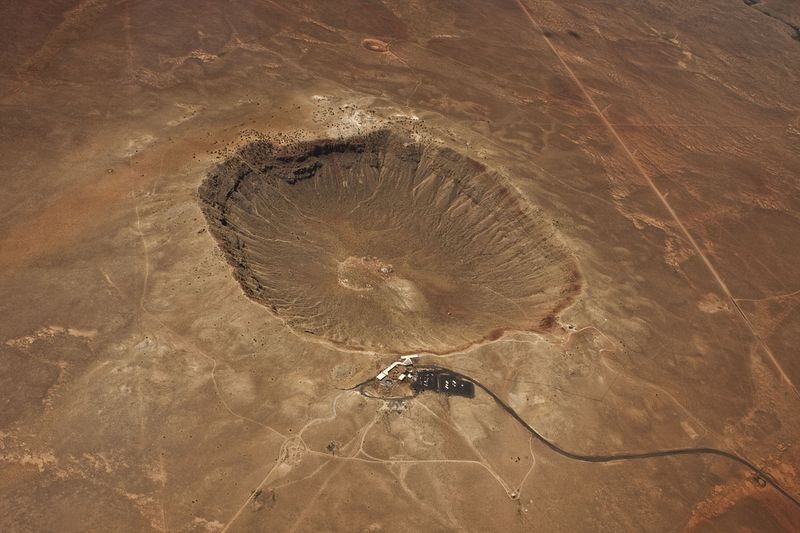
Barringer Crater in Arizona, the US, is the most famous impact crater.

To date there are 188 confirmed impact craters on earth, but most of them are barely recognizable. Only a handful of them have escaped erosion and weathering or show the classic features that result from a large meteorite striking the earth. Here are 16 impact craters that provide the most stunning visuals.

Barringer Crater

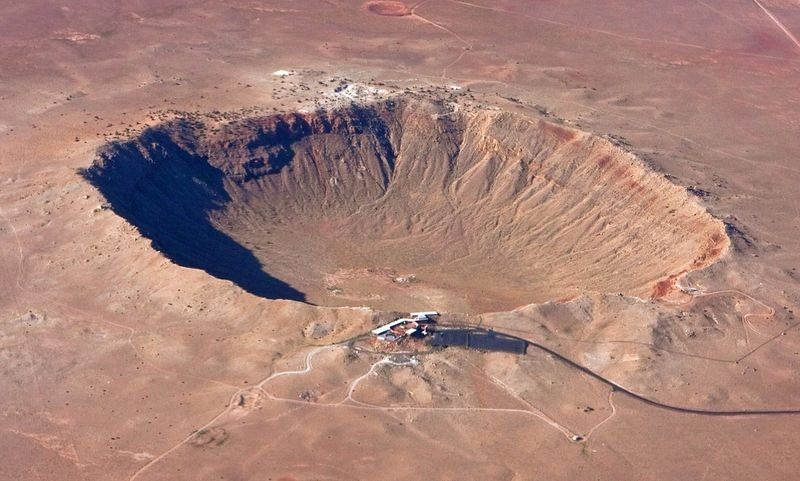
The Barringer Crater near Winslow in the northern Arizona desert of the United States, is not only the most beautiful and one of the best preserved impact craters on Earth, its discovery was a turning point in geological science. Before Daniel Barringer conclusively proved that the crater was created by a meteor impact and not by volcanism, geologists didn’t believe meteorites played any role in terrestrial geology. Even craters on the moon were attributed to volcanoes. Since Barringer’s discovery, numerous impact craters have been identified around the world. It is now widely accepted that meteor impacts have significantly shaped the earth’s geological and biological history — from the origin of water, extinction of dinosaurs to origin of life itself.

The Barringer crater is about 1,200 meters in diameter, 170 meters deep and is surrounded by a rim that rises 45 meter above the surrounding plains. It was formed 50,000 years ago.
barringer-crater-2


Pingualuit Crater

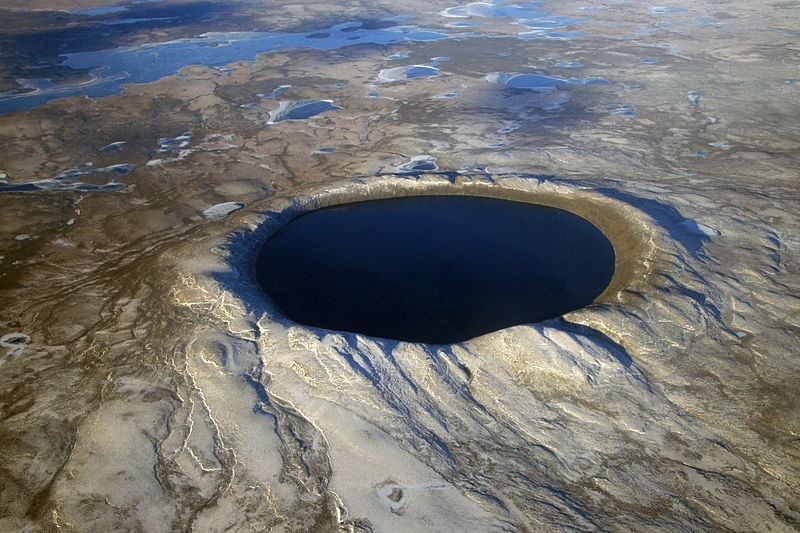
The Pingualuit Crater is located in Quebec, in Canada. It has a diameter of 3.44 km and was probably formed by an impact roughly 1.4 million years ago. The crater rises 160 meters above the surrounding tundra and is 400 meters deep. A 267 meters deep body of water fills the depression, forming one of the deepest lakes in North America. The lake also holds some of the purest fresh water in the world, and has great visibility at 35 meters.
Pingualuit-crater

Photo credit: NASA

Wolfe Creek Crater

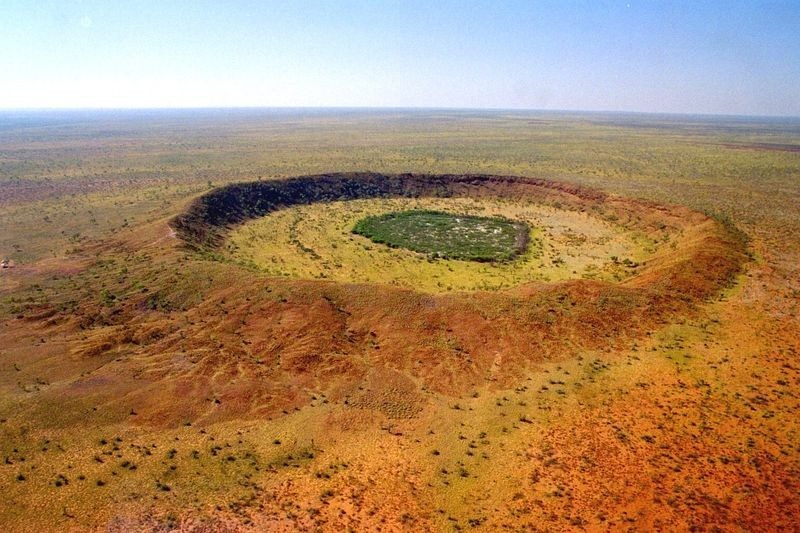
This well-preserved meteorite impact crater is located in the flat plains of the northeastern edge of the Great Sandy Desert in Western Australia, some 150 km south of the town of Halls Creek. It measures roughly 880 meters in diameter, and the mostly flat crater floor sits some 55 meters below the crater rim and some 25 meters below the sand plain outside of the crater. At the crater’s center, the ground rises slightly. Here grows some surprisingly large trees that draw moisture from the crater’s water reserves that remain after summer rains.

The crater was formed 300,000 years ago.
wolfe-creek-crater

Photo credit: unknown


Amguid Crater

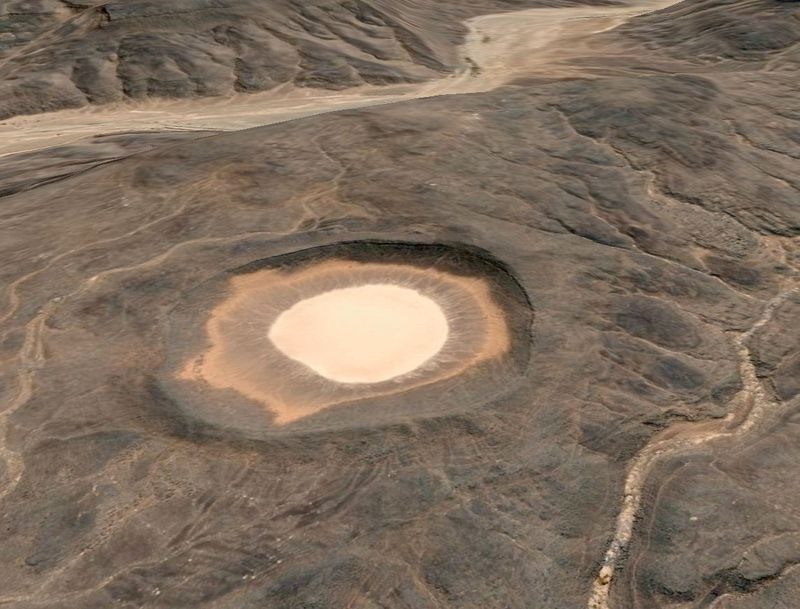
Amguid crater is located in a remote and inaccessible region of southwestern Algeria. The crater is about 500 meters across and 65 meters deep, but the actual depth has not been measured as the crater is partly filled with a wind blown sand. The central part of Amguid crater is flat and covered with aeolian silts. These silts refract the light due to which the crater appears white when viewed from space.

The crater is thought to have been formed less than 100,000 years ago but older than 10,000 years.
amguid-crater

Photo credit: NASA


Lonar Crater

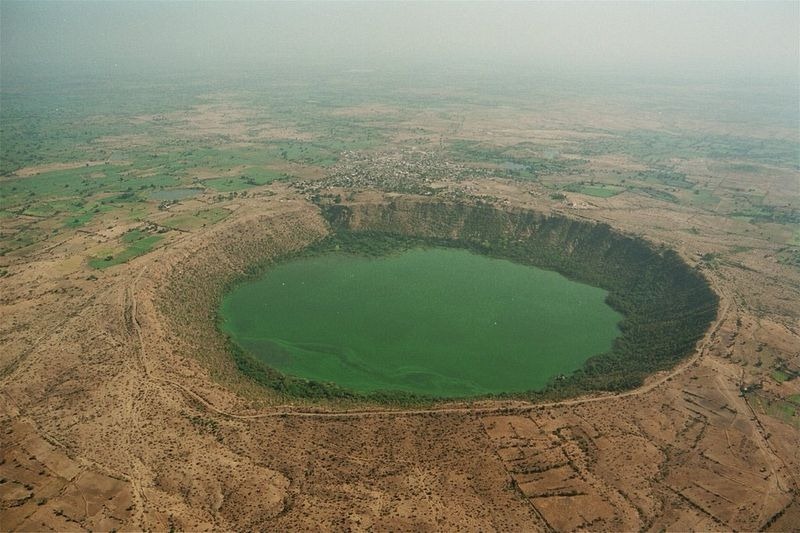
Lonar crater is located in a small Indian village of Lonar in Maharashtra. The crater was formed about 52,000 years ago when a gigantic chunk of rock crashed into this place creating a hole 1.8km wide and 150m deep. Over time perennial streams transformed the crater into a lake.
lonar-crater


Gosse’s Bluff

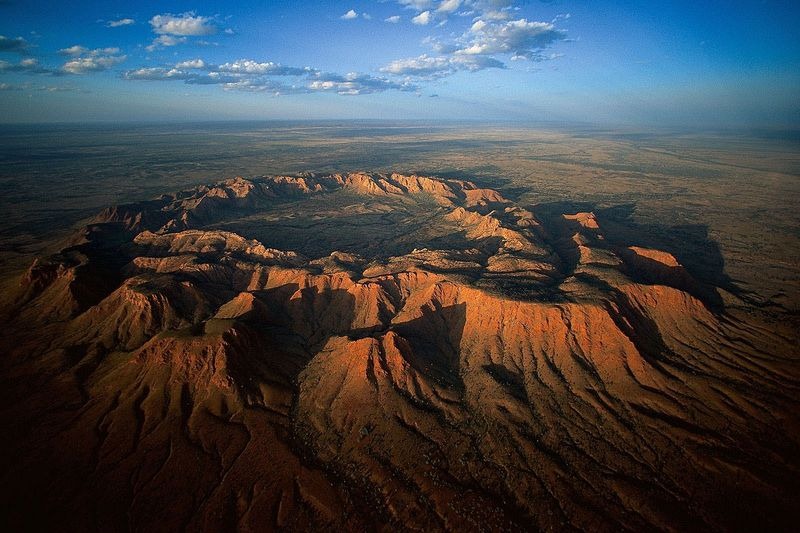
Gosse’s Bluff is located in the southern Northern Territory, near the center of Australia, about 175 km west of Alice Springs. The crater is thought to have formed by the impact of an asteroid or comet approximately 142 million years ago. The original crater rim was 22 km across but has been eroded away. The 180 meters high, 5 km diameter structure that is visible now is the eroded remains of the crater’s central uplift.
gosses-bluff

Photo credit: Yann Arthus-Bertrand


Tenoumer Crater

This crater is located Mauritania, in the western Sahara Desert. It’s a near perfect circle of diameter 1.9 km with a rim 100 meters high. The age of the crater is estimated to be between 10,000 and 30,000 years.
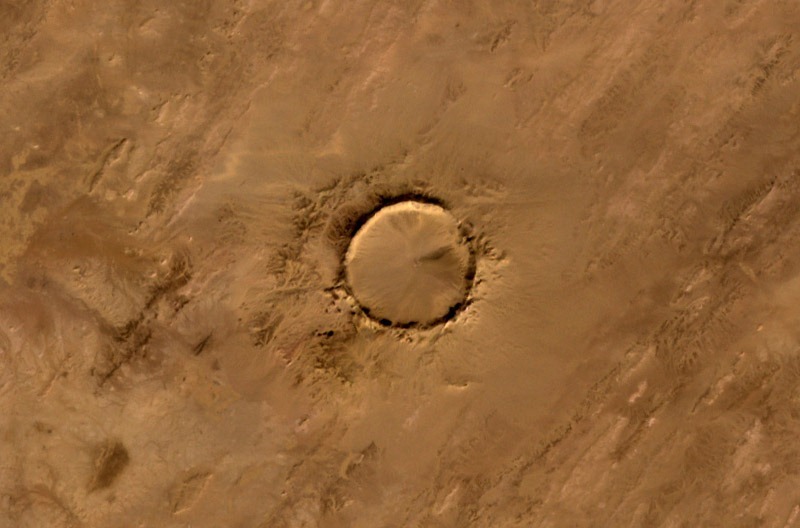
aouelloul-crater


Tswaing Crater

Tswaing crater is in South Africa, 40 km to the north-west of Pretoria. The crater is 1.13 km in diameter and 100 meters deep with an estimated age of 220,000 ± 52,000 years. Surface springs, ground water and rain water have filled the crater and turned it into a lake rich with dissolved carbonates and sodium chlorides which was harvested until 1956.
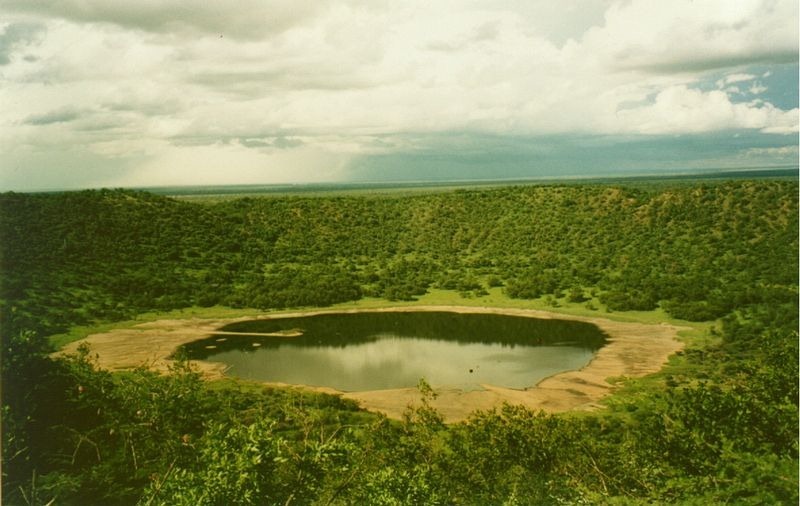
tswaing-crater

Photo credit: M J Gaylard


Roter Kamm

Roter Kamm in Namib Desert is 2.5 km in diameter and is 130 meters deep, but appears like a very shallow depression because the floor is covered with 100 meters of sand. It was formed between 4 and 5 million years ago.
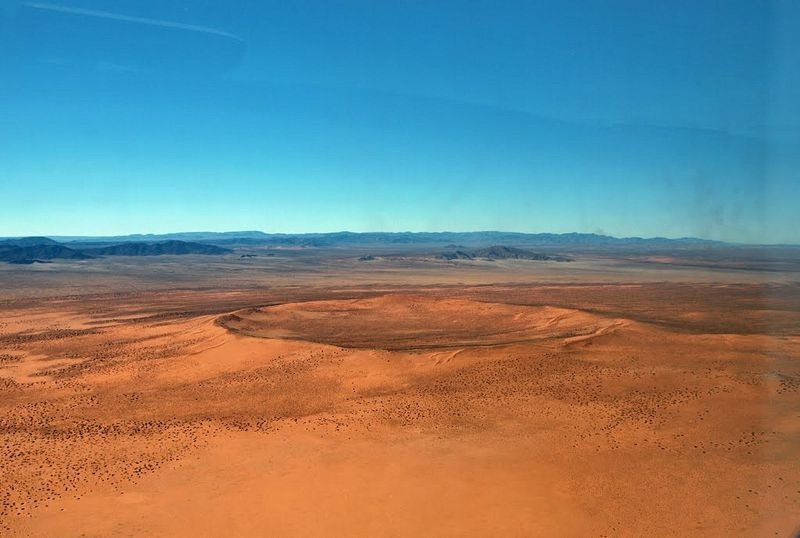
roter-kamm-crater


Manicouagan crater

The Manicouagan Crater in Québec, Canada, is one of the oldest known impact craters and is the largest ‘visible’ impact crater on Earth. It is thought to have been caused by the impact of a 5 km diameter meteorite about 215.5 million years ago. The crater is a multiple-ring structure about 100 km across, with a 70 km diameter inner ring, which is now the Manicouagan Reservoir.
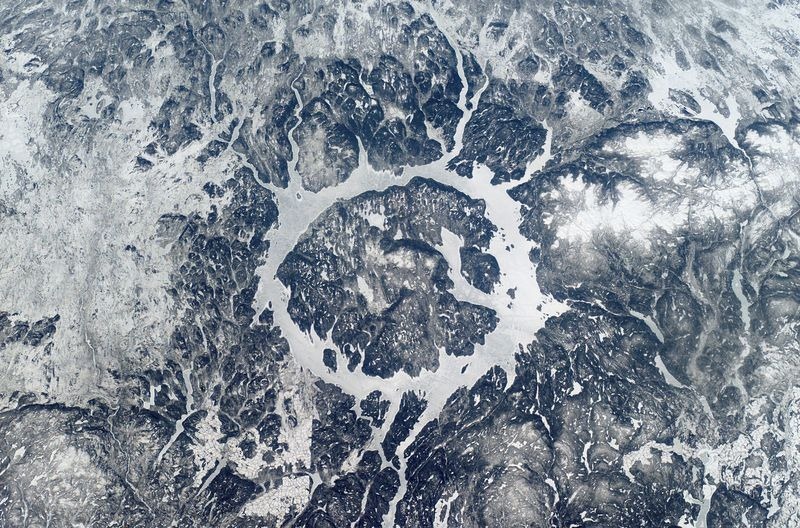
manicouagan-crater

Photo credit: NASA


Shoemaker Crater

The Shoemaker crater is situated in arid central Western Australia, about 100 km north-northeast of Wiluna. The crater has a central circular region of uplifted Archaean Granite (Teague Granite) about 12 km in diameter, surrounded by a downwarped ring of sedimentary rocks with traces of a rim about 30 km in diameter. The age of the crater is uncertain.
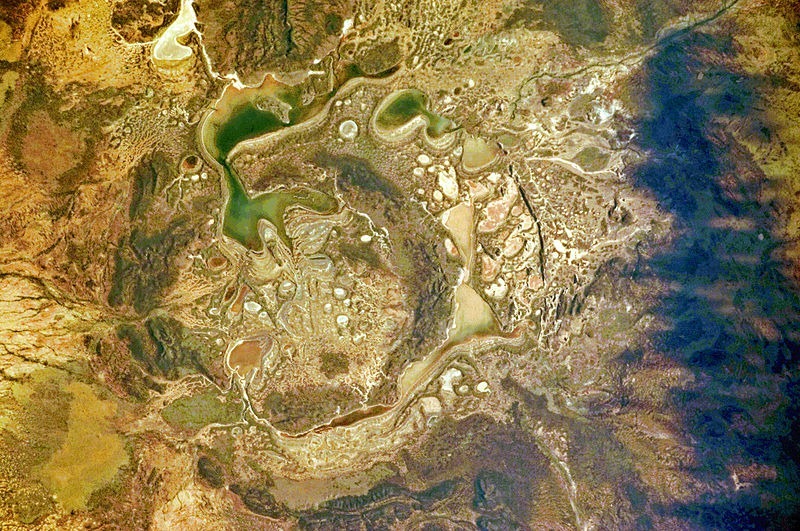
Shoemaker_Impact_Structure

Photo credit: NASA


New device puts music in your head — no headphones required

LONDON (AP) — Imagine a world where you move around in your own personal sound bubble. You listen to your favorite tunes, play loud computer games, watch a movie or get navigation directions in your car — all without disturbing those around you.

That’s the possibility presented by “sound beaming,” a new futuristic audio technology from Noveto Systems, an Israeli company. On Friday it will debut a desktop device that beams sound directly to a listener without the need for headphones.

The company provided The Associated Press with an exclusive demo of the desktop prototype of its SoundBeamer 1.0 before its launch Friday.

The listening sensation is straight out of a sci-fi movie. The 3-D sound is so close it feels like it’s inside your ears while also in front, above and behind them.

Noveto expects the device will have plenty of practical uses, from allowing office workers to listen to music or conference calls without interrupting colleagues to letting someone play a game, movie or music without disturbing their significant others.

The lack of headphones means it’s possible to hear other sounds in the room clearly.

The technology uses a 3-D sensing module and locates and tracks the ear position sending audio via ultrasonic waves to create sound pockets by the user’s ears. Sound can be heard in stereo or a spatial 3-D mode that creates 360 degree sound around the listener, the company said.

The demo includes nature video clips of swans on a lake, bees buzzing and a babbling brook, where the listener feels completely transported into the scene.

But even CEO Christophe Ramstein finds it hard to put the concept into words. “The brain doesn’t understand what it doesn’t know,” he said.

In a Noveto demonstration conducted via Zoom from Tel Aviv, SoundBeamer Product Manager Ayana Wallwater was unable to hear the sound of gunshots on a gaming demo.

That’s the point. But she does get to enjoy the reactions of people trying the software for the first time.

“Most people just say, ‘Wow, I really don’t believe it,’” she said.

“You don’t believe it because it sounds like a speaker, but no one else can hear it…it’s supporting you and you’re in the middle of everything. It’s happening around you.”

By changing a setting, the sound can follow a listener around when they move their head. It’s also possible to move out of the beam’s path and hear nothing at all, which creates a surreal experience.

“You don’t need to tell the device where you are. It’s not streaming to one exact place,” Wallwater said.

“It follows you wherever you go. So it’s personally for you — follows you, plays what you want inside your head.”

“This is what we dream of,” she adds. “A world where we get the sound you want. You don’t need to disturb others and others don’t get disturbed by your sound. But you can still interact with them.”

After his first listening experience Ramstein asked himself how it was different from other audio devices.

“I was thinking, ‘Yeah, but is it the same with headphones?’ No, because I have the freedom and it’s like I have the freedom of doing what I want to do. And I have these sounds playing in my head as there would be something happening here, which is difficult to explain because we have no reference for that.”

While the concept of sound beaming is not new, Noveto was the first to launch the technology and their SoundBeamer 1.0 desktop device will be the first branded consumer product.

Ramstein said a “smaller, sexier” version of the prototype will be ready for consumer release in time for Christmas 2021.

“You know, I was trying to think how we compare sound beaming with any other inventions in history. And I think the only one that came to mind is… the first time I tried the iPod I was like, ‘Oh, my God. What’s that?’ I think sound beaming is something that is as disruptive as that. There’s something to be said about it doesn’t exist before. There’s the freedom of using it. And it’s really amazing.”

Amazing Drone Magical Holographic Light Shows in China and the USA

Back in America. Intel dazzled its Folsom audience on July 15, 2018 with a spectacular light show designed to feature 1,500 drones, in an effort to outdo its previous world record of 1,218 Intel Shooting Star drones. The performance displayed multicolored choreography including bright, fireworks-like orbs. A single pilot mans the entire fleet of light-emitting remotely controlled machines.

Nerves of Steel Very High Up

The CN Tower in Toronto has a very  scary attraction, a chance to show you are brave, or in my opinion a chance to just plain show-off and gloat about it to friends by walking around the edge of the tower. 

The tower’s EdgeWalk allows thrill-seekers to stroll outside on the world-famous tower on a 1.5 metre ledge that rings the main pod 356 metres (1,168 feet) above the ground.

Opened in 2011, this walk of wobbly knees sends groups of six to eight people out on the ledge where they walk hands-free while attached to an overhead safety harness.

During the walk, specially trained guides encourage visitors to push their personal limits, even allowing them to lean out 116 storeys above the city.

“Our facilities and engineering team supervised the EdgeWalk project design and build to ensure that it is both exciting and safe,” said CN Tower chief operating officer Jack Robinson in a news release.

“EdgeWalk is both thrilling and unique and pushes visitors to their limits — literally and figuratively,” said Mark Laroche, president and CEO of Canada Lands Company, which owns and operates the CN Tower. The entire EdgeWalk experience takes about 90 minutes, with the walk itself lasting between 20 to 30 minutes.


They give you a breathalyzer before the walk.  To make sure you are not under the influence of alcohol.  Well there goes my opportunity, I would not touch this Edgewalk unless I had gulped down at least 10 ounces of Canadian rye whiskey.

French Atomic Bomb Tests

FRENCH ATOMIC BOMB TESTS – 1968 – FANGATAUFA ATOLL

Canopus was the code name for France’s first two-stage thermonuclear test, conducted on August 24, 1968 at Fangataufa atoll in French Polynesia.


In 1966, France was able to use fusion fuel to boost plutonium implosion devices with the Rigel shot. Roger Dautry, a nuclear physicist, was selected by the CEA to lead the development effort to construct a two-stage weapon. France did not have the ability to produce the materials needed for a two-stage thermonuclear device at the time, so 151 tons of heavy water was purchased from Norway and an additional 168 tons from the United States. This heavy water went into nuclear reactors in 1967 to produce tritium needed for the device.

The announcement by France in the late 1960s to test a hydrogen bomb provoked the People’s Republic of China to conduct a full scale hydrogen bomb test of its own on June 17, 1967.

France was to test the new device as part of a 5 shot series conducted at the nuclear testing grounds in French Polynesia. The device weighed three tons and used a lithium deuteride secondary stage with a highly enriched uranium jacket primary.

Fangataufa was selected as the location of the shot due to its isolation in respect to the main base on Mururoa. The device was suspended from a large hydrogen filled balloon. It was detonated at 18:30:00.5 GMT with a 2.6 megaton yield at an altitude of 1800 feet. As a result of the successful detonation, France became the 5th thermonuclear nation.


Chimp is nanny to tiger cub

This two year old chimpanzee called Do Do is showing off a motherly instinct to rival even the most maternal of mankind. They were photographed at Samut Prakan Crocodile Farm and Zoo on the outskirts of Bangkok, Thailand. The farm doesn’t just contain crocodiles. Monkeys and tigers also live there, alongside elephants, lions, horses and hippopotamuses. These adorable images reveal the close bond that has formed between chimpanzee and a two month old tiger cub called Aorn.