Mystery Utah Monolith Update

Mystery Monolith in Utah Located on Google Earth and May Be Removed

In a pair of developments surrounding the mysterious monolith found in the Utah desert, online sleuths have managed to located the odd object on Google Earth and officials in the state say that it may not be around much longer because it is actually illegal. The ten-to-12-foot tall metallic enigma sparked worldwide headlines earlier this week when news of its discovery was revealed. Fueling all manner of speculation as to its origin and purpose, at least one question about the monolith has reportedly been solved: its location.

Although the precise spot in the desert where the object had seemingly been planted had originally been kept secret by officials in Utah for fear of curious thrillseekers attempting ill-equipped visits to the site, their reticence was no match for the diligence of online detectives, who managed to find the location using Google Earth. Amazingly, based on images from the service, it would appear that the monolith was installed between August 2015, when it does not appear on satellite photos, and October 2016, which is when it can first be seen. This would mean that the curious object has been sitting in the desert waiting to be discovered for years and was seemingly only stumbled upon in the last week.

Now that it has been found, however, its time may quickly come to an end. That’s because officials with the Utah Department of Public Safety noted that placing an art installation on “federally managed public lands” is actually illegal. They went on to say that they are investigating the matter and, presumably, could opt to remove the monolith in order to stop it from becoming somewhat dangerous tourist destination. Given the furor surrounding the object, one hoped that its origin and purpose would eventually be revealed, but the potential problems which could befall its creator should they come forward suggest that we might never know the answers to those questions.

It is made of 1/8th sheet steel that is riveted on the seams. There is an amount of Insulation inside dampening when you strike it. There is epoxy along the base. The road in is not difficult. The hike in from road is not difficult.

The people that found the monolith have provided the location coordinates. Therefore the object will have to be removed as there will be a stampede of curious investigators to the site. It could be stolen or vandalized.

Snakebite Epidemic

Snakebites kill tens of thousands of Africans a year

SIMON ISOLOMO AWOKE around 5 a.m., said goodbye to his wife and seven children, and climbed into his dugout canoe. That Tuesday in December 2018 had begun like many others in Isolomo’s 30 years of fishing in the province of Équateur, in the Democratic Republic of the Congo. Paddling on the Ikelemba River toward his fishing camp with a couple of friends, Isolomo, a 52-year-old French teacher, snacked on kwanga, a popular manioc dish, and enjoyed the cool morning air.

Three hours later they arrived at the camp, and Isolomo began checking the fishing lines he’d set up the day before. Feeling resistance on one, he thrust his hand into the murky water.

A sharp pain sent him reeling. Blood oozed from two puncture wounds on his hand. Just below the surface, a yellowish snake with black rings—probably a banded water cobra—slithered from view.

Isolomo’s companions helped him into the canoe and paddled frantically back to their village of Iteli. By the time they arrived, about three hours after Isolomo was bitten, he was slipping in and out of consciousness.

“His eyes had changed color, and he was vomiting,” his wife, Marie, recalls, starting to cry. After a traditional healer applied a tourniquet, they set out by canoe for the hospital in Mbandaka, the provincial capital, some 60 miles away. But before they arrived, Isolomo stopped breathing and died.

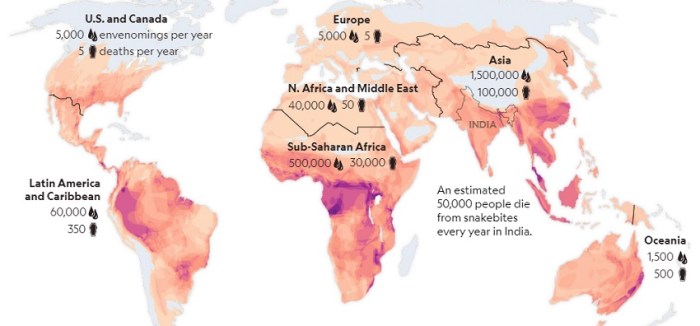
Isolomo’s story encapsulates the global snakebite crisis: Bitten in a remote area, hours from the closest hospital, he didn’t have a chance. As many as 138,000 people around the world die from snakebites each year, according to the World Health Organization (WHO), and roughly 95 percent of those deaths occur in poor, rural communities in developing nations. Another 400,000 people survive with amputated limbs and other permanent disabilities.

One of the worst-hit locations is sub-Saharan Africa, where up to 30,000 deaths from snakebites are believed to occur each year. But some doctors and snakebite experts say the true toll may be double that. A major factor is a severe shortage of the only medicine that can neutralize the toxins of dangerous snakes: antivenom. Complicating matters is that many victims, for lack of money or transportation, or because of distrust of Western medicine, don’t go to hospitals—or don’t get there in time. Staff at many health centers are insufficiently trained to treat snakebites, and even if the drug is on hand, it’s too expensive for many victims. Additionally, most of the more reliable African antivenoms need to be kept refrigerated to stay stable and effective. With frequent power cuts, even in cities, keeping them cold can be nearly impossible.

To draw attention to the snakebite crisis and to attract funding for research and treatment, in 2017 WHO added snakebite envenomation to its roster of neglected tropical diseases, which includes rabies, dengue, and leprosy. In 2019 it announced a goal of slashing the number of annual deaths and disabilities from envenomation by 50 percent by 2030—an undertaking that could cost nearly $140 million.

Most African snakebite victims are farmers who work in remote fields barefoot or in sandals, making them particularly vulnerable. Once a venomous snake strikes, a race against the clock begins. Transport to the nearest hospital can take hours, even days. By then it may be too late.

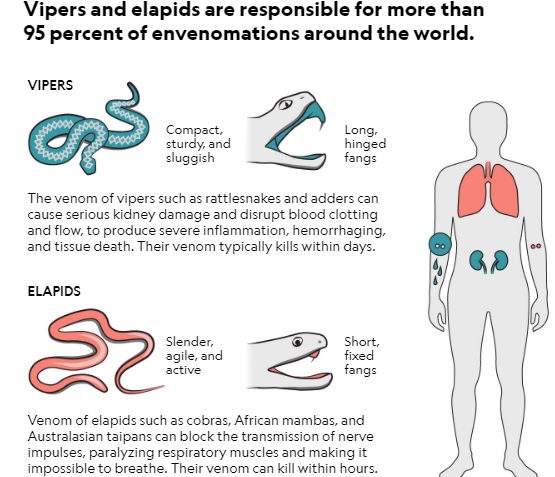
The venom of elapids, a family of snakes that includes mambas and cobras, can kill within hours. Their neurotoxins rapidly paralyze respiratory muscles, making breathing impossible. The venom of vipers, however, can take several days to kill, interfering with clotting and leading to inflammation, bleeding, and tissue death.

Agile and arboreal, the eastern green mamba is one of four African mamba species. Mamba strikes can release a neurotoxic venom that acts quickly, paralyzing respiratory muscles and causing death by asphyxiation.

A puff adder, one of Africa’s most dangerous snakes, basks on a warm rock in Guinea. In 2017 the World Health Organization added snakebite to its list of neglected tropical diseases, spotlighting this health crisis to attract funding for research and treatment.

Nationalgeographic.com

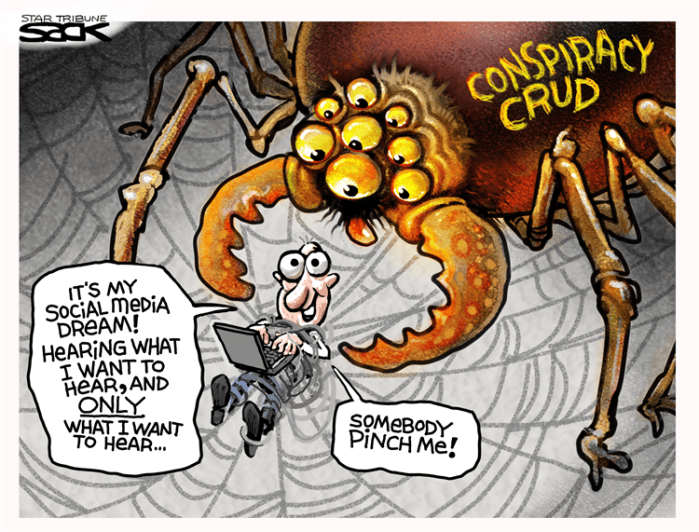
The Mind of a Conspiracy Theorist

By now, scientists have roundly debunked the theory that the coronavirus was created in a lab. But that hasn’t stopped nearly 30 percent of Americans from believing it, according to a recent Pew survey—and many of these believers have made the leap from that premise to the theory that a powerful villain unleashed the virus to control the population. (Billionaire philanthropists George Soros and Bill Gates are on the short list, although conspiracy theorists aren’t ruling out the Clintons.) When the Black Lives Matter movement gained momentum in the midst of the pandemic, another wave of believers embraced conspiracy theories linking the two phenomena, including the rumor that Soros had instigated the protests as the next step in his path to world domination.

Both Covid-19 and systemic racism pose real life-or-death dangers. So why are so many people becoming preoccupied instead with threats that have no grounding in reality? It’s partly because of the magnitude of the real threats, psychologists say. Studies show that conspiracy theories tend to snowball during times of crisis, when fear is rampant and clear explanations are in short supply. They appeal in part because they offer a straightforward narrative and someone to blame. But researchers are starting to pay more attention to these theories, and the motives and mechanisms that drive them, as it becomes clear that they aren’t a harmless method for coping with the unknown. They can have truly damaging consequences in the real world.

The coronavirus pandemic is a particularly fertile breeding ground for such thinking, says Roland Imhoff, a social psychologist at Germany’s Johannes Gutenberg University: It’s terrifying, not well understood, and happening on a massive scale. And in the face of pandemic-level panic, our minds have a tendency to seek explanations that match the intensity of our feelings. “To say that the whole world has come to a halt because a teeny-weeny virus jumped from a bat to another animal and then to a guy in a Chinese market seems too insignificant an explanation,” Imhoff says. “But a conspiracy theory that has thousands of people in cahoots? That seems more proportional.”

It’s no surprise that so many people are currently in thrall to this narrative. But studies show that some people are especially prone to these beliefs, even without the motivating uncertainty of a global health crisis. Researchers have found that this “conspiracy mentality” correlates with particular personality traits, including low levels of trust and an increased need for closure, along with feelings of powerlessness, low self-esteem, paranoid thinking, and a need to feel unique.

On its own, belief in conspiracies isn’t inherently dangerous or wrong, psychologists say. After all, sometimes powerful people really are hatching secret schemes. If Edward Snowden hadn’t suspected that top U.S. intelligence officials were engaged in a massive wiretapping conspiracy, for example, he couldn’t have exposed the NSA’s very real covert surveillance program.

Even more troubling, conspiracy thinking is correlated with a tendency toward violent thoughts and fantasies, and to some degree with real violence. University of Miami political scientist Joseph Uscinski found that people who were generally inclined to believe in conspiracy theories were twice as likely as non believers to agree that violence was an acceptable form of political protest. Some, such as Timothy McVeigh, whose suspicions of the federal government led to the 1995 Oklahoma City bombing, have even committed atrocities on the basis of conspiracy beliefs.

As the connections between conspiracy theories and real-world harm become evident, researchers are focusing more on beliefs they might have once shrugged off as a bit of innocuous eccentricity on the social fringes. “We can’t assume anymore that they’re trivial, harmless little things,” says social psychologist Karen Douglas of the University of Kent. “Some of them are reasonably popular—the belief that climate change is a hoax or that vaccines are dangerous, for example. These beliefs have real consequences. You can’t just dismiss them.”

How can we stop conspiracy theories from spreading? It’s a critical question, especially now, researchers say—and there’s no easy answer. After all, conspiracy theories have always existed, and no amount of counter evidence has been able to change the minds of people who still think the moon landing was fake or that JFK’s assassination was the work of a “deep state” conspiracy.

The difference is that the stakes have never been higher when it comes to believing misinformation. “The consequence of believing the earth is flat or the moon landing was staged is basically nothing—no one’s harmed by that. But in a pandemic, you could potentially have deaths on a massive scale if people believed the pandemic was a hoax,” says NYU social psychologist Jay Van Bavel.

And conspiracy theories seem to be spreading faster than ever, partly because of the way they are magnified by social media, Van Bavel says. His research examines why false information on social media travels faster and reaches larger audiences than accurate information. “The ‘Plandemic’ video was viewed by millions of people within days. There’s no editorial oversight. So it moves much faster,” he says.

Recent efforts by Twitter and Facebook to crack down on misinformation—including the QAnon conspiracy theories, which center on the belief that a powerful cabal of pedophiles and Satanists is working to undermine the president—are a step in the right direction, Van Bavel believes.

But social media isn’t solely responsible for the spread of these theories, Uscinski says. We can’t even say for certain whether conspiracy theories are any more prevalent or influential now than in the past—just look at the witch trials of the 17th century and the Illuminati panics of the early 19th century. The fact that social media can carry theories like these farther, wider, and faster doesn’t mean that a greater proportion of people will ultimately believe them.

Right now, people are just trying to make sense of a frightening, confusing time. The more facts they’re equipped with, the less powerless they’ll feel—and the harder it will be for conspiracy theories to take hold, especially when it comes to the coronavirus, Sternisko says. “The more we learn about this virus, the fewer gaps people have to fill with conspiracy theories,” she says. “If there is so much information that contradicts their false notions, at some point people who aren’t diehard conspiracy theorists will have to update their beliefs. They’re not deluded—they just want to understand and have certainty.”

From psychologytoday.com
SpaceX Dragon at ISS for Six Months

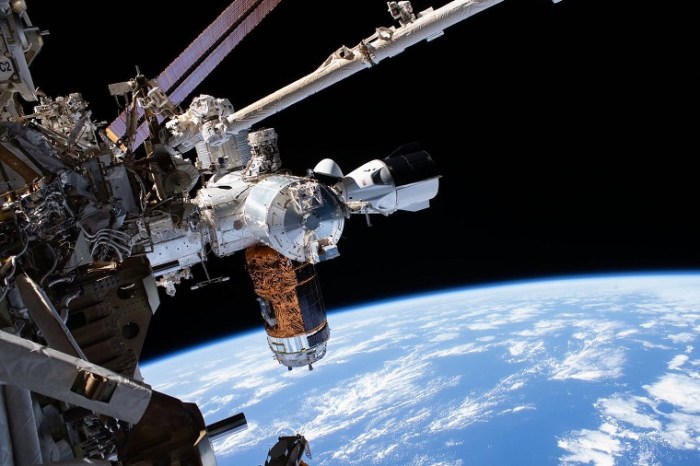
SpaceX Crew-1 (also known as USCV-1 or simply Crew-1) is the first operational crewed flight of a Crew Dragon spacecraft. It is also the first crewed night launch by the United States since that of STS-130 in February 2010. The Crew Dragon spacecraft Resilience launched on 16 November 2020 at 00:27:17 UTC on a Falcon 9 from the Kennedy Space Center, LC-39A, carrying NASA astronauts Michael Hopkins, Victor Glover and Shannon Walker along with JAXA astronaut Soichi Noguchi, all members of the Expedition 64 crew. The mission is the second overall crewed orbital flight of the Crew Dragon.
Crew-1 is the first operational mission to the International Space Station in the Commercial Crew Program. Originally designated “USCV-1” by NASA in 2012, the launch date was delayed several times from the original date of November 2016. The mission is expected to last 180 days, meaning the flight will return to Earth sometime around May 2021. Resilience is expected to return to Earth via splashdown for reuse for another future mission.
Update on Mysterious Monolith in Utah

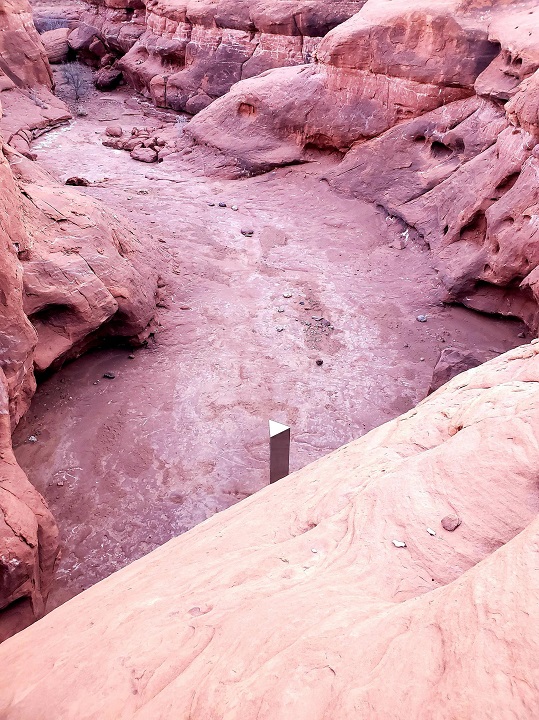
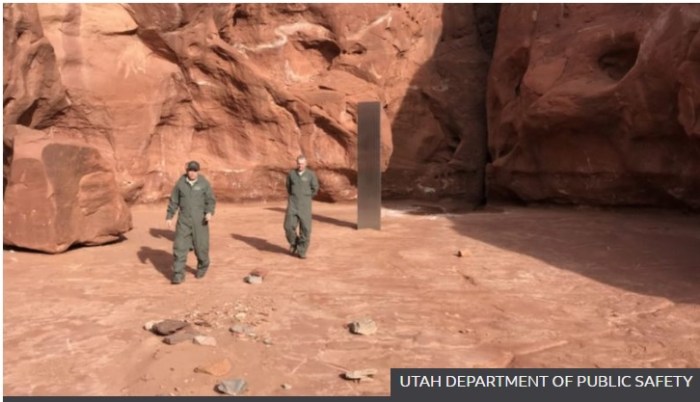
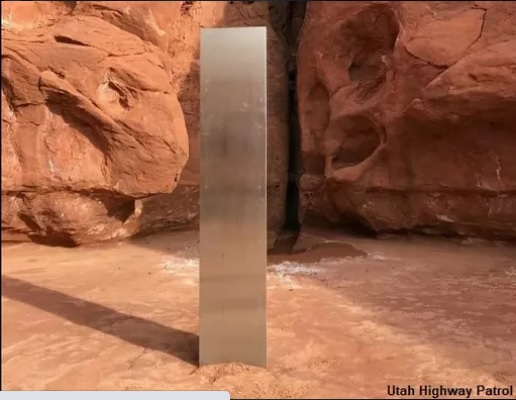
Some new pictures have surfaced demonstrating the size of the monolith.

Wildlife officials spotted the “unusual” object while counting sheep during a flyover in a remote south-eastern area of the US state.

They said the structure had been planted in the ground between red rock.

There was no indication who installed the monolith, which was about 10 to 12ft (3.6m) tall.

In an interview with local news channel KSLTV, the helicopter pilot, Bret Hutchings, said: “That’s been about the strangest thing that I’ve come across out there in all my years of flying.”

The Utah Department of Public Safety Aero Bureau released images of the rectangular-shaped metal object in a news release last week.

It said authorities would determine if “they need to investigate further”.

“It is illegal to install structures or art without authorisation on federally managed public lands, no matter what planet you’re from,” the department said.

The department has not disclosed the exact location of the monolith, fearing explorers may try to seek it out and “become stranded”. The big horn sheep wildlife officials were counting are native to many parts of southern Utah, where the terrain is rugged.

As yet, no one has claimed responsibility for installing the structure.

Looking for answers, Utah’s highway patrol turned to social media, writing in a post on Instagram: “Inquiring minds want to know, what the heck is it? Anyone?”

Most observers presumed it was an installation left by a sculptor, with some saying it resembled the work of late minimalist artist John McCracken.

https://markozen.com/2020/11/23/mysterious-monolith-appears-in-utah/

One Hell of a Snail

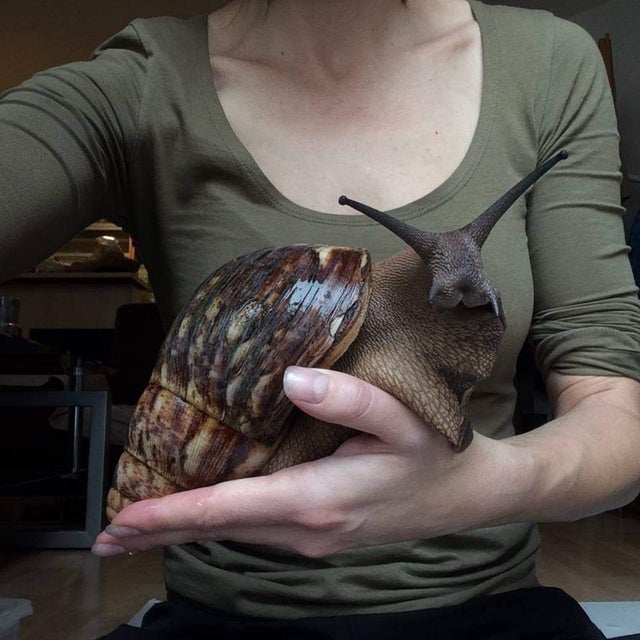
Achatina fulica is a species of large land snail that belongs in the family Achatinidae. It is also known as the Giant African land snail. It shares the common name “giant African snail” with other species of snails such as Achatina achatina and Archachatina marginata.

This snail species has been considered a significant cause in pest issues around the world. Internationally, it is the most frequently occurring invasive species of snail.

Outside of its native range, this snail thrives in many types of habitat in areas with mild climates. It feeds voraciously and is a vector for plant pathogens, causing severe damage to agricultural crops and native plants. It competes with native snail taxa, is a nuisance pest of urban areas, and spreads human disease. This snail is listed as one of the top 100 invasive species in the world.

The species is native to East Africa, but it has been widely introduced to other parts of the world through the pet trade, as a food resource, and by accidental introduction.

This species has been found in China since 1931 and its initial point of distribution in China was Xiamen. The snail has also been established on Pratas Island, of Taiwan, throughout India, the Pacific, Indian Ocean islands, Southeast Asia and the West Indies. The species was established in the United States in 1936. They were brought to the U.S. through imports. They were intended to be used for educational uses and to be pets. Some were also introduced because they were accidentally shipped with other cargo. Eradication is currently underway in Florida.

The adult snail is around 7 cm (2.8 in) in height and 20 cm (7.9 in) or more in length.

The shell has a conical shape, being about twice as high as it is broad. Either clockwise (dextral) or counter-clockwise (sinistral) directions can be observed in the coiling of the shell, although the dextral cone is the more common. Shell colouration is highly variable, and dependent on diet. Typically, brown is the predominant colour and the shell is banded. The shell is particularly tough and has the highest heavy metal content of any snail species.