Major League Baseball Team Payrolls

This is what happens when there is no team salary caps. The teams that are located in markets where they haul in profits hand over fist can buy a championship. The Dodgers payroll is over 3 times that of Tampa Bay.  Both of these teams are facing off in the World Series.

1 New York Yankees 0.550 28 $77,215,694 $9,920,725 $21,482,977 $6,593,300 $109,439,081
2 Los Angeles Dodgers 0.717 28 $77,165,961 $493,889 $16,917,530 $11,339,500 $107,917,397
3 Boston Red Sox 0.400 28 $34,811,788 $17,903,483 $15,053,004 $19,962,928 $83,710,390
4 Houston Astros 0.483 28 $61,049,512 $18,763,334 $250,000 $6,075,200 $82,536,161
5 Philadelphia Phillies 0.467 28 $57,105,401 $13,236,891 $7,762,073 $6,399,500 $78,643,547
6 New York Mets 0.433 28 $46,017,813 $15,399,881 $14,418,790 $4,947,000 $77,603,005
7 Chicago Cubs 0.567 28 $66,116,504 $6,448,626 $1,464,463 $11,069,500 $75,596,171
8 San Francisco Giants 0.483 28 $40,474,622 $1,428,006 $13,996,618 $22,631,250 $73,321,225
9 San Diego Padres 0.617 28 $54,293,958 $3,531,020 $13,971,215 $6,086,600 $72,597,954
10 St. Louis Cardinals 0.517 28 $51,757,860 $12,343,763 $11,000,000 $7,340,100 $72,246,343
11 Washington Nationals 0.433 28 $45,664,863 $20,500,582 $387,096 $2,563,500 $68,317,703
12 Los Angeles Angels 0.433 28 $56,525,010 $509,650 $3,356,290 $6,884,500 $66,040,893
13 Texas Rangers 0.367 28 $30,877,925 $16,905,177 $14,338,320 $4,301,000 $63,214,137
14 Atlanta Braves 0.583 28 $50,458,292 $7,255,497 $500,284 $17,610,000 $63,061,931
15 Colorado Rockies 0.433 28 $23,940,328 $17,205,744 $24,851,852 $4,017,500 $61,808,533
16 Arizona Diamondbacks 0.417 28 $20,283,697 $1,589,593 $34,416,446 $4,524,600 $563,500 $59,998,752
17 Cincinnati Reds 0.517 28 $51,957,121 $658,696 $1,922,138 $6,117,500 $55,638,685
18 Minnesota Twins 0.600 28 $45,057,558 $6,876,058 $7,063,300 $6,669,000 $55,429,689
19 Toronto Blue Jays 0.533 28 $33,467,052 $5,114,444 $14,167,030 $6,643,100 $54,497,060
20 Chicago White Sox 0.583 28 $43,034,329 $1,819,815 $6,562,642 $6,821,500 $52,415,251
21 Seattle Mariners 0.450 28 $24,865,136 $3,268,960 $29,208,712 $5,731,000 $48,933,829
22 Detroit Tigers 0.397 28 $29,636,694 $6,108,631 $6,488,226 $5,099,700 $43,164,880
23 Milwaukee Brewers 0.483 28 $28,464,819 $1,203,704 $2,984,938 $4,963,300 $39,934,086
24 Cleveland Indians 0.583 28 $34,471,070 $209,630 $1,519,241 $4,642,500 $564,800 $37,549,107
25 Oakland Athletics 0.600 28 $35,283,875 $902,038 $113,148 $3,957,000 $36,720,178
26 Kansas City Royals 0.433 28 $25,320,148 $7,093,210 $1,464,114 $6,818,450 $34,812,194
27 Miami Marlins 0.517 28 $14,721,932 $2,897,429 $12,110,262 $10,427,000 $31,330,593
28 Tampa Bay Rays 0.667 28 $23,621,315 $1,958,020 $2,086,951 $4,537,125 $28,290,689
29 Pittsburgh Pirates 0.317 28 $12,738,842 $8,462,127 $2,187,508 $2,817,500 $5,750,000 $25,087,837
30 Baltimore Orioles 0.417 28 $10,252,278 $11,102,531 $1,264,595

Spanish Town Situated on the Edge of a Canyon

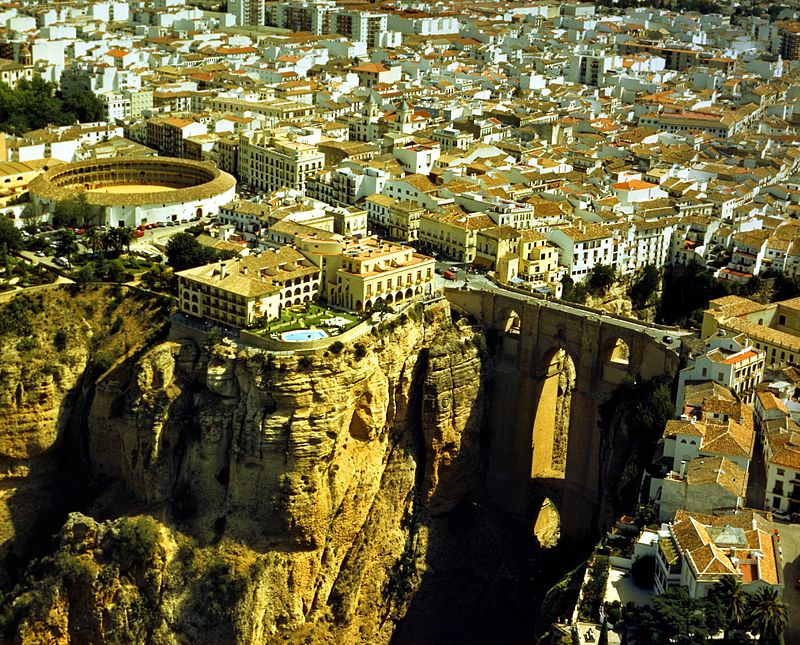
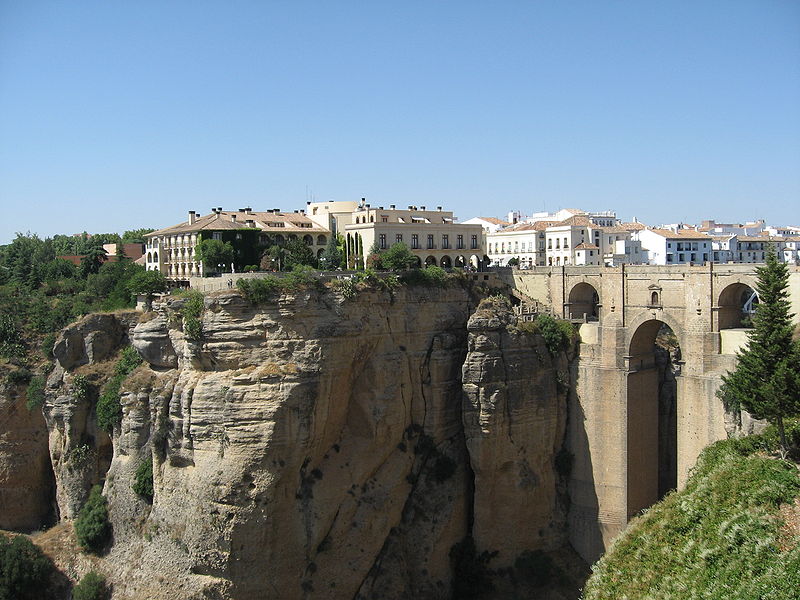
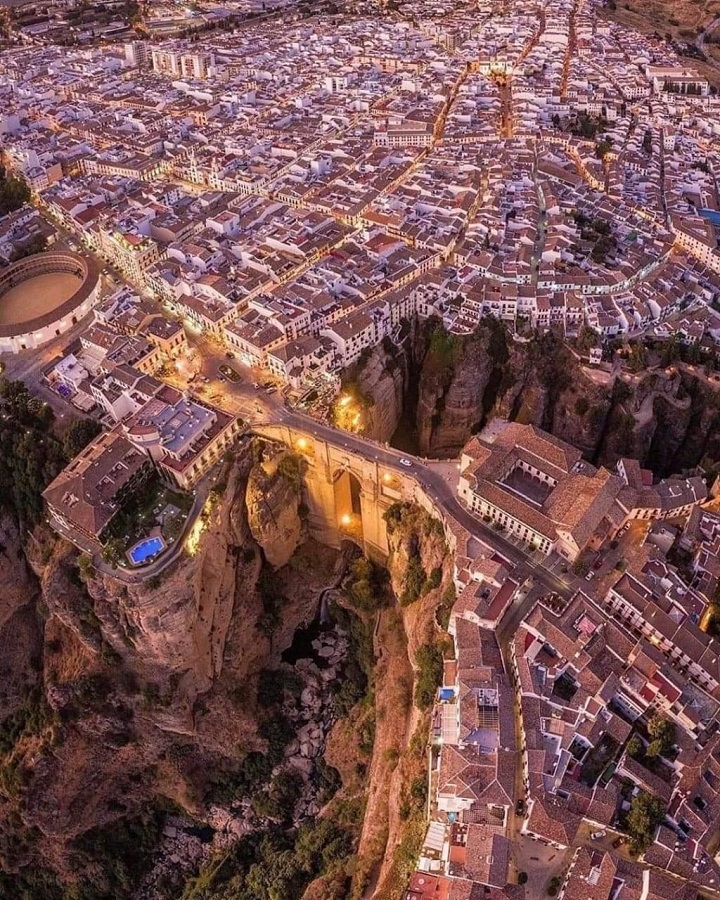
Ronda is a town in the Spanish province of Málaga. It is located about 105 km (65 mi) west of the city of Málaga, within the autonomous community of Andalusia. Its population is about 35,000 inhabitants.

It now is one of the towns and villages that is included in the Sierra de las Nieves Natural Park.

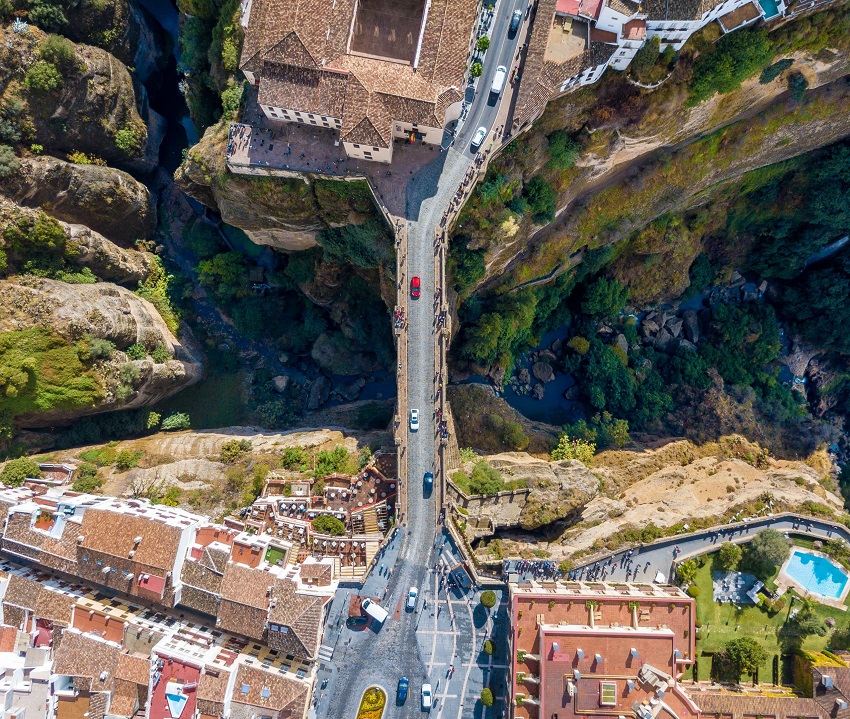
Ronda is situated in a mountainous area about 750 m (2,460 ft) above mean sea level. The Guadalevín River runs through the city, dividing it in two and carving out the steep, 100-plus-meter-deep El Tajo canyon above which the city perches. The Spanish fir (Abies pinsapo) is endemic to the mountains surrounding Ronda.

Slawburgers and Possum Sacks

Nine Pound Hammer is an American cowpunk band formed in 1985 by vocalist Scott Luallen and guitarist Blaine Cartwright (later of Nashville Pussy) in their hometown of Owensboro, Kentucky. Though not recorded until 1988, the band were one of the initial wave of acts to combine the roots sound of country music with punk rock, and became a forerunner to subsequent roots-punk artists.

Hungry now?

The Champ dances over to his neighbour

MacLean & MacLean were a Juno Award nominated, Canadian musical-comedy duo. They performed regularly in Canada between 1972 and 1998, and recorded seven albums. The duo consisted of brothers Gary MacLean (25 June 1944 – 5 December 2001) and Blair MacLean (2 December 1942 – 29 October 2008). The MacLeans were originally from Glace Bay, Nova Scotia, but were later based in Winnipeg, Manitoba.

Why Almost Everyone in Russia Has a Dash Cam

Wired

How is it possible that a dozen different motorists around the Russian city of Chelyabinsk were able to capture video of a massive meteor flying through the sky? Because almost everyone in Russia has a dash-mounted video camera in their car.

The sheer size of the country, combined with lax — and often corrupt — law enforcement, and a legal system that rarely favors first-hand accounts of traffic collisions has made dash cams all but a requirement for motorists.

“You can get into your car without your pants on, but never get into a car without a dash cam,” Aleksei Dozorov, a motorists’ rights activist in Russia told Radio Free Europe last year.

Do a search for “Russia dash cam crash” in YouTube — or even better, Yandex.ru, the county’s equivalent of Google — and you’ll find thousands of videos showing massive crashes, close calls and attempts at insurance fraud by both other drivers and pedestrians. 

A combination of inexpensive cameras, flash memory and regulations passed by the Interior Ministry in 2009 that removed any legal hurdles for in-dash cameras has made it easy and cheap for drivers to install the equipment.

And it’s turned into an online phenomenon.

YouTube content policing means some of the most disturbing videos get pulled from U.S. video sites almost immediately, but as Marina Galperina reported at Animal New York last year, sites like the Ru CHP LiveJournal community are filled with disturbing videos of profanity-laden fist-fights, massive crashes and gruesome deaths, all captured on camera and shared for the world to see.

But then there are times like today, when dash cams catch a once-in-a-lifetime meteor falling from the sky, from every possible angle — something that couldn’t have happened just a few years ago.

British Antarctic Research Station can be raised and re-located

Halley VI Research Station is the first fully relocatable research station in the world. It was commissioned in 2006 and its unique and  innovative structure was the result of an international design  competition in collaboration with the Royal Institute of British Architects (RIBA). The state-of-the-art research facility is segmented  into eight modules, each sitting atop ski-fitted, hydraulic legs. These  can be individually raised to overcome snow accumulation and each module towed independently to a new location.

The station took four  years to build and delivered its first scientific data in 2012. Its iconic design houses a cutting-edge science platform and modern, comfortable accommodation.

The central red module contains the  communal areas for dining, relaxation etc., while the blue modules provide accommodation, laboratories, offices, generators, an observation  platform and many other facilities. Remote scientific equipment, set up for long-term monitoring, is housed in a number of cabooses around the  perimeter of the site, which also contains numerous aerials and arrays for studying atmospheric conditions and space weather.


halley


halley2


Science at  Halley VI provides vital information for a global understanding of ozone depletion, polar atmospheric chemistry, sea-level rise and climate  change. Since it was first established in 1956, meteorological and  atmospheric data has been continually collected at Halley, providing an  unbroken record.

The station operates throughout the year with a  maximum population of 70 in the summer and an average of 16 over winter.  The Emperor penguin colony near Halley, which is present from May to  February, is a special attraction, while other recreational trips take members further inland towards the “hinge zone” where the floating ice  shelf is joined to the continent.


halley1


There  have been six Halley bases built so far. The first four were all buried  by snow accumulation and crushed until they were uninhabitable. Various construction methods were tried, from unprotected wooden huts to steel  tunnels. Halley V had the main buildings built on steel platforms that  were raised annually to keep them above the snow surface. However, as the station’s legs were fixed in the ice it could not be moved and its occupation became precarious, having flowed too far from the mainland to a position at risk of calving as in iceberg.


halley5


halley3


Summer team

halley6 summer team


halley-research-station-2

See also: https://markozen.com/2017/01/15/how-antarctic-bases-went-from-wooden-huts-to-sci-fi-chic/

Duck-Billed Russian Fighter Aircraft

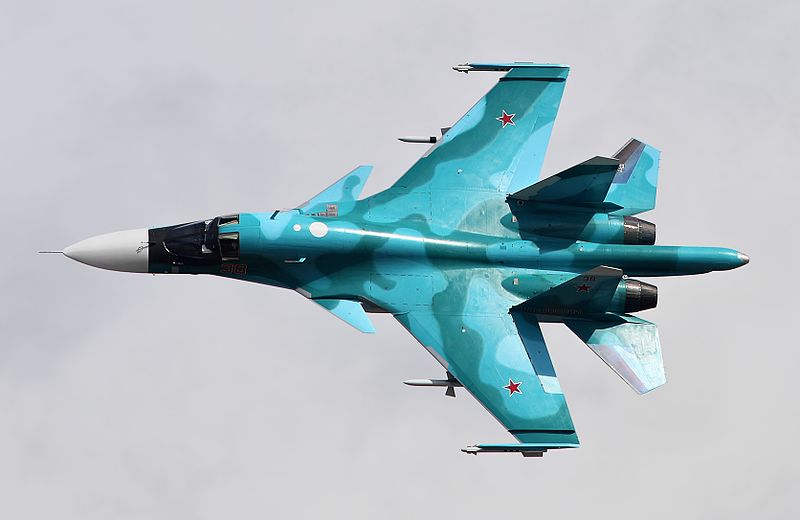
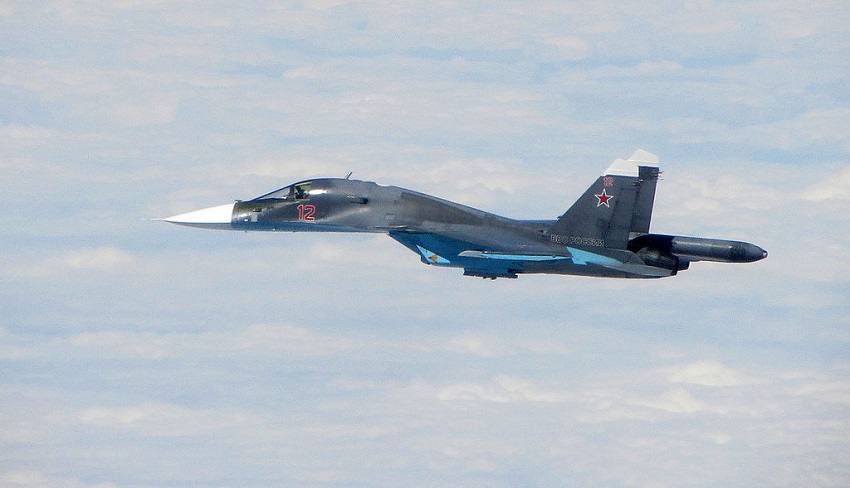
The Sukhoi Su-34 (Russian: Сухой Су-34) (export designation: Su-32, NATO reporting name: Fullback) is a Russian twin-seat fighter-bomber. It is intended to replace the Sukhoi Su-24. The jet has a different look to it as it has a duck-billed nose.


duck


Role Fighter-bomber
Manufacturer Sukhoi
First flight 13 April 1990
Introduction 2012 (plan)
Status In production
Primary user Russian Air Force
Produced 2006–present
Number built 136 of plus 7 prototypes
Unit cost US$36 million
Developed from Sukhoi Su-27


duck1


General characteristics

  • Crew: 2
  • Length: 23.34 m (72 ft 2 in)
  • Wingspan: 14.7 m (48 ft 3 in)
  • Height: 6.09 m (19 ft 5 in)
  • Loaded weight: 39,000 kg (85,980 lb)
  • Useful load: 8,000 kg (17,600 lb)
  • Max. takeoff weight: 45,100 kg (99,425 lb)
  • Powerplant: 2 × Lyulka AL-31F1 turbofans, 13,500 kgf (132 kN, 29,762 lbf) with afterburner each

Performance

  • Maximum speed:
    • High altitude: Mach 1.8 (2,200 km/h, 1,375 mph)
    • Low altitude: Mach 1.2 (1,400 km/h, 870 mph) at sea level
  • Range: 1,100 km (680 mi) at low level altitude
  • Ferry range: 4,000 km (2,490 mi)
  • Service ceiling: 15,000 m (49,200 ft)
  • Wing loading: 629 kg/m² (129 lb/ft²)
  • Thrust/weight: 0.68


This jet has really nice sleek lines.


Atacama Large Millimeter Array

The Atacama Large Millimeter/submillimeter Array (ALMA) is an astronomical interferometer of 66 radio telescopes in the Atacama Desert of northern Chile, which observe electromagnetic radiation at millimeter and submillimeter wavelengths. The array has been constructed on the 5,000 m (16,000 ft) elevation Chajnantor plateau – near the Llano de Chajnantor Observatory and the Atacama Pathfinder Experiment. This location was chosen for its high elevation and low humidity, factors which are crucial to reduce noise and decrease signal attenuation due to Earth’s atmosphere. ALMA is expected to provide insight on star birth during the early Stelliferous era and detailed imaging of local star and planet formation.

ALMA is an international partnership among Europe, the United States, Canada, Japan, South Korea, Taiwan, and Chile. Costing about US$1.4 billion, it is the most expensive ground-based telescope in operation. ALMA began scientific observations in the second half of 2011 and the first images were released to the press on 3 October 2011. The array has been fully operational since March 2013.

alma


alma2


The initial ALMA array is composed of 66 high-precision antennas, and operates at wavelengths of 3.6 to 0.32 millimeters (31 to 1000 GHz). The array has much higher sensitivity and higher resolution than earlier submillimeter telescopes such as the single-dish James Clerk Maxwell Telescope or existing interferometer networks such as the Submillimeter Array or the Institut de Radio Astronomie Millimétrique (IRAM) Plateau de Bure facility.

The antennas can be moved across the desert plateau over distances from 150 m to 16 km, which will give ALMA a powerful variable “zoom”, similar in its concept to that employed at the centimetre-wavelength Very Large Array (VLA) site in New Mexico, United States.

The high sensitivity is mainly achieved through the large numbers of antenna dishes that will make up the array.

The telescopes were provided by the European, North American and East Asian partners of ALMA. The American and European partners each provided twenty-five 12-meter diameter antennas, that compose the main array. The participating East Asian countries are contributing 16 antennas (four 12-meter diameter and twelve 7-meter diameter antennas) in the form of the Atacama Compact Array (ACA), which is part of the enhanced ALMA.


alma3


The complex was built primarily by European, U.S., Japanese, and Canadian companies and universities. Three prototype antennas have undergone evaluation at the Very Large Array since 2002.

General Dynamics C4 Systems and its SATCOM Technologies division was contracted by Associated Universities, Inc. to provide twenty-five of the 12 m antennas, while European manufacturer Thales Alenia Space provided the other twenty-five principal antennas (in the largest-ever European industrial contract in ground-based astronomy). Japan constructed 16 Antennas. The first antenna was delivered in 2008, the last in 2011.
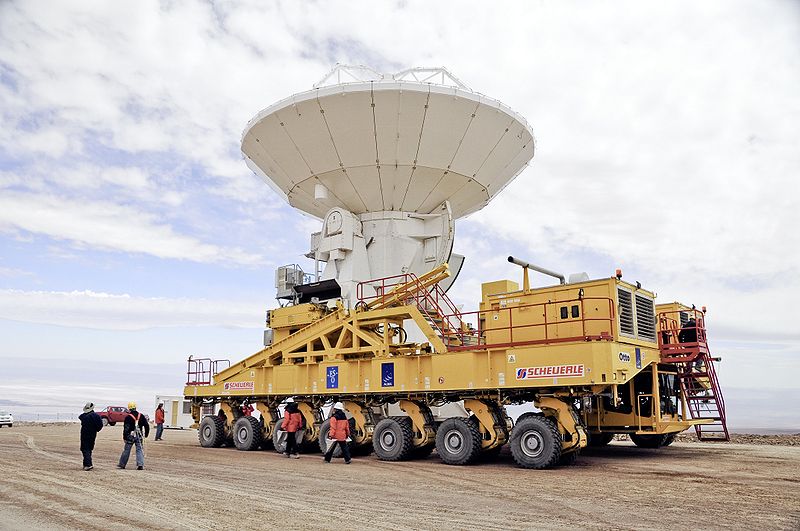
 

alma5


The Atacama Large Millimeter/submillimeter Array (ALMA), an international astronomy facility, is a partnership of Europe, North America and East Asia in cooperation with the Republic of Chile. ALMA is funded in Europe by the European Southern Observatory (ESO), in North America by the U.S. National Science Foundation (NSF) in cooperation with the National Research Council of Canada (NRC) and the National Science Council of Taiwan (NSC) and in East Asia by the National Institutes of Natural Sciences of Japan (NINS) in cooperation with the Academia Sinica (AS) in Taiwan. ALMA construction and operations are led on behalf of Europe by ESO, on behalf of North America by the National Radio Astronomy Observatory (NRAO), which is managed by Associated Universities, Inc (AUI) and on behalf of East Asia by the National Astronomical Observatory of Japan (NAOJ). The Joint ALMA Observatory (JAO) provides the unified leadership and management of the construction, commissioning and operation of ALMA. Its current director since February 2018 is Sean Dougherty.


alma4


What is ALMA?

Half of all light in the universe is in millimeter-wavelength light between the far infrared and radio waves. ALMA can detect this light, which is emitted by cool objects and distant objects. It’s possible thanks to the telescope’s location at 16,400 feet in the driest desert on Earth, and because of the incredible precision of its 66 antennas.

All  telescopes are limited in their angular resolution by the ratio of their aperture to the wavelength they observe, explained Michael Thornburn, head of the ALMA department of engineering. ALMA is an aperture synthesis telescope.

“We cannot make a single aperture 15 kilometers across, so we do it in pieces,” he said. “The signals from individual dishes are combined to build up the image from a single large aperture.”

Radio signals from distant cosmic sources arrive at each dish at ever-so-slightly different times, and these are combined with the signals from every other antenna. This technique, interferometry, allows ALMA to operate like a single huge dish with an adaptable radius.

In a carefully choreographed ballet, each dish moves in unison with the others to change the telescope’s observing area. Along with moving in place, giant transporter trucks, specially designed for the dishes, can pick them up and cart them across the Chajnantor Plateau to one of 192 concrete pads. At their greatest distance apart–16 kilometers–ALMA’s angular resolution will be equivalent to the Hubble Space Telescope, Peck said.

ALMA is observing sources that are 10 times weaker than those observed with other arrays, explained Pierre Cox, ALMA’s incoming director. This is key to ALMA’s capability for observing phenomena like star formation, he said.

“Future observations should allow us to detect dark matter substructure and shed light on its nature,” he added.

There’s much more to learn about how ALMA works, and why astronomers are so excited about it–stay tuned for more dispatches from the Atacama.


There’s a Riot in Cellblock #9

Wanda Lavonne Jackson (born October 20, 1937) is a retired American singer, songwriter, pianist and guitarist who had success in the mid-1950s and 1960s as one of the first popular female rockabilly singers, and a pioneering rock-and-roll artist. She is known to many as the “Queen of Rockabilly” or the “First Lady of Rockabilly”.

Troll A Platform

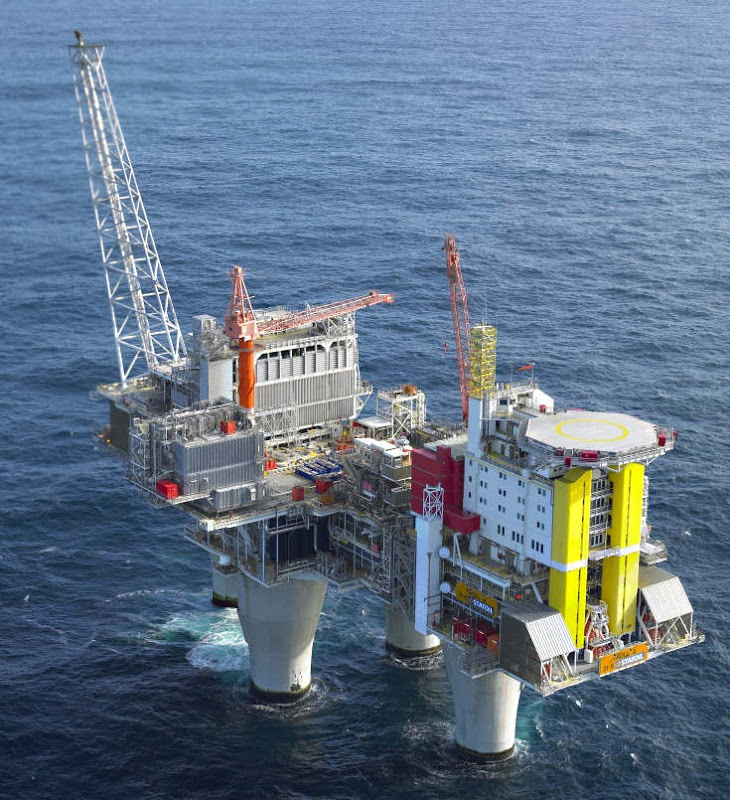
The Troll A platform is an offshore natural gas platform in the Troll gas field off the west coast of Norway. At 1.2 million ton ballasted under tow, 472 meters high, with underwater concrete structure at 369 meters, and dry weight of 656,000 tons, the Troll A platform is a majestic piece of design and construction. Not only is Troll A among the largest and most complex engineering projects in history, it is the largest object ever to be moved by man across the surface of the Earth. The platform was a televised sensation when it was towed into the North Sea in 1996, where it is now operated by Statoil.

Normally a platform’s legs are transported on their side and then – supported by flotation devices – are dropped into place. In the case of Troll A, however, the whole platform was assembled in one location, and then floated out to sea. The Troll platform was towed over 200 kilometers from Vats, in the northern part of Rogaland, to the Troll field, 80 kilometers north-west of Bergen. The tow took seven days.


plat


The platform stands on the sea floor 303 meters below the surface of the sea and one of the concrete cylindrical legs has an elevator that takes over nine minutes to travel from the platform above the waves to the sea floor. The walls of Troll A’s legs are over 1 meter thick made of steel reinforced concrete formed in one continuous pour. The four legs are joined by a “Chord shortener”, a reinforced concrete box interconnecting the legs, but which has the designed function of damping out unwanted potentially destructive wave-leg resonances. Each leg is also sub-divided along its length into compartments a third of the way from each end which act as independent water-tight compartments. The legs use groups of six 40 meters tallvacuum-anchors holding it fixed in the mud of the sea floor.

In 1996 the platform set the Guinness World Record for ‘largest offshore gas platform’. The title now belongs to the Petronius Platform in the Gulf of Mexico which stands 2,000 feet (610 m) above the ocean floor.


plat1


plat2


plat3


plat4


plat5


plat6